Overview

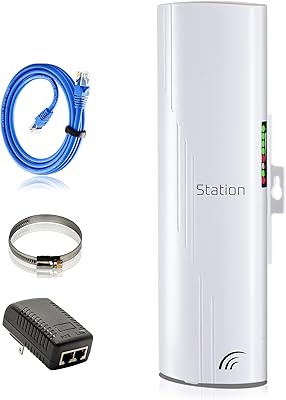
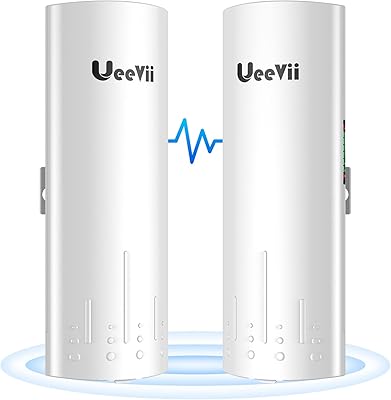
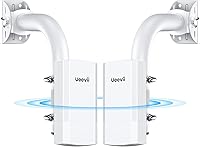
The UeeVii CPE58G Flex Point-to-Point Wireless Bridge is a complete kit built to wirelessly link two separate buildings — no trenching, no cable runs, no electrician required. It runs on 5.8GHz single-band technology, which gives it a practical edge over cheaper 2.4GHz alternatives by reducing interference from neighboring routers and other wireless devices. The box includes two bridge units, two PoE injectors, test cables, and mounting brackets, so you are not hunting for missing parts on day one. At its price point, it competes well for homeowners and small farm operators. One honest note upfront: the 2km range ceiling is measured in open, line-of-sight conditions — expect meaningfully less when trees, hills, or structures stand in the way.
Features & Benefits

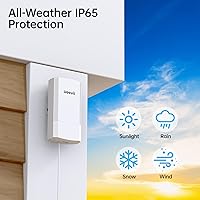
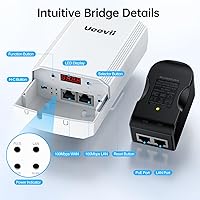
The 12dBi directional antenna inside this wireless bridge kit focuses signal in a tight beam rather than broadcasting in all directions — that concentration is what makes long-distance links practical at this price. Each unit carries an IP65 rating, so it holds up through rain, dust, and freezing winters without any special housing. The dual LAN ports are genuinely useful: one connects back to your source network while the other can feed a local device at the far end, like a camera or a small switch. Power delivery via 24V PoE injectors means you only need a standard outlet near each bridge, not one mounted on the pole itself. The adjustable mounting brackets tilt and rotate enough to dial in alignment without custom hardware.

Best For

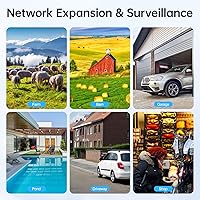
This point-to-point bridge earns its place for anyone who needs reliable internet in outbuildings — garages, barns, workshops — without the cost or disruption of burying cable. It fits especially well on rural properties running Starlink, where the main dish delivers solid speeds but the signal never quite reaches a second structure or back barn. Small farms deploying IP cameras along driveways or fence lines will find the setup manageable. Neighbors or family compounds sharing a single connection are also a natural fit. If you are a confident DIY installer who can roughly align two units by compass heading and navigate a basic web browser interface, you are precisely the buyer this kit was designed for.

User Feedback

Buyers who get this wireless bridge kit running consistently highlight two things: how quickly the two units paired out of the box and the solid real-world throughput at distances between 200 and 500 meters. The plastic housing draws occasional commentary, though most consider it acceptable given the pricing tier. Criticism clusters around obstructions — trees, uneven terrain, even a dense hedge — cutting usable range well short of the stated 2km maximum. A handful of users found the web-based configuration interface a bit dated, though workable for a basic setup. Long-term outdoor reliability reports lean positive, with buyers noting consistent performance through full seasonal cycles. It is a practical, no-frills choice rather than a premium one.

Pros

  • Complete kit arrives with both bridge units, PoE injectors, cables, and brackets — nothing critical is missing from the box.
  • The 5.8GHz band cuts through neighborhood wireless interference far better than budget 2.4GHz alternatives.
  • IP65 weatherproofing holds up through rain, freezing temperatures, and dusty farm environments without added protection.
  • Power over Ethernet delivery means you only need a standard outlet indoors, not up on the mounting pole.
  • Dual LAN ports on each unit let you connect a local device at the far end without adding extra hardware.
  • WPA2-PSK encryption and SSID hiding offer a reasonable baseline of security for shared rural links.
  • Real-world setup time is short for a confident DIY installer — most buyers report being up and running within a few hours.
  • Adjustable mounting brackets handle poles, walls, and rooftops without requiring custom fabrication.
  • Consistent long-term outdoor reliability is a recurring theme in buyer reports across full seasonal cycles.
  • Competitive throughput at distances under 500 meters makes it a strong fit for typical barn-to-house or garage-to-house runs.

Cons

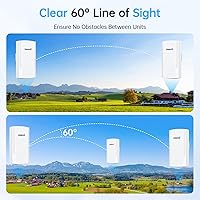
  • Usable range drops sharply when trees, uneven ground, or structures interrupt the line of sight between units.
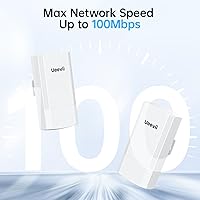
  • The 100Mbps wired port speed becomes a bottleneck for households with high-bandwidth demands across multiple devices.
  • The web-based configuration interface feels dated and can confuse buyers who are not comfortable navigating network settings.
  • Plastic housing feels utilitarian rather than robust — adequate for the price tier, but not reassuring on first handling.
  • No gigabit LAN option limits the kit for anyone planning to future-proof against faster internet service.
  • Single-band 5.8GHz operation means there is no fallback frequency if interference becomes an issue in your area.
  • The kit includes short test cables only — buyers will need to source their own longer runs for a permanent install.
  • No centralized management or controller software makes this impractical for anyone overseeing multiple links across a larger property.
  • Customer support documentation is sparse, so troubleshooting a finicky link may require patience and forum research.

Ratings

Our editorial AI system analyzed hundreds of verified global purchases of the UeeVii CPE58G Flex Point-to-Point Wireless Bridge, actively filtering out incentivized, duplicate, and bot-generated submissions to surface what real buyers actually experience. The scores below reflect a balanced synthesis of genuine praise and recurring frustrations — nothing has been softened or inflated. Where this kit earns strong marks, you will see why; where it falls short, that is reflected honestly too.

Ease of Setup
83%
Most buyers report having both units communicating within an hour or two, even without prior networking experience. The factory pre-pairing means that in straightforward installations, you simply mount, plug in, and point — the link comes up without touching the configuration interface at all.
The web-based admin interface, while functional, looks dated and lacks clear on-screen guidance for first-timers. A small but consistent share of buyers get tripped up adjusting settings like operating mode or IP addressing, and the printed manual offers limited troubleshooting depth.
Real-World Range
67%
33%
For the typical use case — linking a house to a barn, workshop, or garage within a few hundred meters — the signal holds up reliably and buyers consistently report stable connections. At distances under 500 meters with minimal obstructions, the 12dBi directional antenna performs exactly as expected.
The advertised 2km ceiling is achievable only in genuinely open, line-of-sight conditions, and many buyers discover this the hard way. A tree line, a ridge, or even dense shrubs between the two units can cut effective range to a fraction of the stated maximum, which causes frustration for rural properties with complex terrain.
Throughput Performance
74%
26%
For IP cameras, general web browsing, and standard video calls, the real-world throughput is more than adequate, and buyers running a handful of devices at the remote end rarely feel constrained. Starlink users in particular report that the bridge passes enough bandwidth to handle everyday household use in an outbuilding comfortably.
The 100Mbps wired port is a hard ceiling, and homes or farms with multiple high-demand users at the remote end will bump against it. Throughput also degrades meaningfully at longer distances or in marginal signal conditions, falling noticeably short of the spec sheet figure in less-than-ideal real-world deployments.
Build Quality
71%
29%
The plastic housing is solid enough for a product in this price range, and the overall fit of the units feels consistent rather than cheap. Buyers who handle both units side by side generally agree the construction is appropriate for an outdoor networking device at this tier.
It does not feel premium in hand — the plastic has a lightweight quality that gives some buyers pause before mounting it permanently outdoors. A few users noted that connector covers and sealing points look adequate on paper but feel less robust than what you would find on a commercial-grade outdoor unit.
Weather Resistance
81%
19%
The IP65 rating translates into genuine year-round durability, and buyers in cold northern climates, rainy coastal areas, and dusty agricultural environments consistently report that the units keep working through extended outdoor exposure. Several long-term owners specifically mention reliable performance after full winter cycles.
While the bridge units themselves hold up well, the Ethernet entry points where cables pass into walls or junction boxes are not sealed by the kit, and that junction is where moisture issues tend to emerge for buyers who do not weatherproof it themselves. The kit includes no guidance or materials for sealing cable entries.
Value for Money
86%
Getting two bridge units, two PoE injectors, brackets, and cables in a single purchase at this price point is a strong proposition compared to buying components separately or paying for a trenched cable run. For homeowners and small farm operators, the all-in kit format removes a significant sourcing burden.
Buyers who encounter range or throughput limitations relative to the marketing claims tend to feel the value proposition weakens considerably. If your specific installation does not achieve a solid line-of-sight link, the effective cost-per-meter of usable connection rises sharply.
Mounting & Alignment
78%
22%
The angle-adjustable brackets are genuinely versatile — buyers successfully mount these on round steel poles, timber fence posts, brick walls, and rooftop fascias without needing to fabricate anything custom. The adjustment range is wide enough to accommodate imperfect mounting positions.
Achieving a well-aligned link requires patience, and the kit provides no alignment assistance beyond a signal-strength indicator in the admin interface. Buyers doing solo installs — mounting one unit while someone else checks the interface at the other end — often describe the alignment process as the most frustrating part of setup.
Compatibility
88%
The CPE58G Flex works cleanly with standard home routers, Starlink terminals, IP cameras, and basic switches without requiring any special configuration on the upstream equipment. Buyers plugging it into an existing home network report it behaves like any other wired connection from the router's perspective.
The 24V passive PoE standard is not universally compatible with all PoE-enabled switches or injectors — buyers who try to power the units from a standard 802.3af switch rather than the included injectors will find they do not power on, which has confused a subset of more technically-inclined buyers.
Signal Stability
76%
24%
Under good line-of-sight conditions, buyers describe the link as rock-solid over extended periods with no spontaneous drops or reconnection cycles. Long-term owners monitoring the connection for surveillance camera feeds report consistently stable uptime across days and weeks of continuous operation.
In marginal signal environments — partial obstructions, longer distances, or locations where the link is operating near the edge of viable range — some buyers report intermittent drops that are difficult to diagnose and resolve without networking experience. Wind-induced movement of a poorly secured mount can also introduce instability.
Security Features
73%
27%
WPA2-PSK encryption and the ability to hide the SSID give rural buyers a meaningful baseline of protection for a shared link between buildings or neighbors. For the primary threat model — keeping casual passersby or nearby households off the connection — these tools are entirely adequate.
The security feature set is functional but not deep; there is no guest network isolation, no per-device access control, and no traffic monitoring. Buyers sharing a connection with a neighboring household and wanting finer-grained control over who accesses what will need additional hardware or software to fill that gap.
Documentation & Support
58%
42%
The included user manual covers the basic installation steps clearly enough for a standard point-to-point setup, and buyers who follow it step by step in a simple two-building scenario generally get the kit running without needing outside help. Some buyers also found useful community forum posts and YouTube walkthroughs.
Beyond the basics, UeeVii's documentation is thin and the official support channel responses are inconsistent in quality and speed according to multiple buyer reports. Troubleshooting anything beyond a standard setup — multipoint configurations, VLAN tagging, or integrating with managed switches — requires outside research that the brand does not facilitate.
Package Completeness
84%
Receiving both ends of the link, both power supplies, and both sets of mounting hardware in a single box is a genuine convenience that buyers consistently appreciate. There is no scrambling for missing components before the installation can begin, which is not something every bridge kit at this price tier can claim.
The included test cables are short — useful for bench-testing but not for a permanent run between a mounting point outdoors and your router inside. Almost every buyer needs to purchase longer Ethernet cable separately, which is an expected but mildly inconvenient addition to the project cost.
Long-Term Reliability
77%
23%
Buyers who have owned the kit for six months or more generally report that it keeps working without intervention, which is exactly what you want from a set-and-forget outdoor link. Firmware stability appears good, with no reports of units requiring frequent reboots or developing faults after initial setup.
The sample size of very long-term owners is still relatively limited given the product launched in late 2024, so multi-year reliability data is not yet available. A small number of buyers report unit failures within the first few months, though it is unclear whether these stem from hardware defects or installation issues like moisture ingress at cable entry points.

Suitable for:

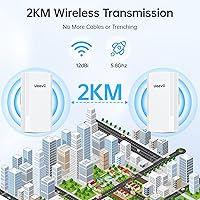
The UeeVii CPE58G Flex Point-to-Point Wireless Bridge is built for property owners who need to move internet access across a gap between two structures without burying cable or hiring a contractor. It fits especially well on rural and semi-rural properties — think a farmhouse with a detached workshop, a homestead running Starlink that needs coverage out to a barn or storage shed, or a family compound where two households want to share one connection. Small farm operators who are adding IP cameras along driveways or fence lines will find the all-in-one kit format a practical starting point, since both ends of the link arrive pre-matched and ready to configure through a basic browser interface. DIY-oriented buyers who are comfortable mounting hardware outdoors and following a straightforward setup guide should have this running within an afternoon. The included brackets, PoE injectors, and test cables mean you are not making a second order before the install can begin.
Not suitable for:

The UeeVii CPE58G Flex Point-to-Point Wireless Bridge is not the right tool for environments where a clear line of sight between two points cannot be guaranteed. Dense tree lines, rolling terrain, intervening buildings, or even a thick hedgerow will degrade the link noticeably — the advertised 2km range is a best-case, open-sky figure, not a practical benchmark for most wooded or hilly properties. Buyers expecting gigabit-class throughput for bandwidth-heavy applications like 4K video streaming to multiple devices or large file transfers will hit the ceiling of the 100Mbps wired ports sooner than they expect. This kit is also not well suited for anyone needing enterprise-grade management tools, VLAN support, or centralized controller software — the web interface is functional but basic. If your link needs to pass through a wall or a building rather than travel through open air, a different technology entirely would serve you better.
Specifications

  • Frequency Band: Operates on the 5.8GHz single-band frequency, which provides better resistance to interference compared to 2.4GHz alternatives.
  • Wireless Standards: Supports IEEE 802.11a, 802.11n, and 802.11ac protocols for broad compatibility with modern networking equipment.
  • Antenna Gain: Each unit is equipped with a built-in 12dBi directional antenna that concentrates signal in a focused beam for long-distance links.
  • Max Range: Rated for up to 2km in a clear, unobstructed line-of-sight environment; real-world range will vary based on terrain and obstructions.
  • LAN Ports: Each bridge unit includes two 100Mbps Ethernet LAN ports, allowing simultaneous uplink and local device connections at both ends.
  • PoE Standard: Uses 24V passive Power over Ethernet; each unit is powered via the included 24V PoE injector connected to a standard indoor outlet.
  • Weatherproofing: Rated IP65 for outdoor use, providing protection against water jets, heavy dust, and freezing temperatures throughout seasonal changes.
  • Mounting Options: Ships with angle-adjustable brackets compatible with poles, exterior walls, and rooftops for flexible directional alignment during installation.
  • Encryption: Supports OPEN, WPA, WPA2, WPA-PSK, and WPA2-PSK encryption protocols, along with SSID hiding to restrict unauthorized access.
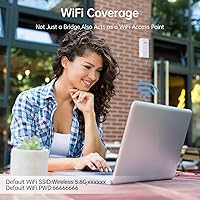
  • Operating Mode: Functions as a point-to-point wireless bridge or access point, configurable through a browser-based web interface on the local network.
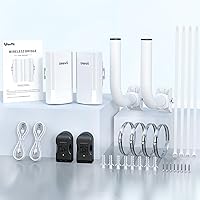
  • Kit Contents: Each package includes 2 CPE58G bridge units, 2 x 24V 100Mbps PoE injectors, 2 x 3-foot test network cables, and 2 mounting brackets.
  • Package Weight: The full retail package weighs 4.66 lbs, covering both bridge units and all included accessories.
  • Package Dimensions: The retail box measures 12.99 x 8.31 x 7.24 inches, sized to accommodate both units and their respective accessories.
  • Compatible Devices: Designed to work with routers, IP security cameras, personal computers, smartphones, and Starlink satellite internet terminals.
  • FCC Compliance: The device complies with U.S. FCC communication standards, making it legally approved for use across the United States.
  • Brand & Model: Manufactured by UeeVii under the model designation CPE58G Flex, first made available in October 2024.

Related Reviews

GOOD STORY WB504H Outdoor Wireless Bridge
71%
88%
Ease of Setup
81%
Link Stability
63%
Real-World Range
69%
Throughput Performance
83%
Value for Money
More
UeeVii CPE450 Point-to-Point Wireless Bridge Kit
76%
88%
Ease of Setup
82%
Signal Stability
67%
Real-World Range
61%
Throughput & Speed
79%
Build Quality & Durability
More
AdaLov CPE660 Wireless Bridge
76%
83%
Ease of Setup
71%
Real-World Range
63%
Actual Data Throughput
84%
Build Quality & Weather Resistance
79%
Value for Money
More
NETGEAR WAX615 Wireless Access Point
86%
91%
Performance
88%
Ease of Setup & Installation
93%
Coverage & Range
89%
Security Features
87%
App & Remote Management
More
Ubiquiti U6+
Ubiquiti U6+
80%
88%
Wireless Performance
54%
Setup & Configuration
84%
Range & Coverage
82%
Build Quality & Design
91%
PoE+ Implementation
More
AdaLov CPE366 Point-to-Point Wireless Bridge
75%
86%
Ease of Setup
71%
Range Performance
82%
Throughput & Speed
84%
Value for Money
67%
Build Quality
More
AdaLov CPE661 Outdoor Wireless Bridge
80%
83%
Ease of Setup
76%
Real-World Range
71%
Throughput & Speed
89%
Dual WiFi Broadcasting
88%
Build Quality
More
BrosTrend AC1200 Dual-Band WiFi Access Point
76%
88%
Ease of Setup
71%
WiFi Signal Strength
74%
Connection Stability
81%
Build Quality & Design
76%
Dual-Band Performance
More
ANJIELO SMART AH9066 Outdoor Wireless Bridge
65%
83%
Ease of Setup
71%
Outdoor Range Performance
67%
Signal Stability
74%
Weatherproofing & Durability
63%
Indoor Penetration
More
Cisco WAP4410N Wireless-N Access Point
71%
88%
Build Quality
91%
Long-Term Durability
58%
Wireless Performance
76%
PoE Implementation
62%
Ease of Setup
More

FAQ

For the actual wireless link, yes — both bridge units, both PoE injectors, mounting brackets, and short test cables are all in the box. The one thing you will likely need to source separately is longer Ethernet runs to connect each bridge to your router or switch indoors, since the included cables are short test lengths only.

In a wide-open field with nothing in between, hitting close to 2km is plausible. In real backyard or farm scenarios though, trees, sloped ground, fences, and buildings all chip away at that figure noticeably. Most buyers find the link works well at distances between 100 and 600 meters, which covers the vast majority of garage, barn, and workshop installs. If your path has heavy vegetation or a hill in the way, expect less.

Not a lot. The two units come pre-paired from the factory, so in many straightforward installations you just plug them in, mount them, and point them at each other. There is a browser-based interface for adjusting settings if needed, which is functional but fairly basic. If you can connect a router at home and log into a web page, you should be fine.

Yes, and it is actually one of the more popular use cases for this point-to-point bridge. You connect one bridge unit to your Starlink router, mount it with line of sight toward your outbuilding, then connect the second unit there to a local switch or device. Starlink dishes are typically stationary and positioned for open sky, so line-of-sight between two structures is often achievable on rural properties.

The default setup is strictly point-to-point — one unit to one other unit. The CPE58G Flex does support an access point mode, which opens up some multipoint possibilities, but that requires more advanced configuration and the throughput gets divided among connected nodes. For straightforward multi-building setups, it is generally better to run separate pairs of units between each building.

The IP65 weatherproof rating covers it against rain, wind-driven dust, and freezing temperatures, so it is genuinely built for year-round outdoor installation. Buyers in cold-weather climates report consistent performance through full winters. Just make sure your cable entry points are properly weatherproofed where the Ethernet enters the building, as that junction is your most likely weak spot, not the bridge unit itself.

In real-world conditions at moderate distances, throughput sits comfortably in the range needed for IP camera feeds, general web browsing, and standard-definition or HD video streaming. The 100Mbps wired port is the hard ceiling, and you will rarely saturate it in typical home or farm use. For multiple simultaneous 4K streams or large file transfers, you may notice the limits, but for the use cases this kit is designed around, it performs well.

The included brackets are designed for round poles and flat wall surfaces, and they will attach to a wooden post without issue as long as it is sturdy enough not to flex in wind. Stability matters here — if the unit shifts even a few degrees on a flimsy post, it can degrade your link. A solid treated timber or steel fence post works well; a wobbly thin stake does not.

It supports WPA2-PSK encryption and gives you the option to hide the SSID so the link does not broadcast its presence to nearby devices. That is a reasonable level of security for a private property link. It is not enterprise-grade, but for keeping a neighbor or passerby off your connection, it is more than adequate.

In theory you can configure two units of the same model to work together regardless of whether they shipped as a pair, since the pairing is done through the web interface rather than being hardware-locked. In practice, buying a second full kit is often the easiest route since individual units are harder to source. Keep your original configuration settings noted down so re-pairing a replacement unit is straightforward.