Overview

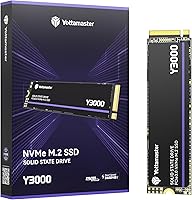
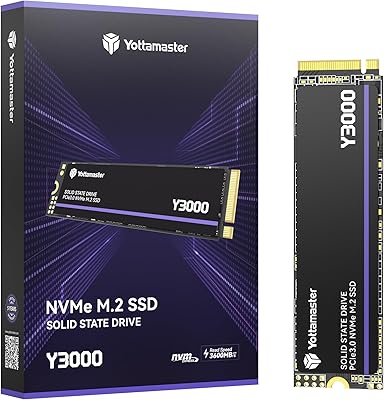
The Yottamaster Y3000 2TB NVMe Internal SSD arrived on the market in late 2024 and has already carved out a respectable position among budget-conscious upgraders. For a 2TB NVMe drive, the price puts it squarely in the value tier — competing against established names while offering something most rivals skip at this level: a bundled aluminum heatsink and thermal pads right out of the box. It runs on a PCIe 3.0 interface, which is worth acknowledging upfront. That is not a knock — most mainstream desktops and laptops operate perfectly well on Gen 3 — but if you are expecting Gen 4 headroom, you will not find it here.
Features & Benefits

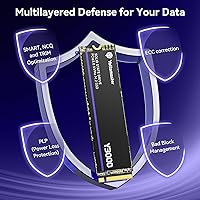
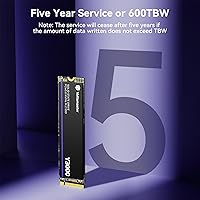
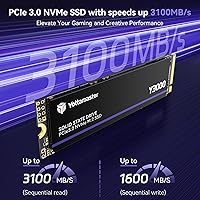
The Y3000 SSD's headline figures — 3,100 MB/s read and 1,600 MB/s write — are burst speeds made possible by its SLC cache layer. Once that cache fills up during large, continuous file transfers, sustained write performance steps down considerably, as is true of nearly every drive using this architecture. For typical workloads like booting your OS, opening applications, or loading game levels, you will likely never push past the cache ceiling. The M.2 2280 form factor covers most desktops and laptops, but PS5 users need to look elsewhere — this drive is incompatible with Sony's console. Reliability features include SMART monitoring, TRIM support, bad-block management, and power-loss protection, backed by a 5-year warranty and 300 TBW endurance rating.

Best For

This 2TB PCIe 3.0 drive is a natural fit for anyone stepping up from a mechanical hard drive or a SATA SSD and wanting a meaningful speed boost without a premium price tag. Gamers on Gen 3 platforms will notice shorter load screens and snappier system response without paying extra for Gen 4 speeds their hardware cannot fully exploit. Students and everyday users storing large media libraries, software collections, or project archives will find the 2TB capacity genuinely useful. That said, it is not the right tool for everyone. Heavy video editors regularly writing large files will run into post-cache slowdowns, and PS5 users should not bother — this drive simply is not compatible with Sony's console.

User Feedback

With a 4.3-star average across 61 reviews, this Yottamaster NVMe drive has earned a solid early reception, though the sample size is still small enough that the picture could shift over time. Buyers most often praise how painless the installation process is and how dramatically faster their systems feel compared to what they replaced. The bundled heatsink earns favorable mentions — appreciated as a practical no-cost extra rather than an afterthought. On the flip side, a few users note that you need to format the drive before it shows up in your system, which catches some first-timers off guard. Since it only launched in late 2024, long-term durability remains an open question — encouraging so far, but worth monitoring.

Pros

  • Delivers a dramatic real-world speed boost over HDDs and SATA SSDs for everyday tasks and game loading.
  • 2TB of NVMe storage at a budget-friendly price is genuinely difficult to beat in this market tier.
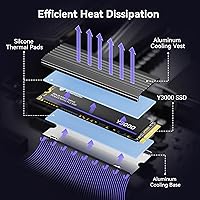
  • Bundled aluminum heatsink and dual thermal pads are practical extras most rivals do not include at this price.
  • M.2 2280 form factor fits the overwhelming majority of modern desktops and laptops without adapters.
  • A 5-year limited warranty provides meaningful peace of mind for a budget storage purchase.
  • 300 TBW endurance rating is reasonable and appropriate for light-to-moderate daily workloads.
  • Power-loss protection helps guard against data corruption during unexpected shutdowns.
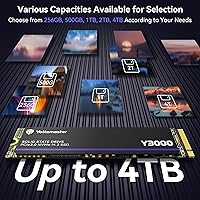
  • Multiple capacity options — from 256GB to 4TB — let buyers right-size their purchase.
  • Early user ratings trend positively, with buyers frequently praising painless installation.
  • SMART monitoring and bad-block management add a layer of proactive drive health oversight.

Cons

  • Advertised peak speeds rely on SLC cache; sustained write performance drops noticeably once that cache fills.
  • The Y3000 SSD is strictly incompatible with PS5 — console upgraders must look elsewhere entirely.
  • New drives must be formatted before the system recognizes them, which catches first-time builders off guard.
  • Yottamaster is a relatively unknown brand in Western markets, which may raise questions for cautious buyers.
  • Only 61 reviews as of early 2025 — far too few to draw confident conclusions about long-term durability.
  • PCIe 3.0 means the drive will not saturate Gen 4 slots, leaving bandwidth on the table in newer systems.
  • Thermal pads included are thin; heavy sustained workloads may still benefit from aftermarket cooling solutions.
  • No companion software or dashboard utility is offered for drive health monitoring out of the box.

Ratings

The scores below were generated by AI after analyzing verified buyer reviews for the Yottamaster Y3000 2TB NVMe Internal SSD from multiple global sources, with spam, bot activity, and incentivized feedback actively filtered out. Each category reflects a balanced synthesis of real ownership experiences — strengths are credited where earned, and genuine pain points are not softened or buried. The result is an honest snapshot of how this drive performs across the use cases that matter most to actual buyers.
Value for Money
91%
At this price point for 2TB of NVMe storage, buyers consistently describe it as a no-brainer upgrade. The fact that a heatsink and thermal pads are bundled in — accessories most rivals charge extra for — makes the overall package feel even more generous for budget-conscious builders.
Some buyers note that slightly pricier drives from more established brands offer better-documented sustained write performance, which may justify the extra spend for users who do heavy workloads. The value equation weakens somewhat if you end up needing a Gen 4 drive down the line.
Read Speed Performance
84%
For everyday tasks — booting Windows, launching apps, loading game levels — users report that the Y3000 SSD feels genuinely fast, with system responsiveness that is a clear step above SATA drives. The SLC cache handles burst reads efficiently, making common workloads feel snappy and immediate.
The headline 3,100 MB/s figure is a burst measurement, not a sustained one, and reviewers with benchmarking experience note real-world sequential reads can fall short of that ceiling under continuous load. Buyers expecting peak speeds across the board may feel slightly misled by the spec sheet.
Write Speed Performance
68%
32%
For casual writing tasks — saving documents, installing games, downloading files — the 2TB PCIe 3.0 drive handles things comfortably within its SLC cache window. Users upgrading from HDDs or SATA SSDs typically notice a significant and immediate improvement in write-heavy tasks like software installations.
Once the SLC cache is saturated during large, continuous file transfers, write speeds drop considerably — a limitation that is inherent to the architecture but still disappoints users who expected the advertised 1,600 MB/s to hold up during big video exports or bulk file moves. This is a meaningful caveat for prosumers.
Installation Ease
93%
Across reviews, installation is one of the most consistently praised aspects of this Yottamaster NVMe drive. Users with minimal PC building experience describe the process as painless: slot it in, secure the screw, and you are done. The included instructions help first-timers navigate the physical install without confusion.
A recurring friction point is the required formatting step before the drive appears usable in Windows — something experienced builders take for granted but that catches newer users off guard. A clearer callout in the packaging about this mandatory step would prevent avoidable confusion and support inquiries.
Thermal Management
78%
22%
The bundled aluminum cooling vest is a legitimate differentiator at this price tier, and users appreciate not having to source a heatsink separately. For most desktop builds and open-chassis configurations, it keeps temperatures in a comfortable operating range during typical workloads.
A few reviewers note that the thermal pads included are on the thinner side, limiting their effectiveness in high-ambient-temperature environments or small form-factor builds with restricted airflow. Users running the drive in particularly cramped laptops should verify there is clearance for the heatsink before assuming it will fit.
Compatibility
72%
28%
The M.2 2280 form factor is broadly supported, and users confirm the drive works without issue in a wide range of desktop motherboards and laptops from major manufacturers. Buyers running PCIe 3.0 or 4.0 systems both report successful installs, since Gen 4 slots are backward compatible.
The PS5 incompatibility is a hard stop for console users who may not read product details closely enough — this creates frustrated returns and negative reviews from buyers who simply did not realize PCIe 3.0 drives are not supported by Sony's console. Compatibility with SATA-only M.2 slots is also zero, which trips up owners of older ultrabooks.
Build & Component Quality
73%
27%
The physical construction feels solid for a budget NVMe drive, and the aluminum heatsink adds a sense of substance compared to bare-board competitors. Early adopters describe the included accessories as genuinely functional rather than decorative, which is a fair reflection of the thoughtful packaging.
As a brand with limited Western market history, Yottamaster does not yet have the component transparency that established players provide — the NAND and controller supplier are not publicly disclosed, which makes it harder to independently assess long-term quality. Some buyers prefer knowing exactly what hardware is inside.
Long-term Reliability
61%
39%
The 5-year warranty and 300 TBW endurance rating are solid commitments on paper, and users who have had the drive for a few months report no issues with stability or unexpected failures. For light-to-moderate daily use, the durability specs are more than adequate.
The drive only launched in October 2024, meaning there is almost no long-term real-world reliability data available yet. Buyers who want years of proven ownership feedback before committing will not find it here — and that uncertainty is a legitimate reason for cautious buyers to hesitate.
Sustained Workload Handling
58%
42%
For short-burst workloads that define most consumer use cases — copying a folder of photos, downloading a game update, transferring a project archive — the Y3000 SSD handles things with ease and without noticeable hesitation. It performs its intended role well within those boundaries.
Push the drive into continuous, large-file write territory and the performance curve drops in a way that frustrates power users. Video editors, content creators working with RAW files, and anyone regularly transferring dozens of gigabytes at a stretch will find the post-cache slowdown a tangible, workflow-disrupting limitation.
Noise & Vibration
96%
As a solid-state drive with no moving parts, this 2TB PCIe 3.0 drive is completely silent during operation — a straightforward advantage over HDDs that users upgrading from spinning disks specifically call out as an unexpected quality-of-life improvement in quieter work and gaming environments.
There is nothing meaningful to criticize here — the absence of mechanical components means silence is guaranteed by design. This category is essentially a non-issue for NVMe drives and does not meaningfully differentiate this model from its competitors.
Packaging & Unboxing
82%
18%
Buyers describe the packaging as clean and well-organized, with the heatsink, thermal pads, and screw neatly separated from the drive itself. The presentation feels more considered than many budget competitors, giving the product a positive first impression that matches its price-to-value positioning.
The instruction sheet is brief and primarily text-based, which some first-time builders find insufficiently detailed — particularly around the heatsink installation and the pre-use formatting requirement. A QR code linking to a setup video would meaningfully reduce post-purchase confusion for less experienced users.
Warranty & Support
69%
31%
A five-year limited warranty is a genuinely reassuring commitment for a budget-tier drive, and users appreciate that Yottamaster backs the product with a longer coverage period than some mid-tier competitors offer. The warranty signals a degree of confidence in the product's expected lifespan.
Yottamaster's customer support infrastructure and warranty claim process are not yet well-documented in public buyer feedback, largely due to the brand's limited track record in Western markets. Buyers have little community experience to draw on if something goes wrong, which introduces uncertainty around how smoothly a claim would actually be resolved.
Benchmark vs. Real-World Gap
55%
45%
Users who approach this drive with realistic expectations — understanding that NVMe spec-sheet numbers represent best-case burst conditions — generally come away satisfied. The performance improvement over HDDs and SATA SSDs is real and immediately perceptible in day-to-day use.
The gap between advertised peak speeds and actual sustained performance is wider than some buyers anticipate, particularly for write operations. Users who run standard benchmarking tools after purchase sometimes feel the results do not match the product listing, even when the drive is technically performing within its designed parameters.

Suitable for:

The Yottamaster Y3000 2TB NVMe Internal SSD is a strong pick for everyday PC users and laptop owners who are ready to leave behind a spinning hard drive or an older SATA SSD and want a real, tangible speed improvement without stretching their budget. If your motherboard tops out at PCIe 3.0 — which describes the vast majority of systems sold before 2022 — you have absolutely nothing to gain by paying a premium for a Gen 4 drive, making this 2TB PCIe 3.0 drive a genuinely sensible choice. Gamers running mid-range platforms will appreciate shorter game load times and snappier OS boot speeds that translate into a noticeably better daily experience. Students and content consumers who need bulk storage for large media libraries, software installs, or ongoing project files will find 2TB of fast NVMe storage at this price tier hard to argue against. The bundled heatsink and thermal pads are a practical bonus that removes one more thing to buy separately, which matters when you are already managing a tight build budget.
Not suitable for:

The Yottamaster Y3000 2TB NVMe Internal SSD is not the right answer for every buyer, and it is worth being direct about where it falls short. PS5 owners searching for a console storage upgrade should stop here — this drive runs on PCIe 3.0 and is explicitly incompatible with Sony's PlayStation 5, full stop. Professional video editors and content creators who regularly move massive files — think raw 4K or 8K footage — will run into a real limitation: once the SLC cache is exhausted during sustained large writes, throughput drops well below the advertised peak, which can slow down workflows in ways that matter. Prosumers and power users who demand consistent, high-throughput performance over long write sessions should look at pricier drives with larger sustained write headroom. Finally, because the Y3000 SSD only launched in late 2024, there is simply not enough long-term owner data yet to make confident claims about multi-year reliability — buyers who prioritize a proven track record may prefer a drive with a longer history in the field.
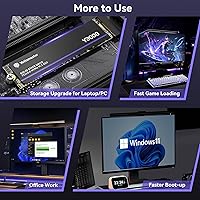
Specifications

  • Capacity: This drive is available in 256GB, 512GB, 1TB, 2TB, and 4TB variants; this listing covers the 2TB configuration.
  • Interface: Uses a PCIe 3.0 x4 NVMe interface, delivering significantly faster throughput than older SATA-based solid state drives.
  • Form Factor: Follows the M.2 2280 standard, meaning the board is 22mm wide and 80mm long — the most common M.2 size in modern PCs and laptops.
  • Sequential Read: Peak sequential read speed reaches up to 3,100 MB/s under optimal, cache-assisted conditions.
  • Sequential Write: Peak sequential write speed reaches up to 1,600 MB/s, also measured during SLC cache operation rather than sustained workloads.
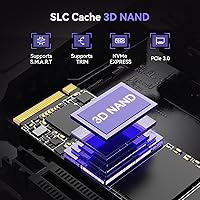
  • Flash Type: Built on 3D NAND flash memory with an SLC (Single-Level Cell) caching layer to boost burst transfer performance.
  • Endurance Rating: Rated at 300 TBW (terabytes written), which is a reasonable threshold for light-to-moderate daily use over several years.
  • Warranty: Backed by a 5-year limited warranty from Yottamaster, covering manufacturing defects under normal operating conditions.
  • Compatibility: Compatible with desktop PCs and laptops that feature an M.2 PCIe 3.0 slot; explicitly not compatible with the PlayStation 5.
  • Included Items: Each package includes the SSD itself, an aluminum cooling vest, two silicone thermal pads, one mounting screw, and a printed instruction sheet.
  • Protection Features: Incorporates SMART monitoring, NCQ, TRIM support, bad-block management, and power-loss data protection for improved drive reliability.
  • Item Weight: The drive and its packaging weigh approximately 2.39 ounces, making it light enough to handle without any special tools or equipment.
  • Package Dimensions: The retail package measures 5 x 3.46 x 0.87 inches, compact enough to ship safely in standard padded envelopes.
  • Generation: This is a PCIe Gen 3 drive and will not deliver Gen 4 speeds even when installed in a motherboard slot that supports PCIe 4.0.
  • Thermal Design: The bundled aluminum cooling vest combined with two silicone thermal pads helps dissipate heat during sustained read and write operations.
  • Brand & Series: Manufactured by Yottamaster under the Y3000 product series, first made available in October 2024.

Related Reviews
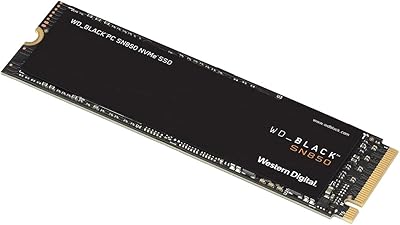
WD_BLACK SN850 2TB NVMe Gaming SSD
85%
96%
Read Performance
91%
Write Performance
67%
Thermal Management
88%
Installation Ease
93%
Long-Term Reliability
More
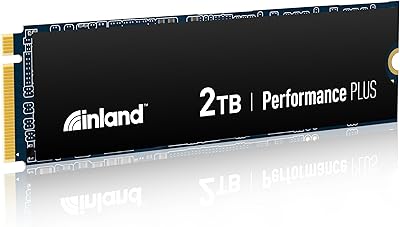
INLAND Performance Plus 2TB NVMe SSD
80%
84%
Sequential Read Performance
77%
Sustained Write Consistency
93%
PS5 Compatibility
71%
Random Read/Write Speed
63%
Thermal Management
More
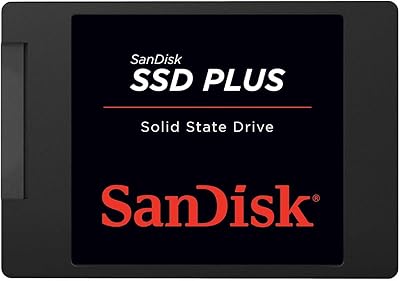
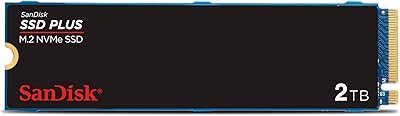
SanDisk SSD Plus 2TB Internal SSD
82%
88%
Read Speed Performance
74%
Write Speed Performance
94%
Installation & Compatibility
91%
Value for Money
86%
Long-Term Durability & Reliability
More
SanDisk 2TB SSD Plus M.2 NVMe SSD
86%
89%
Performance
92%
Ease of Installation
88%
Reliability
91%
Value for Money
90%
Capacity
More
Yottamaster Y3000 512GB NVMe Internal SSD
75%
83%
Read Speed Performance
67%
Write Speed & Cache Behavior
91%
Installation Experience
86%
Value for Money
72%
Heatsink & Thermal Accessories
More
Yottamaster S25PRO 2TB SATA SSD
81%
88%
Value for Money
83%
Read & Write Speed
91%
Build Quality
93%
Ease of Installation
79%
Reliability & Endurance
More
ORICO X7000 2TB NVMe SSD
79%
88%
Read & Write Performance
84%
PS5 Compatibility
91%
Thermal Management
93%
Installation Ease
82%
Value for Money
More
PHIXERO P5000 2TB NVMe SSD
88%
93%
Performance (Speed)
88%
Build Quality
90%
Heat Management
85%
Ease of Installation
92%
Compatibility
More
ORICO e7400 2TB M.2 NVMe SSD
81%
91%
Sequential Speed
78%
Random Read/Write
86%
Thermal Management
83%
PS5 Compatibility
88%
Value for Money
More
RONGSHU RP7000 2TB NVMe SSD
78%
88%
Read/Write Performance
91%
Value for Money
93%
PS5 Compatibility
74%
Thermal Management
67%
Endurance & Longevity
More

FAQ

No, it does not. The Y3000 SSD runs on PCIe 3.0, and Sony's PS5 requires a PCIe 4.0 NVMe drive for its expansion slot. If you are upgrading a PS5, you will need to look at a different drive entirely — this one is strictly for PC and laptop use.

Yes, and this trips up a lot of first-time builders. When you install a brand-new drive, your operating system will see it but it will not be ready to use until you initialize and format it. On Windows, just open Disk Management, find the new unallocated drive, right-click it, and follow the prompts to create a partition and format it. The whole process takes about two minutes.

It will work in most modern laptops that have an M.2 slot running PCIe 3.0 or PCIe 4.0 (Gen 4 slots are backward compatible). The drive uses the standard M.2 2280 size, which fits the overwhelming majority of M.2 slots. Just check your laptop's manual or manufacturer spec sheet to confirm it has an M.2 NVMe slot rather than an M.2 SATA-only slot, as those are not compatible.

In simple terms, the drive sets aside a portion of its NAND flash to act as a fast buffer for incoming data. When you are copying files, booting your system, or loading a game, that cache handles the burst activity and delivers the headline speeds. If you are continuously writing a very large file — say, a 100GB video export — the drive will eventually write past the cache boundary and slow down. For typical daily tasks, most users will never notice this limitation.

The aluminum cooling vest clips or slides onto the drive and is straightforward to attach using the included thermal pads. Whether you need it depends on your setup — if your motherboard already has its own M.2 heatsink cover, you may not need the bundled one at all (and should check that both do not stack in a way that prevents the motherboard cover from closing). For builds without built-in M.2 cooling, the included heatsink is a genuinely useful addition.

Absolutely, and that is one of the best uses for this 2TB PCIe 3.0 drive. Installing your operating system on an NVMe SSD will produce a dramatic improvement in boot times and application launch speeds compared to a spinning hard drive. You will likely want to do a clean OS install rather than cloning, though cloning tools do exist if you prefer to migrate your existing setup.

Yottamaster covers the drive for five years from the purchase date against manufacturing defects. In practice, this means if the drive fails under normal use — not physical damage or misuse — you can contact their support team and work through a replacement process. It is worth keeping your purchase receipt or order confirmation, as you will need proof of purchase to make a warranty claim.

For most people, yes. 300 TBW means you can write 300 terabytes of data to the drive over its lifetime before the NAND cells are likely to wear out. At a typical daily write load of 20 to 40GB — which already covers heavy everyday use — you would reach that threshold after roughly 20 to 40 years of use. Power users doing constant large file transfers or frequent database writes are a different story, but for home PCs and laptops, 300 TBW is more than sufficient.

No, it will not hurt anything. PCIe slots are backward compatible, so this drive will work fine in a Gen 4 slot — it will just run at PCIe 3.0 speeds. The slot will not be damaged, and the drive will not be throttled beyond its own rated maximum. The only trade-off is that you will not get Gen 4 speeds from a Gen 3 drive, which is expected.

The Y3000 SSD competes in a crowded space where several established brands also offer budget PCIe 3.0 drives. The main differentiator here is the included heatsink and thermal pads, which most competitors at this price point do not bundle. On raw specifications, the figures are competitive. The honest caveat is that Yottamaster is a newer brand in Western markets with a shorter track record, so buyers who prioritize a proven multi-year reliability history may prefer a brand with a longer public record.