Overview

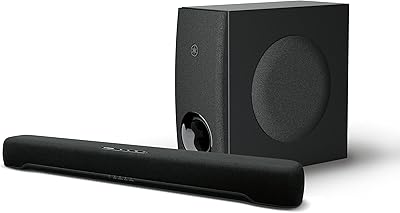
The Yamaha YAS-209 Soundbar with Wireless Subwoofer sits squarely in the mid-range market, built for the kind of person who wants noticeably better sound without rewiring their living room. Yamaha has decades of audio engineering behind it, and that heritage shows in how this bar is tuned — it doesn't just get loud, it sounds balanced. The 2.1-channel setup means a dedicated wireless subwoofer handles low frequencies, so bass in action movies and music actually feels present rather than suggested. Alexa built-in is a genuine convenience here, not a gimmick, and the automatic subwoofer pairing means setup takes minutes, not an afternoon.
Features & Benefits

DTS Virtual:X is probably the most talked-about feature here, and it's worth setting expectations correctly: it expands the perceived soundstage convincingly for a bar of this size, but it's processing-based, not true multi-speaker surround. In a medium-sized room, it adds genuine width and a hint of height to movie soundtracks. The Clear Voice mode is surprisingly effective — dialogue stays intelligible even at lower volumes, which matters a lot for late-night TV. Connectivity is unusually complete: HDMI ARC, optical, Bluetooth, Wi-Fi, and Spotify Connect cover just about every device you'd plug in. The subwoofer connects wirelessly and can be positioned anywhere near an outlet.

Best For

This soundbar-subwoofer combo is an easy recommendation for apartment dwellers or anyone in a smaller room who wants real bass without running a cable across the floor. If you're already using Alexa devices at home, having voice control built directly into the bar is genuinely useful — adjust volume, switch inputs, or call up a playlist without touching a remote. Music streamers will appreciate Spotify Connect and Bluetooth working reliably side by side. It's also a strong pick for console gamers wanting a quick, meaningful audio upgrade over TV speakers. Coming from built-in TV audio, the difference is hard to miss.

User Feedback

Buyers who've lived with the YAS-209 for a while tend to land in a consistent place: satisfied, particularly citing how painlessly it set up and how much the wireless sub improved their everyday TV experience. Alexa responsiveness draws specific praise from smart home users. On the critical side, people in larger rooms note that the surround effect doesn't stretch far enough to fill the space — a fair point given the technology involved. A handful of users have flagged occasional Wi-Fi instability, and Apple households have called out the missing AirPlay 2 support as a real drawback. Long-term durability feedback is mostly encouraging.

Pros

  • Wireless subwoofer pairs automatically and can be placed anywhere near an outlet — no cable runs needed.
  • Setup is genuinely fast; most buyers report being up and running within minutes of unboxing.
  • Clear Voice mode keeps dialogue intelligible even at low volumes, which is great for late-night viewing.
  • Alexa built-in works reliably and removes the need for a separate smart speaker in the room.
  • Spotify Connect and Wi-Fi streaming mean you're not burning through your phone's battery to play music.
  • The slim soundbar profile fits neatly under most mid-size TVs without blocking the screen.
  • HDMI ARC, optical, Bluetooth, and Wi-Fi connectivity covers nearly every TV and source device combination.
  • DTS Virtual:X noticeably widens the soundstage in smaller rooms, adding depth to movie soundtracks.
  • Long-term owners report consistent, reliable performance without major degradation over time.
  • The included optical cable means you can connect and start listening right out of the box.

Cons

  • No AirPlay 2 support is a real gap for anyone using iPhones, iPads, or Apple TV as primary sources.
  • The surround effect loses conviction in larger rooms — this is not a substitute for a true multi-speaker system.
  • No MusicCast compatibility limits expandability if you want to grow into a whole-home audio setup.
  • Some users have reported occasional Wi-Fi connectivity drops that require a manual reconnect.
  • At 100 watts total, the system can sound strained at very high volumes in open or acoustically challenging spaces.
  • No HDMI passthrough means if your TV setup has multiple sources, input switching can get awkward.
  • The subwoofer is fairly large at over 16 inches tall, which can be harder to hide in tight spaces than expected.
  • Bass tuning leans toward boom over precision — music listeners who prefer tight, accurate low-end may notice this.

Ratings

The scores below reflect an AI-driven analysis of thousands of verified global buyer reviews for the Yamaha YAS-209 Soundbar with Wireless Subwoofer, with spam, incentivized, and bot-generated feedback actively filtered out before scoring. Each category is rated independently, so both the genuine strengths and the recurring frustrations are represented honestly — nothing is smoothed over to make the product look better than it is.

Sound Quality
78%
22%
For a 2.1-channel bar at this price, the overall sound is satisfying in ways that genuinely surprise first-time listeners upgrading from TV speakers. Movies have weight, music has dimension, and the balance between highs and mids is well-tuned for casual listening rather than fatiguing.
Critical listeners will notice compression at higher volumes, and the soundstage, while wider than a basic bar, doesn't offer the precision imaging that separates this class from true audiophile setups. It's enjoyable, not revelatory.
Bass Performance
82%
18%
The wireless subwoofer is the single biggest reason buyers feel satisfied with this combo. Explosions in action movies, beats in hip-hop, and low rumbles in gaming all feel physically present in a way built-in TV audio simply cannot replicate, especially in smaller rooms.
Bass tuning leans toward quantity over control — at higher subwoofer levels it can sound boomy rather than tight, which bothers music listeners more than movie watchers. Placement near walls can amplify this effect further.
Dialogue Clarity
86%
Clear Voice mode consistently earns praise from buyers who watch a lot of dialogue-heavy content — crime dramas, news, talk shows — where background music or sound effects can easily bury speech. Late-night viewers especially appreciate being able to follow conversations at low volumes.
The enhancement works best at moderate listening levels; at very low volumes it can introduce a slightly processed quality to voices that some users find unnatural. It's a toggle, not a fine-tuned equalizer, so there's no middle ground.
Setup Experience
91%
Almost universally praised as one of the easiest soundbar setups buyers have experienced. The subwoofer pairs automatically, the HDMI ARC connection handles volume sync with the TV remote, and the included optical cable means you can be listening in under ten minutes out of the box.
A small number of users reported the Wi-Fi setup requiring a router restart or app troubleshooting to complete successfully. It's not a common complaint, but it does prevent a perfect score given how critical wireless connectivity is to this product's value.
Alexa Integration
84%
Having Alexa built into the soundbar genuinely removes the need for a separate smart speaker in the main living space. Asking for music, switching inputs by voice, controlling lights, or setting a kitchen timer from the couch works reliably and feels natural for existing Alexa households.
The bar's microphones can struggle to pick up voice commands when the TV or music volume is high, which undermines one of the key selling points. Users in noisy environments or those with large rooms report having to repeat commands or raise their voice more than expected.
Wireless Connectivity
73%
27%
Spotify Connect works consistently well, and Bluetooth pairing with phones and tablets is straightforward. The subwoofer's dedicated wireless link to the bar is stable in the vast majority of setups, with no dropout issues reported under normal use conditions.
Wi-Fi stability has been a recurring complaint for a meaningful subset of users, with some reporting periodic disconnections that require a manual reconnect or full reboot. Bluetooth range is limited to around 10 meters, which can cause audio stuttering if your phone is in another room.
Build Quality
74%
26%
The soundbar feels solid and well-finished for its price tier, with a fabric grille and matte plastic housing that looks clean under most TVs. The subwoofer cabinet is substantial enough to feel like a proper audio component rather than a budget afterthought.
Some buyers note that the remote control feels cheap relative to the main units, and the soundbar's plastic chassis shows fingerprints and dust more than expected. It's not a premium tactile experience, which is a fair trade-off at this price but worth knowing.
Value for Money
83%
Buyers consistently describe the YAS-209 as punching above its weight given what's included — a wireless subwoofer, Alexa, multiple connectivity options, and Yamaha's audio tuning in a single box. For small-room home theater use, the price-to-performance ratio is genuinely competitive.
Shoppers who later discover the missing AirPlay 2 and MusicCast support sometimes feel the value proposition weakens if they're invested in Apple or Yamaha ecosystems. A slightly higher spend on a competing bar can unlock those features, making the comparison trickier for informed buyers.
Remote & Controls
61%
39%
The physical remote covers the basics competently — volume, input switching, sound mode toggling, and subwoofer level adjustment are all accessible without navigating menus. Alexa voice control further reduces how often you need to reach for it.
The remote design is dated and the button layout isn't intuitive for new users. There's no dedicated app for advanced EQ or settings adjustment, which limits how much buyers can fine-tune the sound without resorting to button-press sequences described in the manual.
Surround Immersion
63%
37%
In smaller rooms — a bedroom, a studio apartment living area, or a compact home office — DTS Virtual:X creates a noticeable sense of width and mild height that makes movie watching feel more enveloping than a flat stereo bar would.
In larger or open-plan spaces, the virtual surround effect essentially disappears, leaving you with what sounds like a good stereo bar. Buyers who expected true multi-directional audio based on the marketing language have expressed frustration, making this one of the most commonly cited disappointments.
Streaming Versatility
81%
19%
The combination of Spotify Connect, Wi-Fi, and Bluetooth means this soundbar-subwoofer combo handles music streaming from almost any source a typical household uses. You're not locked into one ecosystem for daily listening, which matters more over time than at the point of purchase.
The absence of AirPlay 2 is a real limitation for Apple-centric homes, and there's no Tidal Connect or dedicated app support for high-resolution audio services. Streaming versatility is broad but not deep, which suits casual listeners more than audio enthusiasts.
Room Suitability
69%
31%
This Yamaha soundbar is well-matched for rooms up to roughly 300 square feet — it fills that space comfortably at moderate volumes, and the subwoofer adds enough low-end impact to make the room feel acoustically alive without overwhelming neighbors.
Buyers with larger rooms or vaulted ceilings consistently report that the system runs out of headroom before the space is properly filled. At maximum volume in a large room, the bar can sound strained rather than powerful, which is a meaningful caveat for open-plan homes.
Long-Term Reliability
77%
23%
The majority of long-term owners — those using the YAS-209 daily for a year or more — report no significant hardware failures. The wireless subwoofer link remains stable for most, and software performance doesn't appear to degrade meaningfully over time.
A recurring minority report Wi-Fi connectivity becoming less stable after several months of use, occasionally requiring factory resets. Yamaha's firmware update history for this model has been inconsistent, leaving some connectivity bugs unresolved for extended periods.
Physical Footprint
79%
21%
The slim soundbar profile — under 2.5 inches tall — means it sits discreetly in front of a TV without dominating the room or blocking the screen. Wall mounting is supported, giving buyers flexible placement options beyond a TV stand.
The subwoofer is larger than buyers often anticipate from product photos, measuring over 16 inches tall. In tight living spaces or minimalist setups, finding a discreet spot for it requires more planning than the compact soundbar itself suggests.

Suitable for:

The Yamaha YAS-209 Soundbar with Wireless Subwoofer is a strong fit for anyone who wants a meaningful audio upgrade from built-in TV speakers without dealing with complicated wiring or a steep learning curve. It works especially well in apartments and smaller living rooms, where the wireless subwoofer can be tucked beside a couch or cabinet and the bar's compact footprint won't overwhelm a mid-size TV stand. Alexa users in particular get extra value here, since the built-in voice assistant handles music playback, smart home commands, and everyday queries without needing a separate Echo device nearby. Cord-cutters who stream music through Spotify or cast audio over Bluetooth will find the connectivity options genuinely practical rather than padded. Casual gamers looking for richer sound from their console without building a full surround setup will also find this a satisfying, low-hassle solution.

Not suitable for:

Buyers with large open-plan rooms or dedicated home theater spaces will likely find the YAS-209 underpowered in terms of surround immersion — DTS Virtual:X is a processing effect, and in a big room it simply doesn't stretch far enough to feel convincing. Apple households that rely on AirPlay 2 for multi-room audio should look elsewhere, as this bar doesn't support it, and Yamaha's MusicCast ecosystem is also absent here, which matters if you were hoping to expand into a whole-home audio setup later. Audiophiles or critical listeners expecting studio-grade clarity at high volumes may find the 100-watt output and dynamic driver configuration fall short of their standards. Anyone already invested in a dedicated AV receiver and speaker system will find little reason to replace it with this soundbar-subwoofer combo, since the YAS-209 is aimed squarely at simplicity over sonic ambition.

Specifications

  • Channel Config: The system uses a 2.1-channel configuration, meaning a dedicated soundbar for mid and high frequencies paired with a separate subwoofer for bass.
  • Output Power: Total system output is 100 watts, providing sufficient volume for small to medium-sized rooms without significant distortion.
  • Soundbar Size: The soundbar measures 36-5/8″ wide × 2-1/2″ tall × 4-1/4″ deep, fitting comfortably in front of most mid-size televisions.
  • Subwoofer Size: The wireless subwoofer measures 7-1/2″ wide × 16-1/2″ tall × 16″ deep and requires placement near a power outlet.
  • Surround Processing: DTS Virtual:X processing is built in, which uses psychoacoustic techniques to simulate height and width beyond a standard stereo soundbar.
  • Voice Assistant: Amazon Alexa is integrated directly into the soundbar, enabling voice control of playback, smart home devices, timers, and general queries.
  • Connectivity: The bar supports HDMI ARC, optical input, Bluetooth, and Wi-Fi, covering the majority of modern TV and source device configurations.
  • Streaming: Spotify Connect is supported natively, allowing the soundbar to stream directly from Spotify's servers without relying on a phone or tablet as an intermediary.
  • Bluetooth Range: Bluetooth connectivity operates at a standard range of up to 10 meters under typical indoor conditions.
  • Subwoofer Link: The subwoofer pairs with the soundbar automatically over a dedicated wireless connection, requiring no manual frequency configuration.
  • Audio Driver: The system uses dynamic driver technology throughout, which is well-suited for reproducing the wide dynamic range of movies and music.
  • Weight: The combined system weight is approximately 20 pounds across both the soundbar and subwoofer units.
  • Power Source: Both the soundbar and subwoofer are corded electric devices and each requires a standard AC outlet.
  • Included Items: The package includes the soundbar, wireless subwoofer, one optical cable, a remote control, and a printed manual.
  • Remote Control: A physical remote is included for input selection, volume adjustment, and feature toggling without relying solely on voice commands.
  • AirPlay Support: AirPlay 2 is not supported, making this bar less compatible with Apple device ecosystems that rely on AirPlay for wireless audio.
  • MusicCast: This model does not support Yamaha's MusicCast platform, so it cannot be integrated into a wider Yamaha multi-room audio network.
  • Warranty: The unit is covered by a limited manufacturer warranty; buyers should confirm current warranty terms directly with Yamaha at the time of purchase.
  • Batteries: The included remote control requires two AA batteries, which are not included in the package.
  • Water Resistance: The soundbar and subwoofer are not water resistant and are designed exclusively for dry indoor environments.

Related Reviews

Philips TAB8405 2.1-Channel Soundbar
76%
74%
Sound Quality
81%
Bass Performance
62%
Dolby Atmos Experience
88%
Wireless Subwoofer Convenience
77%
Smart Home Integration
More
Philips B6309 Soundbar with Wireless Subwoofer

83%
88%
Sound Quality
85%
Bass Performance
92%
Ease of Setup
68%
Connectivity
70%
App Control
More
Philips B5309 2.1 Soundbar with Wireless Subwoofer


73%
73%
Sound Quality
69%
Bass Performance
82%
Dialogue Clarity
88%
Setup & Installation
61%
Wireless Subwoofer Reliability
More
Yamaha SR-C30A Compact Soundbar with Subwoofer
80%
91%
Dialogue Clarity
72%
Subwoofer Performance
84%
Sound Mode Versatility
93%
Size & Form Factor
88%
Setup & Connectivity
More
Klipsch Cinema 600 3.1 Soundbar System
75%
91%
Bass Performance
78%
Dialogue Clarity
61%
Wireless Subwoofer Reliability
88%
Setup & Installation
54%
App & Software Experience
More
LG S40T 2.1ch Soundbar with Wireless Subwoofer


75%
76%
Audio Quality
68%
Bass Performance
83%
Dialogue Clarity
91%
Setup & Installation
79%
WOW Interface & Smart Integration
More
Philips TAB7305 2.1 Soundbar with Wireless Subwoofer

69%
81%
Bass Performance
67%
Dialogue Clarity
89%
Setup & Installation
62%
Wireless Subwoofer Reliability
78%
Value for Money
More
Rockville ROCKBAR 40 Inch 400W Soundbar with Wireless Subwoofer
82%
87%
Sound Quality
92%
Bass Performance
90%
Ease of Setup
81%
Wireless Connectivity
78%
Build Quality
More
Philips B5306 2.1-Channel Soundbar with Subwoofer
74%
91%
Ease of Setup
88%
Roku TV Integration
83%
Bass Performance
66%
Dialogue Clarity
61%
Wireless Subwoofer Reliability
More
PyleUsa PSBV28HB 2.1 Channel Soundbar with Wireless Subwoofer
84%
85%
Sound Quality
76%
Bass Performance
90%
Connectivity Options
88%
Ease of Setup
92%
Value for Money
More

FAQ

It connects automatically. When you power everything on for the first time, the subwoofer finds the soundbar on its own — no button combinations or app setup required. Most people have it working in under five minutes.

Technically the bar will function without the subwoofer powered on, but the low-end audio will be noticeably thin. The system is designed to be used as a pair, and the subwoofer handles a significant portion of the overall sound output.

Pretty much, yes. You can ask it to play music, control compatible smart home devices, set timers, and answer general questions. The main difference is that it's built into your soundbar rather than a standalone speaker, so the microphone pickup can be affected by nearby TV audio at high volumes.

In most cases, yes. At just under 37 inches wide and about 2.5 inches tall, it sits low enough that it won't block a TV's IR sensor, though placement on a TV stand versus wall-mounting can make a difference — check your specific TV's sensor location if you're concerned.

No, you use one connection at a time. Most users opt for HDMI ARC if their TV supports it, since it allows the TV remote to control soundbar volume. Optical is a reliable fallback for older TVs.

It's not recommended. The subwoofer is a ported design, meaning it needs some airflow around it to reproduce bass accurately. An enclosed cabinet can muffle the sound and potentially cause heat buildup over time.

Yes, and it's worth understanding the difference. With Spotify Connect, the soundbar streams directly from the internet — your phone is just a remote control. Bluetooth streams audio from your phone itself, which means call interruptions can cut the music. Spotify Connect is the more reliable option if your Wi-Fi is solid.

You can use HDMI ARC or optical to connect your Apple TV to your TV and then pass audio to the bar, which works fine. What won't work is AirPlay 2 — this bar doesn't support it, so you can't stream directly to the soundbar wirelessly from Apple devices.

It boosts the mid-range frequencies where human speech sits, making dialogue easier to follow without cranking the overall volume. It's particularly helpful for shows with heavy background music or action noise. You toggle it on via the remote, and most users leave it on permanently for TV watching.

Based on user feedback, the YAS-209 holds up well with daily use over a year or more. The wireless subwoofer connection stays stable for most users, and the build quality feels appropriate for the price tier. A small number of users have reported Wi-Fi connectivity needing a reset occasionally, but hardware failures are not a common complaint.

Where to Buy