Overview

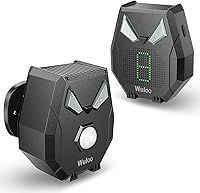
The Wuloo WUL-MTY0102-1T1 Solar Driveway Alarm System arrived in mid-2024 as an upgraded take on Wuloo's existing wireless alert line, and it shows a few meaningful improvements over what came before. This driveway alert system runs entirely on solar power, backed by a rechargeable LiPo battery that Wuloo rates for up to 24 months on a charge — handy if your sensor spot gets limited winter sun. The wireless range is marketed at half a mile, though real-world testing in areas with trees and buildings puts the reliable signal closer to a third of a mile. For the price, it is a solid, no-wiring-needed option for anyone who wants passive perimeter monitoring without monthly fees or an electrician.
Features & Benefits

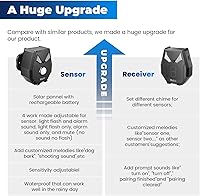
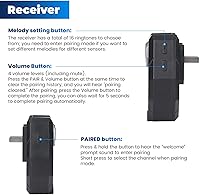
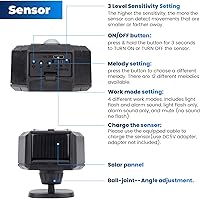
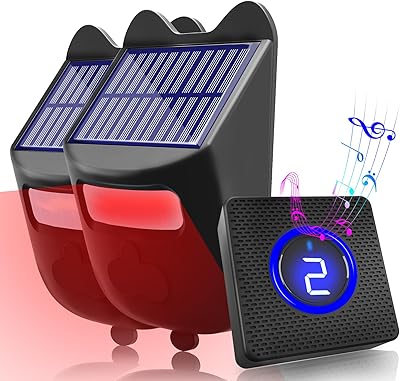
The sensor itself offers four work modes, letting you decide whether the alarm sounds, the light activates, or both — useful for situations where a flashing light alone is enough of a deterrent. The receiver gives you 16 chime options, including a dog-barking sound and a gunshot tone, and you can assign different melodies to different sensors if you add more later. Sensitivity is adjustable, which helps cut down on false trips from squirrels or gusts of wind. One thing worth knowing upfront: the sensor volume is fixed, so if your installation spot is noisy, the receiver indoors is where you control how loud alerts get, across four volume levels including mute.

Best For

This wireless motion alarm suits a pretty specific type of buyer, and that is actually a compliment — it does not try to be everything. It works best for rural homeowners or anyone with a long driveway who wants an early heads-up before a vehicle or visitor reaches the house, without any wiring or professional installation. Renters will appreciate that the wall-mount sensor can come down as easily as it went up. Small business owners watching a back gate or delivery area on a tight budget will find it functional and fuss-free. And if you already own an older Wuloo unit, adding this kit as a second zone is straightforward — the same receiver handles up to eight sensors total.

User Feedback

Buyers tend to praise the Wuloo sensor kit for two things above all: how quickly it comes together out of the box, and how distinct the chime tones are — no confusion about which zone triggered an alert. Where the feedback gets more mixed is range. Several users in wooded or suburban settings report that the real detection distance lands well below the advertised half-mile. High-wind spots also generate more false alerts than some buyers expected. On the durability side, most report solid performance through rain, but a handful note concerns after a full winter with minimal sun affecting battery charge. Overall, the consensus is positive for the price point, provided you set realistic expectations about range and outdoor placement.

Pros

  • No wiring or professional installation needed — most users have it running within minutes of opening the box.
  • Solar charging paired with a long-life LiPo battery means the sensor rarely needs manual attention.
  • Sixteen receiver chime options let you assign distinct tones to different sensors, so you always know which zone triggered.
  • Adjustable sensitivity reduces false alerts from small animals or blowing debris when tuned correctly.
  • The system expands to eight sensors on one receiver, making future coverage upgrades simple and affordable.
  • Weatherproof construction holds up well through rain and snow across multiple seasons for most users.
  • Four receiver volume levels, including a mute setting, give you control over how disruptive alerts are indoors.
  • Works equally well monitoring a driveway, a gate, a barn entrance, or any outdoor perimeter point.
  • Compatible with older Wuloo sensor units, so existing users can add this kit without replacing their receiver.

Cons

  • Real-world wireless range in wooded or suburban areas falls noticeably short of the marketed half-mile figure.
  • The sensor volume cannot be adjusted, which is a genuine drawback if it is mounted in a loud outdoor environment.
  • High-wind locations generate false alerts more frequently, even after dialing back the sensitivity setting.
  • Solar performance drops in winter or shaded spots, potentially cutting into the two-year battery life estimate.
  • The 25-foot detection radius is relatively narrow, meaning placement angle and height are critical to catch vehicles reliably.
  • A handful of users report concern about long-term seal integrity after prolonged exposure to heavy rain.
  • No smartphone connectivity or app integration means you get no remote monitoring or alert history.
  • Only one receiver is included in the base kit, so covering multiple indoor rooms requires buying additional receivers separately.

Ratings

Our AI rating system analyzed thousands of verified global buyer reviews for the Wuloo WUL-MTY0102-1T1 Solar Driveway Alarm System, actively filtering out incentivized, bot-generated, and spam submissions to surface what real owners actually experience day to day. The scores below reflect both what this wireless motion alarm does genuinely well and where it falls short — no category has been softened to protect the brand. If you are weighing a purchase, these ratings give you an honest picture of what you are getting into.

Ease of Installation
91%
Buyers consistently describe setup as one of the fastest they have experienced in the home security category — most report going from box to working system in under fifteen minutes with no tools beyond a screwdriver for the wall mount. The lack of any wiring, hub pairing, or app account makes it accessible even for people who are not particularly tech-comfortable.
A small number of buyers found the initial sensor-to-receiver pairing step confusing when the manual instructions skipped over frequency-matching details. Users adding a third or fourth sensor later occasionally reported having to re-pair the whole system from scratch, which is a minor but frustrating reset process.
Wireless Range
58%
42%
In genuinely open settings — flat rural driveways with no tree cover or outbuildings — the signal holds up surprisingly well for a budget-tier system, with some users reporting solid performance at distances that most competing products at this price struggle to match in similar conditions.
The half-mile range figure on the box creates real expectations that the system rarely meets outside of a field test. Buyers in wooded suburbs or properties with brick walls between sensor and receiver frequently report signal dropping out or delayed alerts at distances as short as 600 to 800 feet, which is a significant gap from the marketing claim.
Detection Accuracy
72%
28%
When the sensitivity is properly tuned and the sensor is mounted at the right angle and height, this driveway alert system catches vehicles and adult-sized movement reliably within its 25-foot zone. Buyers who took time with placement rarely complained about missed detections under normal conditions.
False positives are the more common complaint, especially in windy environments or near roads with heavy truck traffic causing vibration. Even at reduced sensitivity settings, some users in exposed locations report nuisance alerts several times a day, which erodes trust in the system over time.
Battery & Solar Performance
67%
33%
For buyers in sun-rich climates who mount the sensor in a south-facing, unobstructed spot, the solar-assisted battery genuinely reduces maintenance to near zero across spring, summer, and autumn. Several long-term owners in California and Texas report over a year of use without ever manually recharging.
Winter performance is a consistent weak point, particularly for buyers in northern states or Canada where short days and panel-shading from snow dramatically cut solar input. In those conditions, the 24-month battery life estimate proves optimistic, and some users find themselves manually charging every few weeks during the coldest months.
Chime & Alert Customization
86%
The 16-chime receiver with per-sensor tone assignment is one of the standout practical features at this price point. Households running two or three sensors genuinely use distinct tones to instantly know whether an alert is from the front driveway, the back gate, or the side yard — a real-world convenience that buyers appreciate daily.
The sensor's own onboard alert volume is fixed, which bothers users who mounted it somewhere noisy — near a barn, workshop, or street — and wanted the local beep to be louder. A few buyers also found some of the included chime tones thin or tinny at higher receiver volume levels.
Weather Resistance
74%
26%
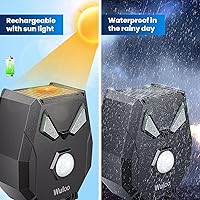
The weatherproof housing handles routine rain exposure well for most buyers across multiple seasons, and there are plenty of reports of the sensor surviving direct downpours and heavy snow without operational issues. The sealed design does not require any additional weatherproofing out of the box in moderate climates.
Extended or particularly harsh exposure starts to reveal some limitations, with a subset of long-term owners reporting signs of seal degradation after one to two full winters. Buyers in coastal or high-humidity environments note that gasket integrity is worth monitoring, especially around the battery compartment door.
Build Quality
69%
31%
The sensor feels appropriately solid for a budget outdoor device, and the matte black finish resists obvious scuffing and UV fading reasonably well through a full year of outdoor exposure. The mounting bracket is sturdy and holds a reliable angle once tightened.
The plastic housing does not feel premium, and buyers who handle it alongside mid-range competitors notice the difference immediately. A few users have reported the mounting bracket's adjustment mechanism becoming stiff or cracking after sustained freeze-thaw cycles.
Receiver Usability
83%
The plug-in receiver is straightforward — volume knob, chime selector, and a clear LED indicator are all easy to operate without consulting the manual. Buyers who switch chimes seasonally or add new sensors find the interface intuitive enough to navigate on the fly.
The receiver lacks any visual display showing which zone triggered an alert, so in a multi-sensor setup you rely entirely on memorizing which chime corresponds to which location. A small number of buyers also note that the receiver's indicator light is not bright enough to notice from across a large room in daylight.
Value for Money
88%
At its price point, this wireless motion alarm competes with systems that offer far fewer features — the expandability to eight sensors, 16 chimes, and solar operation together represent genuine value that buyers notice and comment on positively when comparing alternatives they considered.
The value equation weakens slightly if you end up needing to buy an additional receiver for a second indoor location, since that cost is not built into the initial purchase. Buyers who expected half-mile performance and got a third of a mile may also feel the value proposition overpromised.
Sensitivity Adjustment
71%
29%
Having a physical sensitivity dial rather than a fixed threshold is something buyers in mixed environments genuinely rely on — turning it down a notch or two typically eliminates most small-animal triggers without meaningfully reducing detection of people or vehicles.
The adjustment range is not wide enough for buyers in very high-interference locations, such as properties bordering agricultural fields with frequent machinery or roadsides with constant truck traffic. Some users report that even the lowest sensitivity setting still produces more false triggers than they can tolerate.
Expandability
89%
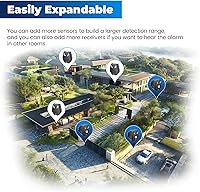
The ability to grow from one to eight sensors on a single receiver without replacing any hardware is a practical design choice that long-term owners consistently praise. Adding a sensor to a new entry point years later is a straightforward purchase with no compatibility headaches for most users.
While adding sensors is easy, the system offers no way to group or prioritize zones — all eight sensors alert with equal urgency, which can feel overwhelming on larger properties. Buyers hoping to set quiet hours or delayed alerts for specific sensors will find no such functionality available.
Signal Reliability
63%
37%
In stable environments where the sensor and receiver maintain clear line-of-sight or only light obstruction, the wireless connection holds consistently and missed alerts are rare. Many buyers report months of trouble-free signaling once placement is dialed in.
Interference from neighboring wireless devices, metal outbuildings, or dense landscaping introduces dropped signals that are difficult to diagnose and fix. Some buyers report intermittent missed alerts that occur unpredictably, making it hard to know whether the system is functioning correctly on a given day.
Setup Documentation
77%
23%
The quick-start guide is notably better written than what you typically find in this category, reportedly authored with input from a US-based customer — the plain-language instructions reflect real user confusion points and walk through the pairing process step by step without assuming technical knowledge.
The full manual covers advanced features like multi-sensor tone assignment and work mode selection less clearly, and buyers who skip the quick-start guide in favor of jumping straight to the main manual often find themselves confused about the order of operations during initial setup.

Suitable for:

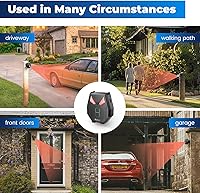
The Wuloo WUL-MTY0102-1T1 Solar Driveway Alarm System is a natural fit for homeowners with long, unpaved, or rural driveways who want a heads-up before anyone reaches the front door — no electrician, no wiring, no subscription required. If your property sits far enough from the road that you genuinely cannot hear a car pull in, this kind of passive alert system fills that gap without demanding much from you technically or financially. Renters who need a removable security layer will appreciate that the wall-mount sensor leaves almost no trace when taken down. Small business owners keeping an eye on a rear gate, a side entrance, or a delivery zone will find it functional and low-maintenance. It also works well as an expansion piece for anyone already running an older Wuloo system, since the receiver supports up to eight sensors — so adding coverage at a back fence or workshop door later is genuinely straightforward.
Not suitable for:

The Wuloo WUL-MTY0102-1T1 Solar Driveway Alarm System is not the right tool if you need rock-solid, long-range detection in a densely wooded, hilly, or heavily built-up environment. The half-mile range figure on the box reflects open-field conditions; in the real world, with trees, walls, and buildings in the path, reliable signal drops to closer to a third of a mile, and buyers who miss that distinction tend to be disappointed. If your sensor location receives very little direct sunlight during winter months, battery performance may fall short of the rated two-year life, which adds maintenance you might not have bargained for. The sensor volume is fixed, so if it is mounted in a noisy outdoor area — near a road, a workshop, or livestock — you cannot turn it up to compensate. Finally, buyers who need precise, professional-grade perimeter security with tamper resistance and guaranteed reliability should look at hardwired or cellular-connected systems instead; this driveway alert system is a convenience tool, not a substitute for a serious security setup.
Specifications

  • Brand: Manufactured by Wuloo, a company specializing in FM, ASK, FSK, and GFSK wireless technology for over 20 years.
  • Model: This system carries the model designation WUL-MTY0102-1T1 and was first made available in July 2024.
  • Power Source: The outdoor sensor runs on a built-in solar panel paired with a rechargeable Lithium Polymer (LiPo) battery included in the box.
  • Battery Life: Wuloo rates the sensor battery for up to 24 months on a full charge under typical solar conditions.
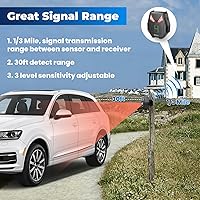
  • Wireless Range: The system is marketed at up to half a mile of wireless range, with real-world tested performance closer to one-third mile in areas with trees or structures.
  • Detection Radius: The passive infrared sensor detects movement within a 25-foot radius of its mounting position.
  • Dimensions: The sensor unit measures 5.12 x 3.31 x 5.08 inches and weighs 12.3 ounces.
  • Mounting Type: The sensor is designed for wall-mount installation and can be positioned outdoors without any wiring or drilling into conduit.
  • Weather Resistance: The sensor housing is weatherproof and rated to perform reliably through rain and snow for extended outdoor use.
  • Receiver Chimes: The indoor receiver offers 16 selectable chime tones, including dog-barking and gunshot sounds, with different tones assignable per sensor.
  • Sensor Work Modes: The sensor supports four selectable work modes that control whether the onboard light, alarm sound, or both activate upon detection.
  • Volume Control: The receiver offers four volume levels including a mute setting; the sensor's own alert volume is fixed and cannot be adjusted.
  • Expandability: A single receiver supports up to eight sensors simultaneously, allowing users to cover multiple zones without additional receiver units.
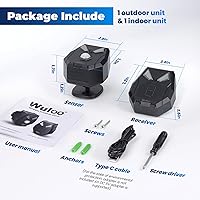
  • Included Components: Each base kit includes one outdoor sensor and one indoor receiver, with the LiPo battery pre-installed in the sensor.
  • Battery Type: The sensor uses a Lithium Polymer rechargeable cell; no disposable batteries are required for standard operation.
  • Receiver Power: The indoor receiver operates on 110V AC power, meaning it plugs into a standard North American wall outlet.
  • Compatible Uses: The system is suitable for driveways, gates, perimeter monitoring, parking areas, and both indoor and outdoor security applications.
  • Sensitivity: Sensor sensitivity is user-adjustable to reduce false triggers caused by small animals, blowing leaves, or wind movement.

Related Reviews
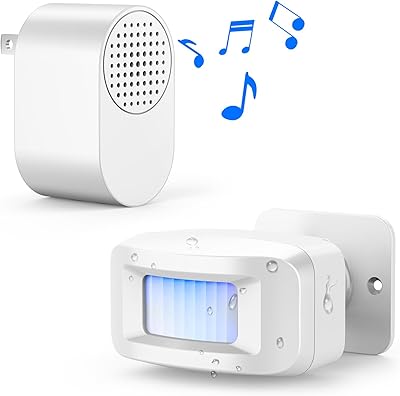
Chesbung Solar Driveway Alarm System
87%
93%
Ease of Installation
88%
Detection Range
90%
Battery Life
85%
Reliability of Motion Detection
87%
Build Quality and Durability
More
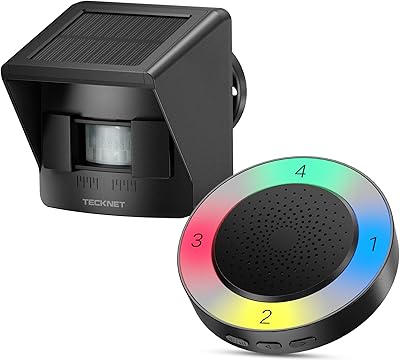
FREETIM Wireless Driveway Motion Sensor Alarm System
74%
91%
Ease of Setup
78%
Detection Reliability
67%
Wireless Range
72%
Weather Resistance
58%
Battery Life
More
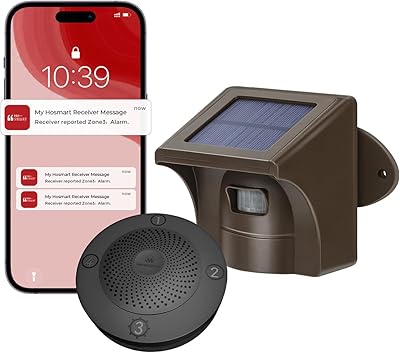
TECKNET EMD01001BA01 Solar Wireless Driveway Alarm
76%
91%
Ease of Setup
74%
Solar Charging Performance
68%
Detection Accuracy
86%
Wireless Signal Range
83%
Alert Customization
More
Qualirey Driveway Alarm Wireless Motion Sensor System
86%
92%
Value for Money
94%
Ease of Installation
89%
Range of Detection
88%
Weather Resistance
85%
Alert Customization
More
1byone Wireless Driveway Motion Sensor Alarm
71%
91%
Ease of Setup
67%
Wireless Range
63%
Detection Accuracy
88%
Alert Volume & Clarity
71%
Build Quality
More
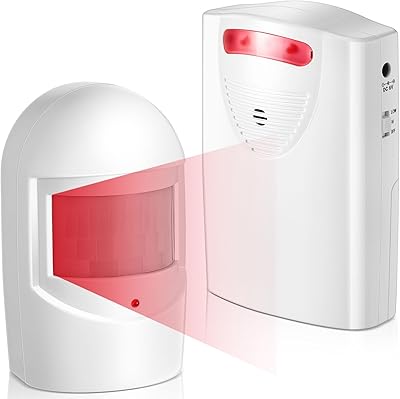
eMACROS HS002W Solar Driveway Motion Alarm
72%
83%
Solar Charging Reliability
76%
App Notification Speed
71%
Ease of Setup
62%
Motion Detection Accuracy
67%
Transmission Range
More
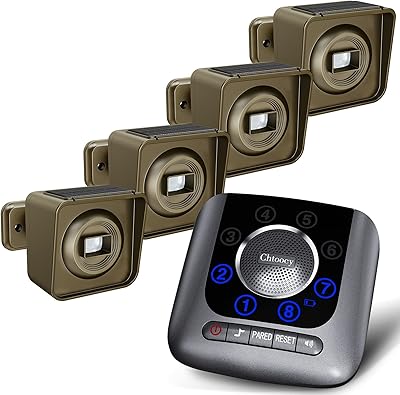
Chtoocy Solar Driveway Alarm 4 Sensors 1 Receiver
85%
88%
Value for Money
91%
Range & Detection Performance
85%
Battery Life
82%
Build Quality
89%
Weather Resistance
More
Dakota Alert DCMA-4k Plus Driveway Alarm System
75%
83%
Wireless Range
58%
False Alarm Rate
88%
Battery Life
91%
Ease of Installation
79%
Signal Reliability
More
HTZSAFE 808A Wireless Driveway Alarm System
76%
83%
Wireless Transmission Range
91%
Ease of Installation
72%
Motion Detection Accuracy
61%
Battery Life
68%
Receiver Alert Volume
More
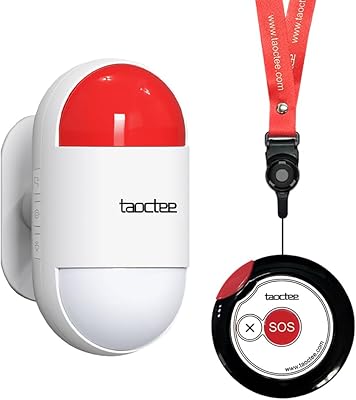
taoctee RC-P7 Wireless Panic Button Alarm
78%
83%
Alarm Volume & Loudness
66%
Wireless Range
91%
Ease of Setup
69%
Battery Life
74%
Strobe Light Effectiveness
More

FAQ

It is genuinely straightforward. Most buyers report having the sensor mounted and paired with the receiver within ten to fifteen minutes. There is no app, no account, and no wiring involved — you mount the sensor, plug in the receiver, and it is ready to go. The included quick-start guide covers the basics clearly.

It will work, but solar input does slow down during short winter days or in shaded spots. The LiPo battery is rated for up to 24 months on a full charge, so there is a decent reserve to draw from, but if your sensor location gets very little direct sun for weeks at a time, you may find the battery depletes faster than expected. Some users in northern climates top up the charge manually during the darkest months.

Honestly, yes — the half-mile figure is a best-case, open-field number. In a typical residential setting with trees, fences, or buildings between the sensor and receiver, most buyers find reliable signal closer to a third of a mile. If your driveway is shorter than that, you will be fine. If you are trying to cover a full half-mile through dense woods, this wireless motion alarm will likely fall short.

Not necessarily, but placement and sensitivity tuning matter a lot. The sensor has an adjustable sensitivity setting specifically to help with this — dialing it back usually filters out small animals and minor movement. That said, in very windy locations or near busy roadsides, some users report more false alerts than they expected even at lower sensitivity settings.

Yes, and that is genuinely one of the more practical things about this system. A single receiver can handle up to eight sensors total, and you can assign a different chime tone to each one so you always know which zone triggered. Buying an extra sensor down the road to cover a second entrance is a natural and affordable upgrade path.

In most cases, yes — Wuloo has maintained compatibility across its sensor lineup, and many users have successfully paired older sensors with the newer receiver and vice versa. That said, it is worth checking with Wuloo support directly if you have a particularly old unit, just to confirm the frequency and protocol match.

Yes. The sensor has four work modes, and one of them disables the sensor's own alarm sound so only the visual indicator activates outdoors. The indoor receiver chimes independently of whatever mode the sensor is in, so you can keep alerts quiet outside while still getting notified inside.

The sensor housing is rated weatherproof, and the majority of users report no issues through normal rain exposure. A small number of longer-term owners have noted concerns about seal integrity after a very wet season, so it is worth checking the housing periodically and ensuring it is not mounted in a spot where water pools or runs directly over it.

Yes, the receiver runs on standard 110V AC power, so it needs to stay plugged into a wall outlet to function. It is not battery-powered, which means you need a convenient outlet near where you want to hear alerts. Most people plug it in near the kitchen or front room.

The sensor is designed primarily for outdoor use and is weatherproofed accordingly, but there is nothing stopping you from mounting it inside a garage, barn, or workshop entrance if that is where you need detection. The 25-foot detection radius works the same indoors, and since it does not need direct sunlight to operate short-term, placement flexibility is reasonable.