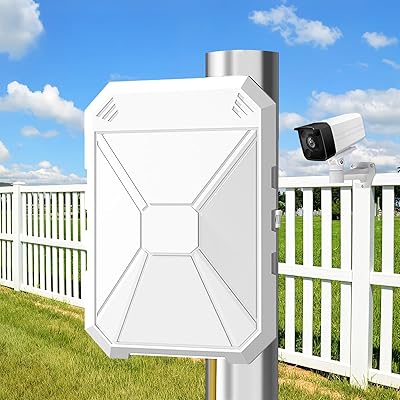
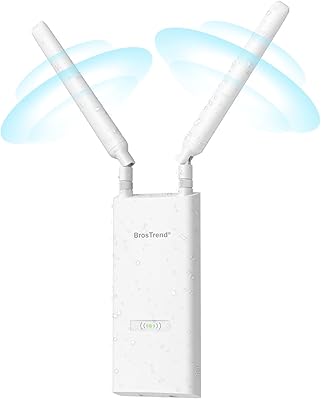
Overview

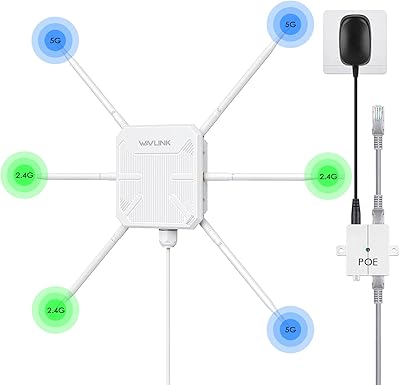
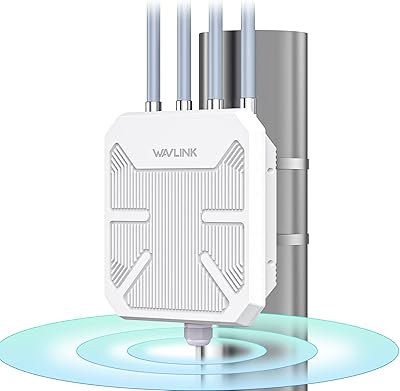
The WAVLINK WN570HP2 Outdoor WiFi Range Extender is a purpose-built outdoor wireless bridge aimed at anyone who needs to push a network signal well beyond their home or office walls. Unlike plug-and-play mesh nodes, this outdoor Wi-Fi bridge leans toward practicality over polish — it supports four operating modes (Access Point, Router, Repeater, and WISP), making it adaptable to a surprising range of network setups. Its IP65-rated enclosure and built-in lightning protection mean it can stay mounted outside year-round. Passive PoE support keeps installation straightforward by eliminating the need for a separate power outlet near the mounting point.
Features & Benefits

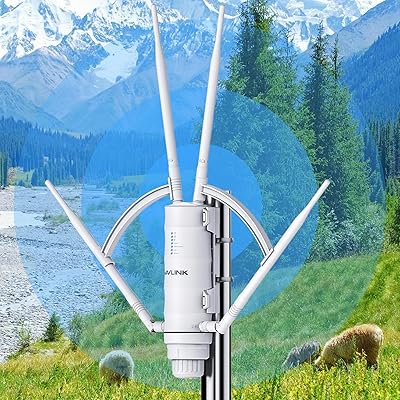
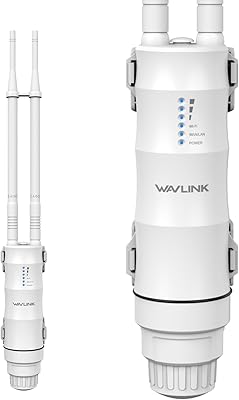
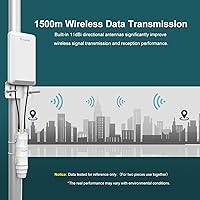
At the heart of this directional range extender are two built-in 11dBi directional antennas that concentrate the signal in one direction rather than broadcasting it everywhere. That focused approach translates to stronger coverage over longer distances — WAVLINK claims up to 1.5km in ideal open-air conditions, though real-world performance will vary considerably depending on obstacles and interference. The 24V passive PoE design is genuinely useful: one Ethernet cable handles both power and data, so you can mount the unit on a rooftop or fence post without running a separate electrical line. Worth noting: the single 2.4GHz band tops out at 300Mbps, and the Ethernet port caps at 100Mbps — adequate for cameras, but a real constraint for heavy data work.

Best For

This outdoor Wi-Fi bridge hits its stride in situations where trenching cable isn't an option but you still need a reliable wireless link across a meaningful distance. Think property owners pulling connectivity to a detached barn or garage, small businesses blanketing a parking lot with camera coverage, or installers bridging two buildings too far apart for a standard access point. It can handle up to 64 devices, comfortably covering most small-scale outdoor deployments. That said, anyone expecting effortless plug-and-play setup or dual-band throughput for video streaming will be disappointed — this directional range extender is built for deliberate, configured installations, not casual home use.

User Feedback

Across roughly 114 ratings, the WAVLINK extender holds a 4.0-star average — solid for a brand that lacks the household recognition of TP-Link or Ubiquiti. Non-technical buyers tend to appreciate how straightforward the initial setup is, with the PoE injector drawing particular praise for eliminating extra wiring. The recurring complaint, though, is range: real-world coverage often falls noticeably short of the 1.5km figure once trees, walls, or even moderate vegetation enter the picture. The 2.4GHz-only spec is another sticking point for users who need more bandwidth. On a positive note, WAVLINK's customer support earns quiet but consistent credit — a genuine differentiator that nudges confidence when buying from a lesser-known brand.

Pros

  • Passive PoE means a single Ethernet cable handles both power and data, cutting installation complexity significantly.
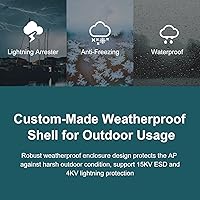
  • IP65 weatherproofing and lightning protection make this outdoor Wi-Fi bridge genuinely built for year-round outdoor exposure.
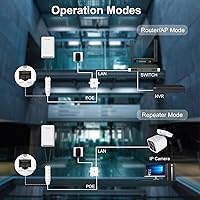
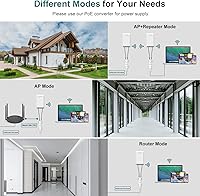
  • Four operating modes — Access Point, Router, Repeater, and WISP — give it real flexibility across different network scenarios.
  • Dual 11dBi directional antennas deliver focused, long-range signal rather than scattering it in every direction.
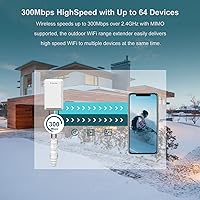
  • Supports up to 64 simultaneous devices, which is more than enough for most small outdoor deployments.
  • Installation is straightforward enough that non-technical users have completed it successfully, according to buyer feedback.
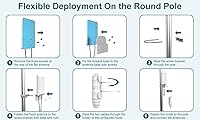
  • Compact and lightweight at just over a pound, making wall or pole mounting easy without heavy hardware.
  • WAVLINK's customer support has earned consistent praise, offering reassurance when buying from a less familiar brand.
  • The directional range extender can bridge two buildings wirelessly, eliminating the need for buried cable runs.
  • Operates across a wide temperature range, from well below freezing to high summer heat, without performance complaints.

Cons

  • Real-world range falls well short of the 1.5km marketing figure in anything other than a completely open environment.
  • The 100Mbps Ethernet port is a throughput bottleneck that limits usefulness for high-bandwidth applications.
  • Single-band 2.4GHz-only operation means more susceptibility to interference from neighboring networks and household devices.
  • The web management interface feels dated and may frustrate users accustomed to modern, app-based network tools.
  • No dual-band or Wi-Fi 5 support limits future-proofing as device ecosystems continue to demand more spectrum.
  • Point-to-point pairing requires two units, which doubles the cost for a full building-to-building wireless bridge.
  • Configuration errors during setup can result in complete loss of connectivity, which is disorienting for first-time users.
  • The 300Mbps maximum data rate is a practical constraint for anyone running multiple high-resolution camera feeds simultaneously.

Ratings

Our AI-generated scores for the WAVLINK WN570HP2 Outdoor WiFi Range Extender are based on a systematic analysis of verified global buyer reviews, with spam, incentivized, and bot-generated feedback actively filtered out before scoring. Every category below reflects the honest distribution of real user experiences — strengths are credited where earned, and frustrations are surfaced without being softened. If a score looks lower than you might expect, that is intentional: it mirrors what actual buyers encountered in the field, not what the spec sheet promises.
Wireless Range
61%
39%
In genuinely open environments — flat farmland, wide parking lots, unobstructed line-of-sight between two rooftops — buyers report impressively long usable links that would be impossible with a standard access point. For barn-to-house connections on open rural properties, the directional antennas deliver noticeably better reach than omnidirectional alternatives in the same class.
The 1.5km claim collapses quickly once real-world obstacles enter the picture. Reviewers dealing with tree lines, wooden fences, or even moderate foliage consistently report effective range dropping to a few hundred meters — and a handful of users in suburban environments found the performance only marginally better than a conventional repeater.
Installation Ease
78%
22%
The passive PoE setup earns consistent praise because it eliminates what is usually the most frustrating part of any outdoor install: finding a power source at the mounting point. Running a single Ethernet cable from an indoor PoE injector to the unit on a fence post or eave keeps the job clean, and non-technical buyers specifically call out how approachable the process felt.
Configuration still requires comfort with a browser-based admin interface and a basic understanding of networking concepts like IP addressing and operating modes. Users who expected a smartphone app or a guided plug-and-play experience ran into friction, and a few reported locking themselves out of the interface during initial setup.
Build Quality & Weatherproofing
83%
The IP65-rated housing handles sustained rain and dust without complaint across multiple buyer reports, and the unit's temperature tolerance from well below freezing to well above summer peaks makes it genuinely suitable for year-round outdoor deployment. Several reviewers noted the housing feels solid and purposeful rather than cheap, which matters when it is going on a rooftop or barn wall.
A small number of buyers raised concerns about the longevity of the exterior connectors and cable entry points after prolonged exposure to UV light and coastal humidity. The unit lacks any explicit UV-resistance rating, and a few long-term reviewers noticed cosmetic degradation of the casing over a year or more in direct sunlight.
Throughput & Speed
53%
47%
For the specific tasks this outdoor Wi-Fi bridge was designed around — connecting IP cameras, keeping a remote terminal online, sharing a basic internet connection to a detached building — 300Mbps on 2.4GHz is workable. Buyers using it for a handful of low-resolution security cameras or basic web browsing at a workshop report it holds up without dropouts.
The 100Mbps Ethernet port is the hard ceiling, and it shows when anyone tries to push real bandwidth through the link. Modern IP camera systems running multiple high-resolution streams, NAS-to-NAS transfers, or cloud backup jobs hit that wall fast. The single-band 2.4GHz spec also makes it vulnerable to crowded airspace in suburban or light-industrial areas.
Value for Money
74%
26%
Relative to hiring a contractor to trench cable between two buildings, or buying into a more expensive enterprise-grade outdoor bridge system, this directional range extender represents a genuinely cost-effective option for small-scale deployments. Buyers who matched the product to the right use case — modest bandwidth, modest distance, open environment — consistently feel it delivered fair value.
Those who bought it expecting performance closer to higher-tier outdoor networking gear were disappointed, and the single-band limitation feels harder to justify as dual-band outdoor options become available at comparable prices. Buyers needing two units for a proper bridge link also find the total outlay climbs faster than the individual price suggests.
Signal Stability
69%
31%
In fixed, line-of-sight point-to-point setups where the antennas are properly aligned, buyers report stable connections that hold without frequent dropouts or renegotiation. For static applications like a permanently mounted camera feed, the directional focus of the antennas helps maintain a steady link once calibrated.
Stability degrades noticeably when the environment changes — seasonal foliage growth, vehicles parking in the signal path, or even shifting weather conditions have caused link drops in buyer reports. The 2.4GHz band's susceptibility to interference from neighboring networks adds another variable that can introduce instability in denser areas.
Web Interface & Configuration
62%
38%
The management interface is logically laid out and covers the necessary configuration options clearly enough for users with basic networking familiarity. The four-mode selection is presented straightforwardly, and buyers who have configured a home router before typically navigate setup without needing to consult outside resources.
The interface design feels dated compared to modern consumer networking dashboards, and several reviewers flagged a lack of advanced diagnostics that would help with troubleshooting range or alignment issues. Mobile browser compatibility is inconsistent, which matters when you are on a ladder trying to fine-tune settings during physical installation.
Antenna Performance & Directionality
77%
23%
The dual 11dBi directional MIMO setup genuinely focuses energy where it is needed, and buyers who took the time to align the unit carefully before final mounting report a clear improvement over conventional omnidirectional extenders. For point-to-point scenarios in open conditions, the antenna design is one of the unit's strongest assets.
Directionality is a double-edged characteristic — buyers who needed broader coverage across an irregular outdoor area found the focused beam unhelpful and sometimes counterproductive. Alignment sensitivity also means that a slightly off-axis mount, especially after wind movement or bracket settling, can meaningfully degrade performance.
PoE Implementation
81%
19%
The 24V passive PoE design is practical and well-executed for this application. Including the PoE injector in the box means buyers are not left sourcing compatible hardware separately, and the ability to power the unit through a standard Ethernet run genuinely simplifies outdoor deployments where conduit runs for power would otherwise be required.
Passive PoE is not compatible with active PoE switches, which means users who assumed they could power the unit directly from a PoE-capable network switch were caught off guard. A few buyers who tried to use it with 802.3af or 802.3at switches reported the unit failing to power on until they switched to the included injector.
Multi-Device Handling
66%
34%
A 64-device ceiling is generous for the outdoor use cases this extender targets, and buyers running small camera networks or connecting a handful of devices at a remote workshop report no congestion issues at normal load levels. For dedicated point-to-point links with limited connected endpoints, device capacity is a non-issue.
The theoretical limit means little when total bandwidth is constrained to 300Mbps on a shared 2.4GHz channel. Buyers who connected more than a dozen active devices simultaneously — particularly in outdoor event or job-site scenarios — reported noticeable slowdowns that had less to do with device count and more to do with total throughput saturation.
Mounting & Physical Design
76%
24%
The compact form factor and low weight make single-person mounting straightforward, and the unit's flat panel profile keeps wind load manageable on exposed outdoor brackets. Buyers mounting it under eaves or on wooden poles report the included hardware is adequate for most typical scenarios.
The mounting kit is basic, and buyers installing the unit on metal posts, masonry walls, or in high-wind environments often needed to source more robust brackets independently. The cable entry point design also received criticism for requiring additional weatherproofing tape to feel fully sealed in driving rain conditions.
Brand Trust & Support
71%
29%
WAVLINK's customer support team earns more positive mentions in buyer reviews than you might expect from a lesser-known brand, with several reviewers specifically calling out responsive email support that helped them work through configuration issues post-purchase. The lifetime technical support commitment, beyond the one-year hardware warranty, is a meaningful differentiator.
WAVLINK does not carry the ecosystem reputation of established networking brands, which creates a layer of hesitation for buyers making decisions on equipment that will live outdoors and be difficult to replace quickly. Firmware update frequency and long-term software support remain open questions that more cautious buyers have flagged.
Compatibility
68%
32%
The browser-based configuration approach means the WAVLINK extender works with routers and network hardware from any brand without requiring proprietary apps or cloud accounts. Buyers integrating it into existing mixed-brand home or small-business networks report no compatibility friction at the network level.
The passive PoE requirement creates compatibility headaches for buyers with existing active PoE infrastructure, as noted in multiple reviews. There is also no mobile app, which limits management options and makes remote configuration changes more cumbersome than users accustomed to app-controlled networking gear would prefer.

Suitable for:

The WAVLINK WN570HP2 Outdoor WiFi Range Extender is a strong fit for anyone who needs to push a network signal across a meaningful outdoor distance without digging trenches or running new electrical lines. Property owners trying to get reliable connectivity to a detached garage, barn, workshop, or shed will find the combination of directional antennas and passive PoE particularly practical — one cable does the whole job. It also makes real sense for small businesses that rely on outdoor IP cameras or access control systems spread across a parking lot or campus, where a traditional access point simply cannot reach. Installers who need a clean point-to-point wireless link between two nearby buildings will appreciate the multiple operating modes, which offer more configuration flexibility than most consumer-grade options at this price. If your environment is relatively open and your bandwidth needs are modest — streaming a few camera feeds, sharing files, or keeping a remote workstation online — this outdoor Wi-Fi bridge can handle it without fuss.
Not suitable for:

The WAVLINK WN570HP2 Outdoor WiFi Range Extender is not the right tool if you need high throughput for modern, bandwidth-intensive tasks like 4K video streaming, large file transfers, or cloud backups running in parallel. The single 2.4GHz band with a 300Mbps ceiling and a 100Mbps Ethernet port create hard limits that no amount of placement or configuration will overcome. Buyers who expect the full 1.5km range claim to hold up in typical real-world conditions — with trees, fences, or neighboring buildings in the way — are likely to be disappointed. It also is not a good match for anyone who wants a plug-and-play experience comparable to a consumer mesh system; the web interface requires some comfort with network concepts, and setup mistakes can mean no connectivity at all. Finally, if brand familiarity and an established support ecosystem matter to you, WAVLINK's relative obscurity may feel like a risk, even with a one-year warranty in place.
Specifications

  • Brand: Manufactured by WAVLINK, a networking hardware company offering a range of routers, extenders, and wireless access points.
  • Model: The model number is WN570HP2, also referenced by WAVLINK as RCAMUS-WN570HP2-FBA for retail fulfillment.
  • Wireless Standard: Operates on the 802.11n (Wi-Fi 4) protocol, providing broad compatibility with older and current network infrastructure.
  • Frequency Band: Single-band 2.4GHz only, which offers longer range and better wall penetration but lower peak throughput than dual-band devices.
  • Max Data Rate: Delivers a maximum wireless data transfer rate of 300Mbps under optimal conditions on the 2.4GHz band.
  • Antennas: Equipped with two built-in 11dBi directional MIMO antennas designed to focus and concentrate the wireless signal along a specific axis.
  • Claimed Range: WAVLINK rates maximum wireless transmission range at up to 1.5km in a clear, unobstructed environment during point-to-point pairing.
  • Ethernet Port: Features a single 100Mbps Fast Ethernet port for wired network connection, which acts as the practical throughput ceiling for data transfer.
  • Power Input: Powered via 24V passive Power over Ethernet (PoE), allowing a single Ethernet cable to supply both power and network connectivity simultaneously.
  • Operating Modes: Supports four configurable modes: Access Point, Router, Repeater, and WISP, covering a wide range of deployment scenarios.
  • Device Capacity: Can support up to 64 wirelessly connected devices simultaneously, suitable for small-to-medium outdoor network deployments.
  • Waterproof Rating: Carries an IP65 ingress protection rating, meaning it is fully dust-tight and protected against direct water jets from any direction.
  • Temperature Range: Rated for continuous operation in ambient temperatures ranging from -22°F to 158°F (-30°C to 70°C).
  • Lightning Protection: Built-in surge protection rated at 15KV ESD and 4KV to guard against voltage spikes caused by nearby lightning strikes.
  • Dimensions: The unit measures 7.8 x 3 x 2 inches, making it compact enough for pole or wall mounting without requiring heavy mounting brackets.
  • Weight: Weighs 1.11 pounds, which is light enough for straightforward single-person installation on a standard outdoor mount.
  • Warranty: Backed by a one-year manufacturer warranty, with WAVLINK offering ongoing lifetime technical support beyond the warranty period.
  • ASIN: Listed on Amazon under ASIN B09SG9K11B, first made available for purchase in April 2022.

Related Reviews

WAVLINK WN588HX3 WiFi 6 Outdoor Access Point
75%
83%
Outdoor Signal Range
91%
Build Quality & Weatherproofing
78%
Installation & Mounting
61%
Setup & Configuration Experience
86%
WiFi 6 Performance
More
WAVLINK WN572HP3 AC1200 Outdoor WiFi Extender
72%
78%
Outdoor Signal Range
71%
Ease of Setup
66%
PoE Implementation
73%
Build Quality & Weatherproofing
74%
Dual-Band Performance
More
WAVLINK WN573HX1 AX1800 Outdoor WiFi 6 Access Point
80%
92%
Weather Resistance & Durability
84%
WiFi Range & Signal Strength
81%
Installation & Setup
61%
Configuration Interface (UI/UX)
86%
WiFi 6 Performance & Speed
More
WAVLINK AC600 Outdoor WiFi Extender
76%
86%
Build Quality
89%
Weather Resistance
91%
PoE Installation
72%
Signal Range
61%
Throughput & Speed
More
TODAAIR Outdoor N300 WiFi Extender
65%
78%
Weatherproof Durability
63%
Signal Range
74%
Ease of Setup
51%
Real-World Speed
67%
Build & Hardware Quality
More
INEAUTO AC1200 Outdoor WiFi Extender
75%
91%
Weather Durability
88%
PoE Installation
83%
Signal Range
62%
Setup & Configuration
78%
Throughput Performance
More
BrosTrend AC1200 Outdoor WiFi Extender
79%
91%
Weather Durability
74%
Signal Coverage
82%
Ease of Installation
78%
Value for Money
86%
Build Quality
More
NETGEAR EX6120 WiFi Range Extender
74%
83%
Ease of Setup
76%
Signal Coverage
61%
Connection Speed
79%
Value for Money
58%
5GHz Band Performance
More
rockspace AC1200 WiFi Range Extender
72%
79%
Value for Money
88%
Ease of Setup
71%
Signal Coverage
57%
Real-World Speed
61%
Connection Stability
More
TODAAIR AC1200 WiFi Range Extender
82%
88%
Wireless Coverage
85%
Dual-Band Performance
90%
Setup & Installation
82%
Device Capacity
80%
Speed Consistency
More

FAQ

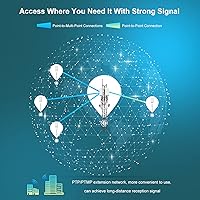
Yes, if your goal is a true point-to-point wireless bridge between two buildings, you need one unit at each end. A single unit can extend or repeat an existing signal, but a dedicated building-to-building link requires a matched pair.

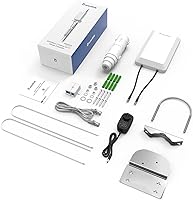
Passive PoE means the unit receives both power and network data through a single Ethernet cable, with no need for a separate power outlet at the mounting location. WAVLINK includes a PoE injector in the box, so you plug that into a standard outlet indoors, connect your router to it, and run a single cable out to the unit — no electrician required.

Treat the 1.5km figure as a best-case ceiling, not a reliable real-world expectation. That number assumes a completely open, unobstructed line of sight between two paired units. In practice, trees, fences, buildings, and even heavy foliage can cut effective range significantly — many users see solid performance at a few hundred meters, but plan your setup with that in mind rather than counting on the maximum spec.

Yes, the WAVLINK WN570HP2 Outdoor WiFi Range Extender is brand-agnostic and will work with routers from TP-Link, Netgear, ASUS, or any other standard brand. You configure it through a browser-based web interface, not a proprietary app, so compatibility is broad.
Absolutely — this is one of its strongest use cases. The directional antennas and PoE power delivery make it well suited for pushing a network signal to IP cameras mounted on outbuildings, fence lines, or across a parking lot. Just keep in mind that the 100Mbps Ethernet port limits total throughput, so plan your camera count and resolution accordingly.

Setup is more involved than a consumer mesh node, but many non-technical users have completed it successfully by following the included guide. You access configuration through a web browser by typing in the unit's IP address, then walk through a setup wizard. If you've ever logged into a home router to change a password, you'll likely manage fine. If you've never done anything like that, expect a short learning curve.

The IP65 rating means it handles rain, sleet, and dust without issue under normal outdoor conditions. The temperature rating covers genuinely harsh winters down to -22°F, and the built-in surge protection adds a layer of resilience against electrical storms. Users in cold climates have reported reliable operation through winter seasons without any housing or performance issues.

No — this is a single-band 2.4GHz device only. If you need 5GHz support for faster speeds or less interference, you'll need to look at a different product. The 2.4GHz band is a deliberate choice here because it travels farther and penetrates obstacles better, which suits the long-range outdoor use case, but it does come with a throughput trade-off.

Each unit has its own individual browser-based management interface, so there is no centralized dashboard that controls all units simultaneously. For a point-to-multipoint setup with up to four units, you'd configure and manage each one separately. It's workable for small deployments but would feel cumbersome at scale.

WAVLINK offers what they describe as lifetime technical support, meaning you can still reach out to their support team for help with configuration questions or troubleshooting even after the warranty period ends. Hardware replacements after the first year would be at your own cost, but the ongoing support access is a genuine plus compared to brands that cut contact once the warranty lapses.