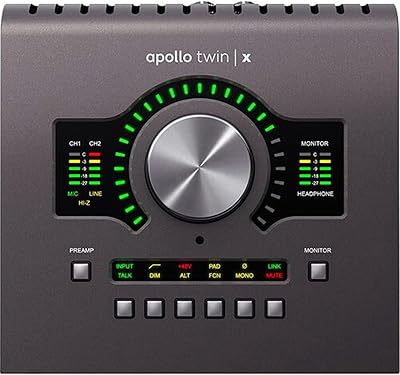
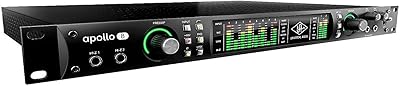
Overview

The Universal Audio Apollo x8 Heritage Edition Interface is UA's top-tier Thunderbolt 3 audio interface, built for serious home studio operators and professional engineers who want high-caliber conversion and DSP power in a single rack unit. What separates the Heritage Edition from the standard x8 is a curated UAD plug-in bundle added on top — a meaningful head start for producers building out their toolkit. One hard boundary to flag upfront: this is a Mac-only device. Thunderbolt 3 exclusivity and LUNA compatibility mean Windows users should look elsewhere. The 18-in/24-out I/O and 2U rack-mount form factor reflect UA's professional studio pedigree, built over decades of respected hardware development.
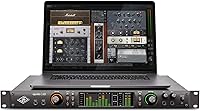
Features & Benefits

At the core of this Apollo interface is 24-bit/192kHz conversion that captures audio with the kind of depth and clarity that holds up under heavy mixing and mastering scrutiny. Six onboard UAD DSP chips — the HEXA Core setup — let you run processor-hungry plug-ins in real time with near-zero latency, even at lower buffer sizes where most interfaces start straining. The Unison preamp technology on all four mic inputs emulates Neve, API, SSL, and Manley circuits at the hardware level, not just in software. The Heritage bundle adds the UA 610-B, classic LA-2A, 1176, Pultec EQ, Marshall Plexi, and more — essential studio tools for tracking and mixing. Surround monitoring up to 7.1 rounds out a serious feature set.

Best For

UA's flagship x8 is most at home in a Mac-based professional studio where the engineer wants to consolidate preamp emulation, DSP processing, and conversion quality without filling a rack with outboard hardware. It's a strong match for producers already building their workflow around UAD plug-ins who need a platform with enough DSP headroom to run several simultaneously during a session. Post-production composers will appreciate the 7.1 surround monitoring capability, which few interfaces at any tier support. If you're upgrading from a smaller Apollo — say, an x4 or Twin — this Apollo interface offers a logical, compatible path forward. The Heritage bundle also shortens the ramp-up time for anyone starting fresh in the UA ecosystem.

User Feedback

With 27 ratings and a 3.9 out of 5 average on Amazon, the sample size here is modest — draw broad conclusions carefully. That said, existing feedback paints a fairly consistent picture. Buyers who rely on this Apollo interface daily tend to praise the conversion quality and the authenticity of the Unison preamp emulations, describing them as noticeably closer to real hardware than competing software options. The Heritage bundle reads as a practical bonus rather than a marketing afterthought. On the critical side, Mac-only exclusivity surfaces repeatedly, and some buyers flag the ongoing cost of expanding a UAD plug-in library, noting the ecosystem can feel like a significant long-term financial commitment beyond the initial purchase.

Pros

  • Class-leading 24-bit/192kHz conversion holds up under serious mixing and mastering scrutiny.
  • Six onboard UAD DSP chips handle real-time plug-in processing without taxing your Mac's CPU.
  • Unison preamp emulations of Neve, API, SSL, and Manley circuits feel genuinely close to the real hardware.
  • The Heritage plug-in bundle includes workhorse tools like the LA-2A, 1176, and Pultec EQ right out of the box.
  • 18-in/24-out I/O gives you the routing flexibility a busy studio session actually demands.
  • Surround monitoring up to 7.1 is a rare and practical feature for post-production and scoring work.
  • Expandable to four Thunderbolt Apollos, so it grows with your studio rather than becoming a bottleneck.
  • Selectable +24/+20 dBu headroom makes integration with professional consoles straightforward.
  • LUNA Recording System offers a tightly integrated recording environment for producers who want everything in one place.

Cons

  • Mac-only compatibility via Thunderbolt 3 completely locks out Windows users with no workaround.
  • The UAD plug-in ecosystem requires ongoing purchases beyond the included bundle, adding long-term cost.
  • Only 27 Amazon ratings makes it difficult to gauge reliability and long-term satisfaction with confidence.
  • Setup complexity and UA software dependencies can frustrate engineers who prefer minimal software overhead.
  • Four Unison preamp inputs may feel limiting for larger live-to-tape sessions requiring more simultaneous mic channels.
  • The Heritage Edition bundle, while useful, does not cover every genre or production style equally well.
  • Thunderbolt dependency means older or non-Thunderbolt Macs require an adapter, adding potential compatibility headaches.

Ratings

The Universal Audio Apollo x8 Heritage Edition Interface earns its scores below from AI-driven analysis of verified buyer reviews worldwide, with spam, bot, and incentivized feedback actively filtered out before scoring. Ratings reflect both the genuine strengths this Apollo interface delivers to serious Mac-based studios and the real friction points that surface in day-to-day ownership. Nothing here is softened — where buyers consistently hit walls, the scores reflect it.

Conversion Quality
93%
Users with critical ears consistently single out the A/D and D/A conversion as a standout strength, noting that recordings retain a sense of depth and air that holds up under heavy mixing and mastering. Engineers tracking vocals and acoustic instruments report a noticeable step up from mid-tier interfaces in the same workflow.
At 24-bit/192kHz, the conversion ceiling is effectively as high as any working studio needs — but a small number of users note that fully appreciating the difference requires high-quality monitoring and well-treated rooms, meaning the gains can be harder to hear in less optimized environments.
DSP Performance
91%
The HEXA Core engine is where this Apollo interface genuinely separates itself from the competition. Producers running dense sessions with multiple compressor and EQ instances report that the DSP headroom rarely becomes a bottleneck, even during complex mixing passes with UAD-heavy signal chains.
DSP allocation is a finite resource, and users who lean on the most demanding UAD plug-ins — certain convolution reverbs or amp simulators — find they can exhaust headroom faster than expected. Monitoring DSP usage in UA's Console app becomes a regular habit rather than an occasional check.
Preamp Emulation
89%
Unison technology draws consistent praise from engineers who track live instruments and vocals, because the impedance and gain-staging characteristics of the physical preamp circuit actually shift to match the target emulation. Users describe the Neve and API settings in particular as feeling convincingly close to the real hardware response.
The four available Unison inputs can feel limiting during larger live-to-tape sessions where five or more simultaneous mic channels are needed. Some users also note that fully unlocking the most sought-after preamp emulations requires purchasing additional UAD titles beyond what ships in the Heritage bundle.
Heritage Plug-in Bundle
82%
18%
For producers starting fresh in the UA ecosystem, the Realtime Analog Classics Plus bundle provides an immediately useful set of tools — the LA-2A and 1176 compressors alone are staples across nearly every genre, and the Pultec EQ and UA 610-B cover a wide range of tonal shaping needs from day one.
The bundle is a strong starting point, not a complete toolkit. Engineers working in niche areas like heavy guitar production or orchestral scoring will quickly find gaps and face additional UAD purchases. Buyers who already own several of the included titles gain little incremental value from choosing the Heritage Edition over the standard x8.
Ecosystem & Software Integration
71%
29%
For committed Mac users, the integration between the hardware, UA's Console software, and LUNA creates a cohesive recording environment where routing, monitoring, and plug-in management all live in one logical place. Users already working in the UA ecosystem find expanding to this interface practically frictionless.
The closed nature of the UA ecosystem is a genuine frustration for some buyers. Console software adds a layer of complexity that simpler interfaces don't have, and users new to UAD hardware often report a steep initial learning curve before their first session runs cleanly. Updates occasionally introduce driver instability that requires troubleshooting.
Mac-Only Compatibility
44%
56%
For Mac users with modern Thunderbolt 3 ports, connectivity is clean and reliable. The Thunderbolt backward compatibility with TB1 and TB2 via adapter gives owners of slightly older Mac hardware a practical path to use the interface without immediately upgrading their entire setup.
The hard Mac-only limitation is the single most common complaint in buyer feedback and the clearest dealbreaker in this product category. Windows users who discover this limitation after purchase or after researching the interface extensively express significant frustration, and there is no roadmap or workaround that changes this restriction.
Build & Hardware Quality
88%
The 2U rack-mount chassis feels solidly constructed and purpose-built for permanent studio installation. Front panel controls including the Alt Speaker switching, Talkback mic, and Dim function are laid out logically and respond with the tactile confidence users expect at this price tier.
A small number of users flag that the unit runs warm during extended sessions, which is worth considering for rack builds with limited ventilation. The rackmount-only form factor also means it is not a practical option for producers who need a portable interface for location recording or travel sessions.
Latency Performance
87%
Near-zero latency monitoring through UAD preamp emulations is a meaningful practical advantage during tracking sessions. Singers and instrumentalists who need to hear themselves through processed signal — compression, EQ, reverb — while recording report that the monitoring response feels immediate and does not disrupt their performance.
The near-zero latency applies specifically to monitoring through UA's Console routing. DAW roundtrip latency is still subject to the audio buffer size set in the host application, which means latency-sensitive MIDI and software instrument work still requires careful buffer management like any other interface.
I/O Flexibility
84%
The 18-in/24-out configuration gives engineers enough routing headroom for complex studio setups involving outboard gear, multiple speaker systems, and hardware inserts. The switchable +24/+20 dBu headroom setting simplifies integration with professional mixing consoles and tape machines without the need for external level matching equipment.
While the channel count is generous for a single-unit interface, engineers running large-format sessions with many simultaneous inputs will still need to expand via additional Apollos or digital expanders over ADAT or S/PDIF. Four physical Unison preamp inputs are the ceiling without adding external preamps.
Surround Monitoring
79%
21%
Built-in support for surround monitoring up to 7.1 is a genuinely useful capability that few interfaces at any price point offer natively. Post-production engineers and film composers managing surround deliverables appreciate not needing a dedicated external monitor controller to handle format switching.
This feature serves a specific subset of users — primarily post-production and scoring professionals — and adds little practical value for producers working exclusively in stereo. Those expecting to use it will need to invest time configuring the routing correctly in Console, which is not immediately intuitive for first-time surround users.
Value for Money
63%
37%
For Mac-based engineers who will actively use the Heritage plug-in bundle and rely on UAD plug-ins as a core part of their mixing workflow, the all-in value proposition is legitimate. The DSP processing power and conversion quality represent a long-term investment that holds its relevance across multiple studio upgrade cycles.
The ongoing cost of expanding a UAD plug-in library catches many buyers off guard after the initial purchase. At a premium price tier, some users feel the Mac-only restriction and ecosystem lock-in represent a significant hidden cost beyond the hardware itself, particularly when competitive interfaces offer more platform flexibility at lower price points.
Setup & Onboarding
66%
34%
Users with prior experience on Apollo hardware or other professional interfaces tend to get up and running within a single session. UA provides detailed documentation and an active support community, and the Console software is logically organized once its routing model clicks into place.
First-time UA hardware users consistently report a steeper-than-expected setup curve, particularly around understanding how Console, the DAW, and UAD plug-in routing interact. Driver updates have occasionally introduced compatibility issues that require rollback or support intervention, which is a real friction point for users mid-project.
Expandability
86%
The ability to chain up to four Thunderbolt Apollos and six total UAD devices gives this Apollo interface meaningful long-term headroom for studios that expect to grow. Users who start with UA's flagship x8 and later add an Apollo 8p or an Satellite for additional DSP report that the system integrates cleanly and scales predictably.
Expansion requires additional Thunderbolt-equipped hardware, which adds meaningful cost at each step. Users on tighter budgets who anticipate needing more I/O or DSP sooner than later may find the total system cost climbs quickly, and each additional device requires its own Thunderbolt port or a supported hub configuration.

Suitable for:

The Universal Audio Apollo x8 Heritage Edition Interface is built for Mac-based producers and engineers who want to consolidate serious conversion quality, hardware-level preamp emulation, and real-time DSP processing into a single rack unit. If you're running a professional or semi-professional home studio on a Mac and you've been eyeing UAD plug-ins as a core part of your workflow, this Apollo interface is designed precisely for that setup. The HEXA Core DSP means you can stack multiple processor-intensive plug-ins during tracking and mixing sessions without choking your computer's CPU. Post-production composers and film scorers will find genuine value in the 7.1 surround monitoring support, which is rare at any tier. Those already working within the UA ecosystem — perhaps upgrading from a smaller Apollo — will slot this in without disruption, and the included Heritage plug-in bundle gives newcomers a meaningful library of classic tools to start with rather than an empty slate.

Not suitable for:

Windows users should stop here: the Universal Audio Apollo x8 Heritage Edition Interface runs exclusively on Mac via Thunderbolt 3, and no firmware update or workaround changes that reality. If your studio is PC-based, this interface is simply not an option regardless of how appealing the specs look on paper. Budget-conscious buyers should also think carefully — the upfront cost is significant, and the UAD plug-in ecosystem operates on an ongoing purchase model, meaning the included bundle is a starting point, not a complete solution. Engineers who prefer a straightforward plug-and-play interface with minimal software overhead may find the UA ecosystem's learning curve and software dependencies more friction than they bargained for. If you only need basic I/O for a simple recording setup, the processing power here is more than you'll ever use, and the investment won't make practical sense.

Specifications

  • Interface Type: Thunderbolt 3 audio interface, backward compatible with Thunderbolt 1 and 2 on Mac via adapter.
  • I/O Count: 18 inputs and 24 outputs provide extensive routing flexibility for complex studio setups.
  • Bit Depth & Rate: Records and plays back at up to 24-bit/192kHz for high-resolution audio capture and reproduction.
  • DSP Engine: HEXA Core processing uses 6 UAD DSP chips to run UAD plug-ins in real time with near-zero latency.
  • Unison Preamps: 4 Unison-enabled mic/line preamp inputs offer hardware-level emulation of classic preamp circuits.
  • Surround Support: Onboard surround monitor controller supports formats up to 7.1 for post-production and film scoring work.
  • Headroom Settings: Switchable +24 dBu and +20 dBu operating levels allow direct integration with professional mixing consoles and outboard gear.
  • Plug-in Formats: UAD Powered Plug-Ins run via VST, Audio Units, and AAX 64 across all major DAWs.
  • Included Software: LUNA Recording System is included as a fully integrated Mac-only recording application optimized for Apollo hardware.
  • Heritage Bundle: Realtime Analog Classics Plus bundle includes the UA 610-B Tube Preamp, Pultec EQ, LA-2A, 1176, Marshall Plexi Classic, Ampeg SVT-VR Classic, and additional titles.
  • Expandability: Up to 4 Thunderbolt-equipped Apollo interfaces and 6 total UAD devices can be combined in a single system.
  • Operating System: Mac only; no Windows support is available due to Thunderbolt and LUNA software dependencies.
  • Form Factor: 2U rack-mount chassis designed for installation in a standard equipment rack or desktop rack shelf.
  • Model Number: Official model identifier is APX8-HE, distinguishing it from the standard Apollo x8 (APX8).
  • Front Panel Controls: Includes Alt Speaker switching, a Talkback microphone input, and assignable Dim or Mono monitoring functions.
  • Connectivity: Connects to Mac via a single Thunderbolt 3 cable, which carries both audio data and device power negotiation.
  • Amazon Rating: Currently holds a 3.9 out of 5 rating based on 27 Amazon customer ratings as of available data.

Related Reviews

Universal Audio Apollo Solo Heritage Edition
87%
96%
Audio Conversion Quality
93%
Build Quality & Durability
89%
DSP Processing Performance
94%
Unison Preamp Integration
82%
Software Ecosystem & LUNA
More
Universal Audio Apollo x4 Heritage Edition Audio Interface
80%
93%
Preamp Quality
91%
Conversion Quality
89%
DSP Performance
78%
Value for Money
88%
Build Quality
More
Universal Audio Apollo x8p Heritage Edition Audio Interface
83%
94%
Conversion Quality
91%
Preamp Emulation Accuracy
89%
DSP Performance
86%
Build & Hardware Quality
71%
Software & Driver Stability
More
Universal Audio Apollo x6 Heritage Edition Interface
76%
94%
Audio Conversion
91%
DSP Processing
93%
Preamp Emulation
71%
Value for Money
33%
Platform Compatibility
More
Universal Audio Apollo Twin MkII Heritage Edition
86%
93%
Audio Performance
94%
Build Quality
88%
UAD Plug-in Bundle
90%
Latency & Tracking
72%
Software Compatibility
More
Universal Audio Apollo Twin USB Heritage Interface
79%
91%
Audio Conversion Quality
86%
UAD DSP Performance
88%
Preamp Quality
71%
Windows Compatibility
74%
Value for Money
More
Universal Audio Apollo Twin X QUAD Interface
81%
93%
Audio Conversion Quality
88%
DSP Performance
91%
Preamp Quality
74%
Value for Money
86%
Build Quality
More
Universal Audio Apollo Twin X DUO Interface
79%
93%
Sound Quality
91%
Preamp Quality
74%
DSP Performance
81%
Value for Money
57%
Platform Compatibility
More
Universal Audio Apollo X16 Audio Interface
82%
94%
Conversion Quality
91%
UAD DSP Performance
89%
Build & Hardware Quality
92%
Low-Latency Tracking
88%
I/O Flexibility
More
Universal Audio Apollo 8 QUAD Audio Interface
79%
93%
Preamp Quality
91%
DSP Performance
89%
Audio Conversion
92%
Build Quality
74%
Software & Console 2.0
More

FAQ

No, it does not. The Apollo x8 Heritage Edition relies on Thunderbolt 3 and the LUNA software ecosystem, both of which are Mac-only. If your studio runs Windows, this interface is not compatible regardless of whether your PC has a Thunderbolt port.

The Realtime Analog Classics Plus bundle ships with the UA 610-B Tube Preamp, the legacy Pultec EQ, LA-2A and 1176 compressors, the Marshall Plexi Classic guitar amp emulation, and the Ampeg SVT-VR Classic bass amp, among others. These are genuine UAD plug-ins that run on the onboard DSP — not lite or time-limited versions.

The core hardware is identical between the two. The Heritage Edition simply includes the Realtime Analog Classics Plus UAD plug-in bundle pre-licensed, which adds meaningful value if those are tools you would have purchased anyway. If you already own those plug-ins, the standard x8 may make more financial sense.

Yes. The Universal Audio Apollo x8 Heritage Edition Interface is backward compatible with Thunderbolt 1 and 2 on Mac when using the appropriate Apple-certified adapter. Performance should remain solid, though you'll want to confirm adapter compatibility with your specific Mac model.

That depends on the DSP load of each plug-in, but the six-chip HEXA Core engine offers considerably more headroom than earlier Apollo models. Lighter plug-ins like EQs can stack easily; more demanding emulations like certain reverbs or amp sims will consume more DSP per instance. UA's Console software shows real-time DSP usage so you can monitor headroom during sessions.

LUNA is optional. This Apollo interface works with any major DAW that supports VST, Audio Units, or AAX 64 plug-in formats, including Pro Tools, Logic Pro, Ableton Live, and Cubase. LUNA is an additional recording environment UA offers for Mac users who want a tightly integrated workflow, but it is not required.

There is a learning curve, particularly around UA's Console software, which handles monitoring, preamp emulation routing, and DSP allocation separately from your DAW. Most experienced engineers find it logical after a session or two, but if you've only ever used simpler plug-and-play interfaces, expect to spend some time in the documentation before your first session runs smoothly.

Yes. You can combine up to four Thunderbolt-equipped Apollo interfaces and up to six total UAD devices in a single Mac-based system. This makes the x8 a reasonable long-term foundation if you anticipate needing more I/O or DSP capacity as your studio grows.

Unison preamp emulation is genuinely useful if you track through the interface rather than recording dry and processing later. The technology adjusts the hardware impedance and gain characteristics of the physical preamp circuit to match the target emulation — so a Neve 1073 setting isn't just an EQ curve applied after the fact. Engineers who track vocals and instruments live tend to get the most out of it.

Treat the 3.9 out of 5 rating as a rough indicator rather than a firm verdict. Twenty-seven ratings is a small sample for a product at this price tier, and a single outlier review can shift the average noticeably. It's worth cross-referencing with reviews on dedicated audio forums and gear sites like Sweetwater or Gearslutz, where the UA Apollo line has a much larger and more detailed feedback base.

Where to Buy