Overview

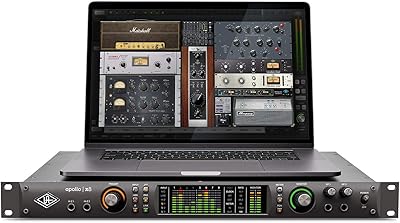
The Universal Audio Apollo X16 Audio Interface is a 1U rackmount unit built for professional studios and post-production environments that have outgrown consumer-grade I/O. Launched in 2018, it connects via Thunderbolt 3, which keeps round-trip latency low enough to track through processor-hungry plug-ins without the buffer-size compromises that plague USB or FireWire alternatives. At its core is UA's HEXA Core DSP engine — six dedicated processors that handle UAD plug-in loads independently of your computer. This is not a starter interface or a home-studio curiosity. It is a serious, high-investment piece of infrastructure designed for operations where I/O count, conversion quality, and onboard processing headroom all matter at once.

Features & Benefits

The Apollo X16 packs 16 channels of analog I/O through DB-25 connectors, giving a large tracking room the ability to run a full console patchbay without adding extra converter boxes. 24-bit/192kHz conversion handles the analog-to-digital path with enough transparency that engineers regularly report not needing to reach for external AD/DA gear. The real differentiator, though, is the HEXA Core processing — you can run classic compressor or preamp emulations on every input channel during tracking, and your CPU barely notices. Rounding things out, the selectable +24 dBu headroom makes patching into a large-format console or tape machine straightforward, and 7.1 surround monitoring control is built right in for post-production work.

Best For

This rack-mount interface is purpose-built for commercial studios, tracking rooms, and post-production facilities that need a high channel count without stacking multiple units. Engineers and producers who track using UAD plug-ins — vintage EQs, tape emulations, compressors — will get the most out of the onboard DSP headroom since it handles that load entirely off the host machine. Film composers and music-for-picture engineers will appreciate the integrated surround monitoring. On the Mac side, the LUNA integration adds meaningful workflow advantages that Windows users simply won't have access to, so platform matters here. It also fits well as an I/O expander for studios already invested in the Apollo ecosystem.

User Feedback

Based on 35 ratings averaging 4.5 stars, UA's flagship audio interface earns consistent praise — but that is a relatively small pool, so take the consensus with appropriate weight. Reviewers most often call out conversion transparency and the solid, rack-worthy build quality as standout strengths, and several note that the DSP handles heavy UAD loads without hiccups even during long sessions. The main friction points are predictable: the cost of building out a meaningful UAD plug-in library adds up fast since most titles are sold separately, and Windows users note that LUNA is unavailable to them entirely. A few users also mention that initial setup and routing has a learning curve for those new to the Apollo ecosystem.

Pros

  • Sixteen channels of analog I/O in a single 1U rack unit removes the need for multiple converter boxes.
  • 24-bit/192kHz conversion is transparent enough that many engineers skip outboard AD/DA gear entirely.
  • HEXA Core UAD processing lets you track through high-end emulations without touching CPU resources.
  • Selectable +24 dBu headroom makes patching into large-format consoles and tape machines straightforward.
  • Built-in surround monitor control up to 7.1 is a genuine convenience for post-production facilities.
  • Thunderbolt 3 connection keeps round-trip latency low regardless of session buffer size.
  • Build quality is rack-solid — users running it in busy commercial studios report long-term reliability.
  • The Apollo X16 fits naturally into an existing Apollo ecosystem as a clean, scalable I/O expander.
  • Included Realtime Analog Classics Plus bundle provides a useful starting point for UAD processing.

Cons

  • Most premium UAD plug-in titles are sold separately, and the costs add up fast.
  • LUNA recording application is exclusive to Mac via Thunderbolt — Windows users get no equivalent.
  • Initial routing and Console setup has a steep learning curve for engineers new to the Apollo platform.
  • Thunderbolt 3 is a hard requirement — there is no USB, Ethernet, or PCIe fallback option.
  • Only 35 user ratings available, which makes it harder to gauge long-term reliability across a wide install base.
  • At 18 pounds, the unit is heavy for a 1U device and warrants a sturdy rack with proper support.
  • No built-in microphone preamps — external pres or a console are required for mic-level sources.
  • The UAD plug-in subscription and licensing model can feel restrictive for studios on tighter software budgets.

Ratings

Our scores for the Universal Audio Apollo X16 Audio Interface were generated by AI after analyzing verified buyer reviews worldwide, with spam, bot-driven, and incentivized feedback actively filtered out before scoring. Each category reflects the honest distribution of praise and frustration real studio professionals have reported — nothing is softened to protect the product's reputation. Where trade-offs exist, you will see them clearly in the numbers.

Conversion Quality
94%
Engineers running the Apollo X16 in commercial tracking rooms consistently describe the AD/DA conversion as transparent and uncolored — exactly what you want when the source signal and outboard gear are doing the heavy lifting. Several users noted they retired dedicated external converter boxes after switching to this unit, which speaks directly to confidence in the converters.
A small number of users at extreme sample rates reported wanting just a touch more air in the high-frequency range compared to some boutique converter alternatives at similar price points. This is a marginal criticism at the professional level and unlikely to be audible in most production contexts.
UAD DSP Performance
91%
The HEXA Core engine genuinely delivers on its promise — users running dense sessions with multiple UAD compressors and tape emulations on every channel report minimal CPU impact on their host machine. For engineers who track through vintage emulations rather than applying them at mixdown, this is the single most compelling reason to choose this unit over a converter-only alternative.
DSP headroom can still get stretched in very large sessions if you are stacking multiple complex UAD plug-ins per channel simultaneously. When you hit the ceiling, you cannot simply add more processing without offloading to the CPU or reducing the plug-in count, which breaks the workflow the unit was designed to enable.
Build & Hardware Quality
89%
The all-metal chassis feels built for the long haul, and users running the unit in busy commercial studios with heavy daily use report no degradation in fit or finish over multiple years. The rack ears are solid, the rear connectors seat firmly, and the unit does not run unusually hot even under sustained processing loads.
At 18 pounds, the unit is on the heavier end for a 1U device, which puts additional stress on rack rails if the installation is not properly supported. A few users flagged that the rear DB-25 connectors, while standard, feel slightly less premium than the front-panel build quality might suggest.
Low-Latency Tracking
92%
Thunderbolt 3 connectivity paired with the onboard DSP means that tracking latency effectively disappears from the conversation — users report being able to work at higher buffer sizes for DAW stability without any perceptible monitoring delay through the Console mix. This is the workflow advantage that separates this unit from USB interfaces in a live tracking environment.
The near-zero latency benefit is fully realized only when monitoring through UA's Console software and using UAD plug-ins for real-time processing. Routing native DAW plug-ins through the same path reintroduces latency like any other interface, so users relying entirely on non-UAD processing will see less of this advantage.
I/O Flexibility
88%
Sixteen channels of analog I/O through DB-25 connectors in a single rack unit is a genuinely practical arrangement for studios that need to patch into a console snake or large patchbay without a nest of individual cables. The total 18-in/20-out count covers digital and monitor paths too, so most mid-to-large studio configurations are handled without additional hardware.
The absence of any onboard microphone preamps is a real limitation for studios that do not already have a console or dedicated preamp rack. Users coming from a smaller Apollo unit with built-in pres sometimes underestimate how much external hardware they will need to make full use of the channel count.
Value for Money
71%
29%
For a fully operational commercial studio that will use all 16 channels, the HEXA Core processing, and the surround monitoring capabilities on a daily basis, the cost-per-feature ratio is reasonable relative to assembling equivalent functionality from separate components. Buyers who are already invested in the UAD ecosystem will extract more value than newcomers.
The total cost of ownership extends well beyond the hardware purchase — building a genuinely useful UAD plug-in library requires significant ongoing investment since most titles are sold separately. Studios on tighter software budgets may find themselves with powerful hardware that feels underutilized until those additional plug-in costs are absorbed.
Mac Integration & LUNA
86%
For Mac users on Thunderbolt, the LUNA recording application adds a layer of hardware-software integration that third-party DAWs cannot replicate with this unit — particularly around Apollo-specific tracking modes and low-latency monitoring workflows. Users who have adopted LUNA as a primary recording environment report it feels purpose-built rather than tacked on.
LUNA is entirely unavailable on Windows, which creates a two-tier ownership experience based purely on platform. Mac users get a meaningful workflow bonus while Windows users pay the same price for hardware that lacks one of its headline software features.
Windows Compatibility
63%
37%
Core audio functionality works reliably on Windows through ASIO drivers, and Windows-based engineers running Pro Tools, Cubase, or Ableton report stable operation for standard recording and playback tasks. The UAD plug-in ecosystem and DSP processing functions correctly cross-platform for most use cases.
Windows users lose access to LUNA entirely and may encounter limitations with certain Thunderbolt-dependent features depending on their specific system configuration. The Windows experience feels noticeably narrower than what Mac users get, which is a real consideration for studios that have not standardized on macOS.
Setup & Ease of Use
67%
33%
Engineers familiar with the Apollo ecosystem find the Console software routing intuitive and the hardware integration predictable after a short onboarding period. UA's documentation is thorough, and the wider community of Apollo users means that setup questions almost always have a detailed answer available online.
For engineers coming to the Apollo platform for the first time, the combination of Console software routing, UAD plug-in authorization, Thunderbolt configuration, and DAW integration has a steep initial learning curve. Several users reported spending significant time troubleshooting their first session before the workflow clicked into place.
Surround Monitoring
83%
Having a built-in surround monitor controller up to 7.1 removes the need for a separate monitor management unit in post-production and film-scoring setups. Users in those environments specifically called this out as a practical convenience that simplifies the rack and reduces the signal chain between the interface and their speaker array.
The surround monitoring implementation, while functional, lacks some of the fine-grained trim and solo-in-place controls that dedicated monitor controllers offer. Studios with complex multi-room monitoring requirements may still want a standalone monitor controller for full flexibility.
UAD Plug-in Ecosystem
74%
26%
The breadth of the UAD library — covering vintage compressors, equalizers, tape machines, reverbs, and console emulations — is a genuine asset for studios that commit to the platform. The included Realtime Analog Classics Plus bundle covers enough ground to make the DSP engine immediately useful without any additional purchases.
The cost of expanding beyond the included bundle adds up quickly, and the proprietary nature of the UAD format means those investments are locked to UA hardware. Engineers who later switch to a non-UA interface would lose access to their entire plug-in library, which is a significant platform lock-in concern.
Reliability & Longevity
87%
Users who have run UA's flagship audio interface in demanding commercial environments since near its 2018 launch report consistent, failure-free operation over years of heavy daily use. Universal Audio has maintained firmware and software updates throughout the product's lifespan, which reinforces long-term platform confidence.
The available rating pool of around 35 reviews is too small to draw statistically robust conclusions about failure rates or edge-case reliability issues. Long-term durability patterns that would show up in a product with thousands of reviews simply cannot be confirmed with confidence at this sample size.
Driver Stability
79%
21%
On supported Mac configurations with a validated Thunderbolt 3 setup, driver and firmware stability is consistently reported as strong — users describe it as a set-and-forget experience once the initial configuration is dialed in. Major OS updates typically receive timely UA driver support.
Windows users and those running less common Thunderbolt controller hardware occasionally report needing to troubleshoot driver conflicts or update sequences before achieving stable operation. These issues appear to resolve eventually, but the initial friction is a recurring theme in community discussions.
Physical Footprint
81%
19%
Consolidating 16 channels of analog I/O, a DSP engine, surround monitoring, and Thunderbolt connectivity into a single 1U unit is a meaningful space saving compared to achieving the same capability through multiple devices. Studios with dense racks appreciate not losing additional units to converter expansion.
The 13.5-inch depth and 18-pound weight mean this is strictly a full-depth rack installation — it cannot be used in shallow-mount or portable rack cases without careful planning. The DB-25 cabling that fans out behind the unit also requires more rear clearance than a typical patchbay connection.

Suitable for:

The Universal Audio Apollo X16 Audio Interface is built for professional recording studios, tracking rooms, and post-production facilities where 16 channels of pristine analog I/O and serious onboard DSP are non-negotiable requirements. Engineers who routinely track large ensembles, full bands, or complex live setups will find the DB-25 connectivity far more practical than daisy-chaining multiple smaller units. Producers who depend on UAD plug-ins during tracking — rather than waiting until mixdown — will get real, tangible value from the HEXA Core processing, since it offloads that work entirely from the host CPU. Film composers and post-production engineers handling 5.1 or 7.1 deliverables will appreciate having integrated surround monitoring control without adding another piece of hardware to the chain. Mac-based studios running Thunderbolt 3 rigs also benefit from LUNA integration, which tightens the recording workflow in ways that third-party DAWs simply cannot replicate with this hardware.

Not suitable for:

The Universal Audio Apollo X16 Audio Interface is genuinely overkill for home studio producers, bedroom beatmakers, or anyone whose sessions rarely exceed eight simultaneous inputs. The hardware investment alone is substantial, and that figure climbs quickly once you factor in that most of the compelling UAD plug-in titles are sold separately at additional cost — the included bundle is a starting point, not a complete toolkit. Windows users should also think carefully before committing: while core audio functionality works cross-platform, LUNA — arguably one of the strongest selling points of the Apollo ecosystem — is Mac and Thunderbolt only, with no Windows equivalent on the horizon. Anyone without a Thunderbolt 3 port on their machine should rule this out immediately, as there is no USB or Ethernet fallback. If your workflow is primarily in-the-box mixing with minimal live tracking needs, the DSP horsepower here will largely go unused.

Specifications

  • Connectivity: The interface connects to a host computer exclusively via Thunderbolt 3, enabling high-bandwidth, low-latency data transfer at speeds that support large I/O counts and real-time DSP processing simultaneously.
  • I/O Configuration: Total I/O is 18 inputs and 20 outputs, covering analog, digital, and monitor paths in a single 1U rackmount chassis.
  • Analog I/O: Sixteen channels of analog I/O are provided through DB-25 multipin connectors, the industry-standard format for patching into console snakes and patchbays.
  • Conversion: Analog-to-digital and digital-to-analog conversion operates at up to 24-bit/192kHz, delivering a wide dynamic range and high-frequency response suited to critical recording and mastering applications.
  • DSP Engine: Six dedicated UAD processing cores (HEXA Core) handle UAD plug-in loads independently of the host CPU, allowing real-time tracking through complex emulations at any buffer size.
  • Operating Level: A selectable +24 dBu operating level allows the unit to interface cleanly with professional mixing consoles, outboard gear, and analog tape machines without level-matching issues.
  • Surround Support: The onboard monitor controller supports surround formats up to 7.1, making it a practical choice for post-production and film-scoring studios handling immersive audio deliverables.
  • Form Factor: The unit occupies a single rack unit (1U) of space and ships in a standard 19-inch rackmount format compatible with full-depth equipment racks.
  • Dimensions: Physical dimensions are 19 x 13.5 x 1.8 inches, which includes the full rack ears and depth required for cabling access at the rear.
  • Weight: The unit weighs 18 pounds, reflecting its all-metal chassis construction; a sturdy rack with proper rail support is recommended.
  • Included Software: The Realtime Analog Classics Plus plug-in bundle is included, covering a curated set of UAD emulations for compression, EQ, and tape saturation to get sessions started without additional purchases.
  • Included App: LUNA Recording System is included for Mac users connected via Thunderbolt, offering deep hardware integration, native Apollo tracking modes, and a session-centric recording workflow.
  • DAW Compatibility: The interface is compatible with all major DAWs including Pro Tools, Logic Pro, Cubase, Ableton Live, and other Core Audio or ASIO-compliant applications.
  • OS Support: Both macOS and Windows operating systems are supported for core audio functionality, though LUNA and certain Thunderbolt-dependent features are exclusive to macOS.
  • Model Number: The official Universal Audio model designation is APX16, which is useful when cross-referencing firmware updates, authorized service, or compatible accessories.
  • Release Date: The Apollo X16 was first made available in September 2018 and has not been discontinued, indicating continued manufacturer support and ongoing firmware development.

Related Reviews
Universal Audio Apollo 8 QUAD Audio Interface
79%
93%
Preamp Quality
91%
DSP Performance
89%
Audio Conversion
92%
Build Quality
74%
Software & Console 2.0
More
Universal Audio Arrow Thunderbolt 3 Audio Interface
77%
93%
Audio Conversion Quality
91%
Unison Preamp Performance
88%
Real-Time UAD Processing
58%
Thunderbolt 3 Connectivity
61%
Windows Compatibility
More
Universal Audio Apollo x6 Heritage Edition Interface
76%
94%
Audio Conversion
91%
DSP Processing
93%
Preamp Emulation
71%
Value for Money
33%
Platform Compatibility
More
Universal Audio Apollo Twin MkII Solo Interface
78%
93%
Preamp Quality
71%
DSP Performance
91%
Build Quality
89%
Audio Conversion
78%
Software Experience
More
Universal Audio Apollo x4 Heritage Edition Audio Interface
80%
93%
Preamp Quality
91%
Conversion Quality
89%
DSP Performance
78%
Value for Money
88%
Build Quality
More
Universal Audio Apollo x8 Heritage Edition Interface

79%
93%
Conversion Quality
91%
DSP Performance
89%
Preamp Emulation
82%
Heritage Plug-in Bundle
71%
Ecosystem & Software Integration
More
Universal Audio Apollo Twin MKII Quad Interface
81%
93%
Audio Conversion Quality
91%
DSP Processing Performance
88%
Preamp Quality
89%
Latency During Tracking
86%
Build & Hardware Quality
More
Universal Audio Apollo x8p Heritage Edition Audio Interface
83%
94%
Conversion Quality
91%
Preamp Emulation Accuracy
89%
DSP Performance
86%
Build & Hardware Quality
71%
Software & Driver Stability
More
Universal Audio Apollo Solo Heritage Edition
87%
96%
Audio Conversion Quality
93%
Build Quality & Durability
89%
DSP Processing Performance
94%
Unison Preamp Integration
82%
Software Ecosystem & LUNA
More
Universal Audio Apollo Twin USB Heritage Interface
79%
91%
Audio Conversion Quality
86%
UAD DSP Performance
88%
Preamp Quality
71%
Windows Compatibility
74%
Value for Money
More

FAQ

Thunderbolt 4 ports are backward-compatible with Thunderbolt 3 devices, so a Thunderbolt 4 machine will work fine. Standard USB-C ports, however, will not — the connection requires actual Thunderbolt signaling, not just the physical USB-C connector shape. Always check your computer's spec sheet to confirm Thunderbolt support before purchasing.

Core audio functionality works on both Mac and Windows, so you can run it with Pro Tools, Ableton, Cubase, or other ASIO-compatible DAWs on a Windows machine without issue. The significant caveat is LUNA — Universal Audio's recording application is Mac and Thunderbolt only, with no Windows version available. If LUNA is central to why you want the Apollo X16, Windows is not a viable platform for that workflow.

The Realtime Analog Classics Plus bundle covers a solid starting set of UA emulations including classic compressors, EQ models, and tape saturation tools — enough to make the DSP engine immediately useful out of the box. That said, the broader UAD library runs into the hundreds of titles, and most are sold separately at additional cost. Think of the included bundle as a genuine foundation, not a complete toolkit.

The six UAD cores run entirely independently of your computer's CPU, so when you load a UAD compressor or tape emulation on a track, that processing is handled on the interface itself. In practical terms, you can track through high-quality vintage emulations in real time without watching your CPU meter climb. It is especially noticeable in large sessions where you might be running 16 or more channels simultaneously.

No — this unit has no onboard mic preamps. All analog I/O is line-level via DB-25 connectors, so you will need external preamps, a console, or a companion Apollo unit with preamps to handle microphone sources. This is by design; the X16 is built as a high-channel-count converter and DSP hub, not a channel-strip interface.

Yes, and this is actually one of the most common use cases. The Apollo X16 is frequently used as an I/O expander in studios that already have an Apollo x8p or similar unit handling the mic preamp duties. Multiple Apollo interfaces can be linked via Thunderbolt and managed through UA's Console software as a unified system, sharing DSP resources and routing.

Most professional mixing consoles and analog tape machines operate at higher internal levels than standard studio gear. The +24 dBu setting shifts the interface's headroom to match, so you avoid the subtle distortion or headroom problems that can occur when patching a lower-operating-level interface into a large-format console. If your studio runs a Neve, SSL, or similar board, this setting matters.

Technically it works in any Thunderbolt 3 studio environment, but the honest answer is that most home studio producers will never use more than a fraction of what it offers. Sixteen channels of analog I/O, 7.1 surround monitoring, and six DSP cores are built for commercial-scale operations. If your sessions typically involve a few inputs and a modest plug-in load, there are far more cost-effective ways to get excellent audio quality.

Based on available user feedback — which is a modest sample of around 35 ratings — long-term reliability appears strong, with users in commercial studio environments reporting consistent performance over years of heavy use. Universal Audio has also continued issuing firmware and software updates since the 2018 launch, which suggests active support rather than a product quietly heading toward end-of-life.

The unit takes one rack unit of vertical space, but the 13.5-inch depth means you need a full-depth rack — shallow or half-depth racks will not accommodate it comfortably. The rear DB-25 connections require breakout cables to reach your patchbay or console, which are sold separately and add to the setup cost. Leave some extra rack space near the unit for cable management, since eight-channel DB-25 snakes are fairly bulky.