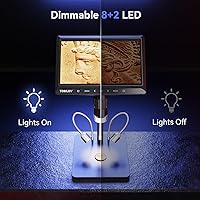
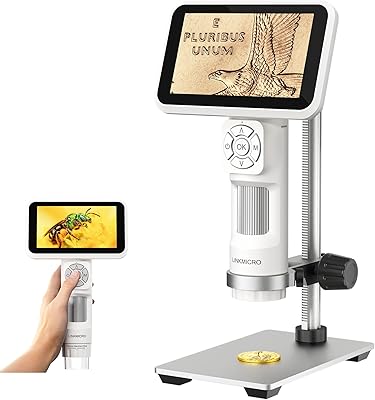
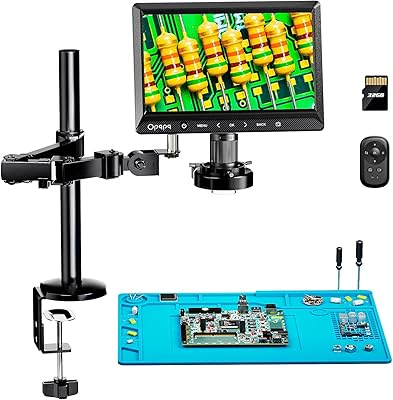
Overview

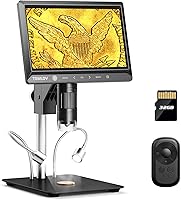
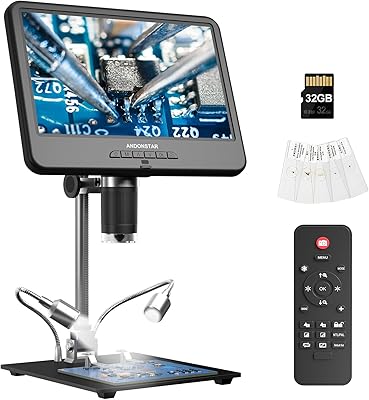
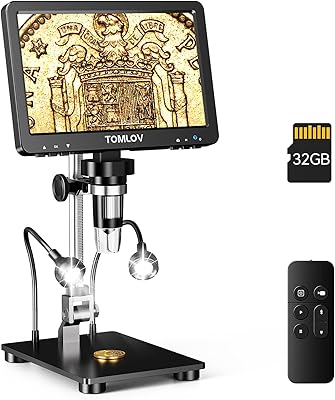
The TOMLOV DM702 Digital Coin Microscope 10-inch sits in an interesting spot — capable enough for serious hobbyists, approachable enough that you don't need an engineering background to set it up. The most immediately striking thing is the large IPS display, which is big enough to show an entire dollar coin without cropping. The 11-inch pro stand gives you real working clearance underneath, whether you're positioning a circuit board or a coin holder. It arrives with a 32GB SD card and a remote shutter already in the box, and the metal construction gives it noticeably more heft than the plastic-bodied options at lower price points.
Features & Benefits

The wide-angle IPS screen reproduces color accurately and stays readable even when a second person leans in to look, which matters more than it sounds during a club meeting or a soldering session with a helper. Magnification reaches into four-figure territory, though it's worth knowing the upper range relies on digital zoom rather than pure optical power — for most coin grading and SMD component work, the mid-range optical settings are where the image stays sharpest. The LED system is genuinely well-designed: top lights can be tilted to cast oblique illumination across a coin surface, cutting the glare that washes out fine details. The 90-degree screen rotation and USB output to a monitor round out a thoughtful feature set.

Best For

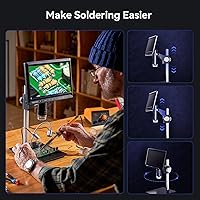
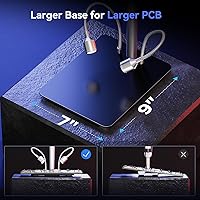
This desktop digital microscope makes the most sense for coin collectors who want to study mint marks, surface luster, and die varieties on a proper screen rather than squinting through a loupe. It's equally at home on an electronics workbench — the spacious base accommodates full-sized circuit boards, and hands-free magnification changes how comfortable extended soldering sessions feel. It also works well for anyone presenting to a small group, since the built-in display removes the need for a connected laptop. If you're stepping up from a basic USB microscope or a handheld magnifier and want a standalone unit, this hits that mark without overcomplicating the setup.

User Feedback

Buyers consistently single out the screen size and image clarity as the reasons they chose this over competitors, and that praise holds across both collector and repair communities. On the critical side, a recurring theme is focus ring sensitivity — some users find fine-tuning focus at higher magnifications takes practice, especially for beginners. A handful of reviewers mention minor quirks when navigating the SD card menu interface. Stand stability gets broadly positive marks given the screen's size, though a few note it benefits from being placed on a flat, non-vibrating surface. Setup time is generally described as short, but first-time digital microscope users occasionally mention a brief learning curve with the lighting controls.

Pros

  • The large IPS display lets you view an entire dollar coin without repositioning, a genuine practical advantage for collectors.
  • Metal construction gives the DM702 noticeably more rigidity and longevity than plastic competitors at a similar price.
  • Oblique LED lighting cuts glare on reflective coin surfaces in a way that fixed ring lights simply cannot match.
  • The tall stand creates ample working clearance for soldering tools and full-sized circuit boards underneath the lens.
  • No PC required — this desktop digital microscope operates fully standalone right out of the box.
  • A 32GB SD card and remote shutter are included, so there are no immediate extra purchases to make.
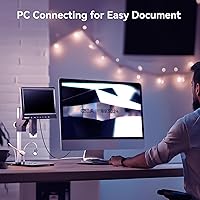
  • USB output to a laptop or monitor works reliably on both Windows and Mac for larger-screen editing or display.
  • The 90-degree screen rotation is a practical ergonomic benefit for electronics repair workflows, not just a gimmick.
  • Bottom transmitted lighting adds flexibility for thin specimens, making the unit more versatile than coin-only alternatives.
  • Setup is quick — most users are capturing images within twenty minutes of unboxing.

Cons

  • The peak magnification figure leans heavily on digital zoom; image quality degrades visibly at the upper settings.
  • The on-device menu interface is slow and takes real effort to navigate efficiently, especially for new users.
  • Focus ring sensitivity can be inconsistent, making fine adjustments at higher magnifications more frustrating than they should be.
  • SD card file management occasionally produces write errors, requiring a reformat to resolve — disruptive mid-session.
  • The unit's size and weight make it a stay-on-the-desk tool; it is not practical to transport regularly.
  • USB connectivity does not power the unit, so a separate power supply is always needed even when tethered to a computer.
  • The remote shutter has a limited effective range and requires a fairly direct line of sight to work reliably.
  • LED brightness at its lowest setting may still be too intense for very reflective proof coins in a dark room.
  • The included manual lacks detailed visual guidance, which steepens the learning curve for first-time microscope users.

Ratings

The TOMLOV DM702 Digital Coin Microscope 10-inch has been evaluated by our AI rating system after processing verified buyer reviews from global marketplaces, with spam, bot-generated, and incentivized feedback actively filtered out. The scores below reflect the honest consensus of real hobbyists — coin collectors, electronics repairers, and educators — who have used this desktop microscope in everyday settings. Both the genuine strengths and the friction points that surfaced repeatedly in buyer experiences are transparently captured here.
Display Quality
88%
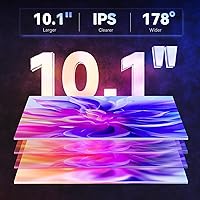
The large IPS panel is the feature buyers mention most enthusiastically. Collectors appreciate being able to see an entire dollar coin on screen without repositioning, and the wide viewing angle means a second person can look alongside without the image shifting or washing out.
A small number of users note that the screen can pick up reflections from overhead lighting in bright workshop environments. At the highest zoom levels, on-screen pixelation becomes visible, which slightly undercuts the otherwise strong display impression.
Magnification Performance
74%
26%
For the tasks this microscope is actually sold for — reading mint marks, inspecting solder joints, examining die details — the optical magnification range is more than adequate. Electronics hobbyists particularly appreciate the ability to check SMD pads without a separate bench microscope.
The top-end magnification figure leans heavily on digital zoom, and the image quality degrades noticeably at those extreme settings. Buyers expecting laboratory-grade optical performance at maximum zoom will find the real-world results more modest than the headline number implies.
Build Quality & Durability
83%
The metal construction sets this apart from similarly priced plastic-bodied competitors. Users describe it as feeling like a proper desktop instrument rather than a toy, and the stand shows no meaningful flex or wobble during normal use at a workbench.
The focus ring mechanism draws some criticism for feeling slightly loose after extended use, which affects repeatability when returning to a previously set magnification. A few buyers also noted that the adjustment knobs could benefit from more tactile resistance.
Lighting System
86%
The ability to angle the top LEDs for oblique illumination is a genuine practical advantage when examining reflective coin surfaces — it cuts the flat, washed-out look that plagues fixed-ring lights. Bottom transmitted lighting adds versatility for transparent specimens or thin circuit traces.
The dimmable range is good but the lowest brightness setting may still be slightly too intense for very reflective proof coins in a dark room. Some users wish there were a way to independently control individual LED zones rather than adjusting both sides simultaneously.
Stand & Working Space
84%
The tall pro stand gives you meaningful clearance underneath the lens, which matters when you are maneuvering a soldering iron or positioning a coin in a holder. The wide base plate accommodates standard-sized PCBs without the board hanging over the edges.
The overall footprint is substantial for a shared desk. A few users working in tight bench spaces found the base plate occupied more room than they anticipated, and the unit is heavy enough that repositioning it mid-session is mildly inconvenient.
Image & Video Capture
79%
21%
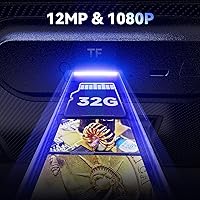
The 12MP camera produces sharp still images that hold up well when zoomed into on a computer screen, and 1080P video is smooth enough for documentation or sharing clips online. The included remote shutter is a thoughtful touch that prevents camera shake when pressing the capture button.
The file management interface on the SD card menu feels dated and takes some getting used to. A handful of users reported occasional hiccups when writing video files to the card, requiring a reformat to resolve — minor but worth noting for workflow-sensitive buyers.
Ease of Setup
81%
19%
Most buyers report being up and running within fifteen to twenty minutes of opening the box, with no driver installation required for standalone operation. The included accessories — SD card, remote, power cable — mean there is genuinely nothing extra to buy before using it.
First-time digital microscope users occasionally struggle with understanding the relationship between the physical focus ring and the digital zoom controls. The manual covers the basics but lacks the kind of step-by-step visual guidance that would help complete beginners get the best image quickly.
Software & Interface
63%
37%
Basic on-device controls for brightness, capture mode, and resolution are accessible enough once you learn the menu layout. For straightforward capture-and-save workflows the interface does what it needs to do without requiring a connected computer.
The UI design feels utilitarian at best. Navigation across menus is slow, and switching between photo and video modes involves more button presses than it should. Several reviewers explicitly called out the interface as the weakest aspect of an otherwise solid hardware package.
USB & PC Connectivity
77%
23%
Connecting the DM702 to a laptop or desktop and using it as a live USB camera works reliably on both Windows and Mac, which is a real plus for users who want to annotate images in dedicated software or display the feed on a larger external monitor.
The USB connection does not support power delivery, so the unit still needs its own power supply even when tethered to a computer. A small number of users also reported that the USB output resolution was lower than expected compared to the on-device display quality.
Value for Money
82%
18%
Compared to similarly priced digital microscopes, the combination of a large built-in screen, metal construction, included storage, and dual lighting system represents a strong overall package. Buyers upgrading from basic loupes or entry-level USB microscopes consistently describe it as a meaningful step up.
Buyers with professional or semi-professional expectations may find the digital zoom inflation and the basic software interface harder to justify at this price. It delivers good value for hobbyists but sits in an awkward spot for anyone eyeing prosumer-grade performance.
Portability & Storage
58%
42%
The unit does pack down reasonably well for transport given its size, and the metal build means it survives being moved between rooms or carried to a coin club meeting without much worry. The detachable stand simplifies packing slightly.
At nearly four and a half pounds with a wide base, this is not something you grab casually on the way out the door. It is fundamentally a stay-on-the-desk instrument, and buyers who pictured taking it to shows or swap meets regularly may find the size and weight limiting.
Remote Shutter Usability
76%
24%
The wireless remote is a small but appreciated inclusion. Coin photographers in particular value being able to trigger the shutter without touching the unit, since even minor vibrations at higher magnifications can blur fine surface details on proof or uncirculated coins.
The remote range is modest and requires a fairly direct line of sight to work consistently. It also has no additional functionality beyond the shutter trigger, so users hoping to control zoom or switch modes remotely will need to return to the device itself.
Screen Rotation & Ergonomics
78%
22%
The 90-degree screen rotation is genuinely useful for soldering workflows where you want the display to one side rather than directly above your work. Electronics repairers mention this as a feature they did not expect to use often but ended up relying on regularly.
The rotation mechanism requires loosening and re-tightening a physical adjustment rather than flipping the display freely, which some users find less convenient mid-task. The screen angle options, while helpful, could be more granular for users with unconventional bench setups.

Suitable for:

The TOMLOV DM702 Digital Coin Microscope 10-inch is a strong fit for coin collectors who want a proper desktop setup for examining mint marks, surface grades, and die varieties without needing to squint through a loupe or wrestle with a laptop. If you attend coin club meetings or like showing finds to fellow collectors, the large built-in screen makes sharing a live view effortless — no projector or external monitor required. Hobbyist electronics repairers working on small circuit boards will also find it genuinely useful: the tall stand creates real clearance for a soldering iron, and the wide base handles standard-sized PCBs without awkward overhanging. It works equally well as a standalone unit straight out of the box, since it requires no PC and arrives with storage and a remote shutter already included. For educators or presenters who need a self-contained magnification tool for small group demonstrations, this desktop digital microscope covers that use case without demanding technical setup knowledge.

Not suitable for:

The TOMLOV DM702 Digital Coin Microscope 10-inch is not the right choice for anyone expecting optical magnification to hold up at the very top of its stated range — the highest figures depend on digital zoom, and the image quality at those settings reflects that honestly. Professional numismatists or graders who need clinically sharp, distortion-free imagery for high-value attribution work will likely find the optical performance short of what dedicated photographic macro rigs or laboratory-grade stereo microscopes can deliver. Similarly, buyers hoping for polished, intuitive software will be disappointed: the on-device menu system is functional but dated, and managing captured files feels cumbersome compared to modern devices. Anyone working in a tight bench space should measure carefully before buying, because the footprint is substantial and the unit is heavy enough that casual repositioning becomes a minor chore. If portability matters — say, bringing a microscope to coin shows regularly — the size and weight make this a poor travel companion.
Specifications

  • Screen: The unit features a 10.1″ IPS display with a 178-degree viewing angle, delivering accurate color reproduction and a wide, consistent image even when viewed from the side.
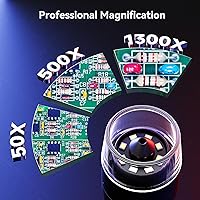
  • Magnification: Optical and digital magnification combined reaches up to 1300x, though the sharpest, most reliable results occur at lower optical settings rather than at the digitally extended upper range.
  • Camera: A 12MP sensor handles still image capture, while video recording is supported at 1080P resolution for smooth, detailed documentation of coins or circuit board work.
  • Stand Height: The pro stand extends to 11″, providing meaningful clearance underneath the lens for positioning soldering tools, coin holders, or larger electronic assemblies.
  • Base Plate: The working base measures 7 by 9 inches, which is large enough to accommodate standard-sized circuit boards and coin trays without awkward overhang.
  • LED Lighting: Dimmable LEDs are positioned both above and below the specimen stage; the top lights can be angled to cast oblique illumination, which reduces glare on reflective coin surfaces.
  • Storage: A 32GB SD card is included in the box, providing immediate capacity for saving high-resolution images and 1080P video without any additional purchase.
  • Remote Shutter: A wireless remote shutter is included, allowing vibration-free image capture without physically pressing the on-device button, which is particularly useful at higher magnifications.
  • Screen Rotation: The display rotates 90 degrees, giving users the option to reposition the screen to the side — a practical ergonomic adjustment for soldering workflows.
  • Connectivity: A USB output allows the DM702 to function as a live camera feed displayed on a connected Windows or Mac computer for larger-screen viewing or image editing.
  • Material: The main structural components are metal, giving the unit a more rigid, durable feel compared to the plastic-bodied digital microscopes found at lower price points.
  • Weight: The unit weighs approximately 1,984 grams (around 4.37 lbs), which contributes to stand stability but also makes casual repositioning or transport a deliberate effort.
  • Power: The microscope runs on 110V AC power and requires a permanent wall connection during use; it does not operate on battery power or receive power through its USB port.
  • Dimensions (Box): The retail package measures approximately 13.58 by 11.73 by 5.24 inches, which reflects the overall footprint buyers should plan for on a desk or workbench.
  • Color: The unit is finished in black with a metal housing, giving it a utilitarian workshop appearance rather than the consumer-white aesthetic common on entry-level microscopes.
  • OS Compatibility: When connected via USB, the microscope is compatible with both Windows and Mac operating systems for live display and image capture on a computer.
  • Voltage: Rated for 110V operation, making it suited for standard North American power outlets without requiring a voltage converter under typical home or workshop conditions.

Related Reviews
TOMLOV P10 Evo Handheld Digital Microscope
78%
93%
Portability
91%
Ease of Use
74%
Optical Clarity
82%
Display Quality
54%
Battery Life
More
Andonstar AD210 10.1 Inch Digital Microscope
83%
91%
Image Quality & Magnification
82%
Usability & Ergonomics
95%
Display Clarity & Viewing Angle
88%
Value for Money
85%
Build Quality
More
TOMLOV DM9 Pro Digital Microscope
83%
88%
Magnification Performance
92%
Image Quality
86%
Lighting Adjustability
84%
Build Quality
79%
Ease of Setup
More
LINKMICRO LM115 Digital Coin Microscope
86%
88%
Performance & Magnification
85%
Build Quality & Durability
90%
Ease of Use & Setup
91%
Display Quality
89%
Illumination & LED Lights
More
Atatat Digital Picture Frame 10-inch
84%
90%
Display Quality
85%
Ease of Setup
88%
Slideshow Functionality
80%
Build Quality
83%
Remote Control Usability
More
Opqpq ODM702 Flex 10″ Digital Microscope

75%
83%
Arm Stability & Rigidity
88%
Built-in Display Quality
76%
Magnification Performance
81%
Boom Arm Flexibility
79%
Coin Inspection Usability
More
Jaihonda 10 Inch Digital Picture Frame
80%
90%
Display Quality
88%
Ease of Use
84%
Value for Money
75%
Build Quality
94%
Setup & Installation
More
Pix-Star 10-inch WiFi Digital Photo Frame

77%
88%
Ease of Setup
91%
Photo Delivery Experience
73%
Display Quality
94%
No-Subscription Value
62%
App Reliability
More
Hayve DM7 4.3″ Digital Microscope
78%
92%
Ease of Setup
88%
Display Quality
71%
Magnification Performance
84%
LED Lighting
58%
Build Quality
More
LINKMICRO LM210 10.1″ LCD Digital Microscope
82%
89%
Value for Money
91%
Display Quality
85%
Ease of Use
87%
Magnification Performance
83%
Build Quality
More

FAQ

Yes, it operates completely standalone. The built-in screen handles everything — live view, image capture, and playback — so you never need a laptop or desktop nearby if you don't want one.

Honest answer: the upper end of that range relies on digital zoom, which stretches the image rather than capturing finer optical detail. For practical tasks like reading mint marks or inspecting solder joints, the mid-range optical settings give you far sharper, more reliable results. Think of the top figure as a ceiling that's technically reachable but not where you'll spend most of your time.

Yes, and this is genuinely one of the DM702's strongest practical advantages. The tall stand allows you to raise the lens high enough that a full dollar coin fits comfortably within the frame, which is not something all digital microscopes at this size can manage.

Images and videos save directly to the included SD card, which comes pre-installed in the unit. You don't need to buy anything extra to start capturing — just point, shoot with the remote, and the files are ready to transfer to your computer whenever you like.

Quite well, actually. The 11-inch stand height gives you meaningful room to maneuver a soldering iron underneath, and the wide base plate handles a standard-sized circuit board without it hanging over the edges. Many electronics hobbyists specifically buy this over smaller tabletop microscopes for exactly this reason.

For standalone use, no installation is required at all. If you want to use it as a USB camera connected to your computer, basic plug-and-play recognition works on both Windows and Mac without additional drivers in most cases.

The LEDs are dimmable and can be angled for oblique lighting, which makes a real difference on reflective surfaces. That said, a few users find the lowest brightness setting still slightly intense for highly polished proof coins in a dark room — combining the dimmer setting with the oblique angle tends to solve this.

Setup is straightforward and most people are up and running within about fifteen to twenty minutes. The stand attaches without tools, and the on-screen menus are accessible once you spend a few minutes exploring them. Complete beginners to digital microscopes may want to watch a short walkthrough video online, as the manual covers basics but skips some useful operational tips.

The USB output connects to a computer for a larger live display, but there is no direct HDMI output, so plugging directly into a TV or standalone monitor is not supported. If you want a bigger screen, routing through a laptop connected to a TV is the workaround most users take.

The metal base is heavy enough to keep things steady during normal use, and the majority of buyers describe the stand as solid. For best results, place it on a firm, non-vibrating surface — a heavy workbench is ideal. It is not designed to sit on an unstable or soft surface, where some wobble could become an issue at higher magnifications.