Overview

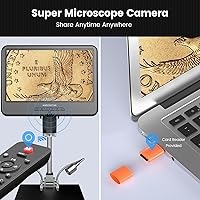
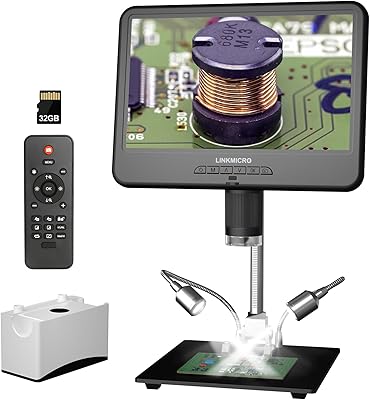
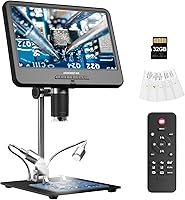
The Andonstar AD210 10.1-inch Digital Microscope is a standalone unit built around a large IPS screen — no laptop, no extra software, no fuss. It sits comfortably in mid-range territory, aimed at hobbyists and collectors who want real magnification without the complexity of a lab instrument. The three core scenarios it was designed for are electronics repair, coin inspection, and biological slide viewing, and the accessory bundle — including a bottom light stage and prepared slide kit — adds genuine out-of-the-box utility. The upgraded metal stand is a meaningful hardware improvement over earlier generations. Honest caveat: this is consumer-grade gear, and expectations should match that.
Features & Benefits

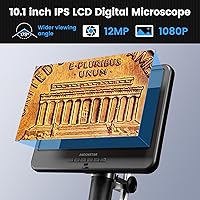
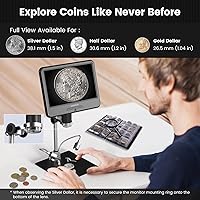
The AD210's most immediately useful feature is its 10.1-inch IPS screen — wide enough that you can work and watch simultaneously without hunching over an eyepiece. The 178-degree viewing angle means a second person can look over your shoulder without losing image quality. Magnification runs from 2.5x up to 260x, covering most real-world repair and inspection work, though at the upper end of that range expect some softness — that's normal for a single-lens consumer sensor. The adjustable working distance (1cm to 26cm) is particularly useful for larger objects like silver dollars, which need clearance that cheaper stands simply don't provide. Captured images and 1080P video store directly to the included 32GB card.

Best For

This LCD microscope punches above its weight for home electronics repair — specifically PCB inspection and SMD soldering, where the big screen replaces a magnifying headset and keeps both hands free. Coin collectors will appreciate the stand's generous clearance, which lets you view a full silver dollar without cropping. Students and curious adults get a reasonable entry into biological slide viewing, thanks to the bottom light stage and the slide kit in the box. It also works well for jewelry inspection, stamp collecting, and fine craft work. If you need direct PC streaming or HDMI output, this unit doesn't offer those — that's worth knowing before buying.

User Feedback

Buyers consistently praise the large, bright display and the surprisingly quick setup — most people are up and running within minutes of unboxing. The stand earns specific compliments from users who owned older Andonstar models, noting the wider base and improved stability as real upgrades. On the critical side, maximum magnification draws occasional complaints about image softness and sensitivity to vibration, which is a known limitation at this end of the zoom range. The SD card workflow — shoot, pull the card, read on a PC — works fine but feels a little dated for buyers who expected USB tethering. Overall, value perception is strong; the accessory kit is frequently cited as making the purchase feel complete.

Pros

  • The 10.1-inch IPS screen is genuinely large enough to work comfortably without eye strain during longer sessions.
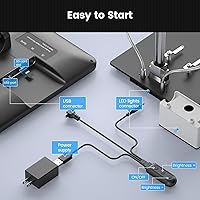
  • Setup is fast — unbox, plug in, and you are magnifying within minutes, no software or drivers needed.
  • The adjustable working distance handles everything from tiny SMD components to large coins without repositioning the whole stand.
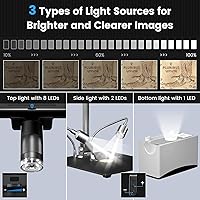
  • LED ring lighting does a good job reducing glare on reflective surfaces like coins or polished metal parts.
  • The included 32GB SD card and card reader mean you can capture and transfer images without buying anything extra.
  • Bottom light stage expands the unit beyond surface inspection into transmitted-light biological slide viewing right out of the box.
  • The enlarged metal stand base is noticeably more stable than earlier Andonstar designs, which users who upgraded consistently call out.
  • 12MP image capture produces detailed stills useful for documentation, sharing findings, or side-by-side comparisons.
  • The wide 178-degree viewing angle means a second person can observe alongside you without losing a clear image.
  • The prepared slide kit adds real educational value, especially for households with students or curious younger users.

Cons

  • Image quality softens meaningfully at maximum magnification — 260x on a single consumer lens has real optical limits.
  • No direct PC streaming means you cannot use this as a live tethered microscope with capture or analysis software.
  • The SD card transfer workflow feels dated compared to units that offer USB connectivity or Wi-Fi image transfer.
  • Vibration sensitivity at high zoom levels makes it tricky to get sharp captures without a very stable work surface.
  • No HDMI output rules it out for anyone who wants to mirror the display to a larger external screen or projector.
  • The power input is rated at 240V, which may require an adapter for users in regions with 110-120V standard outlets.
  • Fixed single-lens optics mean there is no upgrade path if you eventually need a different objective or wider field of view.
  • At heavier zoom settings, manual focus adjustment requires a steady hand, which can slow down repetitive inspection tasks.

Ratings

The scores below for the Andonstar AD210 10.1-inch Digital Microscope were generated by AI after analyzing thousands of verified buyer reviews from global markets, with spam, bot activity, and incentivized feedback actively filtered out. Each category reflects the honest distribution of real user experiences — strengths are recognized where they are genuine, and recurring pain points are represented without being softened. The result is a transparent snapshot of how this LCD microscope actually performs across its core use cases.
Display Quality
88%
The large IPS screen is consistently the first thing buyers mention positively — working under magnification without hunching over an eyepiece genuinely changes the experience. The 178-degree viewing angle means image quality holds up even when you shift position during long soldering or inspection sessions.
In brightly lit workshops, some users report needing to adjust the screen angle to reduce ambient glare since there is no automatic brightness control. A small number of buyers noted the display resolution, while adequate, is not as crisp as higher-end panel options found on pricier units.
Magnification Performance
73%
27%
In the low-to-mid magnification range — the zone where most everyday electronics repair and coin inspection actually happens — the AD210 delivers clear, usable images. For identifying solder bridges, reading component markings, or spotting mint marks on coins, the optics are more than adequate.
At the upper end of the zoom range, image softness becomes noticeable and the unit is sensitive to vibration, making it difficult to capture sharp stills without a very stable surface. Buyers expecting lab-grade sharpness at 260x will be disappointed — this is a consumer-grade lens and performs accordingly.
Stand & Build Quality
84%
The upgraded stand draws specific praise from users who previously owned older Andonstar models — the wider base and taller arm make a tangible difference in day-to-day stability. For coin collectors especially, the additional height clearance allows full-diameter viewing of larger pieces without awkward repositioning.
At very high magnifications, even the improved base cannot fully eliminate minor vibration sensitivity — touching the stand arm while focused at maximum zoom can blur the image. A few users also noted the vertical adjustment mechanism requires deliberate movement to avoid accidental slippage during setup.
Image & Video Capture
79%
21%
12MP stills are genuinely useful for documentation — electronics hobbyists use them to photograph board states before and after repair, while coin collectors capture error details for reference or sharing. The 1080P video recording works well for walkthroughs and inspection logs without needing any connected device.
The lack of direct PC connectivity means there is no live capture-to-software workflow, which limits usefulness for users who want to record straight into editing or analysis tools. A handful of buyers found the on-screen menu for switching between photo and video modes less intuitive than expected.
Storage & File Transfer
68%
32%
Including a 32GB SD card and a card reader in the box means most buyers can start capturing and transferring content immediately without any extra purchases. Files are recognized as standard storage on any computer without drivers.
The SD card swap workflow feels dated compared to units offering USB tethering or wireless transfer — pulling the card each time you want to move files adds friction that accumulates over repeated sessions. A small but consistent group of buyers specifically listed the absence of direct USB connectivity as their main frustration.
Ease of Setup
91%
Nearly every buyer who mentions setup describes it as fast and painless — unbox, assemble the stand, insert the SD card, and power on. There are no drivers, no pairing processes, and no software dependencies to manage, which is a genuine advantage for less tech-savvy users.
The instruction manual is described by some buyers as thin on detail, particularly around the bottom light stage assembly and menu navigation. Users unfamiliar with digital microscopes may spend a few minutes figuring out focus adjustment before the experience clicks.
Soldering Suitability
81%
19%
Electronics hobbyists doing home-level PCB repair consistently report that the working distance and screen size combination is well suited to keeping both hands on tools while monitoring the work area. The LED ring light provides even illumination across solder points without the hot spots that can complicate fine work.
For more complex three-dimensional builds or unusually bulky assemblies, the clearance between the lens and the work surface can feel limiting. Professional repair technicians with heavy daily workloads have noted that the stand rigidity, while improved, still does not match purpose-built industrial soldering microscopes.
Coin Inspection
86%
The extended arm and working distance make this one of the more practical options for coin collectors at this price point — full silver dollars fit comfortably within the field of view without cropping. The LED lighting does a solid job of picking out surface texture and die details on reflective surfaces.
At very high zoom, the image softness makes it harder to resolve the finest die cracks or subtle luster differences that experienced error coin collectors look for. The lack of a polarizing filter option means glare management on highly polished proof coins depends entirely on lighting angle adjustments.
Biological Slide Viewing
74%
26%
The included bottom light stage and prepared slide kit give this unit a genuine secondary function that most competing models at this tier do not offer. For students and curious adults exploring the microscopic world at home, the combination works well for basic cell and organism observation.
The transmitted-light stage is functional but basic — serious biology students or educators will quickly find its capabilities limiting compared to a dedicated optical microscope. Slide positioning is manual and somewhat imprecise, which can make it harder to relocate a specific area of interest on a slide.
Lighting System
82%
18%
The LED ring light produces consistent, even illumination that works particularly well for reflective subjects like coins and circuit boards, where shadow and glare are common problems with other light sources. Brightness is adjustable, giving users flexibility across different subject types and ambient conditions.
The ring light is fixed in its position and angle, so there is no way to introduce raking or angled light for subjects where directional illumination would enhance surface texture visibility. A small number of buyers noted the LEDs can cast a slightly cool color tone that affects the appearance of certain materials in photographs.
Value for Money
87%
Buyers repeatedly describe the accessory bundle — SD card, card reader, bottom light stage, and slide kit — as making the purchase feel complete and justified. For the price tier it occupies, the AD210 covers three distinct use cases in a single unit, which most direct competitors do not match out of the box.
Users who need PC connectivity, HDMI output, or professional-grade optics will find themselves paying significantly more for alternatives that cover those needs — the AD210 does not stretch to those requirements regardless of the price. A small segment of buyers felt the maximum magnification quality did not fully justify the stated specification.
Portability & Storage
76%
24%
At just over four pounds packaged and with a reasonably compact footprint, the AD210 is easy to move between a workbench and a desk, or to store away when not in use. The stand disassembles without tools for compact storage.
It is not a field-portable device — the power cable requirement and stand size mean this is firmly a desktop unit, not something you take to a coin show or use away from a power outlet. The packaged box dimensions, while manageable, are larger than some buyers anticipated based on product images.
Durability & Longevity
71%
29%
The metal stand components feel solid in hand and the display housing has enough heft to suggest reasonable durability for home hobby use. Users who have owned the unit for several months generally report no issues with build degradation.
The lens assembly and adjustment mechanism are not sealed, which means dust accumulation over time is a realistic concern in workshop environments. Long-term reliability data is limited given the product launched in 2023, so multi-year durability remains an open question for prospective buyers.

Suitable for:

The Andonstar AD210 10.1-inch Digital Microscope is a strong fit for electronics hobbyists who do PCB inspection or SMD soldering at home and want both hands free while they work — the large built-in screen replaces the need for magnifying headsets or a connected laptop entirely. Coin collectors will find the extended working distance particularly useful, since it provides enough clearance to view large-diameter coins in their full context rather than just a cropped slice. It also works well for students and curious adults who want to explore biological slides as a hands-on science activity, especially given the bottom light stage and prepared slide kit included in the box. Makers, crafters, and stamp collectors who regularly need precise magnification for fine detail work will get consistent everyday value from the AD210. Anyone who wants a self-contained, plug-and-play magnification setup — without dealing with drivers, software, or PC tethering — will appreciate how straightforward the whole experience is.

Not suitable for:

The Andonstar AD210 10.1-inch Digital Microscope is not the right tool for professionals or researchers who need lab-grade optical precision, consistent parfocal performance, or calibrated measurement outputs. At the upper end of its magnification range, image quality softens noticeably, which rules it out for any application where fine detail at high zoom is non-negotiable. It has no HDMI output and no direct PC streaming capability, so if your workflow depends on displaying a live feed on an external monitor or recording footage into editing software in real time, this unit will frustrate you. Buyers expecting USB connectivity or the ability to use it as a webcam-style microscope with dedicated software should look elsewhere. It is also not ideal for professional repair shops that need industrial-grade stand rigidity or the ability to handle heavy workpieces reliably over long daily shifts.
Specifications

  • Display: The unit features a 10.1″ IPS screen with a 178-degree viewing angle, allowing comfortable observation without precise head positioning.
  • Magnification: Optical zoom ranges from 2.5x to 260x, covering a broad spectrum of inspection tasks from wide-area surveys down to fine component detail.
  • Image Resolution: Still images are captured at 12MP, producing detailed photographs suitable for documentation, sharing, or side-by-side comparison.
  • Video Resolution: Video recording is supported at 1080P full HD, stored directly to the included SD card without requiring a connected computer.
  • Working Distance: The adjustable working distance spans 1cm to 26cm, accommodating objects ranging from tiny SMD components to large-diameter coins.
  • Stand Height: The upgraded metal stand reaches a maximum height of 12.6 inches, providing meaningful clearance for bulkier inspection subjects.
  • Stand Base: An enlarged metal base provides improved stability over earlier Andonstar designs, reducing vibration during high-magnification work.
  • Light Source: An LED ring light delivers even top-down illumination, minimizing glare and shadow on reflective or uneven surfaces.
  • Bottom Light Stage: A transmitted-light bottom stage is included, enabling proper viewing of prepared biological slides in addition to surface inspection tasks.
  • Storage: A 32GB SD card and a USB card reader are included in the box, allowing immediate image and video capture without additional purchases.
  • Lens Count: The unit uses a single objective lens system, which keeps the design straightforward but limits optical upgrade options.
  • Power Input: The microscope is rated at 240V input, which may require a voltage adapter for users in 110–120V regions such as North America.
  • Packaged Weight: The complete packaged unit weighs 4.22 pounds, making it practical to store or move between workspaces without difficulty.
  • Package Dimensions: The box measures 11.77 x 10.16 x 3.7 inches, compact enough to fit on a standard shelf when not in use.
  • Slide Kit: A prepared biological slide kit is included, providing ready-to-view specimens for users exploring the biological observation features.
  • Connectivity: The unit has no HDMI output and no direct PC streaming capability; all data transfer is handled via the SD card and card reader.
  • Brand: Manufactured by ShenZhen Andonstar Technology Co., Ltd, a brand with an established product line of consumer digital microscopes.
  • Release Date: This model was first made available in July 2023, placing it among Andonstar's more recent stand-alone screen microscope releases.

Related Reviews

KECAG 10.1-inch 1080p Digital Picture Frame
73%
88%
Display Quality
91%
Ease of Setup
84%
Value for Money
72%
Motion Sensor
63%
Remote Control
More
LINKMICRO LM210 10.1″ LCD Digital Microscope
82%
89%
Value for Money
91%
Display Quality
85%
Ease of Use
87%
Magnification Performance
83%
Build Quality
More
LEADSTAR 10-Inch Portable Digital TV
72%
91%
Portability
58%
Battery Performance
73%
Picture Quality
62%
Signal Reception
88%
Ease of Setup
More
NOBKLEN 10.1-Inch WiFi Digital Photo Frame
81%
91%
Ease of Setup
86%
App Experience
72%
Display Quality
94%
Gifting Experience
88%
Photo Sharing Speed
More
Cozyla 10.1-inch WiFi Digital Photo Frame
75%
88%
Ease of Setup
67%
App Reliability
79%
Display Quality
58%
Video Playback
82%
Cloud Storage
More
Moonka 10.1-Inch Smart Family Calendar Display
76%
88%
Ease of Setup
81%
Calendar Sync Reliability
84%
Chore Chart Usability
67%
Screen Size & Legibility
62%
App Experience (Free Tier)
More
Canupdog MW002 10.1-inch Digital Family Calendar
75%
91%
Design & Aesthetics
88%
Display Quality
86%
Chore Chart Usability
84%
Setup & Connectivity
82%
Calendar Integration
More
Anna Bella 10.1 Inch Digital Picture Frame
86%
88%
Display Quality
91%
Ease of Setup
82%
WiFi Connectivity
74%
App Performance
89%
Storage Capacity
More
akimart 32GB 10.1-inch WiFi Digital Picture Frame
73%
88%
Ease of Setup
84%
Remote Photo Sharing
71%
Display Quality
63%
Build Quality
82%
Touch Screen Responsiveness
More
Frameo Digital Picture Frame 10.1 Inch with 64GB Memory
83%
85%
Display Quality
92%
Ease of Setup
80%
App Performance
91%
Storage Capacity
72%
WiFi Connectivity
More

FAQ

No, the AD210 is entirely self-contained. You plug it in, power it on, and the built-in 10.1″ screen handles all display duties. There is no software to install and no laptop required for normal use.

Unfortunately, no. The Andonstar AD210 10.1-inch Digital Microscope does not support direct PC streaming or USB tethering. If you need a live feed on your computer for capture software or analysis tools, this unit is not designed for that workflow.

You remove the included 32GB SD card, insert it into the card reader that comes in the box, and plug that into any USB port on your computer. No drivers or special software needed — the files appear like a standard USB storage device.

It is real, but with honest caveats. At the upper end of the zoom range, images can soften and become sensitive to vibration. For most practical tasks — soldering inspection, coin detail, slide viewing — you will spend most of your time well below the maximum, where image quality is solid.

Yes, that is one of the design goals of the upgraded stand. The extended working distance and taller arm provide enough clearance to view larger coins in their entirety, which was a genuine limitation of older, shorter-armed Andonstar models.

Most users doing home-level electronics repair find the clearance adequate for standard SMD work. The large screen makes it easier to keep both hands on your tools rather than squinting through an eyepiece. For unusually bulky PCB assemblies or complex three-dimensional builds, clearance can get tighter, but typical board repair scenarios are well within range.

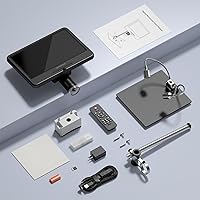
You get the microscope unit itself, the metal stand, the bottom light stage, a prepared biological slide kit, a 32GB SD card, a USB card reader, and a power adapter. It is a reasonably complete kit for getting started right away.

It works well in that context. The bottom light stage and included slide kit make it approachable for anyone curious about the microscopic world, and the large screen is far easier for younger users than a traditional eyepiece microscope. It is not a replacement for a proper school-grade optical microscope, but for home exploration it covers a lot of ground.

The unit is rated at 240V, which is the standard in many countries outside North America. US users will likely need a voltage adapter or power converter, since standard US outlets run at 110–120V. It is worth confirming this before plugging it in.

The stand received a meaningful update — the base is wider and heavier, which reduces wobble during precise work, and the arm reaches higher than previous versions. Users who have owned earlier Andonstar units consistently note the improvement as one of the more noticeable changes in this generation.

Where to Buy