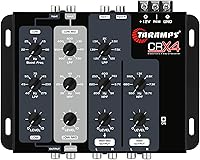
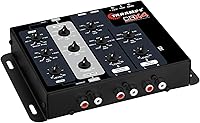
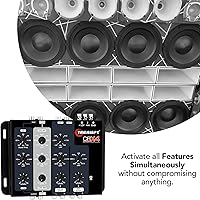
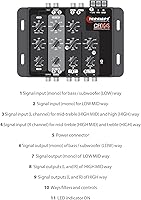
Overview

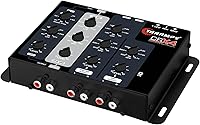
The Taramp's CRX4 4-Way Electronic Crossover is a compact RCA signal processor from Taramp's, a Brazilian brand that has built a solid reputation for delivering real performance without the premium price tag. This crossover slots into your signal chain between the head unit and your amplifiers, sorting frequency bands and sending each to the right speaker — cleanly and precisely. It has been on the market since 2013, and that longevity alone says something meaningful. At its mid-range price point, it sits comfortably above the throwaway budget options while stopping short of full DSP territory, which is exactly where a lot of serious builders want to be.

Features & Benefits

What makes the CRX4 genuinely useful day-to-day is how much control it hands you across four independent channels. The Low and Low-Mid outputs are mono — right for subwoofer and midbass duty — while High-Mid and High run stereo. Every channel has its own adjustable crossover frequency, so you're not stuck with fixed points that may not suit your specific driver combination. The built-in bass boost (20–65Hz, fixed 6dB gain) adds real impact to sub output without requiring a separate component. With 8V RMS handling on both input and output and distortion rated below 0.01%, the signal that leaves this unit is remarkably clean for what it costs.

Best For

This Taramp's unit is purpose-built for multi-amplifier installations where clean frequency splitting actually matters. If you're running a dedicated subwoofer amp alongside separate amplifiers for mids and highs, the CRX4 solves the routing problem without forcing you into a complex DSP setup. It's also an excellent match for high-voltage source units — no clipping risk at 8V RMS input. That said, if you want real-time tuning via an app or need time-alignment and parametric EQ, this crossover won't cover those bases. It's analog and hands-on, and for builders who prefer knob-based precision over software menus, that's a genuine plus.

User Feedback

Sitting at a 4.4-star average across years of reviews, this crossover has earned its rating the slow, honest way — through consistent repeat satisfaction rather than a marketing push. Buyers regularly mention clean signal output and straightforward installation as highlights. The bass boost gets called out surprisingly often as a bonus feature people didn't plan to use but ended up appreciating. On the critical side, a few users have noted that the panel labeling could be clearer, especially for first-time installers unfamiliar with Taramp's layout conventions. Documentation is minimal, so expect to reference a wiring diagram online. Overall though, most buyers feel the CRX4 punches above its price class.

Pros

  • Four fully independent output channels let you precisely tune each frequency band without compromise.
  • Variable crossover points on every channel give you genuine flexibility to match almost any speaker combination.
  • The built-in bass boost adds meaningful low-end punch to subwoofer output without needing extra hardware.
  • Handles up to 8V RMS input and output, making it fully compatible with premium high-voltage head units.
  • Distortion rated below 0.01% at 1kHz means the signal stays clean from input to output.
  • Reverse polarity protection reduces the risk of equipment damage during installation.
  • Compact dimensions make it easy to mount under a seat or tuck into a small trunk space.
  • Has maintained a 4.4-star rating since its 2013 release, reflecting years of consistent buyer satisfaction.
  • Priced in a sweet spot that delivers measurable performance gains over passive crossovers at a fraction of DSP costs.
  • The switched-mode power supply handles a wide voltage range, keeping performance stable even with engine load variations.

Cons

  • Panel labeling is not always intuitive, and first-time users may need to reference an external diagram.
  • Included documentation is minimal — no detailed setup guide comes in the box.
  • The bass boost gain is fixed at 6dB with no adjustment, which may be too aggressive for some tuning preferences.
  • No digital connectivity, app control, or computer interface of any kind — tuning is entirely manual.
  • Does not include time alignment, parametric EQ, or any advanced signal shaping beyond basic crossover filtering.
  • The Low and Low-Mid channels are mono only, which limits flexibility if your build requires stereo bass output.
  • Crosstalk rejection, while rated above 80dB, may not satisfy the demands of high-end competition audio builds.
  • No remote level control or bass knob output, so real-time adjustments from the driver seat require additional components.

Ratings

Our AI rating system analyzed verified global user reviews for the Taramp's CRX4 4-Way Electronic Crossover, actively filtering out incentivized, spam, and bot-generated feedback to surface what real buyers actually experience. The scores below reflect both the genuine strengths that keep this crossover consistently well-rated since 2013 and the honest pain points that show up repeatedly across independent installations. Nothing here is padded — if a category scores lower, it's because real users flagged real issues.

Signal Clarity
91%
Buyers consistently report that the CRX4 passes a remarkably clean signal, with virtually no audible noise floor increase even in high-gain amplifier chains. The sub-0.01% THD rating translates to real-world transparency that users notice immediately after switching from passive crossovers or amp-built filters.
A small number of users reported very faint interference when the unit was mounted directly against certain amplifier chassis, suggesting grounding sensitivity in poorly isolated installs. This is an edge case, but it does require careful placement in complex builds.
Frequency Flexibility
88%
The variable crossover points on all four channels give installers genuine latitude to tailor the sound to their specific driver combination, something users with both budget and premium speaker setups appreciated equally. Being able to sweep the High channel from 550Hz all the way to 13.7kHz without touching a laptop is a real practical advantage.
The bass boost center frequency is variable but the gain is locked at 6dB, which frustrates users who want a lighter touch on their subwoofer channel. A few experienced tuners noted they would prefer at least a gain knob to dial it back without bypassing the feature entirely.
Value for Money
93%
This is where the CRX4 consistently outperforms expectations — buyers routinely compare it favorably to crossovers costing significantly more, and the sentiment has held steady across nearly a decade of reviews. For a mid-range price, the combination of four independently tunable channels and a built-in bass boost is a genuine deal.
A handful of buyers felt the lack of included documentation or a printed setup guide was a shortcoming for the price, expecting at least a basic quick-start card. It is a minor gripe, but it adds friction for newer installers who may need to spend time sourcing wiring diagrams online.
Ease of Installation
79%
21%
Most buyers with intermediate car audio experience report a smooth installation process, praising the compact form factor and the standard RCA and power connections that keep wiring straightforward. The low current draw means it integrates without stressing the vehicle's electrical system.
The panel labeling has drawn repeated criticism, with multiple users noting the text and knob assignments are not immediately intuitive — particularly for first-timers who haven't worked with Taramp's products before. Without a proper manual in the box, that learning curve adds unnecessary time to what should be a simple installation.
Build Quality
76%
24%
The enclosure feels solid and appropriately dense for a unit in this class, and the RCA jacks are firm with no looseness that might introduce signal issues over time. Users who have run the CRX4 for multiple years in hot trunk environments report no structural failures.
The overall aesthetic and finish quality are functional rather than impressive — the casing doesn't feel premium to the touch, and some users noted the knobs feel slightly loose compared to higher-end crossovers. It won't matter once it's mounted out of sight, but it affects the out-of-box impression.
Bass Boost Performance
83%
The built-in bass boost surprised many buyers who initially dismissed it as a gimmick — once dialed into the right center frequency for their subwoofer, it added genuine impact and fullness to low-end output without muddying the midbass. For users running moderate subwoofer setups, it effectively eliminates the need for a separate bass processor.
Because the gain is fixed at 6dB, users with already bass-heavy enclosures or ported sub boxes found it pushed their system slightly over the edge without a clean way to moderate it. Those running sealed boxes in daily-driver builds got the best results; competition-tuned builds sometimes found it excessive.
Channel Separation
87%
Crosstalk rejection rated above 80dB means each output channel stays well isolated in practice, and users building systems with physically separated speaker zones noticed cleaner imaging as a result. The mono Low and Low-Mid channels in particular stay tightly focused without any bleed into the stereo high channels.
Some audiophile-level users argued that for genuinely critical listening environments, 80dB crosstalk rejection is adequate but not exceptional — higher-end DSP units push beyond 90dB. For the vast majority of car audio builds, this distinction is inaudible, but it matters at the top tier.
Compatibility
89%
The 8V RMS maximum input accommodates virtually every aftermarket head unit on the market, including high-voltage alpine and JVC models that often trip up lower-spec crossovers. Users switching from standard 4V pre-outs to 8V units reported no configuration changes needed — it handled both without issue.
The crossover requires RCA outputs from the source unit, so vehicles with factory head units and no preamp outputs need a line output converter as an added step before installation. This isn't a flaw in the unit itself, but it does affect total cost and complexity for some buyers.
Size & Placement
86%
At 190 x 145 x 40mm, the CRX4 fits neatly under seats, behind panels, or in shallow trunk corners where larger processors wouldn't fit. Multiple users specifically mentioned that the compact profile made it possible to keep their trunk space clean and uncluttered.
While the unit is compact, the knobs require enough physical access to turn during tuning, which means truly hidden mounting behind trim or under carpet is impractical until settings are finalized. You will need temporary access during the tuning phase.
Longevity & Reliability
88%
With a product history stretching back to 2013 and consistent positive reviews over that entire span, the CRX4 has demonstrated a level of long-term reliability that newer competitors simply cannot match with data. Users reporting multi-year daily use in hot climates and demanding audio setups consistently describe no failures or degradation.
Because the product predates the era of app-based diagnostics, there is no self-monitoring or error reporting built in — if something does go wrong, troubleshooting is entirely manual. The reverse polarity protection helps, but beyond that, you're relying on the hardware's inherent durability.
Documentation & Support
48%
52%
Taramp's has an established presence in car audio communities, and experienced installers can usually find forum threads and third-party wiring guides that fill the gap left by the sparse official documentation. The product's longevity means there is a reasonable body of community knowledge available online.
The documentation included in the box is genuinely inadequate — multiple reviewers described it as insufficient for anyone who isn't already fluent in crossover installation. Taramp's official English-language support resources are limited, which adds real friction for buyers outside of Brazil who encounter setup questions.
Tuning Precision
77%
23%
Physical knobs with a smooth sweep range allow for reasonably fine adjustments across each channel, and users who spent time carefully tuning by ear or with an RTA app reported satisfying results. The range of available crossover points covers most real-world speaker and driver configurations without gaps.
Without detents or frequency markings on the knobs, replicating an exact tuning position after the unit has been bumped or reinstalled is nearly impossible without measuring equipment. Users who move the unit between vehicles or reinstall after a car change lose their settings entirely and must retune from scratch.
Power Efficiency
84%
Drawing less than 0.4A at 12.6V, the CRX4 places almost no measurable load on the vehicle's electrical system, which matters in builds where multiple amplifiers are already demanding significant current. Users running budget alternators or stock electrical systems appreciated that this unit doesn't add to their power budget concerns.
The switched-mode power supply does its job quietly and reliably in most cases, but a small number of users in vehicles with aging or unstable electrical systems reported minor performance inconsistencies at voltage extremes — particularly below 11V, which sits outside the unit's rated operating range.

Suitable for:

The Taramp's CRX4 4-Way Electronic Crossover is built for car audio enthusiasts who are running multiple amplifiers and need a reliable way to divide the frequency spectrum before the signal ever reaches those amps. If you have a dedicated subwoofer amplifier, a midbass amp, and a separate amp for your tweeters or component speakers, this crossover handles the routing cleanly so each amp and driver only receives the frequencies it was designed to handle. It's also a strong fit for anyone upgrading from a factory or entry-level head unit to a high-voltage aftermarket source — the 8V RMS handling means you won't be leaving headroom on the table. Builders who prefer hands-on, analog tuning with physical knobs over navigating a phone app or laptop interface will feel right at home here. At its price point, it punches well above what most bare-bones passive crossovers can offer, making it a practical step up for anyone serious about sound quality without going all-in on a full digital signal processor.

Not suitable for:

If you're looking for advanced signal processing features like time alignment, parametric EQ, or digital tuning via a smartphone app, the CRX4 is not the right tool — it's a purely analog crossover, and that's a firm ceiling on what it can do. Audiophiles building high-end competition systems with precise staging requirements will likely outgrow it quickly and should look at dedicated DSP units instead. The Taramp's CRX4 4-Way Electronic Crossover also comes with minimal documentation, which can be frustrating for first-time installers who aren't already comfortable reading basic wiring schematics. If you're powering a simple single-amplifier setup with a built-in crossover already on the amp, adding this unit is redundant and unnecessary. And if clean panel labeling is important to your workflow — particularly if you're doing professional installs for clients — the layout may require a short learning curve before it feels intuitive.

Specifications

  • Brand: Manufactured by Taramp's, a Brazilian car audio brand known for performance-oriented electronics.
  • Model: The unit's official model designation is CRX4.
  • Channels: Features 4 output channels: Low (mono), Low-Mid (mono), High-Mid (stereo), and High (stereo).
  • Low Channel: Low output covers 40Hz–275Hz with a variable low-pass filter at 12dB per octave slope.
  • Low-Mid Channel: Low-Mid output spans a minimum HPF of 25Hz up to a maximum LPF of 7.5kHz, both variable.
  • High-Mid Channel: High-Mid output offers a variable HPF starting at 200Hz and a variable LPF up to 12kHz.
  • High Channel: High output provides a variable HPF ranging from 550Hz up to 13.7kHz.
  • Bass Boost: Built-in bass boost targets 20–65Hz with a fixed 6dB gain and a variable center frequency.
  • Signal Level: Maximum input and output level is 8V RMS, suitable for high-voltage aftermarket head units.
  • Distortion: Total harmonic distortion (THD) is rated below 0.01% measured at 1kHz.
  • Crosstalk: Channel crosstalk rejection is rated above 80dB, keeping frequency bands well isolated from one another.
  • Output Impedance: Output impedance is 27K Ohms, compatible with standard RCA amplifier inputs.
  • Power Supply: Uses an internal switched-mode DC-DC converter for stable operation regardless of minor voltage fluctuations.
  • Voltage Range: Operates across a supply voltage range of 10V to 15.5VDC, covering standard 12V automotive systems.
  • Current Draw: Nominal current consumption at 12.6V is 0.38A, placing minimal load on the vehicle's electrical system.
  • Protection: Includes reverse polarity protection to guard against wiring errors during installation.
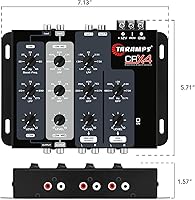
  • Dimensions: Unit measures 190mm x 145mm x 40mm (approximately 7.48″ x 5.71″ x 1.57″).
  • Weight: Unit weighs 560g (approximately 1.23 lb) without packaging.
  • Color: Available in black with a compact, low-profile enclosure design.
  • Availability: First made available in August 2013 and has remained in continuous production since.

Related Reviews
Timpano TPT-360 3-Way Electronic Crossover
85%
89%
Performance
85%
Ease of Installation
90%
Build Quality
88%
Sound Clarity & Balance
91%
Customization Options
More
Behringer CX3400 Stereo Audio Crossover
73%
83%
Signal Transparency
81%
Filter Performance
88%
Routing Flexibility
61%
Build Quality
79%
Limiter Effectiveness
More
Autotek ATEQ709 4-Band Audio Equalizer with 2-Way Crossover
86%
85%
Sound Quality
92%
Ease of Installation
80%
Build Quality
87%
User Interface
88%
Audio Clarity
More
PRV Audio EX4.6PRO 4-Way Electronic Crossover
82%
91%
Signal Quality
93%
Output Headroom
62%
Build Quality
84%
Value for Money
87%
Tuning Flexibility
More
PRV Audio EX3.5 Stereo 3-Way Electronic Crossover
80%
91%
Signal Clarity
83%
Frequency Control Flexibility
88%
Ease of Installation
67%
Build Quality
72%
Bass Boost Quality
More
Dual Electronics LU43PW 4″ Outdoor Wired Speakers

73%
84%
Value for Money
76%
Sound Quality
89%
Ease of Installation
67%
Weather Resistance
72%
Build Quality
More
Rockville RX230 2-Way Stereo/3-Way Mono Crossover
85%
91%
Sound Quality
88%
Build Quality
85%
Ease of Use
72%
Setup and Installation
89%
Subwoofer Control
More
Blaupunkt GTX 401 4-Inch Coaxial Car Speakers
70%
81%
Value for Money
67%
Sound Quality
43%
Bass Response
71%
Treble Clarity
74%
Midrange Performance
More
Taramps TEQ 7.4 7-Band Graphic Car Equalizer
77%
88%
Sound Improvement
91%
Value for Money
79%
Build Quality
83%
Ease of Installation
77%
EQ Flexibility
More
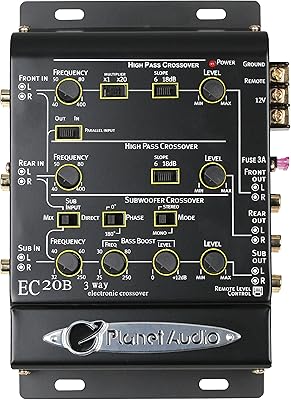
Planet Audio EC20B Car Electronic Crossover
72%
84%
Value for Money
81%
Ease of Installation
57%
Build Quality
76%
Bass Performance
72%
Signal Clarity
More

FAQ

It works with virtually any head unit that has RCA preamp outputs. The CRX4 accepts up to 8V RMS on its inputs, so it handles everything from basic factory-level signals all the way up to high-voltage aftermarket decks without clipping. Just make sure your head unit has RCA outputs — if it doesn't, you'd need a line output converter first.

You can connect up to four amplifier inputs simultaneously, one per output channel. That makes it practical for builds with separate amps handling subs, midbass, midrange, and tweeters. It's genuinely designed around multi-amp installations.

Yes, the bass boost on the Low channel operates independently and doesn't affect the other outputs. You can dial in the center frequency between 20Hz and 65Hz and leave the remaining three channels completely unaffected.

It's manageable for a confident DIYer, but the panel labeling can take a moment to interpret if you haven't used Taramp's gear before. The documentation in the box is minimal, so having a wiring diagram from the manufacturer's website or a forum handy before you start will save you frustration. The actual wiring connections themselves — power, ground, and RCA in and out — are straightforward once you understand the layout.

All the crossover points are adjustable via physical knobs on the unit, so you can fine-tune them at any time without rewiring anything. If your speakers aren't sitting right after the initial setup, just reach in and turn the corresponding knob — no software or special tools required.

In practice, no — not noticeably. The distortion rating is below 0.01% and the crosstalk rejection is above 80dB, which are solid numbers for an analog unit at this price. Most users report clean, quiet signal passing with no audible noise floor increase.

It needs its own dedicated power and ground wiring, plus a remote turn-on wire. It does not draw power through the RCA connections. The current draw is very low (under 0.4A at 12.6V), so it won't stress your electrical system.

The gain is fixed at 6dB when the bass boost is engaged, but you can effectively leave it unused by simply not using that function. There isn't a dedicated on/off switch for the boost, but setting the center frequency away from your target range minimizes its impact if you prefer a flatter response.

All channels use a 12dB per octave slope at the 8th order, which gives you a reasonably steep roll-off to keep unwanted frequencies from bleeding into adjacent channels. It's a standard slope for analog crossovers in this class and works well for most speaker and amplifier combinations.

Honestly, yes. Analog crossover design hasn't changed fundamentally in decades, and the CRX4's core job — splitting an RCA signal cleanly by frequency — is something it still does well. The specs hold up against newer competitors at a similar price, and the long sales history means there's a lot of real-world installation experience available in forums and communities if you run into questions.