Overview

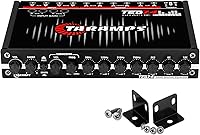
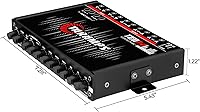
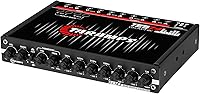
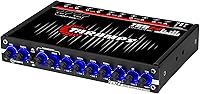
The Taramps TEQ 7.4 7-Band Graphic Car Equalizer comes from Taramps, a Brazilian audio brand that has earned genuine respect among car audio enthusiasts worldwide — though it may be unfamiliar to many North American buyers. Their gear has a strong track record in competitive audio circles, and this graphic EQ reflects that pedigree. It sits at an accessible price point, making real tonal control available without a serious budget commitment. At just 4″ x 3″ x 1″, it tucks cleanly under a dash or behind a panel. The blue LED accent looks sharp in a finished install, but the actual draw here is the flexibility it brings to your audio chain.
Features & Benefits

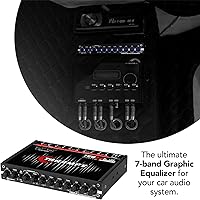
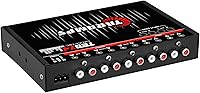
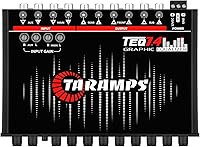
The TEQ 7.4 gives you seven frequency bands — 50Hz, 125Hz, 315Hz, 750Hz, 2.2kHz, 6kHz, and 12kHz — each adjustable by up to 12dB in either direction. That range is wide enough to tame a boomy trunk sub or add presence to flat-sounding factory speakers. What makes it genuinely useful is the three independent outputs: separate RCA channels for front, rear, and subwoofer, so each zone can be tuned individually. Two RCA inputs handle a main source and an auxiliary connection without rewiring. The fader control lets you shift the front-to-rear balance without touching your head unit, and a 100dB signal-to-noise ratio means the circuitry stays clean throughout.

Best For

This car audio equalizer is a strong pick for anyone stuck with a factory head unit that offers little to no built-in EQ adjustment — which covers a large share of daily drivers. It also suits DIY multi-amp builds where you need to split and shape a signal before it reaches separate amplifiers for different speaker zones. If you're integrating a subwoofer into an existing system, the dedicated sub output channel alone makes this worth a close look. Basic RCA wiring knowledge is all you need to install it. That said, if your head unit already includes a capable parametric EQ, the incremental gain from adding this unit is more modest.

User Feedback

Buyers consistently highlight the noticeable audio improvement after installation, particularly those upgrading from stock systems with compressed, lifeless sound. Build quality earns positive comments too — it feels more substantial than the small footprint implies. Installation goes smoothly for most people, though a handful of reviewers mention needing to dial in gain staging carefully to avoid clipping downstream amplifiers. The blue LED divides opinion: some love the subtle glow, others find it too bright for certain mounting locations. Long-term reliability appears solid based on current owner reports, with no recurring failure patterns. Against pricier options from brands like AudioControl, most buyers feel the TEQ 7.4 holds its own comfortably.

Pros

  • Seven adjustable EQ bands cover a wide enough frequency range to fix real-world audio problems like muddy bass or harsh highs.
  • Dedicated front, rear, and subwoofer RCA outputs make multi-amp signal routing clean and straightforward.
  • The fader control lets you adjust front-to-rear balance without touching your head unit settings.
  • A signal-to-noise ratio above 100dB means the circuitry adds minimal noise to your audio chain.
  • Dual RCA inputs allow a main and auxiliary source to stay connected simultaneously without rewiring.
  • Compact dimensions make it easy to mount discreetly under a dash or inside a console.
  • Build quality feels solid and more substantial than the small size suggests.
  • Installation is approachable for anyone familiar with basic RCA wiring — no special tools required.
  • The price point puts genuine EQ control within reach for budget-conscious upgraders.
  • Most buyers report a noticeable improvement in sound quality after installation, especially on factory-source systems.

Cons

  • The blue LED cannot be switched off, which may be unwanted in some mounting locations or interior aesthetics.
  • Gain staging requires careful setup — improper levels can cause clipping in downstream amplifiers.
  • Seven fixed frequency bands offer less precision than a parametric EQ or DSP for advanced tuning needs.
  • The brand is not well known in North America, which can make warranty support or local troubleshooting harder to find.
  • No digital display or visual feedback on band positions makes it easy to lose track of your settings after adjustments.
  • The unit must be mounted in a ventilated spot away from speakers, which can limit placement options in tight installs.
  • Buyers building a premium, acoustically tuned system will likely need to upgrade to a proper DSP processor before long.

Ratings

The scores below for the Taramps TEQ 7.4 7-Band Graphic Car Equalizer were generated by AI after analyzing verified global buyer reviews, with spam, bot-submitted, and incentivized feedback actively filtered out. Each category reflects the full spectrum of real ownership experience — not just the highlights — so both the strengths and the friction points are transparently represented here.
Sound Improvement
88%
Buyers consistently report a clearly audible difference after installation, particularly those upgrading from stock head units with weak or no built-in EQ. The ability to pull back boomy bass and add clarity to the midrange makes a real difference on daily commutes with factory speaker setups.
Users with already-capable aftermarket head units noticed only modest gains, suggesting the improvement is most dramatic when starting from a low baseline. A handful of reviewers noted that achieving the best results required more trial-and-error band adjustment than they expected.
Value for Money
91%
At its price point, the combination of three independent output channels, dual inputs, and clean signal specs is genuinely hard to match. Most buyers feel they are getting DSP-adjacent functionality without the steep cost of a full digital signal processor, which makes this a strong budget allocation for a multi-amp build.
A small number of buyers who compared it directly to more expensive units from AudioControl felt the feature gap justified spending more for serious builds. Those expecting premium packaging or included accessories at this tier were occasionally disappointed by the bare-bones unboxing experience.
Build Quality
79%
21%
The chassis feels more solid than the compact dimensions suggest, and the slider controls have a firm, tactile feel that instills confidence during adjustment. Several reviewers mentioned it held up well after months of daily use without any loosening of controls or connector degradation.
The enclosure is plastic rather than metal, which gives some buyers pause about long-term durability in high-heat mounting locations like under a dash in warmer climates. A few users noted the RCA jacks felt slightly loose compared to higher-end competitors, which raised concerns about connection reliability over time.
Ease of Installation
83%
The RCA-in, RCA-out design keeps the installation process clean and logical for anyone with basic car audio experience. Most reviewers described the process as taking under an hour, with clear labeling on the inputs and outputs that reduces the chance of wiring mistakes.
Buyers with no prior RCA wiring experience found the three-output routing more confusing than anticipated, particularly when integrating a subwoofer amplifier alongside front and rear amp channels. The included documentation is minimal, and several installers wished for a clearer wiring diagram in the box.
EQ Flexibility
77%
23%
Seven bands spanning 50Hz to 12kHz covers the most musically significant frequency ranges, and the 12dB cut and boost range per band gives enough headroom to make meaningful corrections rather than just subtle adjustments. For most daily-driver setups, this breadth of control is entirely sufficient.
Enthusiasts accustomed to parametric EQ or DSP control noted that the fixed center frequencies occasionally fall between the exact problem points they needed to address. The Q-factor of 1.414 produces a moderately wide filter curve, which means precise surgical corrections are not really possible with this unit.
Signal Cleanliness
86%
The 100dB signal-to-noise ratio translates to a noticeably quiet background — reviewers switching from budget alternatives reported a clear reduction in hiss and hum at idle. The 0.01% total harmonic distortion figure holds up in practice, with most users reporting clean, undistorted output even at higher gain settings.
A small number of users reported a faint ground loop hum when sharing a chassis ground with other components, which is a common installation issue rather than a unit defect but still worth noting. Proper grounding technique is essential to realize the full low-noise performance the specs suggest.
Subwoofer Integration
84%
Having a dedicated subwoofer RCA output that operates independently from the front and rear channels makes blending a sub into an existing system considerably easier. Reviewers building two-amp setups — one for speakers, one for a sub — particularly appreciated not needing a signal splitter or Y-adapter to accomplish this.
The subwoofer output carries a full-range signal, so users still need to rely on their subwoofer amplifier's built-in low-pass crossover for proper bass-only filtering. Those hoping for an integrated crossover on the sub output were left wanting more functionality than this unit provides.
Fader Control
74%
26%
The front-to-rear fader knob gives a quick and useful way to shift sound staging without navigating head unit menus, which is handy when switching between solo driving and carrying rear passengers. Reviewers who commute alone appreciated being able to push presence toward the front without permanently changing their system settings.
The fader control does not offer center detent feedback, making it difficult to return to a balanced center position by feel alone. Some users found the knob travel a bit short, leaving the adjustment feel less precise than they would like for critical listening.
AUX Input Utility
71%
29%
The secondary AUX RCA input is a practical feature for builds that involve a separate media source — such as a dedicated DAP or streaming device — running alongside the main head unit. Reviewers who use their vehicles for mobile DJ setups or long road trips with multiple sources found this particularly convenient.
There is no priority switching or automatic source selection between the Main and AUX inputs, so managing two simultaneous sources requires attention to gain staging on both channels. A few users found the lack of any input labeling on the physical unit made it easy to mix up Main and AUX when initially wiring the install.
Mounting & Fitment
82%
18%
The 4″ x 3″ x 1″ footprint is genuinely compact, and most reviewers had no trouble finding a discreet mounting location under the dash, in a center console, or behind a trim panel. The light weight means it does not require heavy-duty mounting hardware and stays put with basic double-sided tape or a small bracket.
The unit must be mounted in a ventilated area away from speakers to avoid vibration damage, which narrows the placement options in smaller vehicles or tightly packed installs. A couple of truck owners noted that finding a ventilated, vibration-free spot in a cab-forward configuration took more effort than expected.
Blue LED Lighting
63%
37%
For buyers who wanted a visual confirmation that their EQ is active, the blue LED glow is a clean and understated indicator that fits the look of a modern audio install. Several reviewers specifically mentioned it adds a polished, finished appearance to an exposed under-dash installation.
The LED cannot be disabled, which is a genuine annoyance for anyone mounting the unit in a visible location where ambient light at night is a concern. Opinions are split — some love the look, while others find it distracting during night driving, and there is no user option to dim or switch it off.
Brand Reputation
72%
28%
Among car audio enthusiasts — particularly those familiar with competitive SPL and sound quality builds — Taramps carries real credibility as a Brazilian brand with proven products. Buyers who researched the brand before purchasing were reassured by its track record and community presence in enthusiast forums.
North American buyers unfamiliar with Taramps sometimes expressed hesitation about warranty support and parts availability outside South America. The relatively low brand recognition in mainstream retail channels makes some buyers cautious, even though the product itself has largely earned positive reviews.
Packaging & Accessories
54%
46%
The unit arrives adequately protected for shipping, and most buyers received it without any cosmetic or functional damage. Some reviewers were pleased to find mounting hardware included, which covered the basics for a straightforward install.
The accessory package is minimal — no RCA cables are included, the manual is brief and lacks a helpful wiring diagram, and there is no mounting template. Buyers new to car audio installs noted they had to look online for guidance that should have been included in the box.
Long-Term Reliability
69%
31%
Based on current owner reports, units in regular use for six months or more have generally held up without control degradation or connector issues. Reviewers who installed the TEQ 7.4 in daily drivers reported consistent performance without needing to revisit gain settings or troubleshoot intermittent signal problems.
The product has a relatively short track record given its 2024 release date, so long-term durability data beyond one year is limited. A small percentage of buyers reported early failures, though it is unclear whether these stemmed from installation errors, electrical issues in the vehicle, or unit defects.

Suitable for:

The Taramps TEQ 7.4 7-Band Graphic Car Equalizer is an excellent fit for anyone driving a vehicle with a factory head unit that offers little meaningful tone control — which honestly describes the majority of cars on the road. If your stock stereo sounds flat, congested, or just plain dull, adding a dedicated graphic EQ inline with your RCA signal chain is one of the most cost-effective ways to fix that without tearing out your dash. It also works well for DIY builders assembling a multi-amplifier system, since the three independent RCA outputs let you feed separate amps for front speakers, rear speakers, and a subwoofer, all from a single unit. Subwoofer enthusiasts in particular will appreciate having a dedicated sub output they can tune independently, rather than relying on a high-pass crossover or amp-level controls alone. The straightforward RCA-in, RCA-out design keeps installation accessible for anyone comfortable with basic car audio wiring.

Not suitable for:

The Taramps TEQ 7.4 7-Band Graphic Car Equalizer is not the right tool for every situation, and it is worth being honest about where it falls short. If your aftermarket head unit already includes a built-in parametric EQ or digital signal processor with time alignment and precise crossover controls, stacking this graphic EQ on top of it adds complexity without meaningful benefit. Audiophiles chasing precision tuning — the kind that involves frequency sweeps, impulse response correction, or per-speaker delay adjustment — will outgrow a 7-band graphic EQ quickly and should look toward dedicated DSP processors from brands like Helix or MiniDSP instead. It is also not ideal for installations where interior visibility is a concern, since the blue LED, while subtle to some, can be distracting in certain mounting positions. Finally, buyers who have no experience with RCA-based signal routing may find the input and output labeling confusing at first, and wiring mistakes during installation could affect audio quality if gain staging is not handled carefully.

Specifications

  • EQ Bands: Features 7 graphic EQ bands centered at 50Hz, 125Hz, 315Hz, 750Hz, 2.2kHz, 6kHz, and 12kHz for broad tonal coverage across the audible spectrum.
  • Gain Range: Each EQ band can be cut or boosted by up to 12dB, allowing meaningful correction of both problem frequencies and desired tonal characteristics.
  • Inputs: Equipped with 2 stereo RCA inputs — one Main and one AUX — enabling two audio sources to be connected simultaneously without rewiring.
  • Outputs: Provides 3 independent stereo RCA outputs labeled Front, Rear, and Subwoofer, allowing separate signal routing to different amplifier zones.
  • Fader Control: Includes a dedicated front-to-rear fader control that adjusts the output balance between Front and Rear channels independently of the head unit.
  • Signal-to-Noise: Signal-to-noise ratio exceeds 100dB, indicating very low background noise relative to the audio signal for clean playback.
  • Distortion: Total harmonic distortion is rated at 0.01%, which is exceptionally low and reflects accurate signal reproduction with minimal coloration.
  • Frequency Response: Frequency response extends from 6Hz to 55kHz at -1dB, covering well beyond the standard audible range in both directions.
  • Input Impedance: Input impedance is rated at 10k Ohms, making it compatible with the preamp outputs of virtually all standard car head units.
  • Output Impedance: Output impedance is 100 Ohms, suitable for driving the RCA inputs of most car amplifiers without signal degradation.
  • Max Signal Level: Maximum input and output level is 28.28Vpp (10 VRMS), accommodating high-voltage preamp outputs from premium head units.
  • Supply Voltage: Operates on 9 to 15VDC, making it fully compatible with standard 12V automotive electrical systems.
  • Crosstalk: Channel crosstalk is rated above 80dB at 1kHz, meaning left and right audio channels remain well isolated from each other.
  • Q-Factor: EQ band Q-factor is 1.414, producing a moderately wide filter curve that affects a musical range of frequencies around each center point.
  • Dimensions: The unit measures 4″ long by 3″ wide by 1″ tall, making it compact enough for under-dash or console mounting in most vehicles.
  • Weight: Weighs 1.76 pounds, which is light enough for easy surface or bracket mounting without structural concerns.
  • Power Source: Powered directly from the vehicle's DC electrical system via a dedicated power connection; no external power supply is required.
  • Lighting: Features blue LED illumination that activates with the unit, adding a visual indicator that the unit is powered on.
  • Connector Type: All audio connections use standard RCA connectors, which are universally compatible with car audio amplifiers and head units.
  • Voltage Range: The supply voltage tolerance of 9–15VDC provides resilience against minor fluctuations typical in automotive electrical environments.

Related Reviews
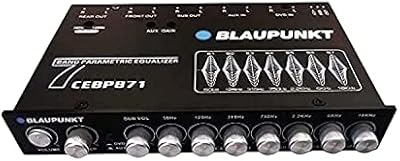
Blaupunkt CEBP871 7-Band Car Audio Graphic Equalizer
86%
89%
Sound Quality
91%
Ease of Installation
85%
Customization Options
87%
Input Versatility
82%
Build Quality
More
DS18 EQX7 7-Band Graphic Equalizer
85%
88%
Sound Quality
90%
Bass Performance
82%
Ease of Installation
85%
Build Quality
87%
Frequency Range
More
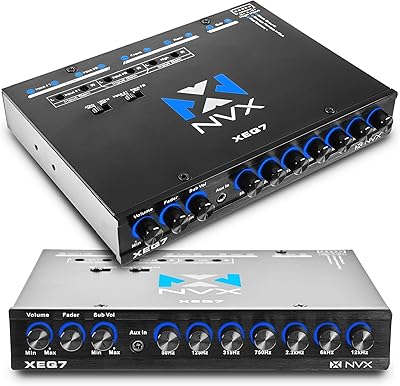
NVX XEQ7 7-Band Graphic Equalizer
86%
87%
Sound Performance
92%
Ease of Installation
90%
Bass Control
83%
Build Quality
88%
Connectivity Options
More
Audiotek AT-EQ700 7 Band Car Audio Equalizer
85%
91%
Bass Control
84%
Ease of Installation
87%
Sound Quality
85%
Compatibility with Audio Devices
92%
Customizability (Frequency Bands)
More
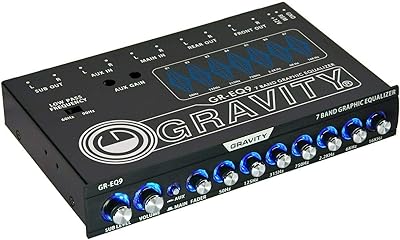
Gravity GR-EQ9 7-Band Graphic Equalizer
82%
89%
Sound Quality
85%
Ease of Installation
90%
Bass Control
80%
Build Quality
82%
User Interface
More
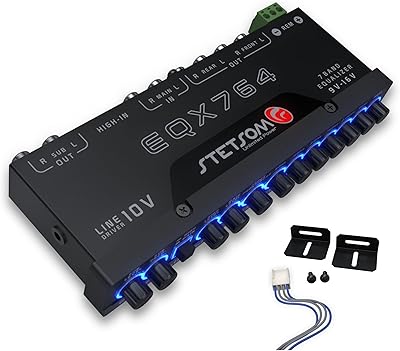
Stetsom EQX764 7-Band Car Audio Equalizer
85%
91%
Sound Quality Enhancement
89%
Ease of Installation
93%
Bass Control
85%
Frequency Band Flexibility
88%
Output Channels
More
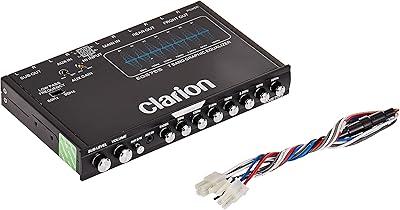
Clarion EQS755 7-Band Car Audio Equalizer
85%
89%
Sound Quality
85%
Connectivity Options
92%
Ease of Installation
87%
Build Quality
90%
Subwoofer Control
More
TOPSTRONGGEAR TSG7EQ 7-Band Car Graphic Equalizer
76%
84%
Sound Quality Improvement
61%
Build Quality
78%
Installation Ease
82%
Value for Money
88%
RCA Output Performance
More
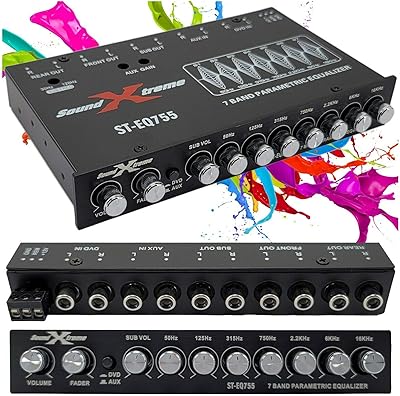
SoundXtreme ST-EQ755 Car Audio Equalizer
73%
83%
Sound Improvement
81%
Value for Money
74%
Installation Experience
78%
Preamp Output Quality
58%
Build Quality
More
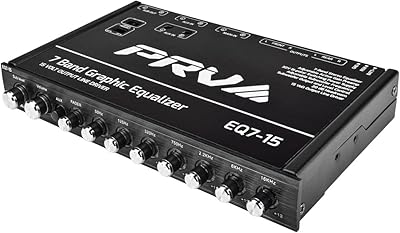
PRV AUDIO EQ7-15 7 Band Graphic Equalizer
83%
91%
Sound Performance
85%
Ease of Installation
80%
Build Quality
88%
Ease of Use
92%
Value for Money
More

FAQ

For most people coming from a factory head unit, the difference is immediately noticeable — especially in the low and mid frequencies. You gain real control over things like boomy bass, nasal midrange, or harsh treble that factory EQ curves can't fix. It is a meaningful upgrade, not just a tweak.

Not at all. The TEQ 7.4 sits in-line between your head unit and your amplifier or speakers using standard RCA cables. As long as your head unit has RCA preamp outputs, you connect it without touching the head unit itself. If your head unit lacks RCA outputs, you would need a line output converter first.

If you are comfortable running RCA cables and have done basic car audio wiring before, the install is straightforward. You connect one or two RCA inputs from your source, route the three output RCAs to your amps or processor, and run a 12V switched power wire. The main thing to be careful about is labeling your connections correctly before you tuck everything away.

The unit accepts both inputs simultaneously, but how they blend depends on your source setup and gain settings. Typically, you would use Main for your primary head unit signal and AUX for a secondary source like a separate media player. Check your specific wiring configuration to make sure the two sources do not interfere with each other.

The LED is tied to the unit's power — when the equalizer is on, the light is on. There is no dedicated switch to disable it. If the glow is a concern for your install location, mounting it out of direct sightlines is the practical solution.

A graphic EQ like this one lets you cut or boost fixed frequency bands manually, which is great for correcting tonal balance and integrating a subwoofer. A DSP processor goes further — it can apply time alignment, digital crossovers, and impulse response correction on a per-speaker basis. The TEQ 7.4 is the right choice for most everyday builds; a DSP makes more sense when you need precise acoustic tuning for a high-end audio setup.

Yes, that is exactly what the dedicated subwoofer output is designed for. It carries the full-range signal, so you would typically handle the low-pass filtering at the subwoofer amplifier itself. This lets you run your sub amp independently from your front and rear speaker amplifiers without any signal splitter or Y-adapter.

Taramps is a well-established Brazilian car audio manufacturer with a strong following in the competitive audio and enthusiast community, particularly in South America. Their amplifiers and signal processors are widely used in serious builds. They may be less visible in North American retail, but the brand has a solid reputation among people who follow the car audio scene closely.

Boosting bands aggressively without matching your downstream amplifier gain can push the signal into clipping, which sounds like distortion and can stress your speakers over time. The safe approach is to set your EQ adjustments moderately and then calibrate your amplifier gain with the EQ in the chain. Starting flat and making incremental adjustments is always better than dialing in everything at once.

It works in any 12V vehicle — cars, trucks, SUVs, and vans. The supply voltage range of 9 to 15VDC covers standard automotive electrical systems across all vehicle types. The compact size actually makes it easier to find a mounting spot in tighter cab configurations like trucks where under-dash real estate is limited.

Where to Buy