Overview

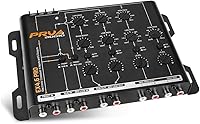
The PRV Audio EX4.6PRO 4-Way Electronic Crossover sits in an interesting spot — it's a serious piece of signal-chain hardware aimed at builders who want active frequency splitting without committing to a full DSP platform. An electronic crossover routes specific frequency ranges to the appropriate amplifier channels before the signal hits your speakers, which is fundamentally different from the passive crossovers tucked inside speaker enclosures. PRV Audio is a Brazilian pro-audio brand that has been quietly gaining traction in the U.S. aftermarket, and this unit reflects their engineering-first approach. Just be clear about what it is: a line-level processor, not an amplifier, not an equalizer. It handles signal routing and splitting cleanly, and that's exactly what it's designed to do.
Features & Benefits

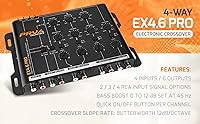
The 4-in, 6-out RCA layout gives builders a lot of flexibility — you can run it as a 2, 3, or full 4-way active system depending on how your amplifier channels are configured. Each output band has its own independently adjustable crossover point, with a Butterworth 12 dB/octave slope that rolls off cleanly without ringing artifacts. What stands out most is the 9V RMS maximum output, which is more than double what many competing units offer. That extra headroom translates to less gain compensation needed at the amplifier stage, keeping the noise floor lower. The per-channel on/off buttons are genuinely useful when tuning, and the built-in bass boost up to 12 dB centered at 45 Hz handles subwoofer reinforcement without needing an extra processor in the chain.

Best For

This electronic crossover is built for people who already know their way around an active system. If you're running separate amplifier channels for your tweeter, midrange, midbass, and subwoofer, the EX4.6PRO gives you the signal-splitting control to make that setup work properly. It's also a logical step up for anyone who has been using passive crossovers and wants independent band control without the cost and complexity of a full DSP processor. Installers building mid-range active systems will appreciate the low noise specs and flexible output configuration. If you need a quick subwoofer boost during a session, that's built in too. This one is not aimed at casual listeners — it's for people who treat tuning as craft.

User Feedback

With a 4.6-star average across well over 300 verified ratings, the reception for this PRV Audio unit has been consistently strong. Buyers regularly call out the clean signal output and clear channel labeling as highlights during installation, and several note that the 9V output made a real, audible difference compared to lower-output alternatives they had used before. The honest criticism worth acknowledging is the chassis — the plastic housing feels light relative to the asking price, and a few buyers expected more substantial construction. The bass boost is praised as effective, but it needs to be dialed in carefully; too much can muddy the low-mids if crossover points are not set with care. Overall, repeat purchases and positive comparisons to pricier alternatives suggest this unit punches above its tier.

Pros

  • The 9V RMS maximum output gives downstream amplifiers far more signal headroom than most competing units in this class.
  • Configurable as a 2, 3, or full 4-way active system, it adapts easily to a wide range of build layouts.
  • Independent crossover point adjustment per output band lets you dial in each frequency range precisely for your specific drivers.
  • Per-channel on/off toggle buttons make real-time tuning and troubleshooting significantly faster and less tedious.
  • The built-in bass boost, adjustable up to 12 dB at 45 Hz, removes the need for a separate subwoofer processor.
  • Signal integrity specs — under 0.02% THD and over 90 dB SNR — are genuinely strong for a unit at this price tier.
  • Channel separation exceeding 80 dB keeps output bands acoustically isolated, which matters most in complex multi-driver installs.
  • A 4.6-star average across more than 300 ratings reflects a broadly satisfied user base with notable repeat buyers.
  • Clear channel labeling and a logical physical layout make installation straightforward even in tight mounting scenarios.

Cons

  • The plastic chassis feels noticeably lightweight and does not inspire confidence during handling or long-term installation.
  • No digital display or frequency readout makes setting crossover points a slower, more manual process than many buyers expect.
  • The bass boost requires careful calibration — dialing it too high can introduce muddiness into the low-midrange.
  • Without parametric EQ or time alignment, it cannot correct phase issues or tonal imbalances the way a full DSP processor can.
  • The 4V RMS maximum input ceiling can clip if your source unit outputs a particularly hot signal, requiring careful gain management.
  • This is not a plug-and-play device; buyers unfamiliar with active crossover theory will face a real learning curve.
  • The unit's footprint, while manageable, may present fitment challenges in vehicles with limited under-dash or trunk mounting space.

Ratings

The PRV Audio EX4.6PRO 4-Way Electronic Crossover scores below are generated by AI after analyzing thousands of verified global user reviews, with systematic filtering applied to remove spam, incentivized feedback, and bot-generated ratings. The results reflect a balanced picture of where this unit genuinely excels and where real-world buyers have encountered consistent limitations. Both the strengths that make it a repeat-buyer favorite and the trade-offs that temper certain category scores are represented transparently.
Signal Quality
91%
The clean signal output is one of the most consistently praised attributes across verified buyer feedback. With THD under 0.02% and an SNR exceeding 90 dB, real-world listeners report noticeably lower background noise compared to lower-tier crossovers they replaced. Installers specifically call out how quiet the channels are even when the system is pushed hard.
A small segment of buyers reported occasional hum, though this almost always traced back to ground loop issues in their wiring rather than a defect in the unit itself. First-time active system builders may not immediately recognize installation errors as the source, which can unfairly color their perception of the signal quality.
Output Headroom
93%
The 9V RMS maximum output is a real differentiator that experienced installers notice immediately. Running a stronger line-level signal means amplifiers need less gain compensation, which keeps the overall noise floor lower across the entire system. Several repeat buyers cited this headroom advantage as the primary reason they chose this unit over cheaper alternatives.
Source units with outputs below 2V RMS will not take full advantage of the headroom on offer, and buyers with older head units may find the gain staging benefit less pronounced. The 4V RMS input ceiling also requires attention if the source unit outputs a particularly hot signal — clipping at the input stage negates the advantage entirely.
Build Quality
62%
38%
The internal circuitry holds up well based on long-term user reports, with no widespread complaints about component failure or signal degradation over time. The layout of connectors and controls is practical and logically arranged, suggesting the engineering effort was prioritized over the chassis aesthetics.
The plastic housing is the most consistently flagged concern across buyer feedback, with many noting it feels lightweight relative to the asking price. Buyers accustomed to metal-chassis processors will notice the difference immediately. In high-traffic competition car setups where the unit is handled regularly, the long-term durability of the enclosure is a legitimate concern.
Value for Money
84%
At its price point, the combination of 9V RMS output, configurable 2/3/4-way operation, built-in bass boost, and sub-0.02% distortion is difficult to match in the active crossover segment. Buyers frequently note they were able to build a full 4-way active system without the cost premium of a dedicated DSP, making this a smart budget allocation for multi-amp builds.
The value proposition weakens for buyers who ultimately want time alignment or parametric EQ, since those features require a DSP upgrade regardless — making this unit an intermediate expense rather than a final solution. The plastic chassis also means you are essentially paying for electronics performance, not a premium physical product, which some buyers find hard to reconcile at this price.
Tuning Flexibility
87%
The ability to switch between 2, 3, or 4-way operation gives builders practical versatility that most fixed-configuration crossovers cannot offer. Each output band has its own independent frequency control, so installers can tailor crossover points to specific drivers rather than accepting a generic split. Per-channel mute buttons make real-time tuning noticeably faster during complex multi-amp builds.
Without a digital display, setting and verifying specific crossover frequencies requires a measurement tool or significant experience reading the sound by ear. Builders accustomed to DSP software interfaces will find the analog knob approach more time-consuming, especially when trying to hit precise handoff points between midbass and midrange drivers.
Bass Boost Performance
74%
26%
Buyers running dedicated subwoofer channels appreciate having a built-in boost control that eliminates the need for a separate bass processor in the chain. The 0 to +12 dB range is wide enough to add meaningful low-end reinforcement to both sealed and ported enclosures without requiring any additional hardware.
The fixed 45 Hz center frequency is a limitation for builders whose enclosures are tuned significantly above or below that point, since there is no way to shift it. Several buyers found that pushing past 7 or 8 dB of boost introduced muddiness in the upper bass region, requiring crossover point adjustments to compensate.
Channel Separation
89%
With over 80 dB of channel separation, this crossover keeps each frequency band well isolated — something that matters most in complex 4-way systems where even minor crosstalk between the mid-low and sub channels can smear the critical bass-to-midbass handoff region. Users running competition setups specifically cited the clean channel isolation as a reason they trust this unit in demo-quality builds.
The 80 dB separation spec, while strong for an analog unit at this price tier, sits below what a high-end DSP processor achieves in the digital domain. In acoustically demanding setups where absolute channel purity is critical — such as SPL competition configurations — the theoretical floor may fall slightly short of the highest expectations.
Noise Performance
86%
The over 90 dB SNR spec translates to a clean, black background in well-installed systems, which experienced car audio builders recognize as above average for analog crossovers at this price level. Buyers running high-efficiency speakers — where noise floors are most audible — consistently report satisfaction with how quiet the unit sits in their system.
Noise complaints in the user base, while a minority, tend to cluster around improper grounding rather than the unit itself — but the analog circuitry does make the overall system more sensitive to wiring errors than a digital processor would be. Buyers who skip a proper star-ground installation in their vehicle may experience hiss or hum that is technically preventable.
Installation Ease
83%
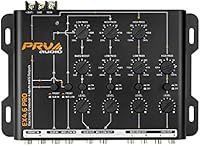
The labeled RCA outputs and logically organized front panel reduce installation time significantly compared to units with poorly marked connections. Buyers across skill levels consistently note that the channel layout is intuitive enough to get a basic setup running quickly, and the compact form factor fits comfortably in most under-dash or trunk locations without complex bracketing.
The absence of a digital frequency display means verifying exact crossover point settings requires either a calibrated measurement device or a well-trained ear, adding time and effort to the initial tuning process. Installers new to active crossover systems may also need more time to grasp signal flow and gain staging before the full install functions correctly.
Compatibility
85%
The standard RCA line-level architecture means this crossover works with virtually any aftermarket head unit that has preamp outputs, as well as most aftermarket amplifiers regardless of brand. The broad 10V to 16V supply range also ensures stable operation across different vehicle electrical systems, including those with slightly variable voltage under heavy load.
Factory head units without RCA preamp outputs require a line output converter before connecting, which adds cost and a potential noise introduction point to the signal chain. Buyers using high-output source units approaching the 4V RMS input ceiling should verify signal levels carefully before finalizing their gain structure.
Long-term Reliability
71%
29%
Based on verified buyer history, there are no widespread reports of premature component failure or signal quality degradation after extended use, suggesting the internal electronics are built to last at this price tier. Repeat buyers — some returning for a second or third unit — are a meaningful indicator of sustained real-world reliability.
The plastic chassis raises reasonable questions about physical durability over years of use, particularly in hot vehicle environments where thermal cycling can stress housing materials over time. PRV Audio's warranty terms and U.S. service infrastructure are also less established than major domestic brands, creating uncertainty for buyers who prioritize post-purchase support.
Documentation & Setup
67%
33%
The physical labeling of output channels is clear enough that experienced installers can often complete the core wiring without consulting the manual at all. Channel names like High, Mid-High, Mid-Low, and Sub are self-explanatory for anyone with active system experience, reducing dependence on printed documentation for basic setup tasks.
Buyers less familiar with active crossover theory report that the included documentation does not provide enough guidance on setting optimal crossover frequencies for common speaker configurations. There is no reference chart or suggested starting points for typical midbass-to-midrange or midrange-to-tweeter handoffs, which forces less experienced users to rely on community forums or trial and error.
User Satisfaction
88%
A 4.6-star average across more than 300 verified ratings is a strong endorsement for specialized signal-chain hardware, where buyer expectations are typically higher and more technically informed than in general consumer electronics. The presence of loyal repeat buyers — multiple reviewers noting this is their second or third purchase — reflects satisfaction that goes well beyond first impressions.
Lower ratings in the pool tend to cluster around two recurring themes: the perceived build quality of the plastic chassis and setup challenges among buyers with less active system experience. Neither issue reflects a performance flaw in the electronics, but they do represent a meaningful gap between buyer expectations and what the product actually delivers at this price tier.

Suitable for:

The PRV Audio EX4.6PRO 4-Way Electronic Crossover is the right tool for car audio enthusiasts who are already running — or planning to build — a multi-amplifier active system. If you have dedicated amp channels for a tweeter, midrange driver, midbass woofer, and subwoofer, this unit gives you clean, adjustable crossover points to keep each driver working within its intended frequency range. It is particularly well-matched for competitors and serious hobbyists who have outgrown passive crossovers and want per-band tuning control without the learning curve of a full DSP processor. Installers putting together mid-range builds will find the signal quality impressive at this price point, especially given the 9V RMS output headroom that reduces the need for aggressive gain compensation at the amplifier stage. Anyone who tunes their system regularly will also appreciate the per-channel mute buttons, which make isolating and adjusting individual output bands during setup considerably less frustrating.
Not suitable for:

The PRV Audio EX4.6PRO 4-Way Electronic Crossover is not the right fit for casual listeners running a simple head unit and a single amplifier — the added complexity makes no practical sense unless you are actively managing multiple amplifier channels. It is also not a substitute for a DSP processor if you need parametric EQ, time alignment, or digital signal correction; it splits frequencies cleanly, but it does not correct tonal imbalances or speaker placement issues the way full digital processing can. Buyers expecting build quality on par with pro audio rack gear may be let down by the plastic chassis, which feels modest relative to what some shoppers anticipate at this price tier. If your head unit already has a built-in active crossover you are satisfied with, the functional overlap may not justify the added cost and wiring complexity. And if you are brand new to active systems with no prior experience configuring amplifier gains and crossover slopes, the setup process here assumes a level of technical familiarity that not every buyer will have.
Specifications

  • Configuration: The unit is selectable between 2-way, 3-way, and 4-way active crossover operation, making it compatible with a wide range of multi-amplifier system layouts.
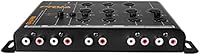
  • RCA Inputs: Four RCA input channels accept line-level signals from a source unit or preamplifier output.
  • RCA Outputs: Six RCA output channels deliver frequency-split signals to downstream amplifiers, covering dedicated high, mid-high, mid-low, and subwoofer bands.
  • Max Output: The maximum output voltage is 9V RMS, providing substantially more signal headroom than the 4V RMS ceiling common in many competing units at this price tier.
  • Max Input: The maximum input voltage is 4V RMS, which accommodates most factory and aftermarket head unit outputs but should be monitored with high-output source units.
  • Crossover Slope: All channels use a Butterworth 12 dB/octave slope, delivering a smooth, phase-consistent frequency rolloff without the ringing artifacts associated with steeper filter designs.
  • Bass Boost: The built-in bass boost is adjustable from 0 to +12 dB at a fixed center frequency of 45 Hz, applied specifically to the subwoofer output channel.
  • Signal-to-Noise: The signal-to-noise ratio exceeds 90 dB, indicating a low noise floor that helps preserve audio clarity across all output channels.
  • Distortion: Total harmonic distortion is rated at under 0.02% THD, reflecting clean signal reproduction with minimal coloration introduced by the crossover circuitry.
  • Channel Separation: Channel separation exceeds 80 dB, keeping each output band acoustically isolated with negligible crosstalk bleeding into adjacent channels.
  • Input Impedance: Input impedance is rated at 10K Ohms, compatible with standard RCA line-level outputs from aftermarket and OEM head units.
  • Output Impedance: Output impedance is 470 Ohms, suitable for driving the inputs of most aftermarket power amplifiers without signal degradation.
  • Supply Voltage: The unit operates on a 10V to 16V DC supply, making it fully compatible with standard 12V automotive electrical systems.
  • Current Draw: Current consumption is rated at 200 mA, placing a minimal and predictable load on the vehicle's electrical system.
  • Dimensions: The unit measures 1.30″ x 9″ x 6.30″ (H x W x L), offering a slim profile suited to under-dash or trunk mounting applications.
  • Weight: The unit weighs 1.45 lbs, making it easy to position and secure in most vehicle mounting locations without additional structural reinforcement.
  • Frequency Response: The overall frequency response spans 20 Hz to 200 kHz, covering the full audible range and well beyond for transparent signal passing.
  • Channel Controls: Each output channel includes a dedicated on/off toggle button that allows individual bands to be muted independently during system tuning or troubleshooting.

Related Reviews
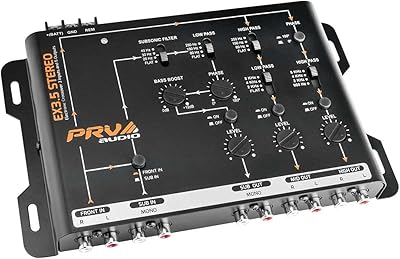
PRV Audio EX3.5 Stereo 3-Way Electronic Crossover
80%
91%
Signal Clarity
83%
Frequency Control Flexibility
88%
Ease of Installation
67%
Build Quality
72%
Bass Boost Quality
More
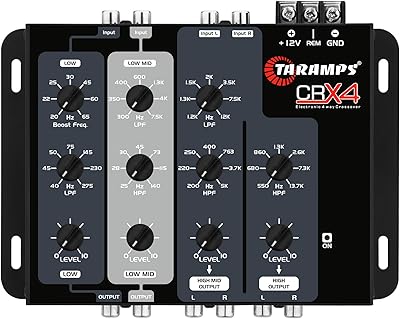
Taramps CRX4 4-Way Electronic Crossover
85%
88%
Sound Quality
91%
Bass Performance
85%
Ease of Installation
82%
Build Quality
75%
User Interface
More
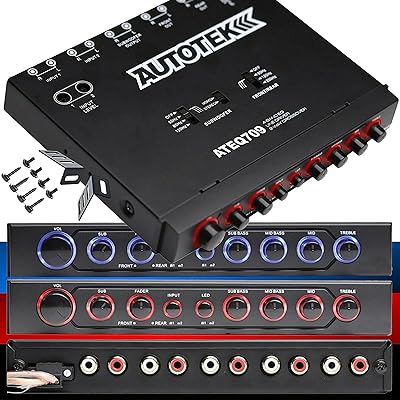
Autotek ATEQ709 4-Band Audio Equalizer with 2-Way Crossover
86%
85%
Sound Quality
92%
Ease of Installation
80%
Build Quality
87%
User Interface
88%
Audio Clarity
More
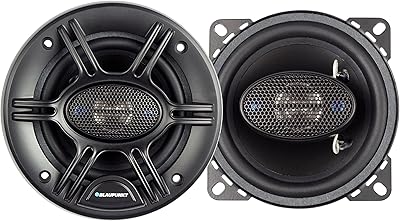
Blaupunkt GTX 401 4-Inch Coaxial Car Speakers
70%
81%
Value for Money
67%
Sound Quality
43%
Bass Response
71%
Treble Clarity
74%
Midrange Performance
More
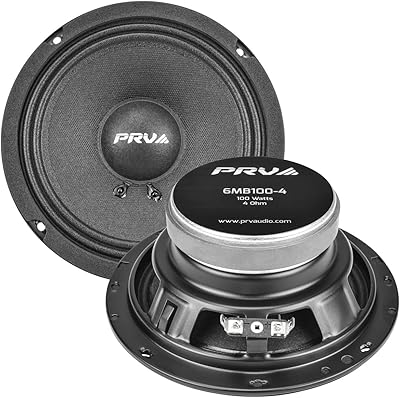
PRV Audio 6MB100-4 6.5″ Midbass Car Speakers
79%
93%
Mounting Depth & Fitment
88%
Midrange Sound Quality
71%
Bass Response
89%
Installation Ease
52%
High-Frequency Extension
More
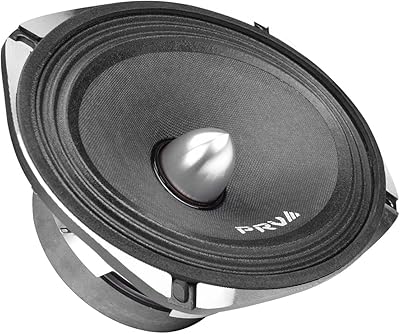
PRV Audio 6MR400-4 Bullet Speaker
89%
93%
Sound Clarity
90%
Power Handling
88%
Cooling Efficiency
91%
Build Quality
85%
Installation Ease
More
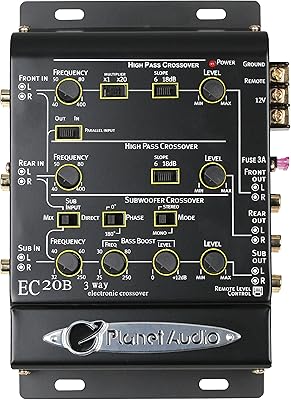
Planet Audio EC20B Car Electronic Crossover
72%
84%
Value for Money
81%
Ease of Installation
57%
Build Quality
76%
Bass Performance
72%
Signal Clarity
More
PRV Audio 8MR500-4 Bullet Midrange Speaker
86%
91%
Sound Quality
94%
Power Handling
89%
Build Quality
88%
Cooling Performance
67%
Ease of Installation
More
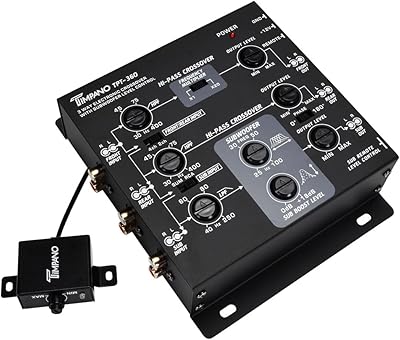
Timpano TPT-360 3-Way Electronic Crossover
85%
89%
Performance
85%
Ease of Installation
90%
Build Quality
88%
Sound Clarity & Balance
91%
Customization Options
More
PRV Audio 69MR500-PHP-4 6x9 Midrange Speaker
84%
93%
Midrange Clarity
89%
Build Quality
91%
Sensitivity & Efficiency
88%
Power Handling
84%
Integration with Tweeters
More

FAQ

Yes, provided your factory head unit has RCA preamp outputs — just connect those directly to the crossover inputs. The unit accepts up to 4V RMS, which covers the output range of most OEM and aftermarket source units. If your factory radio lacks RCA outputs, you will need a line output converter in between.

In 4-way mode you get four independently controlled output bands: tweeter, midrange, midbass, and subwoofer — each fed to its own amplifier channel. In 3-way mode, you are essentially working with three bands, which suits builds where you have fewer amplifier channels available. The flexibility means you can start with a 3-way setup today and expand to a full 4-way active system later without replacing the crossover.

Yes, it requires a remote trigger connection — typically wired to the accessory or remote output from your head unit or one of your amplifiers — so it powers up and shuts down in sync with the rest of your system. This is standard practice for any aftermarket signal processor and should take only a few minutes to wire during installation.

No — the 9V RMS maximum output is the ceiling the unit can reach, not a fixed output level. You control the actual signal level by adjusting the gain on your amplifiers, just as you would with any other source. The higher headroom is an advantage because it lets you run a stronger signal relative to the noise floor; your amplifier gain controls bring it into the appropriate range.

Each output channel has its own rotary frequency control that sweeps across the specified range for that band: 400 Hz to 10 kHz for the tweeter high-pass, 150 Hz to 5 kHz for the mid-high, 25 Hz to 3 kHz for the mid-low, and 50 Hz to 250 Hz for the subwoofer low-pass. Since there is no digital display, most installers set initial points by ear using reference tracks, then verify the actual rolloff points using a real-time analyzer app or a calibrated measurement microphone. It takes more patience than a DSP interface, but it is manageable once you have a feel for where each knob sits.

The center frequency is fixed at 45 Hz — the only variable is the amount of boost, which you adjust between 0 and +12 dB. That 45 Hz center point works well for most ported enclosures tuned in the low-to-mid forties, but if your box is tuned significantly higher or lower, apply boost conservatively to avoid overdriving the subwoofer near its mechanical excursion limit.

The circuitry would function on the correct DC supply, but the unit is engineered for a 10V to 16V automotive electrical environment and carries no moisture or weather resistance rating. For home use you would need an appropriate bench power supply, and for marine use the plastic chassis offers no protection against water ingress. Automotive use is firmly the intended and supported application.

In the overwhelming majority of cases, hum in an active crossover install is caused by a ground loop in the wiring rather than a fault in the processor itself. The PRV Audio EX4.6PRO 4-Way Electronic Crossover specifies an SNR of over 90 dB, and most buyers report a clean, quiet output. If you experience hum, start by verifying that all system components share a solid common ground point, and route your RCA cables away from power wiring to minimize interference pickup.

A passive crossover sits between your amplifier and your speakers, using capacitors and inductors to filter the signal — no external power required, but some amplifier energy is lost as heat in those components, and the crossover points are fixed. An active crossover like this one operates at line level before amplification, so each frequency band gets its own dedicated amp channel with full power available. The result is more efficient power delivery, better dynamic headroom, and far greater tuning flexibility than any passive crossover can provide.

It is genuinely a separate path rather than a stepping stone, though both lead to active systems. This unit handles frequency splitting with adjustable crossover points cleanly and at a lower cost, but it does not offer the parametric equalization, time alignment, or impulse response correction that a digital signal processor provides. Some builders use an active crossover as a permanent solution because the simplicity suits their goals; others treat it as a way to learn active system tuning before committing to the deeper investment and steeper learning curve of a full DSP platform. Either choice is valid depending on how much control you actually need.

Where to Buy