Overview

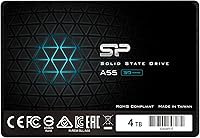
The SP Silicon Power A55 4TB SATA SSD comes from Silicon Power, a Taiwanese manufacturer that has spent years building credibility in the budget-to-mid-range storage market. Four terabytes in a 2.5-inch form factor is genuinely rare at this price tier, making it appealing for anyone who needs bulk local storage without moving into pricier NVMe territory. The drive uses a standard SATA III interface and measures just 7mm thin, so it fits comfortably in most laptops and desktops. A 3-year limited warranty is included, though activating full coverage requires registering on Silicon Power's official website — a small but easy-to-miss step worth completing right after installation.
Features & Benefits

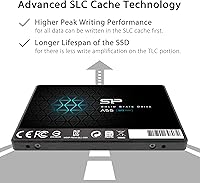
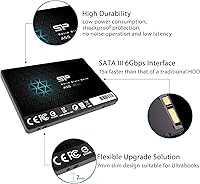
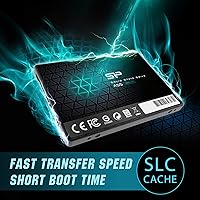
This SATA solid-state drive uses 3D NAND flash, which stacks memory cells vertically rather than sprawling them flat — a design that improves storage density, extends cell longevity, and keeps manufacturing costs down. Silicon Power also builds in SLC caching, where a portion of the NAND acts as a faster temporary buffer during write-heavy bursts. That cache helps considerably for everyday tasks, but sustained write speeds drop noticeably once it fills, which matters if you regularly move large batches of files. Sequential reads reach around 560 MB/s — fast compared to any hard drive, but clearly SATA territory rather than NVMe. The slim 7mm chassis and low power draw make it especially practical for laptop use.

Best For

The A55 4TB SSD is a natural fit for anyone pulling an aging hard drive from a laptop or desktop and wanting a serious capacity upgrade without paying NVMe prices. It works equally well as a secondary storage drive in a desktop where the primary slot already holds a faster M.2 drive — think photo libraries, game installs, or video archives. Students and home users consolidating files into one large drive will appreciate the straightforward setup and broad compatibility. Older machines with only SATA ports get a meaningful second life here, since no M.2 slot is required. Content creators managing large but non-time-sensitive archives will find it a practical choice as well.

User Feedback

With over 12,000 ratings and a 4.5-star average, this Silicon Power drive has earned broadly positive feedback from real buyers. Most praise focuses on easy installation and reliable day-to-day performance for tasks like web browsing, document work, and media playback. Longevity reports are encouraging — users who have owned the drive for a year or more generally report no failures or data integrity issues. On the critical side, some buyers flag that speeds dip during large file transfers once the SLC cache is saturated. A handful also mention that the warranty registration process feels unnecessarily cumbersome, and Silicon Power's customer support response times have drawn occasional complaints worth keeping in mind.

Pros

  • Four terabytes of storage capacity is rare and genuinely useful for consolidating media libraries or large game collections onto one drive.
  • Drop-in compatibility with any standard 2.5-inch SATA bay means installation rarely requires additional hardware or adapters.
  • The 7mm slim profile fits ultrabooks and ultra-slim laptops that stricter thickness tolerances would otherwise rule out.
  • Real-world read speeds around 550 MB/s make everyday computing feel dramatically faster compared to any mechanical hard drive.
  • 3D NAND construction improves cell endurance and density, giving the drive a better long-term reliability profile than older planar NAND designs.
  • Shock-resistant build makes this SATA solid-state drive a practical choice for laptops that get moved around regularly.
  • Low power consumption helps extend battery life on laptops, a meaningful advantage over spinning drives during mobile use.
  • Over 12,000 buyer ratings with a strong average score signals a large base of satisfied, real-world users across varied setups.
  • Buyers report stable, issue-free performance after one to two years of continuous use, which is reassuring for a budget-tier drive.
  • SLC caching provides a solid burst-write buffer that keeps everyday file operations feeling snappy for typical workloads.

Cons

  • Sustained write speeds drop significantly once the SLC cache is saturated, making large single-session transfers noticeably slower.
  • SATA III throughput is fundamentally capped well below what modern NVMe drives deliver, leaving performance on the table in capable systems.
  • Full warranty coverage requires manual product registration on Silicon Power's website — easy to overlook and frustrating if skipped.
  • Silicon Power's customer support response times have drawn criticism from some buyers, which is worth considering before committing.
  • No included mounting bracket or spacer means buyers with 9.5mm drive bays may need a separate adapter to secure the drive properly.
  • The brand carries less recognition than established names like Samsung or Crucial, which may affect resale value or buyer confidence.
  • Write-heavy workloads like frequent large backups or ongoing video renders will consistently push past the cache buffer and expose slower base speeds.
  • No hardware encryption support is listed, which limits suitability for users with data security or compliance requirements.

Ratings

Our AI rating system analyzed thousands of verified global purchases of the SP Silicon Power A55 4TB SATA SSD, actively filtering out incentivized reviews, duplicate submissions, and suspicious rating patterns to surface what real buyers actually experience. The scores below reflect both the genuine strengths that keep this drive consistently well-rated and the honest trade-offs that affect specific use cases. Whether this drive works for you depends heavily on your system and workload, and that nuance is built into every category score.

Value for Money
91%
For buyers who need 4TB of solid-state storage without paying NVMe prices, this Silicon Power drive lands in a sweet spot that few competitors match at the same capacity tier. Reviewers upgrading from mechanical hard drives consistently describe it as one of the most impactful purchases they have made for their aging systems, getting a dramatic speed boost alongside massive storage in a single swap.
Buyers who already own a system capable of NVMe speeds may find the value equation less compelling, since the per-dollar gap between SATA and NVMe at lower capacities has narrowed considerably. For power users, spending a bit more on a faster drive starts to make more sense the moment sustained write performance matters.
Storage Capacity
94%
Four terabytes in a 2.5-inch SATA form factor remains genuinely rare among consumer SSDs, and buyers treat this as the drive's defining feature. Home users, media collectors, and students who previously juggled multiple smaller drives report finally having enough headroom to keep everything in one place without constantly managing space.
The raw capacity figure is slightly lower in practice after formatting — most users see around 3.6 to 3.7TB available — which, while standard across all drives, still surprises buyers who expected the full advertised number. This is an industry-wide convention, not a flaw unique to this drive, but it catches first-time SSD buyers off guard.
Read Speed Performance
83%
Sequential reads up to 560 MB/s translate into noticeably fast boot times and snappy application launches, which is what most everyday users actually feel in practice. Reviewers upgrading from spinning hard drives describe the difference as dramatic, with systems that previously took over a minute to boot now loading Windows or macOS in under fifteen seconds.
Against NVMe competitors, the SATA ceiling is a hard constraint — there is no configuration or firmware update that changes the fundamental throughput limitation of the interface. Users who run benchmark tools and then compare scores to NVMe drives at similar prices will find the numbers humbling, even if real-world general use feels acceptable.
Write Speed & Cache Behavior
62%
38%
Within the SLC cache window, burst write performance is responsive enough for typical file operations like saving documents, downloading files, or installing software. Users doing light to moderate daily workloads rarely trigger the cache saturation point, and for those users the drive feels consistent and reliable throughout the day.
This is the most commonly cited pain point in user reviews: once the SLC cache fills during a large sustained write operation, speeds drop sharply and the transfer slows to a crawl. Moving a large media archive, backing up hundreds of gigabytes, or copying a big game library in one session will expose this behavior clearly, and several reviewers describe it as frustrating when they were not expecting it.
Installation & Compatibility
93%
The standard 2.5-inch SATA form factor and 7mm height cover an enormous range of laptops and desktops, and buyers across very different system types consistently report plug-and-play installation with no drivers, adapters, or configuration required. Even first-time upgraders describe the swap from a hard drive as straightforward.
Desktops with only 3.5-inch bays need a mounting bracket to secure the drive properly, and that accessory is not included in the box. A small number of laptop users with 9.5mm bays also note the drive sits slightly loose without a spacer, which is a minor but occasionally mentioned annoyance.
Build Quality & Durability
78%
22%
The shock-resistant characteristic of flash storage — no spinning platters or moving read heads — gives the A55 4TB SSD a meaningful real-world durability advantage for laptop users who carry their machines around daily. Buyers who previously lost data from hard drive failures due to drops report appreciating the peace of mind, even if it is never explicitly tested.
The enclosure itself feels functional rather than premium, and a handful of reviewers note the plastic casing does not inspire the same confidence as drives from brands like Samsung or WD. No independent shock or vibration rating is published, so the durability claims rest primarily on the inherent nature of solid-state storage rather than any proprietary engineering.
Long-Term Reliability
81%
19%
Users who have run this Silicon Power drive continuously for one to two years report stable, consistent behavior with no data loss incidents or performance degradation, which is the most reassuring feedback a storage drive can generate. For the everyday workloads this drive is designed for, the longevity track record looks solid across a large sample of real users.
The A55 series does not publish official TBW (terabytes written) endurance ratings prominently, which makes it harder to assess long-term write endurance on paper compared to drives that advertise specific durability figures. Power users who write heavily to their drives daily may want to seek out a drive with published endurance specifications before committing.
Thermal Management
76%
24%
Under normal everyday workloads, this SATA solid-state drive runs cool and quiet with no thermal throttling concerns reported by the vast majority of users. Laptop users in particular appreciate that the drive does not add noticeable heat during standard document work, video streaming, or web browsing sessions.
During extended write-heavy operations — the same sessions that saturate the SLC cache — some users report the drive running warmer than expected, which compounds the write slowdown. In enclosed laptop chassis with limited airflow, this can extend the recovery time before the cache refills and speeds normalize.
Warranty & Support
58%
42%
A three-year warranty is a reasonable commitment for a drive in this price class, and buyers who complete the registration process report having a clear path to replacement if something goes wrong within that window. The coverage period aligns with industry norms for value-tier SSDs.
The requirement to manually register the product on Silicon Power's website to activate full warranty protection is a friction point that repeatedly surfaces in user feedback — many buyers simply forget, and discover the gap only when they need to make a claim. Beyond registration issues, Silicon Power's customer support response times have drawn criticism, with some users describing slow or unsatisfying resolutions to warranty inquiries.
Slim Form Factor
88%
The 7mm profile directly solves a compatibility problem for owners of ultrabooks and ultra-slim notebooks that physically cannot fit a standard 9.5mm drive. For those users, options at 4TB capacity are limited, and this drive filling that specific slot requirement is mentioned as a deciding factor in multiple reviews.
Users with older laptops that originally shipped with a 9.5mm hard drive may find the slimmer drive sits with a small gap in the bay, and without an included spacer or mounting shim, a loose fit is possible. It is a solvable problem, but the accessory should arguably come in the box at this price point.
Software & Ecosystem
44%
56%
For buyers who just want to install a drive and get on with their lives, the lack of mandatory companion software is actually a positive — there is nothing to install, no account to create, and no bloatware to manage after setup. The drive works with any disk management tool built into Windows, macOS, or Linux.
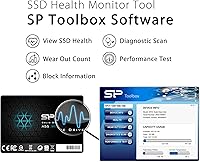
Silicon Power does not offer a robust first-party SSD management utility comparable to Samsung Magician or Crucial Storage Executive, leaving users without an easy way to monitor drive health, check remaining lifespan, or update firmware from a polished dashboard. Technically inclined users can reach for third-party tools like CrystalDiskInfo, but casual buyers expecting a branded companion app will find nothing meaningful here.
Noise & Vibration
97%
Complete silence is one of the most appreciated and frequently mentioned qualities of this drive among buyers migrating from mechanical hard drives. The absence of spinning platters eliminates the clicking, whirring, and seek noise that defined storage for decades, and users working in quiet environments notice the difference immediately.
There is genuinely little to criticize here — flash storage is inherently silent by design, and this drive performs exactly as expected on this front. The only caveat is that silence alone is not a differentiator within the SSD category, since all solid-state drives share this characteristic.
Power Efficiency
86%
Low active power draw — typically under 2 watts — makes a measurable difference for laptop users who previously ran mechanical drives, and several reviewers report improved battery longevity after swapping in this SATA solid-state drive. For portable use, the efficiency benefit is real and consistent across different machine types.
While efficient by hard drive standards, the drive does not match the aggressive power management found in modern NVMe drives with advanced low-power states. In battery-constrained ultrabook use where every milliwatt counts, newer M.2 NVMe options may edge ahead on true idle power consumption.

Suitable for:

The SP Silicon Power A55 4TB SATA SSD is built for a specific kind of buyer, and it delivers well when matched to the right situation. If you have a laptop or desktop still running a mechanical hard drive, this is one of the most cost-effective ways to gain a massive speed and capacity upgrade in one move. It is equally compelling as a secondary drive in a desktop build where an NVMe M.2 handles the operating system and you need a large, reliable pool of storage for games, photos, or video archives. Older machines with only SATA ports get a genuine second life without requiring any motherboard upgrades or adapter hardware. Students and home users who want one drive to hold everything — documents, media, backups — rather than juggling multiple smaller drives will find the 4TB ceiling genuinely liberating. Content creators who archive raw footage or large project files locally, but do not need the sustained write throughput of a premium NVMe drive, are also well served here.
Not suitable for:

The SP Silicon Power A55 4TB SATA SSD is not the right tool if raw transfer speed is your priority. Anyone building a new system with M.2 slots available will almost certainly be better served by an NVMe drive, which can deliver three to five times the sequential throughput for a modest price premium. The SLC caching architecture means write performance is strong in short bursts but throttles back noticeably during large, sustained transfers — moving hundreds of gigabytes of data at once will expose this limitation clearly. Video editors or data professionals who regularly work with multi-gigabyte files in real time should look elsewhere. The warranty, while covering three years, requires manual registration on Silicon Power's website to take full effect, which is easy to forget and a frustration if you ever need to make a claim. Finally, buyers who prioritize brand recognition or robust local customer support may find Silicon Power's service infrastructure less reassuring than what larger storage brands offer.
Specifications

  • Storage Capacity: The drive provides 4TB of usable storage space, formatted and ready for use after installation.
  • Interface: It connects via SATA III at 6 Gb/s, compatible with all SATA II and SATA I ports at reduced speeds.
  • Form Factor: Standard 2.5-inch form factor fits most laptop drive bays and desktop drive cages designed for 2.5-inch or 3.5-inch slots with an adapter.
  • Drive Height: At 7mm (0.28 inches) thin, the drive fits slim and ultra-slim laptop chassis that cannot accommodate standard 9.5mm drives.
  • NAND Type: 3D NAND flash is used, stacking memory cells vertically to improve density, endurance, and cost efficiency over older planar NAND designs.
  • Cache Technology: SLC caching dynamically allocates a portion of the NAND as a high-speed single-level cell buffer to accelerate burst write operations.
  • Sequential Read: Maximum sequential read speed reaches up to 560 MB/s under optimal conditions using the SATA III interface.
  • Sequential Write: Maximum sequential write speed reaches up to 530 MB/s during cached burst operations before base NAND speeds apply.
  • Dimensions: The drive measures 3.94 x 2.75 x 0.28 inches (length x width x height), consistent with the standard 2.5-inch SSD footprint.
  • Weight: The drive weighs 1.76 ounces, making it light enough to have negligible impact on overall laptop weight.
  • Shock Resistance: The drive is rated shock resistant, as flash storage has no moving parts, offering improved durability compared to mechanical hard drives.
  • Power Draw: As a SATA SSD, the drive operates at low power consumption levels, typically under 2W active, which helps preserve laptop battery life.
  • Compatibility: Compatible with laptops and desktops that have a standard 2.5-inch SATA drive bay; no proprietary connectors or drivers are required.
  • Series: This drive belongs to Silicon Power's A55 series, positioned as a high-capacity, value-oriented SATA SSD line.
  • Model Number: The official model number is SP004TBSS3A55S25AY, which can be used to verify product authenticity and register the warranty.
  • Warranty: A 3-year limited warranty is included, but full coverage requires product registration through Silicon Power's official website after purchase.
  • Manufacturer: Silicon Power is a Taiwanese storage brand founded in 2003, with a broad product range spanning SSDs, USB drives, and memory modules.
  • Release Date: This model was first made available in February 2023, placing it within a generation of 3D NAND designs common to that period.

Related Reviews
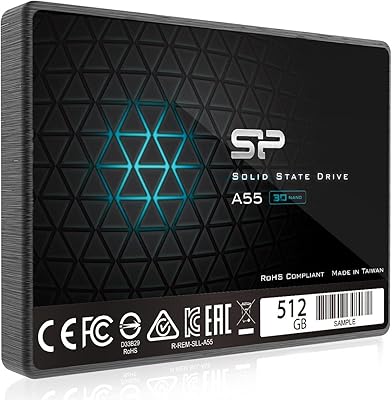
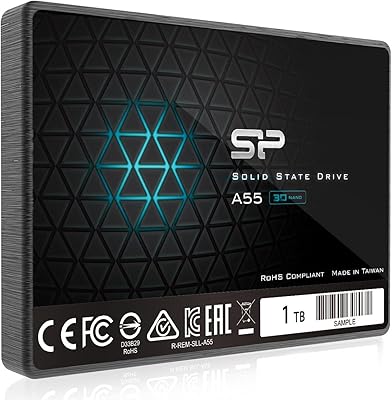
Silicon Power A55 512GB Internal SSD
78%
93%
Value for Money
88%
Boot & OS Performance
61%
Sustained Write Speed
94%
Installation & Compatibility
82%
Long-Term Reliability
More
Silicon Power A55 1TB Internal SSD
77%
92%
Value for Money
74%
Read/Write Performance
88%
Boot & System Responsiveness
83%
Build Quality & Form Factor
91%
Installation Experience
More
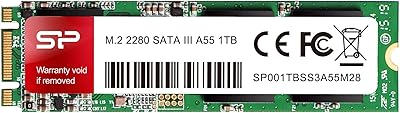
Silicon Power A55 1TB M.2 SATA SSD
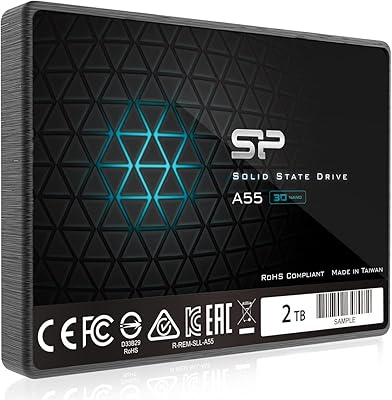
76%
91%
Value for Money
74%
Read/Write Performance
68%
Compatibility
78%
Long-Term Reliability
86%
Ease of Installation
More
Silicon Power A55 2TB Internal SSD
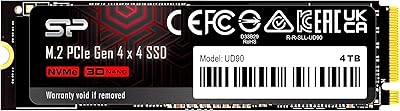
75%
88%
Value for Money
82%
Read Performance
63%
Write Performance
71%
Long-Term Reliability
91%
Installation Experience
More
Silicon Power 4TB XS70 NVMe SSD
88%
95%
Performance
94%
Speed
88%
Thermals
90%
PS5 Compatibility
87%
Build Quality
More
Silicon Power UD90 4TB NVMe SSD
89%
94%
Performance
92%
Speed (Read/Write)
90%
Reliability under Load
91%
Value for Money
88%
Compatibility
More
Silicon Power US75 4TB NVMe M.2 SSD
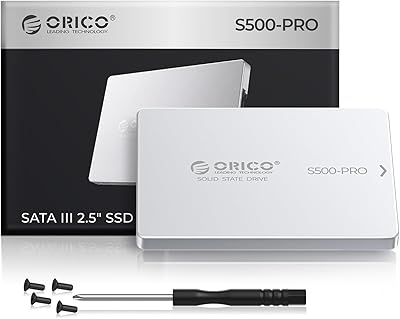
82%
91%
Sequential Read Speed
88%
Sequential Write Speed
83%
Thermal Management
86%
Value for Money
93%
Capacity & Storage Density
More
Crucial BX500 4TB SATA SSD
82%
91%
Value for Money
74%
Read/Write Performance
93%
Installation & Compatibility
67%
Endurance & Longevity
83%
Build Quality & Form Factor
More
ORICO S500PRO 4TB SATA SSD
86%
91%
Performance
88%
Build Quality
90%
Value for Money
89%
Installation Ease
75%
Reliability Under Load
More
fanxiang S101 4TB Internal SSD
77%
91%
Value for Money
82%
Read Speed Performance
71%
Write Speed & Cache Behavior
67%
Long-term Reliability
93%
Ease of Installation
More

FAQ

Yes, that is actually the ideal use case for this drive. Any laptop with a standard 2.5-inch SATA bay will accept it without any adapters or special setup. Just make sure your bay supports the 7mm height, which most modern and semi-modern laptops do.

In everyday tasks like booting up, opening apps, or browsing files, the difference between a good SATA SSD and an entry-level NVMe drive is smaller than benchmarks suggest. Where NVMe pulls ahead is during large, sustained data transfers. If you are not regularly moving dozens of gigabytes at once, you are unlikely to feel the gap in daily use.

Honestly, yes — and it is worth knowing upfront. The drive uses SLC caching to handle burst writes quickly, but once that cache fills during a large transfer, write speeds drop back to the underlying NAND's base rate. For typical everyday use this is rarely noticeable, but moving very large batches of files in one session will expose the slowdown.

It works in both. Any desktop with a 2.5-inch SATA bay accepts it directly, and if your case only has 3.5-inch bays, a simple and inexpensive mounting bracket will do the job. It is a common secondary drive choice in desktop builds where a faster M.2 drive handles the operating system.

No drivers are needed. The operating system — whether Windows, macOS, or Linux — will recognize it automatically as a standard SATA storage device. Just plug it in, format it if it is being used as a secondary drive, and it is ready to go.

You need to register the drive on Silicon Power's official website using the model number and proof of purchase to unlock the full 3-year coverage. The warranty covers manufacturing defects but not physical damage or data loss. It is worth registering right after installation since it is easy to forget about until you actually need it.

You will see slightly less than 4,000GB after formatting because operating systems measure storage differently than manufacturers do — this is standard across all drives and not a defect. Expect around 3.6 to 3.7TB of usable space as reported by your OS.

Yes, it works as a primary OS drive. Booting from a SATA SSD is dramatically faster than a mechanical hard drive, and for most users the boot experience will feel plenty responsive. Just make sure your system's BIOS or firmware is set to boot from the correct drive after installation.

It is a solid choice for game storage. Games load quickly from SATA SSDs compared to hard drives, and 4TB gives you room for a substantial library without constantly managing space. If your games are on a dedicated secondary drive and your OS is on a separate faster drive, this SATA solid-state drive handles that role well.

Solid-state drives have no moving parts, so there is nothing to spin or click. This Silicon Power drive operates in complete silence, which is one of the underrated practical advantages over mechanical hard drives, especially in quiet environments.