Overview

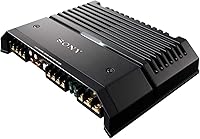
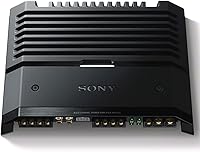
The Sony XMGS4 GS Series 4-Channel Car Amplifier occupies a genuinely interesting position in Sony's GS lineup — it's priced accessibly enough for most enthusiasts, yet engineered with details you typically find at a higher tier. The Hi-Res Audio certification isn't window dressing; it means the amp is tested and verified to handle source material up to 96kHz/24-bit, which pays off if you're running lossless files or a quality streaming setup. The flexible channel layout — operable as a 4, 3, or 2-channel unit — gives real flexibility depending on whether you're building a full speaker stage or need to bridge two channels for a sub. The chassis is compact but feels well-constructed. At this price, the balance between audio quality and honest engineering is hard to argue with.
Features & Benefits

When the wattage debate comes up — and it always does — CEA-2006 certification is what separates honest specs from marketing fiction. The XMGS4 is rated at 70W per channel RMS at 4 ohms, and that's a real, tested figure, not a peak number pulled from ideal lab conditions. Bridging pairs of channels opens up 160W RMS per side, which is enough headroom to drive a decent subwoofer without adding a separate mono amp. The Class AB design prioritizes audio accuracy over efficiency — it runs warmer than a Class D unit, so installation space matters — but the sonic payoff in clarity and dynamics is clearly audible. Hi-Res Audio support rounds it out for listeners with quality source files.

Best For

This four-channel amplifier makes the most sense for someone building out a proper full-range component system and wanting a single unit that handles both the stage speakers and a subwoofer channel. Bridged subwoofer setups in particular benefit from having that option baked in rather than requiring a second amp, which saves both money and trunk space. Sony ecosystem users will find the tuning integration particularly smooth. That said, this isn't the right tool if you're planning a dedicated bass-only build or running a high-demand setup across a large SUV or truck — the output ceiling is honest but not enormous. Buyers who prioritize verified specs over inflated marketing numbers tend to be the most satisfied with the XMGS4.

User Feedback

Among buyers who've lived with this Sony GS amp for six months or more, the consensus hovers around strong satisfaction — particularly around sound quality consistency across all four channels. Installation gets mentioned frequently as straightforward for anyone with basic wiring experience, though a few users in tight installs flagged that the unit runs noticeably warm during extended listening sessions, which is the expected trade-off with Class AB. On the critical side, some buyers running 2-ohm loads noted the output didn't feel dramatically different from 4-ohm operation. Long-term reliability draws mostly positive notes, with few reports of channel failure or performance degradation. Most owners feel the price-to-performance ratio holds up well even after sustained use, and several return buyers describe it as a trusted choice.

Pros

  • CEA-2006 certified ratings confirm the 70W x 4 figure is real and tested, not an inflated peak claim.
  • Bridging capability opens up 160W per side, letting you power a subwoofer without purchasing a separate mono amp.
  • Hi-Res Audio support up to 96kHz/24-bit makes a noticeable difference for listeners using lossless or high-bitrate sources.
  • The flexible 4, 3, or 2-channel configuration adapts cleanly to a wide variety of install layouts.
  • Gain controls and input options integrate well with both factory and aftermarket head units, keeping setup practical.
  • Long-term owners consistently report stable channel performance and solid reliability well past the one-year mark.
  • The XMGS4 delivers near-premium audio engineering at a mid-range price, offering genuine value for the spend.
  • Class AB sound reproduction is audibly cleaner and more dynamic than what typical budget Class D amps produce.
  • Build quality feels substantial and purposeful for the price tier, without the flimsy feel of budget alternatives.
  • Most buyers with basic car audio experience describe the installation process as approachable and well-documented.

Cons

  • Class AB operation generates noticeable heat under sustained high-volume use, making ventilation planning non-negotiable.
  • The bridged output ceiling is modest, leaving dedicated bass builds underpowered for demanding subwoofer applications.
  • Some buyers running 2-ohm loads report the real-world power increase feels less substantial than the spec sheet suggests.
  • The chassis footprint of 13.5 x 11 x 4.25 inches demands a dedicated mounting space that tighter vehicles may struggle to provide.
  • No wireless remote is included, which means remote volume or bass control requires sourcing a compatible add-on separately.
  • Competing brands at a similar price point offer comparable or higher-spec configurations, so this amp rewards careful comparison shopping.
  • There is no built-in bass boost or dedicated subwoofer EQ on the unit itself, which some installers find limiting during tuning.
  • Buyers expecting dramatic loudness gains over a factory head unit may be surprised by how critical proper gain staging is to avoid distortion.

Ratings

The Sony XMGS4 GS Series 4-Channel Car Amplifier earned its 4.4-star buyer consensus across a globally sourced pool of verified owner reviews, with our AI analysis actively filtering out spam, bot-generated feedback, and incentivized submissions before any scores were calculated. The category ratings below reflect the complete picture — genuine strengths and recurring frustrations in equal measure — so you can make a purchase decision based on what real long-term owners actually experienced rather than a curated highlight reel.
Sound Quality
88%
Buyers running full-range component speaker setups consistently describe the audio reproduction as clean and detailed, with a clarity improvement over passive factory systems that is noticeable from the very first listen. The Class AB design handles midrange and high-frequency content with a naturalness that listeners pick up on during both busy commutes and focused late-night listening sessions.
At pushed volumes, a subtle compression in the upper midrange surfaces that audiophiles pairing this amp with premium tweeters will notice on demanding recordings. The performance gap between this unit and dedicated high-end amplifiers is not dramatic, but it does become audible when the rest of the signal chain is high-resolution.
Power Accuracy
93%
Buyers previously burned by wildly inflated peak wattage claims describe the CEA-2006 certification as the single most reassuring specification on this amp, because it guarantees the 70W-per-channel figure is a real, repeatable measurement under realistic voltage conditions. Owners confirm consistent output across all four channels without the familiar drop-off that plagues many uncertified competitors at this price.
A handful of buyers expected verified wattage to feel subjectively louder than similarly priced amps boasting higher unverified peaks, which caused mild initial disappointment before expectations were recalibrated. Pairing it with lower-sensitivity speakers can make the accurate output feel modest — the amp rewards speaker matching more than most buyers anticipate.
Build Quality
82%
18%
The chassis feels more substantial than buyers expect at this price tier, with a metal construction that holds up to the vibration and temperature cycling inherent in daily automotive use. Terminal connections feel secure and well-machined, which installers note translates directly into cleaner, more dependable wiring over the long term.
The fit and finish does not match boutique or dedicated audiophile amplifiers, and a few buyers noted minor sharp edges on the chassis underside that made handling during install slightly awkward. At this price the build quality is appropriate and honest, but it will not impress anyone expecting a premium tactile experience on close inspection.
Installation Experience
74%
26%
Most buyers with basic car audio familiarity describe a manageable install with clearly labeled connections and a gain structure that works predictably across a wide range of RCA preamp signal levels from both line output converters and aftermarket head units. The controls are physically accessible on the unit body, which reduces the trial-and-error frustration that slows down first-time installers.
Buyers with no prior car audio experience find the gain staging and bridging configuration genuinely confusing without a detailed walkthrough, and the included documentation is widely described as too thin for beginners. Vehicles with limited trunk space or cramped wiring channels require real pre-planning before a mounting location can be committed to.
Thermal Performance
58%
42%
Under moderate listening levels with adequate ventilation around the unit, buyers report stable operating temperatures and no thermal protection triggers during typical daily driving sessions. The protection circuit itself functions reliably and does its job when airflow conditions are reasonable.
Class AB operation generates measurably more heat than Class D alternatives, and buyers who mounted the unit under seats or in enclosed panels describe the casing becoming uncomfortably warm after 30 to 45 minutes of sustained high-volume use. A subset of owners in warmer climates reported thermal shutdowns during summer driving until they improved chassis ventilation around the amp.
Value for Money
86%
Buyers who shopped competing options before purchasing consistently return to the CEA-2006 certification and Hi-Res Audio support as features that justify the cost in a way that inflated-spec alternatives simply cannot replicate. Long-term owners who have used this amp through multiple seasons report that the price-to-performance ratio holds up convincingly, which is the most meaningful form of endorsement.
At the upper boundary of the mid-range price window, several buyers note that competing brands offer slightly higher bridged output or include a bass remote at comparable prices, making the value case less automatic. Buyers whose primary goal is raw volume rather than audio accuracy may find more cost-effective options elsewhere in this tier.
Channel Flexibility
89%
The ability to reconfigure from 4-channel to 3-channel or 2-channel operation is consistently praised by installers who want one amp to serve multiple roles as their system evolves over time. Running front components on two channels while bridging the remaining pair for a subwoofer is a popular and practical configuration that buyers find genuinely eliminates the need for a second amp purchase.
The flexibility is only a real advantage if the install actually demands it — buyers running straightforward four-speaker setups gain nothing from the reconfiguration capability and may feel it inflates the price unnecessarily. Reconfiguring the channel layout also requires a full gain reset, which adds an extra calibration step that casual users find fiddly.
Hi-Res Audio Performance
77%
23%
Buyers streaming lossless files or playing FLAC content through a quality head unit report a perceptible improvement in detail retrieval and textural resolution compared to what standard-resolution sources deliver through the same speakers. The certification ensures the amplifier stage itself does not become the bottleneck in a high-resolution signal chain, which matters to buyers building around quality source equipment.
In day-to-day use with compressed streaming or standard bitrate playback — which covers the majority of typical listening — the Hi-Res capability contributes very little to perceived audio quality, making it a conditional rather than universal benefit. Several buyers candidly describe it as more of a future-proofing feature than an immediate daily-use upgrade at this price point.
Bridging Capability
84%
Bridging two channels to drive a subwoofer at 160W RMS is well-implemented and straightforward in practice, with buyers reporting clean and controlled bass output that blends naturally with the full-range stereo channels. Avoiding a dedicated mono amplifier purchase represents a meaningful saving in both cost and trunk real estate for anyone building a complete front stage and sub system.
The bridged output is rated at 4 ohms, and buyers running dual voice coil subwoofers wired down to 2 ohms report the power increase feels less dramatic than expected from the spec sheet. For buyers chasing higher SPL output, 160W bridged will likely feel like a ceiling rather than a ceiling that is difficult to reach.
Gain & Input Controls
79%
21%
The input sensitivity range accommodates a wide span of preamp output voltages without pushing into distortion, which buyers appreciate when interfacing with head units that vary significantly in output level. The physical controls sit in accessible positions on the amp body and respond smoothly, making initial calibration a manageable process rather than a frustrating precision exercise.
There is no onboard bass boost, signal processor, or dedicated subwoofer output level trim, meaning buyers who want tone shaping or driver-seat bass control need to budget for an external component. The absence of a remote level knob — not included in the box — draws specific frustration from buyers who mount the unit in an inaccessible trunk location.
Head Unit Compatibility
71%
29%
Pairing this amp with an aftermarket head unit that has dedicated RCA preamp outputs is a clean experience that the majority of buyers complete without compatibility issues. Sony head unit owners in particular describe a well-matched gain structure and simplified setup that delivers consistent results across the volume range.
Buyers who keep their factory head unit face an additional and easily overlooked step — sourcing and correctly wiring a line output converter — which adds both cost and complexity to the install. A small number of buyers with older factory systems reported faint interference noise that required a ground loop isolator to fully eliminate.
Long-term Reliability
83%
Owners who have run this four-channel amplifier daily through a full year or more consistently report that all channels remain balanced and stable without the gradual performance drift that cheaper units sometimes develop. The amp has a solid track record of surviving the temperature cycling and road vibration of everyday automotive use without channel failure or premature degradation.
A smaller segment of buyers in high-heat climates or with marginally adequate grounding reported intermittent protection mode activation after extended use, a pattern that points to install quality rather than a unit defect but is worth factoring into planning. A few long-term owners also noted minor terminal oxidation in consistently humid environments, requiring periodic contact cleaning to maintain conductivity.
Noise Floor
87%
At idle and through quiet musical passages, this Sony GS amp is exceptionally quiet — buyers upgrading from budget amplifiers consistently describe the near-silent noise floor as one of the most immediately satisfying differences in their system. Sensitive tweeters remain hiss-free at low listening volumes, a specific detail that audiophile-leaning owners highlight as a meaningful real-world improvement.
A subset of buyers running long unshielded RCA cable runs or grounding to suboptimal chassis points reported a faint alternator whine that required a ground loop isolator to fully resolve. The amp itself is not the source of the noise, but its low noise floor means that sloppy install practices elsewhere in the signal chain are exposed more readily than they would be through a lower-resolution unit.
Physical Footprint
63%
37%
For buyers with a dedicated cargo area or open trunk space, the chassis dimensions are workable and the unit mounts flat without unusual hardware. At 6 pounds, a single installer can comfortably position and secure the amp without needing a second set of hands during the process.
The 13.5 x 11 x 4.25-inch profile is simply too large for practical under-seat mounting in most passenger sedans and compact crossovers, which meaningfully limits where the amp can realistically live in a vehicle. Buyers who skipped measuring their intended mounting location before ordering report genuine surprise at how much dedicated flat real estate the unit requires.
Documentation & Setup
68%
32%
The core wiring diagram, gain setting guidance, and channel configuration instructions are present in the included manual, and experienced installers report it as adequate for completing a standard setup without additional research. Sony's online support resources fill some gaps and are generally accessible when buyers run into specific questions post-install.
Several buyers describe the printed manual as too sparse for less experienced installers, particularly around the bridging procedure and proper gain staging methodology for different head unit types. The lack of a vehicle-specific or head unit pairing guide means a meaningful portion of first-time buyers turn to third-party tutorial videos to fill in the gaps the official documentation leaves open.

Suitable for:

The Sony XMGS4 GS Series 4-Channel Car Amplifier is an excellent fit for enthusiasts who have outgrown their factory audio and want to build a properly powered, full-range component speaker setup without overcomplicating the install. If you are running front-stage component speakers and want to add a subwoofer on a bridged channel — all from a single unit — this amp is designed precisely for that scenario. Buyers who have been burned by wildly inflated wattage claims will find real reassurance in the CEA-2006 certified ratings, which reflect verified output rather than theoretical peak numbers. It also suits those already in the Sony ecosystem particularly well, since pairing it with a Sony head unit tends to simplify gain staging and overall tuning. The flexible operating modes across 4, 3, or 2 channels give installers room to adapt as their system grows, adding practical long-term value beyond just the initial build.

Not suitable for:

If your primary goal is dedicated bass and you plan to push a high-excursion subwoofer with serious power, the Sony XMGS4 GS Series 4-Channel Car Amplifier is not the tool for the job — a standalone mono amplifier with a much higher bridged output ceiling would serve that purpose far better. Owners of large vehicles like full-size trucks or three-row SUVs may also find the available headroom limiting when trying to fill a bigger acoustic environment. The Class AB design generates more heat than a Class D equivalent, so installers working with cramped or enclosed mounting locations need to account for ventilation or risk sustained thermal stress on the unit. Buyers on a strict budget who need maximum raw output at the lowest possible cost will find more aggressive options elsewhere, and those already committed to a different head unit brand may not get the same tuning convenience that Sony ecosystem users enjoy. In short, this is a refined, well-engineered amplifier — but only for builds where its output range and installation requirements are a genuine match.
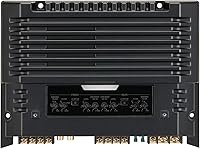
Specifications

  • RMS Output: Delivers 70W per channel into 4 ohms across all four channels, verified under CEA-2006 test conditions at 14.4V supply voltage.
  • Bridged Power: Each pair of channels can be bridged to produce 160W RMS into a 4-ohm load, enabling subwoofer or high-demand speaker operation.
  • Total Output: Combined rated output across all channels totals 280W under CEA-2006 compliant measurement conditions.
  • Channels: Operates as a 4-channel amplifier by default and is field-configurable for 3-channel or 2-channel setups depending on the install.
  • Amp Class: Uses a Class AB topology, which favors low distortion and audio accuracy over the higher power efficiency of Class D designs.
  • Power Rating: CEA-2006 certified, meaning all published RMS figures are measured at 14.4V with total harmonic distortion plus noise held below 1%.
  • Hi-Res Audio: Carries official Hi-Res Audio certification, supporting playback of high-resolution source material up to 96kHz and 24-bit depth.
  • Dimensions: The chassis measures 13.5 x 11 x 4.25 inches (L x W x H), requiring a dedicated flat mounting surface within the vehicle.
  • Weight: Unit weighs 6 pounds, making single-person installation manageable without requiring additional mechanical assistance.
  • Mounting Type: Designed exclusively for fixed in-vehicle car mount installation and is not suitable for portable or temporary deployment.
  • Remote Control: No wireless remote is included in the box; remote level control requires a separately purchased compatible accessory.
  • Manufacturer: Designed and produced by Sony Corporation under the company's dedicated GS Series car audio product line.
  • Model Number: Official Sony model designation is XMGS4, used for parts lookup, firmware reference, and warranty registration.
  • Product Series: Part of Sony's GS Series lineup, which targets enthusiast-grade car audio performance at a mid-range price point.
  • Availability: Currently in active production and confirmed as not discontinued by the manufacturer as of the latest product listing verification.

Related Reviews
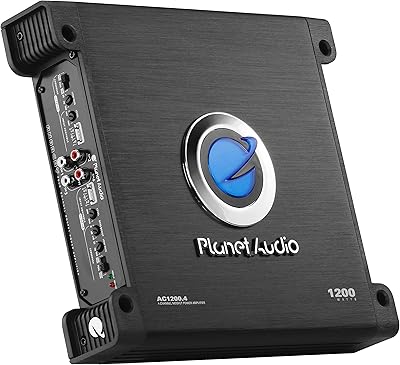
Planet Audio AC1600.4 Anarchy Series 4-Channel Car Amplifier
82%
94%
Power Output
88%
Sound Quality
70%
Ease of Installation
92%
Value for Money
85%
Build Quality
More
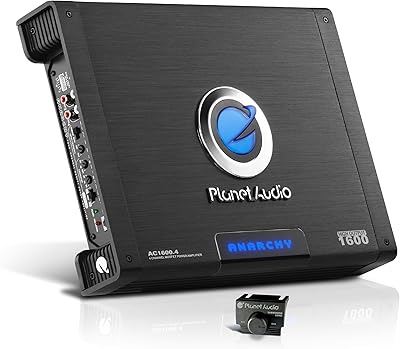
Planet Audio AC1200.4 4-Channel Car Amplifier
73%
88%
Value for Money
67%
Power Output
83%
Installation Ease
74%
Sound Quality
61%
Build Quality
More
Power Acoustik VA4-1800D Vertigo Series 4-Channel Car Amplifier
85%
88%
Performance
85%
Sound Quality
80%
Heat Management
90%
Build Quality
82%
Ease of Installation
More
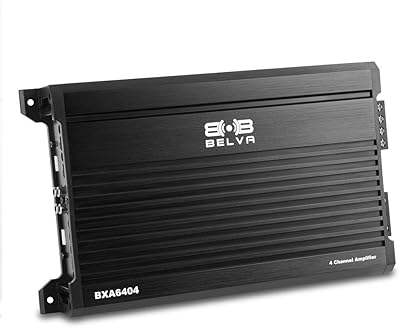
Belva BXA6404 4-Channel Car Amplifier

76%
91%
Value for Money
78%
Sound Quality
74%
Installation Ease
73%
Build Quality
61%
Thermal Management
More
BOSS Audio R2504 4-Channel Car Amplifier
70%
82%
Value for Money
86%
Ease of Installation
51%
Power Output (Real-World)
58%
Thermal Management
62%
Build Quality
More
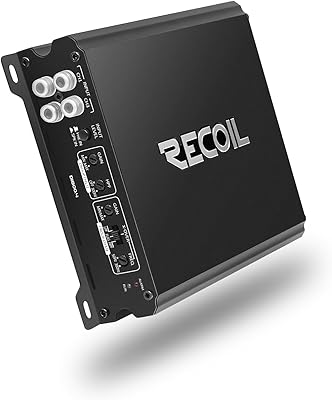
Recoil DI800.4 4-Channel Car Amplifier
75%
88%
Value for Money
51%
Power Accuracy
63%
Build Quality
79%
Thermal Management
86%
Ease of Installation
More
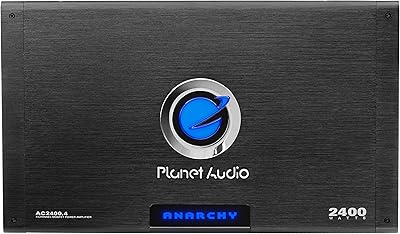
Planet Audio AC2400.4 4-Channel Car Amplifier
84%
95%
Power Output
89%
Sound Clarity
87%
Bass Performance
82%
Ease of Installation
65%
Thermals/Heat Management
More
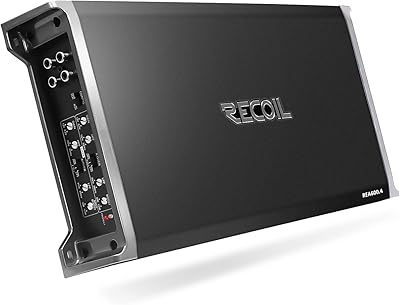
Recoil REA600.4 4-Channel Car Audio Amplifier
84%
89%
Audio Performance
91%
Ease of Installation
85%
Sound Quality at High Volumes
62%
Heat Management
90%
Power Output
More
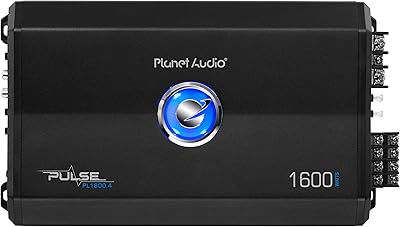
Planet Audio PL1600.4 4-Channel Car Amplifier
72%
88%
Value for Money
84%
Ease of Installation
74%
Sound Quality
58%
Power Output (Real-World)
61%
Build Quality
More
Recoil DI550.4 4-Channel Car Audio Amplifier
74%
91%
Value for Money
78%
Power Output
86%
Ease of Installation
74%
Sound Quality
67%
Build Quality
More

FAQ

The XMGS4 uses standard RCA line-level inputs, so if your factory head unit lacks dedicated preamp outputs, you will need an external line output converter (LOC) to bridge the two. LOCs are inexpensive and widely available, and pairing one with this amp is a common setup among buyers keeping their stock head unit.

It handles both. Bridging any two channels together gives you 160W RMS into a 4-ohm load, which is enough to drive a mid-range subwoofer with authority. A popular install approach is to run two channels for front component speakers and bridge the other two for the sub — all from this single unit, no second amp required.

That frustration is exactly why CEA-2006 exists. The certification requires power measurements to be taken at a realistic 14.4V supply with distortion held below 1%, which reflects actual driving conditions rather than cherry-picked laboratory peaks. Many budget amps publish peak figures that are technically achievable only for a fraction of a second under ideal conditions that never occur during real listening. The Sony XMGS4 GS Series 4-Channel Car Amplifier's 70W x 4 RMS rating is a verified, repeatable figure you can actually plan around when choosing speakers and wiring.

Modern Class D designs have improved significantly, and for many everyday listeners the gap is small. That said, this Sony GS amp still offers the kind of smooth midrange reproduction and dynamic nuance that more critical listeners tend to prefer in a Class AB design. The honest trade-off is that Class AB runs warmer and draws more current than Class D, so your mounting location and power supply wiring matter more.

Under-seat mounting is possible but you need to be realistic about airflow. This four-channel amplifier runs noticeably warm during sustained high-volume sessions, which is normal for Class AB operation but can become a thermal concern in a sealed, poorly ventilated space. If you go under-seat, make sure there is reasonable airflow around the unit and that the amp is not resting directly on carpet with no clearance underneath.

The amp is rated and tested at 4 ohms for both stereo and bridged output. While it will drive a 2-ohm load, Sony does not publish a 2-ohm RMS rating for this unit, and running it at lower impedance will cause it to run significantly hotter. If your speakers or sub are 2-ohm nominal, check your ventilation situation carefully and consider whether a purpose-built 2-ohm stable amplifier would be a better fit.

Any head unit with standard RCA preamp outputs will work with this amp. Sony ecosystem pairing is not a requirement — it's just a convenience. If you are already running a Sony head unit, gain staging and tuning tend to feel more intuitive out of the box. With other brands, you may spend a bit more time dialing in the input sensitivity, but it is entirely standard procedure.

Many buyers with no professional experience have installed this amp successfully, particularly those who take time to research the basics of power cabling, chassis grounding, and RCA routing before starting. The most common pitfall is a poor ground connection or incorrect gain setting — both of which are covered in detail across countless online tutorials. If you are completely new to car electronics, having a professional handle at least the main power cable run is a reasonable precaution to protect both the amp and your vehicle.

It depends almost entirely on your source material. Compressed audio files and standard-quality streaming will not sound noticeably different through a Hi-Res certified amp versus a non-certified one. Where the certification matters is when you are playing FLAC files, high-bitrate lossless streams, or other 24-bit high-resolution sources — in those cases, the amp will not become the limiting factor in your signal chain, and the additional resolution in the recording has a real chance of coming through.

Longer-term owners generally report consistent and reliable performance with all four channels staying stable over time. The most commonly flagged issue is heat-related degradation in installs where ventilation was not adequately planned — something that proper mounting largely prevents. With a clean power supply, a solid ground, and reasonable airflow, the XMGS4 has a solid track record among buyers who have pushed it through multiple seasons of daily driving.

Where to Buy