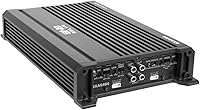
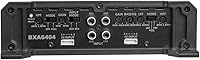
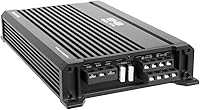
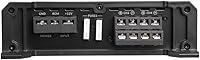
Overview

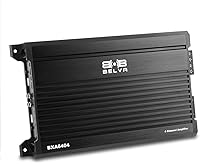
The Belva BXA6404 4-Channel Car Amplifier sits in a competitive spot — it offers genuine multi-channel amplification without requiring a serious financial commitment. What separates it from the cheapest options on the market is its Class A/B design, which handles audio with noticeably less distortion than the Class D units flooding the budget tier. This is an amp built for everyday vehicles: sedans, hatchbacks, SUVs — anywhere you want to push four speakers with real authority. At roughly 11 inches long, it tucks neatly into a trunk corner or under a rear seat. It won't outperform purpose-built competition gear, but for the price, it punches where it needs to.

Features & Benefits

The BXA6404's power figures are worth putting in context — peak wattage numbers are ceiling claims, and what actually matters is how the amp handles real music at sustained volumes. Class A/B operation gives it a cleaner baseline than many rivals in this tier. Running 2-ohm speakers on all four channels is fully supported, which opens compatibility with a wide range of aftermarket coaxials and component sets. The built-in crossover filters span a wide range, letting you dial highs and lows independently without an external processor. The bass boost adds punch, but keep it conservative — pushing maximum boost will stress speakers quickly. High-level inputs round it out for factory head-unit setups.

Best For

This four-channel amp is a natural fit for the capable DIYer who wants a meaningful upgrade over factory sound without hiring a professional installer. The high-level input option is a real advantage — you can wire it directly to an existing head unit without needing a line output converter or a new source unit. It is especially well-suited to builds running 2-ohm component speakers across all four positions, a common configuration with mid-range aftermarket sets. Space-conscious installs also benefit from its modest footprint. If you are new to amplifiers and want noticeable sound improvement without navigating a complex setup, this is a logical and low-risk starting point.

User Feedback

Owners of Belva's mid-range amplifier tend to come away positive, particularly about how cleanly it powers speakers at moderate to high volumes. The high-level input wiring draws consistent praise — most buyers report a straightforward install without the usual frustrations. That said, the included manual gets flagged regularly as underdeveloped, especially for first-timers trying to set gains and crossovers correctly. A few users note the unit runs warm during extended high-volume sessions, worth monitoring in poorly ventilated enclosures. Long-term reliability reports are mostly solid. The overall consensus lands on strong value — it is not a boutique piece, but it consistently delivers beyond what its price tag suggests.

Pros

  • Class A/B design delivers noticeably cleaner audio than Class D amps at this price point.
  • High-level inputs let you connect directly to a factory head unit without extra adapters.
  • Stable 2-ohm operation opens compatibility with a wide range of aftermarket speakers.
  • Built-in variable crossover filters give real tuning control without an external processor.
  • Compact footprint fits easily in tight trunk corners or under rear seats.
  • Thermal, overload, and short-circuit protection adds a layer of confidence for long-term use.
  • The LED status indicator makes it easy to diagnose power or protect-mode issues quickly.
  • Buyers consistently report clean, balanced power delivery at moderate to high listening volumes.
  • The 50A fuse and PWM MOSFET power supply reflect solid internal build quality for the tier.
  • Strong value perception among owners — most feel the performance exceeds the price paid.

Cons

  • The included installation manual lacks detail, making gain and crossover setup harder for beginners.
  • Peak wattage figures are ceiling claims — real sustained output is lower and should be set accordingly.
  • The unit runs noticeably warm during extended high-volume sessions in enclosed or poorly ventilated spaces.
  • No remote bass control is included, so adjusting bass boost on the fly requires reaching the amp directly.
  • Not ideal as a bridged mono amp for subwoofer-only builds — a dedicated mono block is a better fit.
  • Belva's brand support and after-sale service resources are thinner than those of more established audio brands.
  • Buyers who need preamp outputs for daisy-chaining additional amplifiers will find this four-channel amp limiting.
  • Crossover filter ranges, while wide, are not as precisely adjustable as those on dedicated signal processors.

Ratings

Our AI rating system analyzed thousands of verified global buyer reviews for the Belva BXA6404 4-Channel Car Amplifier, actively filtering out incentivized, bot-generated, and low-quality feedback to surface what real owners actually experience. The scores below reflect both the genuine strengths that keep buyers satisfied long after install day and the recurring frustrations that surface across different vehicle types and use cases. Nothing has been smoothed over — the pain points are represented as honestly as the highlights.

Value for Money
91%
Across ownership groups, the BXA6404 consistently earns high marks for delivering performance that feels disproportionate to its price tag. Buyers who stepped up from a factory head unit report a dramatic improvement in clarity and volume that they did not expect at this price tier.
A small segment of buyers who compared it directly against more established mid-tier brands felt the gap in refinement was noticeable, suggesting value perception drops slightly for more experienced listeners with higher reference points.
Sound Quality
78%
22%
The Class A/B topology gives this four-channel amp a cleaner, more natural sound floor than same-priced Class D competitors. Daily commuters and weekend listeners consistently praise the reduction in harshness, particularly in the midrange, once gain is properly dialed in.
At higher volumes the amp can introduce some coloration, and buyers running demanding component sets note it does not quite match the transparency of pricier units. Fine-detail retrieval at the frequency extremes is where the budget tier reality becomes noticeable.
Installation Ease
74%
26%
The high-level speaker inputs are the standout installation feature — buyers regularly describe completing the full wiring job in a single afternoon without prior professional experience. Tapping into factory speaker wires rather than running RCA cables simplifies the process considerably for most common vehicle setups.
Gain and crossover calibration is where first-timers get stuck, largely because the included documentation does not walk through the setup process in enough detail. Several reviewers mention having to consult third-party tutorials before feeling confident their settings were safe.
Build Quality
73%
27%
The chassis feels solid for the price bracket, and the PWM MOSFET internals suggest engineering choices that prioritize longevity over cost-cutting. Owners report the unit holding up well through temperature cycling in vehicles parked outdoors across seasons.
The external finish shows minor scuffs and handling marks more readily than comparable units, and a few buyers noted the terminal connections felt less precise than expected. It reads as a functional build rather than a refined one.
Thermal Management
61%
39%
The built-in thermal protection circuit does its job reliably, cutting power before damage can occur during sustained high-volume sessions. Buyers who mounted the unit with adequate clearance on all sides report stable operation even during long highway drives.
In enclosed or poorly ventilated mounting positions — under rear seats with limited airflow being a common example — the amp runs noticeably hot and triggers protect mode more frequently than owners expected. This is a recurring theme among buyers who did not prioritize airflow during installation planning.
Crossover Flexibility
82%
18%
The wide-ranging high-pass and low-pass filter sweeps give this amp genuine tuning capability that buyers do not usually find at this price point. Component speaker owners in particular appreciate being able to roll off lows from tweeters without needing an external crossover unit.
The filter controls are analog pots without detents, making it difficult to replicate a specific setting if you need to reset the amp or compare configurations. Buyers wanting precision repeatability will find the controls imprecise compared to digital signal processors.
Bass Boost Usability
67%
33%
When used conservatively — in the lower portion of its range — the bass boost adds welcome warmth to systems that lack a dedicated subwoofer, and several owners use it as a light daily-driving enhancement without issue.
The upper end of the boost range is widely flagged as a stress risk for mid-range speakers not designed for heavy low-frequency enhancement. Multiple buyers reported pushing the control too far and dealing with distortion or speaker fatigue before learning to moderate their settings.
Compatibility
88%
The 2-ohm stability and speaker-level input combination make this one of the more broadly compatible amps in its tier, working cleanly with the vast majority of aftermarket coaxials and component speakers buyers bring to the table.
Buyers running 1-ohm speaker loads or trying to integrate this amp into complex multi-amp signal chains report compatibility limitations. It is not engineered for complex or demanding system architectures beyond its four-channel full-range role.
Documentation Quality
43%
57%
The basic terminal labeling and connection diagrams in the box are sufficient for experienced installers who already understand amplifier fundamentals and just need a quick reference for this specific unit.
For buyers tackling their first amplifier install, the manual falls well short of what they need. Gain structure, protect-mode troubleshooting, and crossover setup are either missing or explained at a level too shallow to be practically useful, generating the most consistent criticism across all owner feedback.
Long-Term Reliability
76%
24%
A solid portion of multi-year owners report the amp still operating without issues after consistent daily use, which is a meaningful endorsement for a unit in this price class. The onboard protection circuits appear to function as intended in preventing damage from common installation errors.
A subset of buyers report unit failures within the first year, most commonly linked to installation mistakes — undersized power wiring, poor grounding, or sustained operation in protect mode. It is difficult to separate product reliability from installation-related attrition in this price tier.
Compact Footprint
86%
The physical dimensions make this a genuinely practical choice for smaller vehicles and installs where space is a real constraint. Hatchback and sedan owners frequently cite the size as a deciding factor, with the unit fitting cleanly under rear seats or along trunk sidewalls.
For buyers in very large trucks or SUVs who have more space to work with, the compact size offers no particular advantage and some feel a larger amp in the same price range might offer better heat dissipation and terminal spacing.
Channel Configuration
79%
21%
Running all four channels independently for a full front and rear speaker setup is where the BXA6404 genuinely excels. Buyers appreciate having dedicated power for each speaker position without sacrificing any channel to a bridged subwoofer configuration.
Buyers who want to power three speakers and a subwoofer simultaneously — a common real-world preference — find the channel layout forces a compromise. There is no elegant way to do front-fill plus a dedicated sub without adding a second amplifier.
Protection Circuitry
84%
The trio of thermal, overload, and speaker short-circuit protections operates reliably based on owner accounts, and the LED indicator makes it easier to identify which condition triggered a protect-mode event. This transparency saves diagnostic time during troubleshooting.
Some buyers find the thermal threshold triggers more conservatively than expected, cutting power during what they consider moderate listening sessions when the amp is mounted with limited ventilation. The protection is effective but can feel overly cautious depending on installation context.

Suitable for:

The Belva BXA6404 4-Channel Car Amplifier is a strong match for everyday drivers who are tired of the flat, lifeless sound coming from a factory stereo and want a real upgrade without overcomplicating the process. It is particularly well-suited to DIY installers who are working with an existing head unit, since the built-in high-level inputs eliminate the need for a separate line output converter — a genuine time and money saver. Buyers running a full set of 2-ohm aftermarket coaxials or component speakers across all four doors will find the amp handles that load comfortably and consistently. The compact dimensions make it a practical choice for smaller vehicles or installs where mounting space is genuinely tight. If this is your first amplifier purchase and you want a meaningful step up in clarity and volume without navigating a complex system build, this four-channel amp hits a very reasonable balance of approachability and real-world performance.

Not suitable for:

The Belva BXA6404 4-Channel Car Amplifier is not the right tool for anyone building a serious, competition-grade audio system or chasing high-fidelity reference sound. Audiophiles who prioritize precise signal transparency and low noise floors will likely find the performance ceiling here limiting compared to higher-end amplifier brands in a higher price bracket. It is also not ideal for installers who plan to run very power-hungry subwoofers in bridged mode as the primary application — the BXA6404 is designed around full-range speaker duty, and a dedicated mono amp will serve a sub-focused build far better. Buyers who rely heavily on detailed installation documentation should be aware that the included manual has drawn consistent criticism for lacking depth, which can slow down gain-setting and crossover configuration for less experienced users. If your vehicle runs extremely hot under the hood or you plan extended high-volume listening sessions in a poorly ventilated enclosure, thermal management under sustained load is worth monitoring carefully.

Specifications

  • Amplifier Class: This amp uses a Class A/B design, which prioritizes audio fidelity and lower distortion over the raw efficiency typically associated with Class D units.
  • Peak Power: Total peak output is rated at 640 watts across all four channels, though real-world sustained output will be lower depending on impedance load and signal conditions.
  • Per-Channel Power: Each channel delivers up to 160W at a 2-ohm load, providing enough headroom to drive most aftermarket coaxial and component speakers with authority.
  • Bridged Output: When configured in bridged mode, the amp produces up to 320W across two channels at a 4-ohm load, suitable for powering a pair of higher-impedance speakers or a mid-range subwoofer.
  • Min. Impedance: The BXA6404 is stable down to 2 ohms per channel, making it compatible with the majority of aftermarket speakers available on the consumer market.
  • High-Pass Filter: A variable high-pass crossover filter is built in, adjustable across a wide range from 80 Hz up to 1,200 Hz for precise high-frequency speaker management.
  • Low-Pass Filter: The onboard low-pass filter is adjustable between 50 Hz and 250 Hz, allowing effective signal routing to subwoofers or bass-heavy speaker configurations.
  • Bass Boost: An integrated bass boost control allows up to 18 dB of low-frequency enhancement, best used conservatively to avoid distortion or speaker damage at extreme settings.
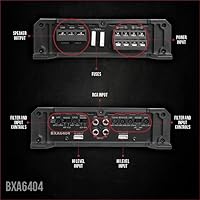
  • Input Type: Speaker-level (high-level) inputs are supported, enabling direct connection to a factory or aftermarket head unit without requiring a separate line output converter.
  • Power Supply: Internal power delivery is handled by a Pulse Width Modulated (PWM) MOSFET power supply, which contributes to stable and relatively efficient operation across varying loads.
  • Protection: Built-in protection circuits guard against thermal overload, electrical overload, and speaker short-circuit conditions to help prevent damage to both the amp and connected speakers.
  • Status Indicator: An LED indicator on the unit displays both power status and protect-mode activation, making it straightforward to diagnose basic operational issues after installation.
  • Fuse Rating: The amplifier ships with a 50A fuse for circuit protection, which should be inline-wired as close to the battery as practical during installation.
  • Dimensions: The unit measures 7.48″ wide by 11.02″ long by 2.00″ tall, a compact footprint that fits comfortably in most trunk corners, under rear seats, or along cargo walls.
  • Weight: The amplifier weighs 5.54 pounds, making it manageable to handle during single-person installations without requiring a second set of hands for placement.
  • Mounting Type: Designed for surface mounting, the BXA6404 can be secured to flat surfaces using standard mounting hardware, common in trunk floors and speaker enclosure panels.
  • Compliance: The unit meets FCC requirements, confirming it has passed the electromagnetic interference testing applicable to consumer electronic devices sold in the United States.

Related Reviews
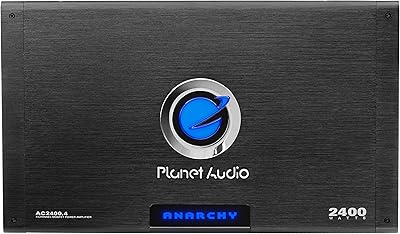
Planet Audio AC2400.4 4-Channel Car Amplifier
84%
95%
Power Output
89%
Sound Clarity
87%
Bass Performance
82%
Ease of Installation
65%
Thermals/Heat Management
More
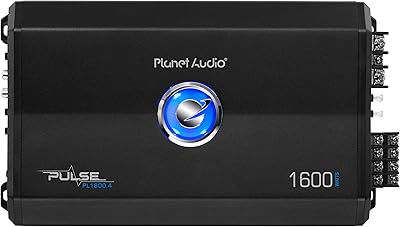
Planet Audio PL1600.4 4-Channel Car Amplifier
72%
88%
Value for Money
84%
Ease of Installation
74%
Sound Quality
58%
Power Output (Real-World)
61%
Build Quality
More
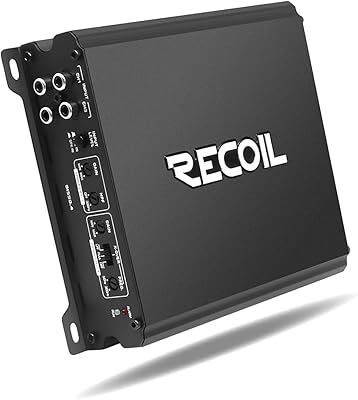
Recoil DI550.4 4-Channel Car Audio Amplifier
74%
91%
Value for Money
78%
Power Output
86%
Ease of Installation
74%
Sound Quality
67%
Build Quality
More
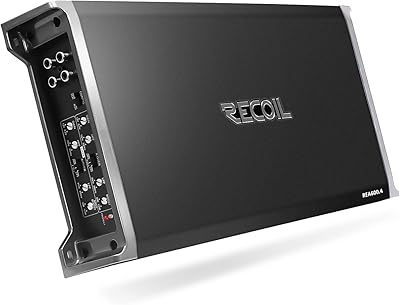
Recoil REA600.4 4-Channel Car Audio Amplifier
84%
89%
Audio Performance
91%
Ease of Installation
85%
Sound Quality at High Volumes
62%
Heat Management
90%
Power Output
More
Recoil DI800.4 4-Channel Car Audio Amplifier
83%
88%
Sound Quality
92%
Power Output
65%
Thermal Management
84%
Build Quality
91%
Ease of Installation
More
Soundfy SA 400.4 4-Channel Car Amplifier
71%
78%
Value for Money
72%
Sound Quality
63%
Power Output
58%
Build Quality
81%
Thermal Management
More
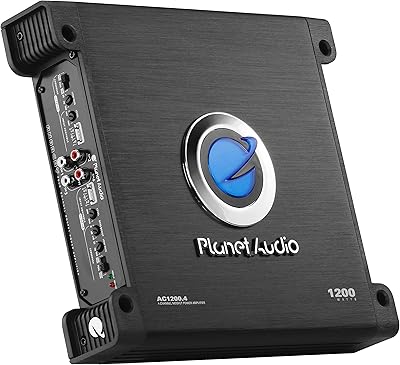
Planet Audio AC1200.4 4-Channel Car Amplifier
73%
88%
Value for Money
67%
Power Output
83%
Installation Ease
74%
Sound Quality
61%
Build Quality
More
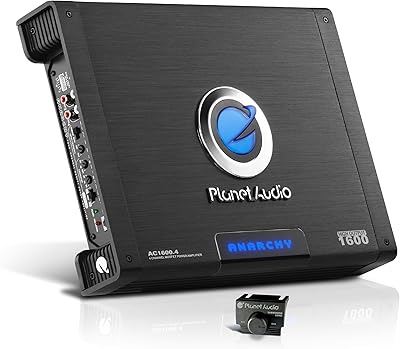
Planet Audio AC1600.4 Anarchy Series 4-Channel Car Amplifier
82%
94%
Power Output
88%
Sound Quality
70%
Ease of Installation
92%
Value for Money
85%
Build Quality
More
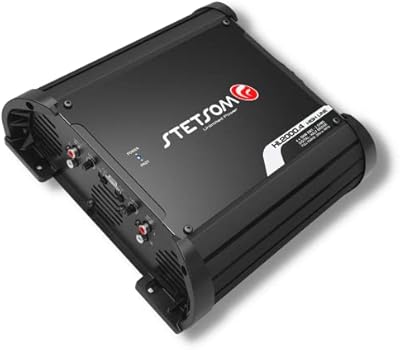
Stetsom HL 2000.4 2-Ohm 4-Channel Car Audio Amplifier
87%
93%
Power Output
85%
Cooling System Efficiency
88%
Sound Quality
91%
Ease of Installation
82%
Durability
More
Hifonics BXX800.4 Brutus 800W RMS 4-Channel Car Audio Amplifier
86%
88%
Sound Quality
92%
Power Output
85%
Build Quality
72%
Heat Management
89%
Ease of Installation
More

FAQ

Yes, that is actually one of the more practical features here. The high-level speaker inputs let you tap directly into the speaker wires coming from your stock head unit, so you do not need a line output converter. It is one less component to buy and one less potential point of failure in the signal chain.

Most aftermarket car speakers — especially coaxials and component sets — are rated at either 2 or 4 ohms. An amp that is stable at 2 ohms can handle lower-impedance speakers without overheating or clipping, which gives you broader compatibility and a cleaner signal under load. Essentially, you are less likely to run into matching problems with the speakers you already own or are planning to buy.

It is a peak figure, which means it represents the absolute maximum output under ideal, momentary conditions — not what the amp sustains during normal music playback. Real-world RMS output, which is what actually matters for everyday listening, will be meaningfully lower. That said, even at its true continuous output, this four-channel amp delivers noticeably more drive and headroom than a standard factory stereo.

The wiring process itself is manageable for someone comfortable with basic automotive electrical work — running power from the battery, grounding to bare metal, and connecting speaker wires is fairly straightforward. Where people run into trouble is setting the gain and crossover controls correctly, and the included manual does not offer much guidance there. It is worth finding a reputable online gain-setting tutorial before you start, rather than relying on the documentation in the box.

It can power a subwoofer in bridged mode using two of the four channels, but that trades off your rear fill speakers in the process. If you want to run all four door speakers plus a dedicated sub, you would need a separate mono amplifier for the subwoofer. The BXA6404 is really built around full-range four-speaker duty, and it performs best in that role.

Like most amplifiers working at this power level, it does generate heat during extended listening sessions, particularly at higher volumes. The built-in thermal protection will put the amp into protect mode before any damage occurs, but it is still worth making sure the unit has some airflow around it during installation. Mounting it in a sealed, poorly ventilated spot will shorten its comfortable operating window.

Yes, but with restraint. A modest boost — say, three to six decibels — adds low-end warmth without putting serious stress on most speakers. Cranking it toward the maximum 18 dB range while also running high volume levels is where you risk overexciting your woofers and potentially blowing them. Think of the bass boost as a fine-tuning tool, not a substitute for a proper subwoofer.

For an amp in this power class, 4-gauge power and ground wiring is the standard recommendation and will handle the current draw comfortably. The unit ships with a 50A inline fuse, so your power wire run should be fused as close to the battery terminal as possible — typically within 18 inches. Using undersized wiring is one of the most common causes of voltage drop and intermittent protect-mode triggering.

It is actually a solid fit for compact vehicles. At just over 11 inches long and a couple of inches tall, it slides neatly under most rear seats or mounts flat against a trunk sidewall without eating up cargo space. The surface-mount design keeps the footprint predictable and the install clean.

The LED has two states: solid when the amp is powered and operating normally, and a different indication when it trips into protect mode. Protect mode typically means the amp has detected a short in the speaker wiring, an impedance mismatch, or excessive heat. When it triggers, you check speaker connections first, then verify impedance, and finally check that ventilation around the unit is adequate. It is a basic but useful diagnostic starting point compared to an amp with no indicator at all.

Where to Buy