Overview

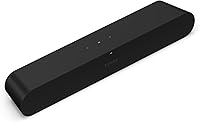
The Sonos Ray Compact Soundbar is Sonos's most accessible entry point into the world of dedicated TV audio, designed for smaller rooms rather than sprawling living spaces. At 22 inches wide, it fits comfortably under most TVs up to around 55 inches without dominating the shelf. One thing worth knowing upfront: it connects via optical audio only — there is no HDMI ARC port, which surprises some buyers after purchase. Think of the Ray as a capable starting point within the Sonos ecosystem, not a standalone home-theater solution. It performs well within its intended scope, but managing expectations from the start makes the experience far more satisfying.
Features & Benefits

The Ray houses two dynamic drivers alongside a 2.76-inch tweeter, producing a noticeably cleaner stereo image than a typical TV speaker — dialogue in particular comes through with much better presence. Streaming works over WiFi through the Sonos app, Apple AirPlay 2, and Spotify Connect, though there is no Bluetooth option, which is a deliberate Sonos design choice. An Ethernet port provides a more stable network connection if needed. Setup is genuinely straightforward: plug in the optical cable, connect power, and follow the app. If you already own other Sonos speakers, multi-room audio ties everything together cleanly, making the Ray feel far more capable as part of a larger system.

Best For

This compact Sonos bar is a strong fit for bedroom TVs, studio apartments, or any space where a larger soundbar would physically or acoustically overwhelm the room. It particularly shines for people already inside the Sonos ecosystem — adding the Ray keeps your audio environment consistent and app-controlled without friction. Viewers who watch a lot of dialogue-heavy content, like dramas or documentaries, will appreciate the vocal clarity it brings. Bass expectations should stay realistic though: low-end output is modest on its own, and buyers who want fuller sound often end up pairing it with the Sub Mini later. If that upgrade path appeals to you, the Ray makes a logical foundation.

User Feedback

Across more than 1,150 ratings, the Ray holds a 4.2-star average — solid, though not without its share of legitimate criticism. The most consistent praise centers on improved voice clarity and how painless the initial setup process is. On the other side, the absence of HDMI ARC is a recurring frustration, particularly for buyers with newer TVs that lack optical outputs. Bass performance also divides opinion noticeably, with many users recommending the Sub Mini addition to fill out the low end. A handful of reviewers question the value against competitors at a similar price point that offer HDMI ARC and more power. Overall, satisfied buyers tend to be those who went in knowing exactly what the Ray is — and is not.

Pros

  • Dialogue and vocal clarity is a genuine, immediately noticeable upgrade over built-in TV speakers.
  • Two-cable setup takes under ten minutes with no technical knowledge required.
  • The Sonos app is reliable, well-designed, and handles multi-room grouping without complications.
  • Apple AirPlay 2 and Spotify Connect work consistently well for household music streaming.
  • At 22 inches wide and under three inches tall, the Ray fits in spaces where larger bars simply cannot.
  • Wired Ethernet port provides a stable network fallback for users on congested WiFi networks.
  • For existing Sonos households, adding the Ray keeps the entire audio setup unified under one app.
  • The upgrade path to a proper surround system — adding a Sub and rear speakers — is straightforward.
  • Polycarbonate housing keeps the unit light and easy to reposition without tools or mounting hardware.

Cons

  • No HDMI ARC support creates real compatibility problems with many modern televisions.
  • Standalone bass output is modest enough that action movies and music feel noticeably flat.
  • No Bluetooth means there is zero audio fallback if your home network goes down.
  • Buyers without other Sonos hardware pay a platform premium that brings them limited ecosystem benefit.
  • Competing soundbars at a similar price point frequently offer more connectivity options and output power.
  • Maximum volume in rooms larger than a bedroom reveals compression and a slight hardness in the highs.
  • The Sub Mini addition — which many users feel is necessary — significantly increases the total cost.
  • Optical-only input means the Ray is already incompatible with a growing segment of new televisions.
  • No virtual surround processing means the soundstage, while clean, never feels truly immersive.

Ratings

Our scores for the Sonos Ray Compact Soundbar were generated by AI after analyzing thousands of verified global buyer reviews, with spam, bot activity, and incentivized feedback actively filtered out. The ratings reflect both what real users consistently loved and the friction points that surfaced repeatedly across different room setups and use cases. Nothing has been smoothed over — if a weakness showed up often enough to matter, it is reflected in the numbers.

Dialogue Clarity
88%
This is where the Ray genuinely earns its keep. Users watching dialogue-heavy content — crime dramas, news broadcasts, subtitled films — repeatedly noted that voices came through with a presence and separation that built-in TV speakers simply cannot match. The tweeter configuration handles the mid-high frequency range where spoken words live, and it shows.
At higher volumes in larger rooms, some users found that clarity started to compress slightly, with voices losing a little of that crispness. It is not a dealbreaker, but the Ray is clearly optimized for near-field listening distances rather than open-plan spaces.
Bass & Low-End Output
54%
46%
For casual TV watching — sitcoms, talk shows, background music — the low-end output is adequate and unlikely to bother most viewers. The Ray does not sound thin or tinny in the way some budget bars do, and for its size the bass presence is reasonable in smaller, acoustically contained rooms.
Action movies, music with real low-end weight, or anything that demands a physical sense of bass will expose the Ray's 2.0 stereo limits quickly. A significant number of users ended up purchasing the Sub Mini within months of buying the Ray, which effectively doubles the total investment and suggests the standalone experience leaves many buyers wanting more.
Setup Experience
91%
Plug in the optical cable, connect power, open the Sonos app — that is genuinely the whole process for most users. Reviewers who described themselves as non-technical were consistently pleasantly surprised by how little friction was involved. The app walks you through each step clearly, and the hardware side requires no configuration knowledge whatsoever.
The setup simplicity does depend on your TV having a working optical output. Buyers with newer TVs that have dropped the optical port in favor of HDMI ARC only hit an immediate wall, and this incompatibility is not clearly flagged at the point of purchase. Several reviews described needing an adapter or returning the unit entirely.
Connectivity & Input Options
47%
53%
WiFi connectivity is stable and responsive, and the addition of an Ethernet port is a thoughtful touch for users who prefer a wired network connection. AirPlay 2 and Spotify Connect work reliably and allow audio handoff between devices without noticeable lag, which is genuinely useful for households that share streaming duties.
The absence of HDMI ARC is the single most cited complaint across all reviews, and with good reason. It means the Ray cannot receive audio from HDMI-connected devices through the TV, cannot use TV remote volume control via CEC in many setups, and is incompatible with a growing number of TVs that have quietly dropped optical ports. There is also no Bluetooth, which limits spontaneous use cases.
Sonos Ecosystem Integration
86%
For users already in the Sonos world, the Ray slots in naturally. It appears in the same app as your other speakers, participates in grouped playback, and can anchor a future surround setup if you add a Sub and a pair of Sonos Era or Play speakers. That long-term upgrade path genuinely adds perceived value for committed Sonos households.
For buyers who do not own other Sonos hardware, the ecosystem benefits are largely hypothetical. You are paying a premium for a platform that only pays off if you continue investing in it. Users who just want a standalone TV soundbar and nothing more may find the ecosystem angle more lock-in than benefit.
Build Quality & Design
78%
22%
The polycarbonate housing feels solid for its weight class and the matte finish resists fingerprints well. At just over four pounds, it is easy to reposition and does not require any special shelf reinforcement. The low-profile rectangular shape sits discreetly under most televisions without drawing attention to itself.
Compared to the premium feel of larger Sonos products, the Ray's plastic construction does feel a tier below what the brand is known for. A few users noted minor flex in the casing when applying pressure, and the overall tactile experience does not quite justify the price point when held next to competing bars made with metal grilles.
Soundstage Width
72%
28%
For a 22-inch bar, the Ray produces a surprisingly spacious stereo image in smaller rooms. Movie scenes with panning audio and music with left-right separation benefit noticeably, and the effect is more convincing than the narrow presentation of most TV speakers, which tend to collapse everything to the center.
The soundstage has clear physical limits — in rooms wider than about 12 feet, the stereo spread starts to feel constrained rather than immersive. There is no virtual surround processing to artificially widen the image, so what you hear is essentially a clean two-channel presentation, nothing more.
Volume & Room-Filling Ability
63%
37%
In a bedroom or small living area, the Ray gets loud enough without any obvious distortion at moderate listening levels. For typical TV watching distances of six to ten feet, the output is comfortable and consistent, and the app volume control is precise enough to dial in exactly the level you want.
The 10-watt rated output is genuinely modest, and users in medium to large rooms reported needing to push the volume close to its ceiling to fill the space. At maximum output, a slight hardness creeps into the high-mids that most listeners will notice, particularly on music content where dynamics matter more than they do with TV audio.
App & Software Experience
83%
The Sonos app has matured considerably and handles the Ray without issues under normal conditions. EQ adjustments, volume scheduling, and multi-room grouping all work as expected, and the interface is clean enough that most users never feel the need to look up instructions.
Sonos has had well-documented issues with app stability following past updates, and while the current version is functional, the memory of those problems lingers in user sentiment. A small but vocal group of reviewers mentioned losing connectivity after software updates, requiring a reset to restore normal function.
Value for Money
61%
39%
For buyers who are already Sonos users, the Ray makes reasonable financial sense as an ecosystem-consistent TV audio solution. The setup experience and software reliability add genuine value that cheaper bars do not offer, and the upgrade path to a proper surround system gives the purchase longer-term relevance.
Evaluated purely as a standalone soundbar, the Ray faces stiff competition at its price point from brands offering HDMI ARC, more power, and virtual surround modes. Several reviewers specifically mentioned returning the Ray after comparing it directly with alternatives that delivered a more complete out-of-the-box audio experience for less money.
Streaming Reliability
84%
WiFi-based streaming via the Sonos platform is consistently reliable in stable home networks, and AirPlay 2 in particular handled mid-stream handoffs and multi-device sharing without dropouts in the vast majority of user reports. Spotify Connect integration works well and is widely appreciated by heavy Spotify users.
Users on congested or older 2.4GHz-only networks occasionally reported buffering or momentary disconnections. The absence of Bluetooth also means that if your WiFi goes down, there is no fallback audio path — a limitation that does not matter most of the time but becomes frustrating in the moments it does.
TV Compatibility
52%
48%
For TVs manufactured before roughly 2020 that retain an optical output, compatibility is essentially plug-and-play. The included optical cable means there is nothing extra to buy, and audio sync issues were rarely reported among users whose TVs supported the connection natively.
The compatibility story deteriorates quickly with modern televisions. Many current TV models have eliminated the optical port entirely, and some that retain it have been known to output compressed or limited audio signals. This is a structural limitation of the optical-only design that no software update can resolve.
Physical Footprint
87%
At 22 inches wide and under three inches tall, the Ray fits cleanly in front of or below televisions in tight spaces where larger soundbars simply would not work. Bedroom setups, compact media consoles, and wall-adjacent shelving arrangements all accommodate it without awkward overhang or visual clutter.
The slim profile does limit internal speaker volume, which is part of why the bass response is constrained. Buyers who want both a compact form factor and full-range audio will find those two goals are in direct tension here, and the Ray lands firmly on the compact side of that trade-off.

Suitable for:

The Sonos Ray Compact Soundbar is a well-matched choice for anyone setting up audio in a bedroom, home office, or small apartment living room where a full-sized bar would physically or acoustically overwhelm the space. It is especially well-suited to viewers who watch a lot of dialogue-heavy content — think true crime series, documentaries, or foreign-language films with subtitles — where vocal clarity matters more than cinematic bass. If you already own other Sonos speakers, the Ray fits naturally into that ecosystem, letting you manage TV audio alongside your existing setup from a single app without any friction. Minimalists who want a tidy two-cable installation and app-based control will find the experience satisfying from day one. It also works as a deliberate starting point for buyers who plan to expand gradually, adding a wireless subwoofer or rear speakers down the line rather than committing to a full system upfront.

Not suitable for:

The Sonos Ray Compact Soundbar is not the right fit for anyone whose TV lacks an optical audio output — and that includes a growing number of TVs released in the last few years that have dropped the optical port entirely in favor of HDMI ARC or eARC. If your TV falls into that category, compatibility will be a problem before you even get to the sound quality conversation. Buyers who primarily want to feel movies — action sequences, bass drops, surround panning — will find the Ray underwhelming as a standalone purchase, since its 2.0 stereo output simply does not deliver that kind of physical impact without an added subwoofer. Those comparing options purely on audio performance per dollar spent will also find that competing soundbars at a similar price point offer more power, HDMI ARC support, and sometimes virtual surround processing. And if you have no existing stake in the Sonos ecosystem, the platform premium baked into the Ray's price is harder to justify when standalone alternatives deliver comparable TV audio without the ecosystem dependency.

Specifications

  • Dimensions: The unit measures 3.74″ deep, 22″ wide, and 2.79″ tall, making it suited for shelves beneath TVs up to approximately 55 inches.
  • Weight: The Ray weighs 4.3 pounds (1,950g), light enough to reposition easily without any mounting hardware.
  • Speaker Config: It runs a 2.0 stereo configuration with two dynamic drivers and a 2.76-inch tweeter for high-frequency reproduction.
  • Audio Input: The only physical audio input is a digital optical (TOSLINK) port; an optical cable is included in the box.
  • Max Output: Rated maximum output power is 10 watts, appropriate for small-to-medium rooms at typical listening distances.
  • Frequency Response: The Ray's frequency response extends down to 20 Hz on paper, though meaningful bass output at the low end requires a paired subwoofer in practice.
  • Tweeter Size: The dedicated tweeter measures 2.76 inches in diameter, handling the upper frequency range where dialogue intelligibility lives.
  • Network: Wireless connectivity uses dual-band WiFi, with a rear Ethernet port available for users who prefer a wired network connection.
  • Streaming: Supported streaming protocols include the Sonos app, Apple AirPlay 2, and Spotify Connect; there is no Bluetooth support.
  • Audio Formats: The Ray supports Dolby Digital decoding via its optical input, but does not support Dolby Atmos or DTS:X.
  • Surround Expansion: A wireless subwoofer (Sonos Sub or Sub Mini) can be added via the Sonos app, and compatible Sonos speakers can be configured as rear channels.
  • Control Methods: The unit is controllable through the Sonos app on iOS and Android, and is compatible with most TV remotes via IR passthrough for volume and mute.
  • Material: The housing is constructed from polycarbonate (PC) plastic with a matte finish that resists fingerprints under normal handling.
  • Mounting Type: Designed for shelf mounting only; no wall-mount bracket or hardware is included or officially supported by the manufacturer.
  • Driver Type: Both drivers use a dynamic driver design, which prioritizes reliability and consistency over the higher-sensitivity approach of planar or ribbon alternatives.
  • Power Source: The Ray is mains-powered via a corded electric connection; a power cable is included and the unit has no battery operation mode.
  • Included Accessories: In the box you will find the Ray unit, one optical audio cable, and one power cable — no remote control or mounting hardware is included.
  • Warranty: Sonos provides a limited warranty on the Ray; specific terms and duration are defined in the documentation included with the product.
  • Multi-Room Audio: The Ray supports Sonos multi-room audio, allowing it to play in sync with other Sonos speakers across different rooms via the app.
  • Model Number: The official model identifier for the black variant sold in the US market is RAYG1US1BLK, with ASIN B0B2KQFTG9 on Amazon.

Related Reviews

Sonos Arc Ultra Soundbar
81%
93%
Sound Quality
91%
Dialogue Clarity
89%
Dolby Atmos Performance
67%
Bass Performance
92%
Setup & Installation
More
Sonos Beam Gen 2 Soundbar
80%
93%
Dialogue Clarity
71%
Dolby Atmos Performance
58%
Bass Response
86%
App & Software Experience
88%
Setup & Installation
More
Westinghouse WS200AM 2.0 Compact Soundbar
73%
91%
Ease of Setup
88%
Roku Integration
84%
Dialogue Clarity
53%
Bass & Low-End Response
58%
Dolby Atmos Performance
More
Sonos Port
Sonos Port
82%
93%
Ecosystem Integration
89%
Multi-Room Audio Performance
86%
Setup & Installation
84%
Wireless Connectivity Reliability
88%
Apple AirPlay 2 Support
More
Sonos Amp Stereo Amplifier
80%
93%
Sound Quality
89%
Multi-Room Integration
74%
App & Software Experience
91%
Connectivity & Compatibility
67%
Value for Money
More
SHANLING SONO
SHANLING SONO
89%
95%
Sound Clarity
88%
Bass Response
92%
Midrange Detail
90%
Treble Resolution
89%
Build Quality
More
MZEIBO 120W 2.1 Bluetooth Soundbar with Subwoofer
76%
83%
Bass Performance
81%
Value for Money
74%
Sound Quality
88%
Connectivity & Compatibility
89%
Setup & Installation
More
Sonos Sub Mini Compact Wireless Subwoofer
79%
88%
Bass Quality
93%
Setup Experience
86%
Ecosystem Integration
61%
Value for Money
84%
Build Quality
More
ZVOX SB500 TV Soundbar
81%
93%
Dialogue Clarity
67%
Bass Performance
91%
Ease of Setup
74%
Value for Money
84%
Build Quality
More
Sonos Era 100
Sonos Era 100
76%
91%
Sound Quality
87%
Trueplay Room Calibration
58%
App Experience & Setup
93%
Multi-Room Integration
84%
Connectivity & Compatibility
More

FAQ

Unfortunately, no — not directly. The Sonos Ray Compact Soundbar connects via optical audio only, and if your TV has removed the optical port in favor of HDMI ARC or eARC exclusively, you will need either a separate HDMI ARC to optical converter adapter or a different soundbar altogether. It is worth checking your TV's rear panel before purchasing.

In most cases, yes. The Ray supports IR (infrared) signal passthrough, which means standard TV remote volume and mute commands will work with it. However, because there is no HDMI CEC connection, some advanced remote features or universal remote configurations may behave differently depending on your TV brand.

For everyday TV watching — news, dramas, talk shows — the bass is perfectly adequate and will not leave you frustrated. Where it falls short is with movies or music that lean heavily on low-end impact, like action films or bass-forward genres. Many users hold off on the Sub Mini for a few weeks and then decide based on their own listening habits.

You do need the Sonos app to complete the initial setup — there is no way around that. After setup, basic TV audio use just works through the optical connection without needing the app open. But for adjusting EQ, adding the unit to multi-room groups, or updating firmware, the app is required.

No, the Ray has no Bluetooth support at all. Sonos has made a deliberate choice to use WiFi-only audio throughout their product line. You can stream from your phone using AirPlay 2 (on Apple devices) or through the Sonos app, but direct Bluetooth pairing is not available.

Almost certainly yes. At 22 inches wide and under 3 inches tall, the Ray is compact enough to sit comfortably in front of most 43-inch TVs without blocking the screen or IR sensor. Just make sure your TV's optical output is accessible from behind, since that cable needs a clear path.

Absolutely — that is one of the Ray's genuine strengths for existing Sonos users. Once set up in the app, it appears alongside your other Sonos speakers and can be grouped for synchronized playback. You can also configure it as the TV audio anchor of a surround setup if you add compatible Sonos speakers as rears.

No. The Ray decodes standard Dolby Digital through its optical input, but Dolby Atmos requires HDMI eARC, which the Ray does not have. If Atmos support is important to you — for compatible streaming content or Blu-ray — you will need to look at a soundbar with an HDMI eARC connection.

For most users, genuinely yes. You plug in the optical and power cables, download the Sonos app if you do not already have it, and follow the on-screen prompts. The whole process typically takes under ten minutes. The main exception is if your router or network has unusual firewall settings, which can occasionally cause the app to have trouble locating the device.

It can be, but go in with clear expectations. A lot of the Ray's appeal comes from how well it integrates with the broader Sonos ecosystem, and if you are starting from scratch, you are partly paying for a platform you have not yet built. For purely standalone TV audio, there are competing bars at a similar price that offer more connectivity and output. That said, if you plan to grow into the Sonos ecosystem over time, the Ray is a reasonable and low-friction place to start.

Where to Buy

Best Buy
In stock $219.00
Creative Audio
In stock $199.00
Wichita Furniture & Mattress
In stock $199.00
Walts TV
In stock $199.00
Bear Security Shop
In stock $218.99
Installations Unlimited
In stock $219.00
DoorDash
In stock $219.00