SMSL AO200 Mk II




Overview
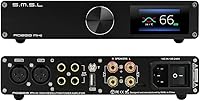
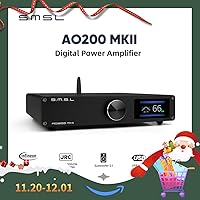
The SMSL AO200 Mk II is a slim, no-frills Class D stereo amplifier built for desktop and home listening setups where space is limited but sound quality isn't negotiable. SMSL has earned a solid reputation in the budget-to-mid audiophile space for delivering measurable performance at accessible prices, and this second-generation model pushes that further. The jump from the original AO200 is meaningful: a new MA5332MS amplifier chip brings a lower noise floor and better efficiency, and the addition of balanced XLR input is a real functional upgrade. One important caveat — this is a pure power amp with no onboard DAC, so pairing it with a separate source component is required to get sound out of it.
Features & Benefits
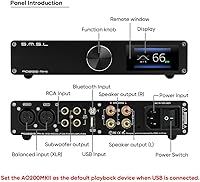
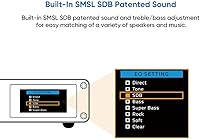
The MA5332MS chip at the heart of this Class D amp isn't just a spec talking point — it translates to a THD+N of 0.004% and a signal-to-noise ratio of 106dB, which means the background stays genuinely quiet even at higher volumes. Power output runs 160 watts per channel into 4-ohm loads and 85 watts into 8-ohm, giving bookshelf speakers plenty of headroom without clipping. The balanced XLR input is particularly useful if your DAC or preamp sits more than a meter away, as it rejects the interference RCA can pick up. A subwoofer pre-out lets you slot in an active sub for a 2.1 system without any extra hardware. The tone controls and SMSL's SDB bass enhancement round out the package for those whose speakers need a nudge.
Best For
This SMSL amplifier is a strong fit for desktop audiophiles running passive bookshelf speakers — think Elac Debut, KEF Q series, or Klipsch RP line — who want clean, high-headroom power without mounting a full AV receiver on their desk. It makes particular sense as an upgrade from entry-level T-amps or budget class-D modules, where the performance jump is clearly audible rather than marginal. If you already own a DAC and just need a transparent amplifier stage to sit between it and your speakers, this Class D amp covers that role without adding coloration. The XLR input is a meaningful plus for anyone building a balanced signal chain. It is less suited to buyers seeking an all-in-one solution or those without an existing source component.
User Feedback
Across verified reviews, the most consistent praise for this Class D amp centers on its quiet noise floor and solid channel separation — qualities that stand out especially when paired with sensitive bookshelf speakers. Build quality is frequently called out as punching above its class for the price tier. On the critical side, a handful of users have flagged inconsistent behavior with the USB input on Windows, requiring driver adjustments or workarounds. The tone controls split opinion: some find them genuinely useful for tuning speakers to a room, while others prefer running the amp flat. A small number of reviewers noted unit-to-unit variance, which is worth keeping in mind. Customer service from AOSHIDA appears responsive based on reported interactions, though experiences vary.
Pros
- Exceptionally quiet noise floor makes it a strong match for sensitive bookshelf speakers with no audible hiss.
- Balanced XLR input is a genuine feature, not a box-ticking addition — it functions cleanly and rejects interference.
- 160 watts per channel into 4-ohm loads delivers real dynamic headroom for desktop speaker systems.
- The CNC-machined aluminum chassis feels and looks more substantial than the price tier typically delivers.
- Subwoofer pre-out enables a 2.1 system expansion without any additional adapters or splitters.
- This Class D amp runs cool and draws only 40 watts at normal listening levels, making it efficient for daily use.
- Channel separation is strong enough that listeners switching from mid-range receivers notice a cleaner stereo image.
- Tone controls and SMSL SDB enhancement give practical tuning flexibility when speaker matching requires it.
- Slim footprint slides easily into a monitor stand or compact audio stack without dominating desk space.
- Upgraders from budget T-amps report a clearly audible and measurable improvement across the board.
Cons
- No onboard DAC means buyers with only a PC source must budget for an additional component before getting sound.
- USB input has documented driver compatibility issues on Windows that require troubleshooting for some users.
- No remote control makes volume adjustment inconvenient for any setup where the amp is not within arm's reach.
- Tone controls lack a hard bypass, which frustrates users who want a fully transparent signal path.
- Rear-panel connectors sit close together, making cable management awkward when all input types are populated.
- Unit-to-unit variance in knob feel and channel consistency has been noted across a small but recurring set of reviews.
- No front-panel display or input indicator makes it difficult to confirm which source is currently active.
- Warranty and RMA support experiences have been inconsistent, with some users reporting slow or difficult resolutions.
- The SDB bass enhancement can feel excessive on already bass-forward speakers if not dialed back carefully.
- Buyers expecting a traditional warm amp character may find the neutral, analytical presentation less engaging over time.
Ratings
The SMSL AO200 Mk II has been put through its paces by a wide range of buyers — from desktop audiophiles to home office builders — and our AI has analyzed thousands of verified global reviews, actively filtering out incentivized and bot-generated submissions to surface what real users actually experience. Scores reflect both where this Class D amp genuinely impresses and where it falls short, with no category glossed over.
Sound Quality
Power Output & Headroom
Build Quality & Chassis
Input Flexibility & Connectivity
Noise Floor & Interference Rejection
Subwoofer Integration
Tone Controls & EQ
Form Factor & Desktop Footprint
USB Audio Implementation
Value for Money
Ease of Setup
Channel Separation
Reliability & Longevity
Customer Support
Suitable for:
The SMSL AO200 Mk II is built for the kind of listener who already has a DAC or preamp in their chain and just needs a clean, compact power stage to drive passive bookshelf speakers on a desk or in a small room. If you are running a pair of KEF Q150s, Elac Debut 2.0s, or similarly efficient bookshelf speakers and want genuine headroom without parking a full-width AV receiver on your workspace, this Class D amp fits that role well. It also makes strong sense for anyone upgrading from a cheap T-amp class device — the jump in measured performance, noise floor, and input flexibility is tangible rather than marginal. The balanced XLR input is a practical bonus for buyers who already own a DAC with balanced outputs, since it keeps the signal clean over longer desktop cable runs. Those who want to grow into a 2.1 setup down the road will also appreciate that the subwoofer pre-out is ready to go without any extra hardware.
Not suitable for:
Buyers who want a single box that handles everything — DAC, amplifier, and speaker switching — will find the SMSL AO200 Mk II too stripped back for their needs, since there is no onboard digital-to-analog conversion and no display to confirm input selection. If your only source is a Windows PC connected via USB and you are not comfortable troubleshooting audio drivers, the USB input's track record for plug-and-play reliability is inconsistent enough to be a real concern. There is no remote control, which rules it out for couch-based listening setups where volume adjustments from across the room are expected. Users planning to drive large floor-standing speakers in a medium or large room may find the power reserves tighter than they would like under demanding conditions. And anyone who wants a warm, tonally colored sound characteristic of classic Class AB designs will likely find this amp's neutral presentation unsatisfying — its strength is transparency, not character.
Specifications
- Amplifier Class: The AO200 Mk II uses Class D amplification, which delivers high efficiency and low heat output compared to traditional Class AB designs.
- Amplifier Chip: The unit is built around the MA5332MS amplifier chip, chosen for its low distortion characteristics and high power efficiency.
- Output Power: Rated output is 160W per channel into 4-ohm loads and 85W per channel into 8-ohm loads, covering a wide range of passive speaker types.
- THD+N: Total harmonic distortion plus noise measures 0.004%, indicating a very clean amplification stage with minimal signal degradation.
- SNR: Signal-to-noise ratio is rated at 106dB, which translates to an essentially silent background at the listening position under normal conditions.
- Channel Separation: Channel separation is specified at 85dB, providing a well-defined stereo image with minimal crosstalk between left and right channels.
- Inputs: The amp accepts signal via three input types: USB, RCA (unbalanced), and XLR (balanced), selectable from the front panel.
- Input Sensitivity: Input sensitivity is 290mV at an impedance of 47kΩ, compatible with standard DAC and preamp output levels.
- Subwoofer Output: A dedicated line-level subwoofer pre-out is included, allowing direct connection to an active subwoofer for a 2.1 configuration.
- Tone Controls: Built-in treble and bass adjustment controls are provided alongside SMSL's proprietary SDB bass enhancement circuit for speaker tuning flexibility.
- Volume Control Chip: The NJW1194 chip handles volume control duties, contributing to precise channel tracking and low-noise attenuation across the gain range.
- Op-Amp: An OPA1678 operational amplifier is used in the signal path, selected for its low distortion and clean output characteristics.
- Power Consumption: Normal operating power draw is 40W at average listening levels, with standby consumption reduced to just 0.5W.
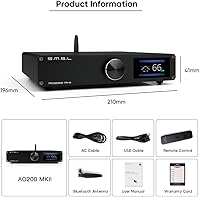
- Dimensions: The unit measures 210mm wide by 41mm tall by 196mm deep, giving it a low-profile footprint well suited to desktop placement.
- Weight: The AO200 Mk II weighs 1.6kg, light enough for easy repositioning but substantial enough to feel solid on a desk surface.
- Chassis Material: The enclosure is constructed from CNC precision-machined aluminum, providing rigidity and effective heat dissipation for the Class D output stage.
- Voltage: The unit is rated for 110V AC operation, intended for use with standard North American power outlets.
- Mounting Type: The amplifier is designed for freestanding placement and does not support rack-mounting or wall-mounting configurations.
Related Reviews
Outlaw RR 2160 Mk II Stereo Receiver
OM System OM-1 Mark II with M.Zuiko 12-40mm f/2.8 PRO II
RØDE VideoMicro II

NEEWER Teleprompter X17 II 17″
SMSL PL100 CD Player
Sony a7S II Camera
Celestron LCD Digital Microscope II
Sennheiser ME 2-II