
Overview

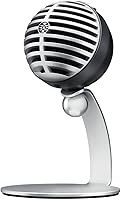
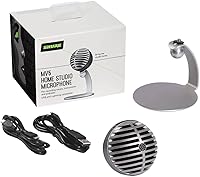
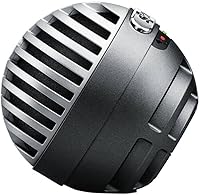
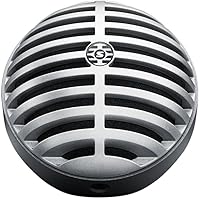
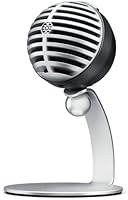
The Shure MV5 is Shure's compact answer to a crowded USB microphone market — an aluminum-bodied condenser with a retro silhouette that genuinely looks good sitting on a desk. It occupies a sensible middle ground: more polished than the budget clip-ons flooding the lower end, but without the complexity of an XLR chain. Out of the box, you get both a USB-A and a Lightning cable, which means iPhone users can plug straight in without hunting for an adapter. No drivers to install, no software to launch — just plug it in and it works on Mac, Windows, iOS, and Android alike.

Features & Benefits

Three onboard recording modes are where this USB mic quietly earns its keep. Switch to Speech mode and the sound tightens up — a slight presence boost that cuts through video calls and podcast recordings without making your voice sound processed. Singing mode opens the high end a little for a warmer, more natural vocal tone. Flat mode captures exactly what is in front of it, which is useful if you plan to do your own EQ work later. The cardioid polar pattern does a solid job rejecting off-axis noise, and the headphone monitoring jack means you can hear yourself in real time — no delay, no awkward lag.

Best For

This desktop condenser is a natural fit for anyone who needs noticeably better audio but does not want to spend time troubleshooting drivers or building an XLR setup. Podcasters and streamers will appreciate how little friction is involved — open a browser, plug in, and you are recording. It is also a smart pick for vocalists who track demos on an iPhone; the included Lightning cable removes one of the usual mobile recording headaches. Remote workers tired of sounding hollow on calls will find a clear upgrade here. If you care how your desk looks on camera, the retro styling is a genuine bonus too.

User Feedback

Owners consistently praise the warm vocal tone the MV5 produces without any tweaking — a quality that takes many USB mics at this price range several firmware updates to approach. The aluminum shell also gets repeated mentions for holding up well over time. That said, honest feedback surfaces a couple of friction points. The fixed desktop stand works fine for straight-on recording, but anyone wanting a boom-arm mount has to source a separate adapter. A handful of users also wish gain control were more accessible. And if your room has hard surfaces, the cardioid pattern alone will not save you — a basic acoustic treatment makes a bigger difference than the mic itself.

Pros

  • Plug-and-play setup works instantly on Mac, Windows, iOS, and Android — no drivers or software required.
  • Three onboard recording modes let you tailor the sound for speech, vocals, or flat capture without touching a computer.
  • The aluminum body feels genuinely solid and holds up well to daily desk use over the long term.
  • Warm, natural vocal tone out of the box is consistently noted by podcasters and streamers as above average for the price tier.
  • Both USB-A and Lightning cables are included, so iPhone users are covered from day one.
  • Zero-latency headphone monitoring lets vocalists and narrators hear themselves clearly while recording.
  • Compact and lightweight enough to slip into a laptop bag without adding noticeable bulk.
  • The retro dome design looks distinctive on camera, which matters for anyone visible during livestreams or video calls.
  • Cardioid polar pattern handles moderate keyboard noise and ambient sound reasonably well in a typical home office.

Cons

  • No official companion app means gain, EQ, and sample rate cannot be configured from a computer.
  • The integrated stand cannot be removed without a separate adapter, limiting boom-arm or side-mount setups.
  • Gain adjustment range is too narrow for quiet speakers or instruments recorded at a distance.
  • Room echo and hard-surface reflections are picked up readily — acoustic treatment is effectively a hidden requirement.
  • The foam windscreen discolors and compresses faster than the rest of the unit with regular handling.
  • Android compatibility is inconsistent across devices and does not always match the smooth experience on Apple hardware.
  • No stereo recording option limits usefulness for capturing instruments or ambient sound realistically.
  • Competing mics at a similar price now include dedicated software mixers and more flexible mounting hardware.
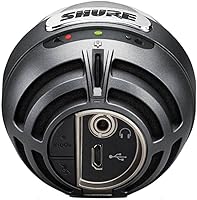
  • Recording modes are toggled via a physical button with an LED indicator, which is not ideal in low-light streaming setups.

Ratings

The Shure MV5 has been evaluated using AI-driven analysis of verified global buyer reviews, with spam, bot activity, and incentivized feedback actively filtered out. Scores reflect real-world usage patterns across podcasters, streamers, vocalists, and remote workers — not just spec sheets. Both the genuine strengths and the honest frustrations are weighted into every number you see below.

Audio Quality
83%
For a USB mic at this price tier, the vocal warmth is consistently above expectations. Reviewers recording voiceovers and podcast episodes note that recordings sound full and clear without needing corrective EQ, which is a real advantage for anyone who edits on a tight timeline.
It does not compete with a dedicated large-diaphragm condenser in a treated room — detail in the high frequencies can feel slightly rolled off. Buyers coming from professional studio backgrounds may find the overall sound a touch polished rather than truly transparent.
Build Quality
91%
The aluminum shell is the first thing buyers comment on when unboxing: it feels dense and solid in a category where plastic-bodied rivals dominate. Long-term owners frequently report zero degradation after a year or more of regular desk use, which speaks to genuine material quality rather than just aesthetic choice.
The fixed stand and the mic body are not separable without a third-party adapter, so if the stand mount ever cracks under stress, the whole unit becomes harder to use. A small number of users have noted that the foam windscreen can start to look worn after extended daily handling.
Ease of Setup
96%
Plug-and-play is not a marketing claim here — reviewers on Mac, Windows, and even iPad consistently confirm it shows up as an audio device within seconds, no drivers, no software. The inclusion of both a USB-A and Lightning cable means mobile users are covered from day one without any extra shopping.
There is essentially no setup learning curve, which some power users see as a limitation — you cannot configure sample rate, bit depth, or input gain from any official desktop app without third-party tools. For most buyers this is a non-issue, but it is worth knowing before you commit.
Recording Modes
78%
22%
The three DSP modes give the mic practical versatility that single-mode USB mics cannot match. Speech mode adds a subtle presence lift that makes voices cut through clearly on livestreams and calls, while Singing mode introduces a flattering warmth that works well for acoustic demos recorded straight into GarageBand or Logic.
Switching between modes requires pressing a physical button and watching an LED, which is not always intuitive in a dark streaming setup. The Flat mode, while useful for post-production flexibility, can sound underwhelming to users expecting a polished result without additional processing.
Noise Rejection
74%
26%
The cardioid pattern does a respectable job of keeping keyboard clatter and ambient room noise off recordings during normal home office conditions. Streamers have noted it handles moderate background noise well enough that viewers rarely comment on it.
In acoustically untreated rooms with hard floors or bare walls, the mic picks up noticeable room reflections that no polar pattern can fully compensate for. A few reviewers were surprised that a cardioid mic still captured reverb from their space — it is a room problem, but buyers may not realize that upfront.
Headphone Monitoring
81%
19%
Zero-latency monitoring through the 3.5mm jack is a genuine quality-of-life feature that vocalists and podcasters who want to hear themselves in real time will appreciate. It removes the disorienting delay that frustrates anyone trying to perform or narrate while monitoring through software.
Volume control for the headphone output is limited to a single onboard dial that also handles mic gain on some firmware versions, which creates friction when trying to balance input and output levels independently. Users who mix in-ear monitoring with software playback may find the control too coarse.
Compatibility
93%
Cross-platform support is genuinely broad — the same unit works on a MacBook, a Windows desktop, an iPhone, and an Android tablet without any reconfiguration. This is especially valued by creators who move between devices or use their phone for on-location recording.
Android compatibility, while listed, can vary depending on the device and USB adapter used. A small number of Android users report inconsistent recognition, which suggests the experience is not quite as frictionless on that platform as it is on Apple hardware.
Portability & Form Factor
88%
At 90 grams and with a footprint smaller than a coffee mug, this desktop condenser travels well in a laptop bag. Educators and remote workers who move between offices or work from different locations consistently highlight how little desk space it claims compared to larger USB mics.
The integrated stand design, while compact, is not ideal for setups where mic placement needs to be adjusted frequently. If you want to mount it on a boom arm or position it off to the side of your monitor, you will need a specific thread adapter that does not come in the box.
Gain Control
61%
39%
For average voice levels in a quiet room, the default gain handles itself reasonably well without manual intervention. Most podcasters and streamers recording at a normal speaking distance report acceptable levels with minimal clipping.
The lack of granular, dedicated gain control frustrates users who speak quietly, record instruments at varying distances, or share the mic between different voices. Several reviewers specifically called out wanting a wider adjustment range, noting that the single dial feels like a compromise at this price point.
Value for Money
79%
21%
Shure's brand reputation carries real weight at this price, and the aluminum construction means buyers are not just paying for a logo — the physical product justifies a portion of the premium on its own. For someone stepping up from a headset mic or a cheap USB stick mic, the audio improvement is immediately audible.
Competing USB mics at similar prices now offer boom-arm compatibility, dedicated gain knobs, and companion apps out of the box. The MV5 is not bad value, but it is no longer exceptional value, and buyers who prioritize flexibility over aesthetics may find better-equipped alternatives.
Aesthetics & Desk Presence
92%
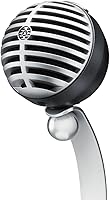
The retro dome design with the dark foam cap is one of the more distinctive silhouettes in the USB mic space, and that matters to streamers and video call users who are visible on camera. Multiple reviewers specifically mention buying it partly because it looks professional without looking clinical.
The aesthetic is polarizing — some buyers find the vintage styling dated or mismatched with modern minimal desk setups. Color options are limited, and the dark foam windscreen shows dust and skin oils relatively quickly, requiring periodic cleaning to maintain the visual appeal.
Durability Over Time
87%
The aluminum body holds up well to daily use, with long-term owners reporting no degradation in sound quality or physical condition after extended periods. The cable connectors on the unit itself also appear robust, with few reports of loosening or intermittent connection issues over time.
The foam windscreen is the weakest durability point — it compresses and discolors noticeably faster than the rest of the unit. The button for switching recording modes has been flagged by a handful of users as feeling less tactile after heavy use, though this appears to be a minority experience.
Software & App Support
53%
47%
The mic works entirely without software, which keeps the barrier to entry near zero. For buyers who just want to record without configuring anything, the absence of a required companion app is actually a feature rather than a gap.
There is no official desktop application for adjusting EQ, monitoring mix, or configuring the recording modes remotely — everything is handled physically on the unit. Compared to rivals that offer dedicated mixing software, the MV5 feels limited for users who want deeper control without reaching for a separate audio interface.

Suitable for:

The Shure MV5 is built for the kind of buyer who wants a meaningful audio upgrade without having to learn signal chains, phantom power supplies, or audio interfaces. Podcasters and streamers who record solo in a home office will get the most out of it — plug it into a Mac or PC, open your recording app, and you are genuinely ready to go in under a minute. iPhone and iPad creators are particularly well served, since the included Lightning cable removes what is usually an annoying compatibility hurdle for mobile recording. Remote workers and educators who are tired of sounding like they are calling from a tin can will notice an immediate and obvious improvement over any built-in laptop or webcam mic. It also suits vocalists who want to capture demo-quality vocals at home without committing to a full studio setup, especially those who prefer to record direct into GarageBand, Logic, or Audacity with minimal post-processing.

Not suitable for:

Buyers who need precise control over their recording signal will quickly feel the limits of the Shure MV5. There is no dedicated software companion, no adjustable sample rate, and the onboard gain control lacks the fine-tuning range that quieter voices or instrument recording often demands. Anyone planning to mount the mic on a boom arm or position it off to the side of a monitor will need to source a third-party thread adapter, since the integrated stand is not removable out of the box. If your recording space has hard walls, bare floors, or any notable acoustic reflection, this mic will capture all of it — no cardioid pattern substitutes for basic room treatment, and buyers sometimes learn that the hard way. Professionals or semi-pros who have already invested in XLR gear will find this USB mic a step down in raw audio flexibility rather than a step forward. And if your priority is the lowest possible price rather than build quality or brand reputation, the market now offers capable alternatives at a lower cost.

Specifications

  • Connectivity: Connects via USB, with both USB-A and Lightning connectors included in the box for broad device compatibility.
  • Polar Pattern: Unidirectional cardioid pattern captures sound from the front while naturally rejecting off-axis noise from the sides and rear.
  • Signal-to-Noise Ratio: Rated at 76 dB, delivering clean audio with minimal background hiss for vocal recording and streaming applications.
  • Audio Sensitivity: Sensitivity is rated at 38 dB, suited for close-range vocal capture in typical home recording distances.
  • Recording Modes: Three onboard DSP modes — Speech, Singing, and Flat — are selectable via a physical button on the unit.
  • Headphone Output: A 3.5 mm headphone jack provides zero-latency direct monitoring without routing audio through a computer.
  • Dimensions: The unit measures 4.1 x 5.1 x 4.4 inches, making it compact enough for small desks and travel bags.
  • Weight: Weighs 90 g (3.17 oz), which is notably light for an aluminum-bodied condenser microphone in this class.
  • Material: Outer shell is constructed from aluminum, providing durability and a premium tactile feel over plastic alternatives.
  • Power Source: Powered entirely via USB bus power; no external power supply or battery is required during operation.
  • Compatible Platforms: Works natively on macOS, Windows, iOS, and Android without requiring driver installation or third-party software.
  • Channels: Records in mono with a single channel, optimized for vocal-centric applications such as podcasting, streaming, and voiceover.
  • Included Accessories: Package includes a 3.2 ft USB-A cable, a Lightning cable, and a desktop stand with a threaded mount base.
  • Microphone Form: Classified as a mini desktop condenser with a dome-shaped retro profile and integrated foam windscreen.
  • Frequency Response: Shure does not publish an official frequency response curve for this model; performance is shaped by the onboard DSP modes.
  • Mount Compatibility: The base features a standard threaded mount, allowing attachment to third-party boom arms or mic stands with an appropriate adapter.
  • Model Number: Official model designation is MV5-DIG, distinguishing the digital USB version from earlier analog configurations.

Related Reviews
Shure MV7-K
Shure MV7-K
89%
95%
Sound Clarity
92%
Background Noise Rejection
94%
Build Quality
88%
Ease of Setup
90%
USB/XLR Versatility
More
Shure SM7B
Shure SM7B
83%
98%
Vocal Sound Quality
96%
Background Noise Rejection
94%
Build Quality & Durability
41%
Ease of Setup
88%
Plosive & Sibilance Control
More
Shure SRH145 Headphones
83%
79%
Sound Quality
93%
Portability
85%
Comfort
87%
Build Quality
70%
Noise Isolation
More
Shure VP89L Microphone
86%
92%
Sound Quality
89%
Modularity
90%
Build Quality
85%
Ease of Use
91%
Directional Accuracy
More
Shure Beta 57A
Shure Beta 57A
90%
97%
Build Quality
93%
Feedback Rejection
91%
Midrange Clarity
89%
Off-Axis Bleed Control
88%
Handling Noise Suppression
More
Shure MV7i
Shure MV7i
78%
91%
Audio Clarity
94%
Ease of Setup
88%
Auto Level Mode
89%
Built-in Audio Interface
76%
Noise Reduction & DSP
More
Shure WL185 Lavalier Microphone
87%
92%
Sound Quality
90%
Background Noise Rejection
88%
Durability and Build Quality
85%
Portability and Size
83%
Ease of Use/Setup
More
Shure PGA48-XLR
Shure PGA48-XLR
83%
93%
Build Quality
86%
Vocal Clarity
91%
Value for Money
82%
Feedback Rejection
74%
Handling Noise
More
Shure MVL Lavalier Microphone
80%
83%
Audio Clarity
88%
Build Quality
91%
Plug-and-Play Simplicity
79%
RF & Interference Rejection
71%
Omnidirectional Performance
More
Shure PGA58
Shure PGA58
86%
93%
Build Quality
86%
Vocal Clarity
89%
Feedback Rejection
96%
Value for Money
84%
Switch Design
More

FAQ

Yes, and that is one of its more practical advantages. A Lightning cable is included in the package, so iPhone and iPad users can plug directly into their device without hunting for a separate adapter. It shows up as an audio input automatically on iOS.

No installation is required at all. The Shure MV5 is recognized as a standard USB audio device on Mac, Windows, iOS, and Android the moment you plug it in. Just open your recording app of choice and it will be there waiting.

Speech mode adds a subtle presence boost that makes voices sound clearer and more forward — good for podcasts, calls, and narration. Singing mode smooths things out and adds a warmer, fuller tone that flatters acoustic vocals. Flat mode captures audio without any onboard processing, which is useful if you plan to apply your own EQ or effects afterward.

Not directly out of the box. The integrated stand is fixed to the body, and you would need a third-party thread adapter to attach it to a standard boom arm or desk-clamp stand. It is a genuine limitation worth knowing before you buy, especially if flexible mic positioning is important to your setup.

The cardioid pattern does reduce off-axis sound, so moderate background noise at a distance is handled reasonably well. That said, if you have a loud mechanical keyboard right next to the mic, or a room fan at close range, some bleed is likely. Physical distance and angling the mic away from noise sources helps more than any polar pattern alone.

For demo recordings, acoustic guitar, or simple vocal tracks, it does a capable job at this price level. It is not a substitute for a large-diaphragm condenser paired with an audio interface in a treated room, but for capturing ideas quickly or recording covers, the Singing mode produces a warm result that holds up well in casual listening contexts.

Yes, there is a 3.5 mm headphone output on the unit itself. Plugging into it gives you direct, zero-latency monitoring so you can hear your own voice as you record without any delay. This is particularly useful for singers or narrators who find software monitoring latency distracting.

It is a clear step above any built-in laptop or webcam microphone, and most colleagues will notice the improvement immediately. Speech mode is the right choice for calls — it adds enough presence to make your voice sound clean and articulate without coming across as over-processed.

The aluminum shell has earned consistently positive long-term feedback from buyers who use it every day. The body itself shows little wear over time. The foam windscreen is the weakest point aesthetically — it tends to compress and pick up oils with repeated handling — but it does not affect audio performance.

It can be, yes. The cardioid pattern helps reduce some ambient noise, but hard surfaces like bare walls, wood floors, and glass windows create reflections that any sensitive condenser mic will pick up. If your recordings sound roomy or reverb-heavy, basic acoustic panels or even thick curtains behind you will make a bigger difference than any microphone setting.