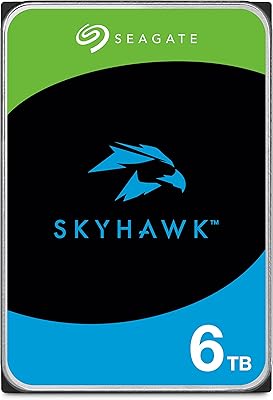
Overview

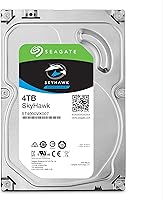
The Seagate SkyHawk 4TB Surveillance Hard Drive is built from the ground up for security applications — not quietly repurposed from a desktop line, as some competing options are. Within the SkyHawk family, the 4TB model sits in a practical middle ground: enough capacity to store weeks of footage without the price premium of higher-tier configurations. This Seagate HDD targets home CCTV setups and small business DVR or NVR systems where always-on recording is the priority. Running at 5900 RPM, it trades a fraction of raw speed for cooler, quieter operation — a sensible trade-off when a drive never really rests. The standard 3.5-inch SATA interface means it drops into virtually any compatible enclosure without compatibility headaches.
Features & Benefits

What separates this surveillance drive from a generic desktop HDD is how thoughtfully it handles the grind of round-the-clock recording. The ImagePerfect firmware prioritizes continuous sequential writes over random read activity — exactly what a DVR or NVR demands — making dropped frames far less likely under sustained load. At 180TB per year, the workload rating is more than three times what a typical desktop drive is engineered to handle, so wear accumulates much more slowly under real surveillance conditions. The 64MB cache keeps things efficient without overengineering for a workload that is almost entirely sequential. RV sensors help maintain stable performance in multi-drive enclosures, and the bundled Seagate Rescue service adds a genuine safety net if something does eventually go wrong.

Best For

The SkyHawk 4TB is a natural fit for home CCTV systems running four to eight cameras at 1080p or below, where continuous recording demands a drive that won't buckle after a few months. Small business owners who need a dependable NVR solution — and would rather not babysit a RAID of smaller drives — will find the single-drive approach appealing. It is also a sensible upgrade for anyone currently running a desktop drive in their DVR who has started noticing stuttering footage or early failures. That said, this Seagate HDD is not the right tool for every job. It is not optimized for NAS parity workloads, general computing, or AI-driven video analytics platforms that require a purpose-different class of drive entirely.

User Feedback

With a 4.5-star average across nearly 2,000 ratings, the consensus is clear: this surveillance drive largely delivers on its promises. Buyers consistently highlight plug-and-play installation and the kind of quiet, unobtrusive operation that lets you forget the drive is even running. Long-term owners — some reporting well over two years of continuous use — are particularly positive, which carries more weight than initial impressions. Recurring criticisms are fairly minor: a handful of users mention noticeable warmth in tightly enclosed enclosures, and a small number have flagged compatibility hiccups with certain Hikvision or Dahua NVR builds. The Rescue recovery service draws mixed user reactions — appreciated in principle, though some found the actual claims process slower than expected.

Pros

  • Purpose-built firmware reduces dropped frames during continuous 24/7 recording sessions.
  • The 180TB/year workload rating means this surveillance drive handles constant writes without burning out prematurely.
  • Rotational vibration sensors help maintain stable performance in multi-drive NVR enclosures.
  • 4TB capacity stores a substantial amount of HD footage before older recordings need to cycle out.
  • Standard 3.5-inch SATA form factor means it fits virtually any DVR or NVR without adapter headaches.
  • Seagate Rescue data recovery service is included, adding a real safety net for critical footage.
  • Long-term owners consistently report reliable operation well beyond the two-year mark.
  • Installation is genuinely straightforward — most buyers report the SkyHawk 4TB working on first boot.
  • Cooler and quieter operation at 5900 RPM compared to faster desktop-class alternatives.

Cons

  • Runs noticeably warm in tightly enclosed enclosures with limited airflow.
  • Occasional compatibility hiccups have been reported with certain Hikvision and Dahua NVR models.
  • The Seagate Rescue claims process can be slower and more bureaucratic than buyers expect.
  • Not a good fit for desktop PC use — the lower RPM and sequential-first tuning limit general performance.
  • No support for AI-optimized or smart analytics workloads that newer surveillance platforms increasingly require.
  • A small number of buyers have reported early failures, which is worth noting despite the strong overall reliability record.
  • The 64MB cache may feel limiting in setups pushing higher camera counts or bitrates beyond standard 1080p.
  • No built-in encryption or advanced security features for sensitive footage environments.

Ratings

The scores below reflect an AI-driven analysis of verified global buyer reviews for the Seagate SkyHawk 4TB Surveillance Hard Drive, with spam, incentivized feedback, and bot activity actively filtered out before any scoring was applied. Ratings span everything from long-term reliability and installation ease to thermal behavior and value — both the strengths and the recurring frustrations are represented here without bias.

Long-Term Reliability
88%
The pattern that stands out most across long-term owners is consistency — buyers running this surveillance drive inside NVRs for two, three, even four years without a single failure are not rare outliers. For home and small business users who set up a system and largely forget about it, that kind of endurance is exactly what they need.
A visible minority of buyers do report early failures within the first year, which is enough to keep the score from reaching the top tier. These cases appear scattered rather than tied to a specific batch or enclosure, making them unpredictable rather than systematic.
Recording Performance
91%
Buyers who switched from desktop drives specifically note the disappearance of dropped frames and recording gaps — problems that were common before the switch. The ImagePerfect firmware clearly makes a practical difference for continuous multi-camera setups, especially systems running six or more streams simultaneously.
At higher bitrates or with cameras recording in 4K, a small number of users report occasional hiccups under peak load conditions. The drive was not engineered for that tier of demand, and performance at the upper edge of its range reflects that honestly.
Installation Ease
93%
An unusually high share of reviewers — including self-described non-technical buyers — describe installation as completely painless. The standard 3.5-inch SATA form factor means it physically drops into virtually any DVR or NVR bay, and the NVR handles the rest through its own format prompt.
A subset of users with certain Hikvision and Dahua models report that the drive was not immediately recognized until a firmware update was applied to the NVR itself. This is not a flaw in the drive, but it does add an unexpected troubleshooting step for some buyers.
Thermal Management
67%
33%
The 5900 RPM spin speed genuinely helps keep temperatures lower than faster alternatives, and buyers using the SkyHawk 4TB in enclosures with decent ventilation consistently report comfortable operating temperatures over extended periods.
In enclosed or poorly ventilated NVR units — a common setup for discreet home installations — warmth is a recurring complaint. Several buyers mention needing to add external cooling to keep temperatures in check during summer months, which adds friction to an otherwise simple setup.
Compatibility
78%
22%
The overwhelming majority of users report no compatibility issues across a wide range of NVR and DVR brands. The SATA 6Gb/s interface is universal enough that most buyers simply plug it in and move on without a second thought.
Edge cases do exist — particularly with older NVR firmware versions or certain budget enclosures that have quirky drive detection behavior. While these situations are resolvable, they create a frustrating initial experience for buyers who expected pure plug-and-play simplicity.
Noise Level
74%
26%
Most users describe the drive as quiet during normal operation, and buyers who have it installed inside a closed cabinet or utility room report hearing virtually nothing during day-to-day use.
During heavy write activity — particularly when multiple cameras trigger recording simultaneously — some users notice a distinct clicking or seek noise that can be audible in quiet indoor environments. It is not alarming, but it is noticeable if the NVR is located in a living space.
Value for Money
83%
Buyers who understand what a purpose-built surveillance drive actually does differently consistently rate the value positively. The combination of a three-times-higher workload rating than a desktop alternative, plus the included Rescue recovery service, makes this Seagate HDD feel well-justified against its price.
Buyers who are comparing it purely on a cost-per-terabyte basis against generic desktop drives sometimes feel the premium is not worthwhile — particularly if they have not personally experienced the consequences of running the wrong drive type in an always-on recording setup.
Workload Endurance
89%
The 180TB per year workload ceiling is one of the most meaningful specifications for any buyer running a system that never sleeps. Users who previously burned through desktop drives in under 18 months find this drive holds up far better under the same continuous write conditions.
For very high camera counts or setups pushing 4K bitrates across the board, the annual workload ceiling can theoretically be approached sooner than expected. Most home users will never get close, but larger SMB deployments should do the math before committing.
Vibration Resistance
82%
18%
Users running multi-drive NVR enclosures specifically call out the RV sensors as a genuine advantage — performance stays consistent even when neighboring drives are active, which is not something they experienced with drives lacking this feature.
For single-drive setups, which represent a large portion of home users, the RV sensors make no practical difference. It is a feature that earns its value only in specific hardware configurations, so its benefit is real but not universal.
Data Recovery Service
69%
31%
The inclusion of Seagate Rescue at no added cost genuinely differentiates this drive from competitors at a similar price point. Buyers who have actually used it report successful data retrieval in situations that would otherwise have meant a total loss of recorded footage.
The claims process draws consistent criticism for being slow and requiring more documentation than buyers anticipated. Several users describe the experience as more bureaucratic than reassuring, which undercuts the peace of mind the service is supposed to provide.
Write Speed Consistency
77%
23%
For its intended purpose — sustained sequential writes from multiple camera streams — the SkyHawk 4TB delivers consistent throughput without the performance dips that plague desktop drives under similar conditions. Buyers note footage is smooth and timestamps remain accurate.
Raw sequential write speeds are not class-leading, and buyers who run benchmark tests are sometimes surprised by the numbers. The drive is tuned for endurance and consistency rather than peak throughput, which is the right trade-off for surveillance but disappoints those expecting desktop-grade speeds.
Packaging & Delivery Condition
85%
The frustration-free packaging format means the drive arrives well-protected and ready to install, and the vast majority of buyers report receiving units in perfect condition with no physical damage or cosmetic issues.
A handful of buyers mention receiving units with superficial scuffs or dented packaging, though drive functionality in these cases was not affected. For a product where the internal components are what matter, packaging damage is a minor concern rather than a dealbreaker.
NVR Software Integration
80%
20%
Most major NVR platforms — including popular options from Hikvision, Dahua, and Q-See — recognize the SkyHawk 4TB immediately and expose health monitoring data through their built-in S.M.A.R.T. reporting tools, which buyers find reassuring for ongoing peace of mind.
Integration depth varies by NVR brand and firmware version. Some lower-cost NVR platforms expose only basic drive detection without granular health data, leaving users with less visibility into how the drive is performing over time than they would like.

Suitable for:

The Seagate SkyHawk 4TB Surveillance Hard Drive is the right call for anyone running a dedicated home or small business security setup that records around the clock. If you have a DVR or NVR handling anywhere from four to eight cameras at 1080p, this drive is sized and engineered precisely for that workload — not overpowered, not underprepared. It is also a smart upgrade for people who have been getting by with a standard desktop drive and are starting to see frame drops, corrupted footage, or premature failures under the constant write load. Small business owners who want a single dependable drive in their NVR enclosure, rather than juggling a stack of smaller disks, will appreciate the straightforward capacity and broad compatibility with standard 3.5-inch bays. Long-term reliability matters in surveillance, and real-world owners back that up with years of uninterrupted use reported across a wide range of enclosures.
Not suitable for:

The Seagate SkyHawk 4TB Surveillance Hard Drive is purpose-built for one job, and that specificity comes with real limitations. If you are looking for a general-purpose internal drive to run your operating system, handle application installs, or manage mixed read-write workloads on a desktop PC, this is not the right fit — it will work, but it is slower and less optimized than drives built for those tasks. NAS users running RAID arrays with heavy parity calculations should look toward drives in the IronWolf line instead, as this Seagate HDD is not rated or tuned for that kind of workload. Anyone deploying AI-driven video analytics platforms that require a higher tier of drive intelligence should also look elsewhere, since this drive does not support those capabilities. And if you are price-shopping purely on capacity and plan to use it outside a surveillance context, the performance trade-offs at 5900 RPM will likely feel limiting.

Specifications

  • Storage Capacity: This drive provides 4TB of usable storage, which translates to approximately 10,000 hours of recorded HD video depending on compression settings and camera resolution.
  • Form Factor: Standard 3.5-inch internal design fits directly into the drive bays of most DVR and NVR enclosures without requiring adapters or mounting brackets.
  • Interface: Uses a SATA 6Gb/s connection, ensuring compatibility with virtually all modern DVR, NVR, and desktop enclosures built in the last decade.
  • Rotational Speed: Spins at 5900 RPM, a deliberate balance between sustained write performance and lower heat output during continuous 24/7 operation.
  • Cache Buffer: Equipped with a 64MB cache, which supports smooth sequential write throughput across the constant recording streams typical of multi-camera surveillance setups.
  • Workload Rating: Rated for up to 180TB of data written per year, which is more than three times the endurance ceiling of a typical consumer desktop hard drive.
  • MTBF Rating: Manufacturer-rated mean time between failures is 1 million hours, reflecting the drive's design intent for always-on, mission-critical recording environments.
  • Firmware: ImagePerfect firmware is built in to prioritize continuous sequential writes over random access, helping prevent dropped frames during high-load recording sessions.
  • Vibration Sensors: Integrated rotational vibration (RV) sensors actively detect and compensate for mechanical interference from neighboring drives in multi-bay enclosures.
  • Data Recovery: Seagate Rescue data recovery service is included, providing a professional recovery option in the event of accidental deletion or drive failure.
  • Optimized Use: Specifically engineered for 24/7 continuous surveillance recording across DVR and NVR systems, and is not intended for use as a primary desktop or NAS drive.
  • Dimensions: Physical dimensions are 5.79 x 4.01 x 1.03 inches, conforming to the standard 3.5-inch internal hard drive specification.
  • Weight: The drive weighs 1.43 pounds, consistent with standard 3.5-inch mechanical hard drives of this capacity class.
  • Compatible Systems: Compatible with DVR and NVR enclosures from major manufacturers, as well as standard desktop towers that include a 3.5-inch SATA drive bay.
  • AI Optimization: This drive is not AI-optimized and does not support enhanced analytics workloads required by AI-driven surveillance platforms.
  • Manufacturer: Designed and manufactured by Seagate, a company with decades of experience producing hard drives for both consumer and enterprise storage applications.

Related Reviews

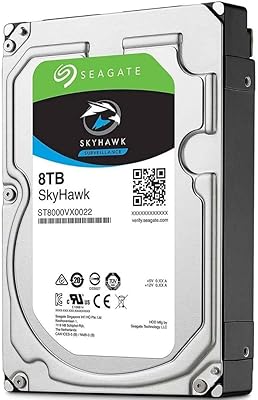
Seagate SkyHawk 8TB Surveillance Internal Hard Drive
80%
88%
Recording Reliability
84%
Workload Durability
91%
Installation Ease
79%
Multi-Drive Performance
82%
Drive Health Monitoring
More
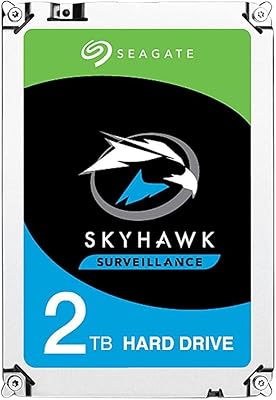
Seagate SkyHawk 2TB Surveillance Hard Drive
80%
83%
Reliability & Uptime
91%
NVR & DVR Compatibility
78%
Value for Money
87%
Noise & Vibration
74%
Heat Management
More
Seagate Exos 7E10 4TB Internal Hard Drive
75%
83%
Sustained Reliability
81%
Read/Write Performance
78%
Value for Money
89%
NAS Compatibility
61%
Vibration & Noise
More
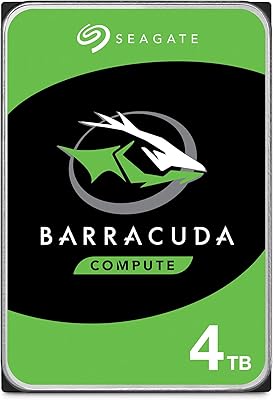
Seagate BarraCuda 4TB Internal Hard Drive
87%
86%
Performance
90%
Reliability
93%
Setup & Installation
95%
Storage Capacity
72%
Data Transfer Speed
More
Seagate One Touch 4TB External Hard Drive
75%
93%
Ease of Setup
88%
Storage Value
74%
Transfer Speed
81%
Build Quality
61%
Long-Term Reliability
More
Seagate SkyHawk AI 16TB (ST16000VE004)
89%
98%
Recording Capacity
94%
Continuous Workload Endurance
93%
Frame Consistency
91%
AI Processing Support
87%
RAID Integration
More
Seagate Skyhawk AI 10TB Internal Hard Drive
80%
91%
Reliability & Uptime
88%
Stream Handling
67%
Value for Money
86%
Drive Health Management
58%
Noise Level
More
Seagate Exos 7E8 4TB Enterprise Hard Drive
80%
83%
Long-Term Reliability
91%
Workload Endurance
78%
Sequential Throughput
86%
NAS Compatibility
73%
Noise & Vibration
More
Seagate SkyHawk 6TB Surveillance Hard Drive
82%
91%
Recording Reliability
88%
Compatibility with NVR/DVR Systems
86%
Noise & Vibration
83%
Heat & Power Efficiency
79%
Value for Money
More
Seagate Expansion 4TB Portable External Hard Drive
74%
94%
Ease of Setup
91%
Storage Capacity
66%
Transfer Speed
73%
Build Quality
88%
Portability
More

FAQ

Most NVR systems will prompt you to format the drive on first boot, which typically takes just a minute or two through the NVR's own interface. You generally do not need to do anything on a PC beforehand — just install it physically, power up your NVR, and follow the on-screen setup prompt.

It depends heavily on your recording settings, but a realistic estimate for a system running four to eight cameras at 1080p with standard H.264 compression is roughly two to four weeks of continuous footage before the drive cycles and overwrites. Higher resolution or higher bitrate settings will fill it faster, so adjusting your NVR's recording quality is often the easiest way to extend retention.

Most users report no issues with both brands, and Seagate lists these as supported platforms. That said, a small number of buyers have reported needing a firmware update on their NVR before the drive was fully recognized. If you run into any issue, checking your NVR manufacturer's compatibility list and ensuring the unit is on the latest firmware is the first step to try.

Physically it will fit and function, but it is not a great idea as your primary PC drive. At 5900 RPM and with firmware tuned for sequential writes rather than the random read-write mix a desktop demands, you will notice slower application load times and general sluggishness compared to a drive designed for that use. It is better suited to staying in a DVR or NVR where it can do what it was built for.

Seagate Rescue is a professional data recovery service that comes bundled with this drive at no extra cost. If the drive fails due to accidental damage or a mechanical issue, you can send it in and Seagate's recovery team will attempt to retrieve the data. It is genuinely useful as a last resort, though real-world users note the process can take time and is not guaranteed — so it complements, rather than replaces, a good backup strategy.

The 5900 RPM speed does help keep temperatures lower than faster drives, but in tightly enclosed spaces with minimal airflow, some warmth is normal and a recurring point of feedback from buyers. If your enclosure has no active cooling, it is worth checking the drive temperature periodically through your NVR's interface. Adding a small fan to the enclosure can make a noticeable difference in long-term stability.

A standard desktop drive is rated for around 55TB of writes per year and designed for mixed workloads with regular idle periods. The Seagate SkyHawk 4TB Surveillance Hard Drive is rated for 180TB per year and tuned specifically for the relentless sequential write demands of always-on video recording. The practical difference shows up over time — desktop drives used in DVR setups tend to develop errors or fail much sooner, often causing corrupted footage or sudden recording gaps.
When multiple hard drives are mounted close together in an enclosure, the physical vibration from one spinning drive can affect the read-write head positioning of a neighboring drive, causing performance dips or errors. The RV sensors in this Seagate HDD detect that interference in real time and make small compensating adjustments to keep the drive performing accurately. For a single-drive setup it makes little difference, but in a multi-bay NVR it is a meaningful safeguard.

Many buyers report two to three years of continuous operation without issues, and some report even longer. The manufacturer's MTBF figure of 1 million hours is a statistical metric across large drive populations rather than a personal guarantee, so individual results do vary. Keeping the drive reasonably cool, ensuring your NVR is on stable power, and periodically checking drive health through your system's S.M.A.R.T. reporting will help you catch any warning signs early.

It is not the recommended choice for a NAS or RAID array. Those environments involve frequent parity calculations, random access patterns, and the kind of vibration-heavy multi-drive configurations that call for a drive like Seagate's IronWolf line, which is specifically designed and rated for NAS use. Using this surveillance drive in a NAS is not dangerous, but you will be running it outside its design envelope and may see reduced performance and longevity over time.

Where to Buy