Overview

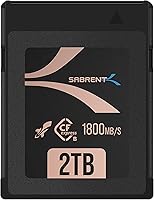
The SABRENT Rocket CFX PRO 2TB CFexpress Card sits at the top end of what professional memory storage can offer right now. CFexpress Type B is the format serious camera manufacturers have standardized around for high-bandwidth workflows — it replaced XQD and brought dramatically faster transfer rates by leveraging PCIe lanes instead of older interfaces. What sets this CFexpress card apart from many competitors is its use of dual PCIe 3.0 lanes, which effectively doubles available bandwidth compared to single-lane designs. It also retains backward compatibility with select XQD-capable cameras, which matters if you are mid-transition between systems. The price reflects what is inside: SSD-grade components throughout, not just a fast controller strapped to budget NAND.
Features & Benefits

The numbers here are impressive, but what they mean in practice is more interesting. Sustained write speeds of up to 1300 MB/s at high capacities mean that shooting continuous RAW 8K footage will not suddenly stutter when the buffer fills — a real concern with slower cards. Peak reads approaching 1800 MB/s also speed up offloading hundreds of gigabytes to a workstation after a long shoot. The 2TB capacity is a genuine convenience: one card, one full day of heavy shooting, no swapping. Data protection features like ECC RAID, wear-leveling, and SmartRefresh are not marketing checkboxes — they are the reason professional-grade flash costs more and consistently outlasts consumer alternatives.

Best For

This high-capacity Type B card was clearly built with specific workflows in mind. Cinema shooters on Canon C500 Mark II or EOS-1D X Mark III rigs, Nikon D850 users pushing high-burst RAW stills, and Panasonic Lumix S1/S1R videographers will all find it a natural fit. Wildlife and sports photographers benefit especially — the card's endurance under burst loads holds up over long sequences without visible slowdown. It is also worth considering if you are currently using an XQD camera and want one card that works across both standards. One honest caveat: if you shoot primarily JPEG or lower-resolution video, most of this performance will go untapped, and a less expensive card would serve you just as well.

User Feedback

Sitting at 4.5 out of 5 stars across more than 150 reviews, the Rocket CFX PRO earns consistently positive marks for real-world speed consistency and camera compatibility. Shooters using the cameras listed above frequently report that the card performs close to its rated speeds without unexpected throttling during extended recording sessions. The praise is not universal, though. A handful of buyers question whether the price premium is justified compared to established names like Sony and ProGrade — and that is a fair debate. A few users also flagged some confusion around the warranty registration process. On balance, complaints are minor; long-term reliability and customer support responsiveness come up favorably far more often than concerns.

Pros

  • Sustained write speeds hold steady through long 8K RAW recording sessions without noticeable buffer slowdown.
  • 2TB of capacity means a full day of heavy shooting fits on a single card, no swapping required.
  • Dual PCIe 3.0 lanes provide bandwidth headroom that single-lane CFexpress cards simply cannot match.
  • SSD-grade controller and NAND flash deliver a level of reliability well above typical consumer memory cards.
  • Enterprise-level data protection features — including ECC RAID and end-to-end integrity checks — reduce the risk of silent data corruption.
  • Backward compatibility with select XQD cameras makes it a practical upgrade without needing to replace your whole kit.
  • Fast random access with over 300,000 IOPs makes culling and browsing large photo libraries noticeably quicker.
  • Offloading hundreds of gigabytes to a workstation after a shoot is dramatically faster than with mid-range alternatives.
  • Registering the product extends the warranty to five years, which is generous for a storage product at this tier.
  • Users across camera brands consistently report real-world speeds that track closely with the rated specifications.

Cons

  • The price is a significant barrier; casual or part-time shooters are unlikely to recoup the value in practice.
  • Compatibility is not universal — some CFexpress Type B slots, particularly on older bodies, may limit performance or reject the card entirely.
  • A few buyers have reported confusion and friction navigating the warranty registration process to unlock the full coverage period.
  • At 2TB, this card is overkill for photographers who shoot JPEG or standard video formats, making it hard to justify the cost.
  • The Rocket CFX PRO faces stiff competition from Sony and ProGrade cards that some users consider better-established in the professional market.
  • There are no bundled accessories — no case, no reader, no recovery software — which adds to the total cost of ownership for new CFexpress users.
  • Limited user reviews relative to more established brands means there is less long-term real-world data on multi-year durability.
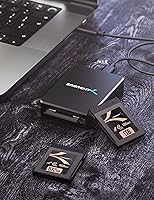
  • Requires a compatible high-speed card reader to actually benefit from the top transfer speeds during file offload.

Ratings

Our AI rating system analyzed verified global buyer reviews for the SABRENT Rocket CFX PRO 2TB CFexpress Card, actively filtering out incentivized, bot-generated, and outlier feedback to surface what real working professionals consistently experience. The scores below reflect both the genuine strengths that keep buyers recommending this card and the friction points that temper an otherwise strong reception. Nothing has been smoothed over — the categories where user sentiment gets complicated are scored accordingly.

Sequential Read Performance
93%
Photographers and videographers offloading sessions to a Thunderbolt-connected reader consistently report transfer times that feel closer to copying from an internal SSD than a traditional memory card. In practice, moving 200GB of RAW files takes a fraction of the time users were accustomed to with older CFexpress or XQD cards.
A small but vocal group of users note that hitting peak read speeds requires a high-end reader — something not everyone already owns. Buyers who tested the card with older USB-A readers were disappointed before realizing the bottleneck was their reader, not the card.
Sustained Write Performance
89%
Cinema shooters recording continuous RAW 8K footage report that the card holds its write speed through long takes without the buffer stalls that have burned them on lesser cards mid-shoot. Wildlife photographers running extended burst sequences also note that the card keeps up where previous options fell short.
A few users shooting in particularly hot ambient conditions reported slight performance dips during very long uninterrupted sessions, suggesting that thermal behavior — while generally controlled — is not entirely immune to environmental factors. This appears rare but worth monitoring in demanding field conditions.
Storage Capacity
91%
The 2TB ceiling genuinely changes how on-location shooters plan their days. Users on multi-day productions or remote wilderness assignments describe the freedom of not rationing card space or swapping mid-session as one of the most practically valuable aspects of this card.
For buyers who only occasionally fill a 256GB card, the 2TB capacity is excess they are paying a significant premium for. A handful of reviewers admitted in hindsight that a smaller capacity variant would have made more financial sense for their actual shooting volume.
Value for Money
67%
33%
Professionals who stress-test storage — cinema crews, sports shooters, photojournalists — generally feel the premium is justified when they factor in SSD-grade internals and a warranty that extends to five years with registration. For them, a card failure on a paid job costs far more than the price difference.
Enthusiasts and part-time shooters find it harder to rationalize the cost when competing cards from Sony and ProGrade offer solid real-world performance at lower price points. The value equation depends heavily on how hard and how often you push the card — casual users simply will not see returns that match the investment.
Camera Compatibility
78%
22%
Users shooting on the Canon C500 Mark II, EOS-1D X Mark III, Nikon D850, and Panasonic Lumix S1/S1R report straightforward plug-and-play operation with no firmware issues or recognition problems. The backward compatibility with XQD-based bodies is a practical bonus that several reviewers called out specifically as a deciding factor.
Compatibility outside the officially listed bodies is inconsistent enough that buyers with less common camera models report uncertainty about whether they will see full performance or any performance at all. This card is not universally plug-and-play across every CFexpress Type B slot, and that nuance has caught some buyers off guard.
Data Reliability
92%
Across a broad pool of reviews, reports of corrupted files or unexpected card failures are strikingly rare. The combination of ECC RAID, end-to-end data protection, and SmartRefresh appears to do real work — users describe a level of confidence in their footage and files that budget cards simply do not inspire.
As with any flash storage, a small number of users have experienced card errors, and when those occur the troubleshooting path through warranty support takes time. No storage medium is unconditionally failure-proof, and buyers should still maintain redundant backup habits regardless of the card's protection features.
Build & Form Factor
88%
The card feels dense and solid in hand — noticeably more substantial than typical SD cards — which professionals tend to interpret as reassuring rather than inconvenient. Its compact dimensions fit neatly into standard CFexpress card cases without any compatibility issues.
A few reviewers wished the card came with even a basic protective case or sleeve included at this price tier. Without a bundled case, the contacts are exposed during transport unless the buyer purchases a storage solution separately.
Write Endurance
86%
Sports and wildlife photographers who run the card hard across consecutive shooting days report no early signs of wear degradation. The SSD-grade NAND and active wear-leveling give this card a lifespan profile that is meaningfully longer than what most photographers will exhaust in years of professional use.
There are no publicly published TBW (terabytes written) endurance ratings for this specific card, which makes it harder for technically-minded buyers to compare endurance on paper against competitors who do publish those figures. The omission is not a dealbreaker but it does leave an information gap.
Warranty & Support
74%
26%
Extending the warranty to five years through product registration is a genuinely competitive offer at this product tier, and users who have gone through the support process for replacements describe the outcome as satisfactory. Knowing that Sabrent has a direct support team — rather than routing everything through a retailer — reassures professional buyers.
The warranty registration process itself has drawn complaints about being unintuitive and feeling outdated compared to what buyers expect from a premium brand. A couple of reviewers also noted response times from support were slower than they anticipated when dealing with time-sensitive production issues.
Read Speed Consistency
87%
Users who benchmarked the card across multiple file types and session lengths found that read speeds stay close to the rated ceiling under normal operating conditions. Culling and previewing large RAW files directly from the card — rather than waiting for a full offload — feels noticeably faster than mid-range alternatives.
Consistency is tied directly to reader quality, and not everyone factors that dependency into their purchase decision. On lower-bandwidth readers, the card performs no better than far cheaper options, which has led to frustrated reviews from buyers who misattributed the bottleneck.
6K and 8K Video Suitability
91%
Cinema users recording in high-bitrate RAW formats treat this card as one of a short list of viable options — the sustained throughput is simply not something every CFexpress Type B card can credibly deliver over a full recording day. Several reviewers specifically upgraded from other Type B cards after experiencing buffer interruptions.
The benefits are almost entirely irrelevant to shooters whose cameras cap out below 6K, which narrows the audience that can fully utilize this aspect of the card. Buyers with 4K bodies are effectively paying for a capability their hardware cannot access.
Ease of Setup
84%
Inserting the card and beginning to shoot is genuinely plug-and-play on compatible bodies — no formatting ritual beyond the camera's standard new-card format prompt. Users switching from XQD report a smooth transition with no unexpected camera menu changes required.
The requirement to register separately for the full warranty term adds an administrative step that feels unnecessary at this price point and has been missed by buyers who only discovered the two-year default coverage after the fact. It is a minor friction point but a recurring one in reviews.
Random Access Speed
82%
18%
Photographers who work directly off the card during tethered sessions or use it as temporary fast storage for on-set review report that navigation through large folders of high-resolution images is quick and responsive. The high IOPs figure translates into a perceptibly snappier experience compared to cards built purely around sequential speeds.
For typical in-camera use during shooting, random IOPs are rarely the limiting factor — the camera's own processing pipeline is usually the bottleneck. This is a benefit most users will appreciate primarily during post-session file management rather than active shooting.
Brand Reputation in Professional Market
72%
28%
Sabrent has built genuine credibility in the high-performance storage space through its SSD lineup, and professional photographers who follow the storage market recognize the brand as technically serious rather than a budget alternative. Positive support experiences have reinforced buyer confidence in repeat purchases.
Sony and ProGrade carry deeper institutional trust among veteran professionals, particularly those who have relied on those brands on high-stakes paid assignments for years. Sabrent is still working to close that perception gap in the CFexpress segment, and some buyers remain hesitant to make the switch on reputation alone.

Suitable for:

The SABRENT Rocket CFX PRO 2TB CFexpress Card is built for professionals who cannot afford storage to be the weak link in their workflow. Cinema and hybrid shooters working on Canon C500 Mark II or EOS-1D X Mark III bodies, Nikon D850 users hammering through high-burst RAW sequences, and Panasonic Lumix S1/S1R videographers pushing continuous 6K or 8K footage will find this card keeps up without flinching. Wildlife and sports photographers benefit particularly — extended burst sessions that would throttle lesser cards stay consistent here thanks to SSD-grade internals and serious wear management. On-location content creators who want to consolidate an entire day of shooting onto a single card, rather than managing a pocketful of smaller ones, will also appreciate the 2TB headroom. If you are still on XQD and considering an upgrade path, the backward compatibility makes this high-capacity Type B card a practical bridge rather than a forced platform switch.
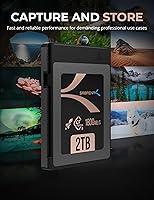
Not suitable for:

For many photographers and videographers, the SABRENT Rocket CFX PRO 2TB CFexpress Card is simply more card than they need. Hobbyists, enthusiasts shooting JPEG, or anyone whose camera tops out at 4K will never stress this card's bandwidth enough to justify the significant cost over more affordable CFexpress options. It is also worth checking your specific camera body against the compatibility list carefully — not every CFexpress Type B slot is created equal, and a handful of older bodies may not unlock the card's full potential or may not support it at all. Buyers on a tighter budget should know that competitive options from Sony and ProGrade exist at lower price points and still deliver strong real-world performance. If your shooting volume does not regularly exceed a few hundred gigabytes per session, 2TB of capacity is excess you are paying for but rarely using.
Specifications

  • Card Type: This card follows the CFexpress Type B standard, the current professional benchmark for high-bandwidth camera storage.
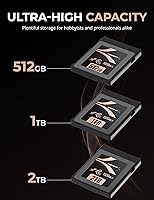
  • Capacity: Available in this configuration at 2TB, providing enough space for extended shoots without needing to swap or carry additional cards.
  • Read Speed: Peak sequential read speed reaches up to 1800 MB/s via dual PCIe 3.0 lanes, enabling rapid file offloading to a compatible card reader or workstation.
  • Write Speed: Peak sequential write speed reaches up to 1700 MB/s, sufficient to handle continuous high-bitrate RAW video without dropping frames.
  • Sustained Write: Sustained write performance holds at up to 1300 MB/s on the 1TB and 2TB variants, which is critical for uninterrupted long-form recording sessions.
  • Interface: The card uses dual PCIe 3.0 lanes, doubling the available bandwidth compared to single-lane CFexpress designs.
  • Random IOPs: Random read/write IOPs exceed 300,000, allowing fast access and browsing of large photo libraries stored on the card.
  • Controller: An SSD-grade controller manages the flash memory, bringing enterprise-level wear management and data integrity to a compact card form factor.
  • Flash Memory: The card uses SSD-grade NAND flash, which offers significantly higher endurance and reliability than the consumer-grade flash found in budget cards.
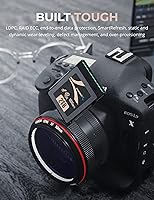
  • Data Protection: Onboard data protection includes LDPC error correction, ECC RAID, end-to-end data integrity checks, and SmartRefresh technology to guard against silent data loss.
  • Wear Management: Active wear-leveling and TRIM support extend the usable lifespan of the NAND flash under heavy, repeated write workloads.
  • Video Support: The card is rated for RAW 6K and 8K video recording, meeting the bandwidth demands of current and near-future professional cinema formats.
  • Dimensions: The card measures 1.52″ long by 1.17″ wide by 0.15″ thick, matching the standard CFexpress Type B physical footprint.
  • Weight: At 0.3 ounces, the card adds negligible weight to any camera kit or carrying case.
  • Compatibility: Designed for CFexpress Type B slots and also backward compatible with select XQD cameras, making it a practical option for users transitioning between standards.
  • Warranty: The card includes a 2-year limited warranty by default, extendable to 5 years upon registering the product at sabrent.com.
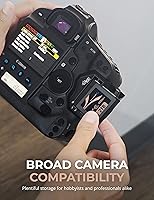
  • Supported Cameras: Officially listed compatible cameras include the Canon C500 Mark II, Canon EOS-1D X Mark III, Nikon D850, and Panasonic Lumix S1 and S1R.
  • Manufacturer: SABRENT is the manufacturer, offering direct technical support and handling warranty claims through their own customer service team.

Related Reviews
Sabrent Rocket CFX PRO 1TB CFexpress Type B Memory Card

91%
96%
Performance for Video Recording
94%
Read Speed
93%
Write Speed
89%
Durability Under Heavy Use
87%
Value for Money
More
SABRENT Rocket Nano 2TB External SSD
79%
88%
Transfer Speed
96%
Portability
91%
Build Quality
63%
Thermal Management
94%
Plug-and-Play Setup
More
SABRENT Rocket 4 Plus 2TB NVMe SSD
83%
94%
Read/Write Performance
91%
Heatsink Build Quality
96%
PS5 Compatibility
88%
Thermal Management
83%
Value for Money
More
SABRENT Rocket Q4 2230 2TB NVMe SSD
81%
97%
Form Factor Compatibility
88%
Read Performance
67%
Write Performance
83%
Installation Experience
74%
Thermal Management
More
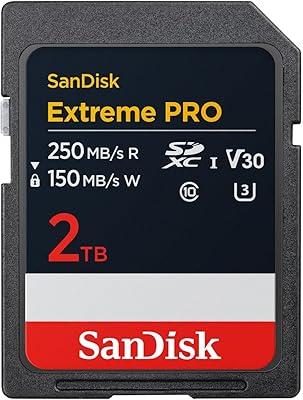
SanDisk Extreme PRO 2TB SDXC Memory Card
79%
88%
Read Speed Performance
84%
Write Speed & Buffer Handling
93%
Storage Capacity
86%
4K Video Recording Reliability
71%
Device Compatibility
More
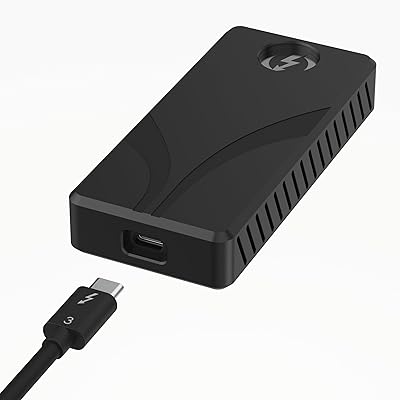
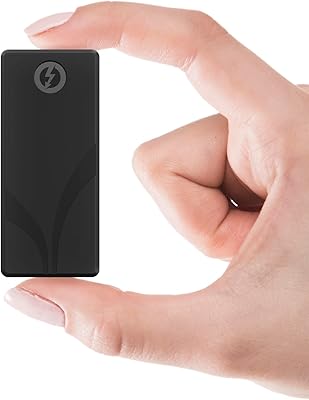
Sabrent Rocket XTRM Plus 2TB Thunderbolt 3 Portable SSD
88%
94%
Performance
90%
Build Quality & Durability
89%
Portability & Size
96%
Setup & Ease of Use
91%
Compatibility
More
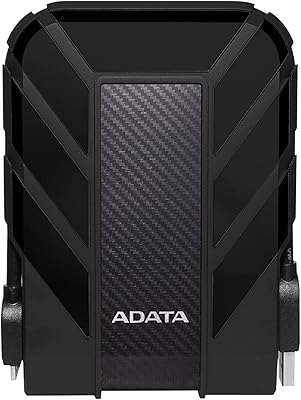
ADATA HD710 Pro 2TB External Hard Drive
81%
93%
Waterproof Protection
91%
Shockproof Durability
89%
Build Quality & Housing
88%
Dustproof Performance
58%
Transfer Speed
More
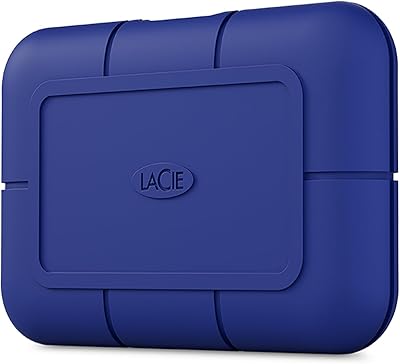
LaCie Rugged SSD Pro 2TB
86%
94%
Performance
91%
Durability/Build Quality
89%
Speed (Read/Write)
88%
Compatibility
85%
Portability/Size/Weight
More
REOLINK Home Hub Pro 2TB Security Hub
76%
83%
Value for Money
61%
Ecosystem Compatibility
88%
Storage Reliability
74%
App Experience
81%
Setup & Installation
More
Samsung 860 PRO 2TB SSD
87%
94%
Performance
89%
Value for Money
92%
Reliability & Durability
88%
Security Features
72%
Ease of Setup
More

FAQ

Yes, the Nikon D850 is one of the officially listed compatible cameras. That said, because the D850 uses an XQD slot rather than a native CFexpress Type B slot, you are relying on the backward compatibility feature. It works, but you will not see the same peak speeds you would in a camera with a native CFexpress Type B slot.

Yes, you do. To offload files at close to the card's rated speeds, you need a card reader that supports CFexpress Type B and has the bandwidth to match — ideally one using USB 3.2 Gen 2x2 or Thunderbolt. A standard USB-A reader will bottleneck you significantly, no matter how fast the card itself is.

All three are legitimate professional choices. Sony and ProGrade have been in the CFexpress space longer and carry strong reputations among working pros. The Rocket CFX PRO competes closely on raw specs, and many users find real-world performance comparable. The honest answer is that brand preference and price sensitivity often drive the final call more than measurable performance differences at this tier.

It depends entirely on your workflow. For a cinema shooter recording RAW 8K over a full production day, 2TB can disappear quickly. For a portrait or event photographer shooting compressed formats, it is genuinely overkill. If you regularly fill 512GB cards in a session, stepping up to 2TB makes real practical sense. If not, a smaller capacity at a lower price is probably the smarter buy.

You register through sabrent.com after purchase. The default warranty is 2 years, and registering bumps that to 5 years — which is a meaningful difference for a storage product at this price point. It takes a few minutes and is absolutely worth doing. A handful of reviewers have noted the registration process feels a bit dated, but it does work.

It handles both well. High IOPs make it responsive for burst RAW stills, while the sustained write performance is what matters for video. There is no practical scenario where a professional stills shooter would find this card limiting.

The sustained write speed of up to 1300 MB/s is designed specifically to prevent this. Most users who have tested it in long recording scenarios report consistent performance without the kind of thermal throttling you sometimes see in cards with less robust controllers. That said, environmental temperature and the camera body itself can also play a role in long-session behavior.

CFexpress Type B cards as a standard are built for field use, and the SSD-grade internals here are more resilient than traditional flash. There are no published environmental ratings specific to this card, so for extreme conditions — salt air, heavy rain, very high altitude — you should still use a protective case and avoid exposing the card's contacts to moisture.

The onboard data protection features — ECC RAID, end-to-end integrity checks, SmartRefresh — are designed to prevent data loss rather than recover it after the fact. If the card does fail catastrophically, professional data recovery services can sometimes retrieve data from flash storage, but it is expensive and not guaranteed. Regular backups remain essential regardless of how good the card's protection features are.

Yes, slightly. The sustained write speed on the 2TB version benefits from more NAND chips operating in parallel, which is part of why the spec sheet shows up to 1300 MB/s sustained writes at 1TB and above. If sustained video write performance is your primary concern, the larger capacity variants have a small but real structural advantage over the 512GB model.

Where to Buy

B&H Photo-Video-Audio
In stock $714.99