Overview

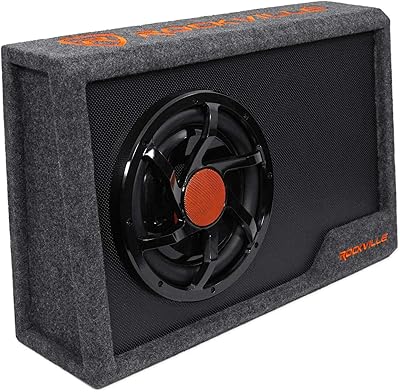
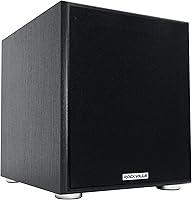
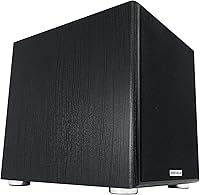
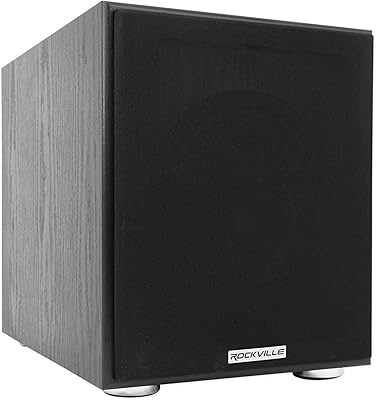
The Rockville Rock Shaker 10″ is a powered subwoofer built for home theater and studio listeners who want real bass without spending a fortune. A built-in Class-D amplifier matched to the MDF enclosure keeps distortion low and efficiency high, so you get tight low-end response without the unit running hot. The cabinet has a vinyl wrap finish that looks presentable in most living rooms — nothing flashy, but solid enough to blend in. With over 900 Amazon ratings and a consistent top-25 ranking among home audio subwoofers, this Rockville sub has clearly found an audience that values performance per dollar above all else.
Features & Benefits

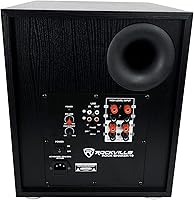
The 300W RMS Class-D amp is the centerpiece here — it pushes enough power to pressurize a small-to-medium room without generating the heat you would expect from older amplifier designs. An adjustable crossover lets you dial in exactly where the sub hands off to your main speakers, which makes a real difference when blending with bookshelf or floorstanding speakers of varying sensitivities. The phase control is a genuinely useful addition at this price, helping you avoid the muddy, hollow bass that often results from awkward sub placement. High-level speaker inputs mean you can connect this powered subwoofer to a stereo receiver that lacks a dedicated subwoofer output — a practical feature many budget subs skip entirely.

Best For

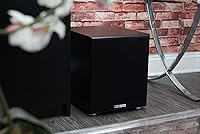
This Rockville sub makes the most sense for home theater setups in small to medium rooms — a 10-inch driver is more than enough to add impact to action movies and gaming sessions without overwhelming the space. Gamers will appreciate the low rumble it adds to engines, explosions, and environmental audio that smaller speakers simply cannot reproduce. It is also a reasonable pick for podcasters or home studio hobbyists who need to check how their mixes translate at low frequencies; just keep expectations realistic, since this is hobbyist-grade monitoring rather than a professional reference tool. If your stereo receiver lacks a sub output, the speaker-level inputs make the connection straightforward.

User Feedback

Buyers consistently highlight value for money as the standout quality — most are genuinely surprised by the bass output relative to the price. That said, a fair number of users flag that the volume and crossover knobs are quite sensitive, so small adjustments carry real weight; take your time during setup rather than rushing. Critical music listeners note that the sub feels less composed than pricier options — it handles movies and gaming confidently, but nuanced acoustic tracks can expose its limitations. Build quality gets described as functional rather than premium, with the vinyl finish picking up fingerprints easily. The included manual is thin on detail, so budget some extra time for dialing it in by ear.

Pros

  • Delivers surprisingly strong bass output for its price bracket, outperforming many similarly priced rivals.
  • Speaker-level inputs make it easy to connect to older receivers that lack a subwoofer preout.
  • The Class-D amplifier runs cool during extended movie or gaming sessions, reducing thermal stress.
  • Adjustable crossover and phase controls give meaningful tuning flexibility rarely found at this price.
  • MDF enclosure feels solid and dense, avoiding the hollow resonance common in cheaper plastic cabinets.
  • Setup is straightforward for most users, especially those connecting via speaker-level terminals.
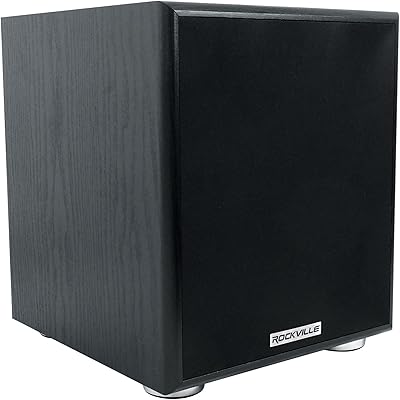
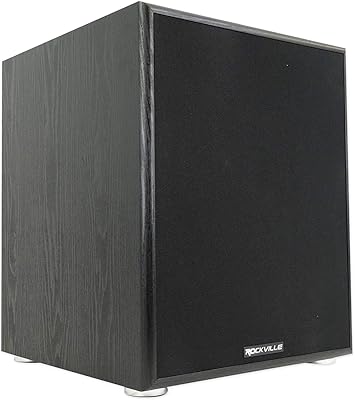
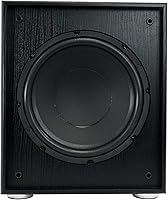
  • Detachable foam grille allows a cleaner exposed-driver look if preferred.
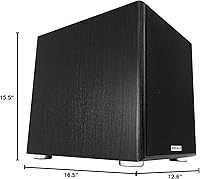
  • At 20 pounds and roughly 18 by 18 inches, it fits neatly beside most TV stands without dominating the room.
  • 85 dB signal-to-noise ratio keeps background hiss inaudible at normal listening distances.
  • Over 900 verified ratings with a strong average score reflects a broad, satisfied buyer base.

Cons

  • The volume and crossover knobs are overly sensitive, making precise calibration a slow, frustrating process.
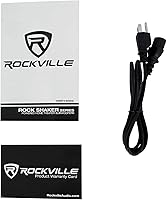
  • The included manual is too sparse to guide first-time subwoofer buyers through proper setup and blending.
  • Vinyl wrap finish collects fingerprints easily and shows seam imperfections on closer inspection.
  • Bass character leans boomy rather than tight, which becomes noticeable on fast or complex bass lines.
  • A notable share of long-term owners report amplifier cutout or driver buzz after 12 to 18 months of use.
  • No wireless connectivity option, which is an increasingly common expectation even at budget price points.
  • The foam grille material looks dated compared to fabric or metal grilles on competing units and collects dust readily.
  • Low-frequency extension rolls off earlier than spec sheets suggest, limiting truly deep sub-bass performance.

Ratings

The scores below for the Rockville Rock Shaker 10″ were generated by our AI engine after analyzing hundreds of verified buyer reviews from global markets, with spam, incentivized, and bot-flagged submissions actively filtered out before scoring. The result is an honest, balanced snapshot of what real owners actually experience — not just the highlights. Strengths and frustrations are weighted equally so you can make a genuinely informed decision.

Bass Output
86%
For the price bracket, the low-end punch this sub produces consistently surprises buyers. Movie explosions, gaming rumble, and hip-hop basslines all benefit noticeably, and most owners say it pressurizes a medium-sized room without straining.
At higher volumes the bass can feel a little one-dimensional compared to more expensive units. Listeners chasing truly deep, sub-30Hz extension will find the driver starts to roll off earlier than advertised.
Value for Money
91%
This is where the Rock Shaker earns its strongest praise. Buyers repeatedly note they expected a lot less for the price, and many compare it favorably to branded alternatives that cost significantly more for similar real-world output.
The value equation holds up well for casual home theater use, but buyers who eventually upgrade to a higher-tier system often look back and note the limitations become more obvious once ears are trained on better gear.
Amplifier Performance
83%
The Class-D design runs cool and quiet, which matters when the sub is tucked inside an entertainment unit or cabinet. Owners report stable, consistent output over long movie sessions without thermal throttling or audible distortion at moderate levels.
Push the gain past about 70 percent and some users detect a slight hardness to the sound. It is not harshness exactly, but the amp does not have the headroom refinement that pricier built-in designs offer.
Connectivity Options
88%
Having both RCA line-level and high-level speaker inputs is genuinely useful at this price. Owners with older stereo receivers that lack a dedicated subwoofer preout praise this flexibility, calling it a feature they did not expect to find in this tier.
There is no wireless or Bluetooth option, and the RCA cables included are basic at best. Buyers who want a cleaner cable run or a wireless connection will need to look elsewhere or invest in third-party adapters.
Crossover & Controls
67%
33%
Having an onboard adjustable crossover and phase control is a real advantage when blending with mismatched speakers. Users who took time to dial the crossover in carefully reported a noticeably smoother blend with their existing bookshelf or tower speakers.
The knobs are extremely sensitive — a tiny turn produces a disproportionate change in output. Several buyers noted they spent far longer calibrating than expected, and the sparse manual offers almost no guidance on suggested starting points.
Build Quality
71%
29%
The MDF enclosure feels reassuringly dense and does not produce the hollow resonance you sometimes get from cheaper plastic-cabinet subs. At 20 pounds it has a planted, substantial feel that inspires confidence in its longevity.
The vinyl wrap finish is functional rather than refined — fingerprints accumulate quickly and the seam work around the corners is imprecise on some units. It looks fine from a distance but does not hold up to close inspection the way premium finishes do.
Ease of Setup
84%
Most owners had the sub connected and producing sound within 15 minutes, particularly those using the high-level speaker inputs. The rear panel layout is logical, and the controls are clearly labeled even if their sensitivity causes issues later.
The instruction manual is genuinely thin — it covers the basics but skips any meaningful guidance on crossover frequency recommendations or phase alignment. First-time subwoofer buyers may find themselves searching online for setup tutorials.
Sound Quality for Music
62%
38%
For bass-heavy genres like electronic, hip-hop, and R&B, the Rock Shaker adds welcome body and weight. Casual listeners upgrading from a soundbar or a basic 2.0 setup will notice a meaningful improvement in musical fullness.
Critical listeners and audiophiles find the sub less convincing with acoustic music, jazz, or orchestral recordings where precise, textured bass is important. It can sound slightly loose on fast bass lines, and the tonal character leans boomy rather than articulate.
Home Theater Performance
87%
Action movies, sci-fi, and thriller content sound markedly better with this sub in the chain. The low-frequency effects channel gets adequate support, and dialogue-heavy scenes are not muddied by excessive bass bleed.
Very demanding Dolby Atmos or DTS:X mixes with continuous deep bass can occasionally expose the limits of the driver at high volumes. It handles most mainstream content confidently but is not the right tool for a dedicated dedicated home cinema with high-output amplification.
Gaming Performance
85%
Gamers consistently rate this sub highly for the tactile dimension it adds to first-person shooters, racing games, and open-world titles. Footsteps, engine roar, and environmental ambience all benefit from the additional low-end support.
Competitive multiplayer gamers who rely on positional audio cues may find that overly boosted bass frequencies mask subtle directional sounds. Keeping the volume conservative is advisable if audio accuracy matters more than immersive impact.
Noise Floor & Hiss
78%
22%
The 85 dB signal-to-noise ratio translates to a reasonably quiet background in practice. Most owners sitting at a normal listening distance report no audible hiss between audio cues, which is a decent result for an amplified sub at this price.
A small number of buyers report a faint hum or idle noise depending on their source component and cable quality. It is not universal, but users with sensitive systems or high-gain receivers may need to invest in shielded RCA cables to resolve it.
Physical Footprint & Placement
74%
26%
At roughly 18 by 18 inches the cabinet fits neatly beside a TV stand or in a corner without dominating the room. The floor-standing design means no wall-mounting complexity, and the square footprint makes corner placement easy.
Twenty pounds is manageable but not light — repositioning during calibration gets tiring quickly. The cabinet size also means it is not ideal for very compact rooms or apartment setups where floor real estate is scarce.
Grille & Aesthetics
73%
27%
The detachable foam grille is a small but appreciated touch. Owners who prefer the industrial look of an exposed driver can remove it cleanly, and it snaps back on firmly without rattling during playback.
The foam grille material looks dated compared to fabric or metal grilles found on competing units. It also attracts dust and pet hair readily, and after extended use the foam can begin to show surface wear.
Long-Term Reliability
69%
31%
The majority of buyers who have owned the unit for over a year report no functional issues. The Class-D amplifier running cool appears to contribute positively to long-term component stability compared to older Class-AB designs in this price range.
There is a smaller but notable group of reviewers who report issues after 12 to 18 months of use, including amplifier cutout and driver buzz. Warranty coverage is limited, and Rockville customer support receives mixed reviews on responsiveness.

Suitable for:

The Rockville Rock Shaker 10″ is a strong match for anyone building a home theater setup on a realistic budget and wanting a genuine low-end upgrade over a soundbar or basic 2.0 speaker system. If your living room or media room is small to medium in size, a 10-inch driver is appropriately scaled — it will fill the space without overwhelming it. Gamers who want their setup to physically respond to in-game explosions, engine rumble, and cinematic sound design will get real value here. The speaker-level inputs make this powered subwoofer particularly appealing for users whose stereo or AV receiver lacks a dedicated subwoofer preout, removing a connectivity barrier that trips up a lot of first-time sub buyers. Podcasters and home studio hobbyists who want a basic sense of how their content sounds at low frequencies will also find it functional, as long as expectations are calibrated to the hobbyist tier rather than professional monitoring standards.
Not suitable for:

Buyers who prioritize refined, accurate bass reproduction for critical music listening should look elsewhere — the Rockville Rock Shaker 10″ handles movies and gaming confidently, but nuanced acoustic recordings and complex orchestral or jazz material can expose its limitations in texture and control. Audiophiles or anyone upgrading from a mid-range or premium subwoofer will likely find the tonal character too loose and the build finish too basic to justify the swap. Large listening rooms or dedicated home cinema spaces with high-output amplification will push this sub to its limits fairly quickly, and the driver does not have the deep extension needed for truly demanding Dolby Atmos or DTS:X content at high volumes. Anyone expecting plug-and-play simplicity backed by a detailed manual may also be frustrated, since the onboard controls are sensitive and the documentation provides minimal guidance for dialing in a proper blend with existing speakers.
Specifications

  • Driver Size: The subwoofer uses a 10-inch dynamic driver designed to reproduce low-frequency content down to the bass and sub-bass range.
  • Peak Power: The built-in amplifier delivers up to 600W peak power output under short-term dynamic conditions.
  • RMS Power: Continuous RMS output is rated at 300W, reflecting the sustained power the amplifier can deliver during normal playback.
  • Amplifier Class: A Class-D amplifier topology is used, offering high efficiency and low heat generation compared to traditional Class-AB designs.
  • Enclosure Material: The cabinet is constructed from MDF (medium-density fiberboard), which resists internal resonance better than particleboard or plastic alternatives.
  • Finish: The exterior is wrapped in a high-grade vinyl finish that provides a clean, furniture-friendly appearance in black.
  • Inputs: Connectivity includes RCA line-level inputs and high-level speaker-wire inputs to accommodate both preamp-equipped and standard stereo receivers.
  • Outputs: The unit also provides RCA line-level outputs and high-level speaker outputs, allowing daisy-chaining or signal pass-through to additional components.
  • Crossover: An onboard adjustable crossover frequency control lets users set the high-pass rolloff point to match their main speakers.
  • Phase Control: A continuously adjustable phase control (0 to 180 degrees) helps align the subwoofer's output with the main speakers to minimize cancellation.
  • Signal-to-Noise Ratio: The amplifier section is rated at 85 dB signal-to-noise ratio, keeping background hiss below audible thresholds at normal listening levels.
  • Impedance: The driver has a nominal impedance of 4 ohms, which the internal amplifier is specifically matched to handle.
  • Dimensions: The enclosure measures 18.9″ deep by 18.3″ wide by 14.6″ tall, making it suitable for floor placement beside standard TV furniture.
  • Weight: The unit weighs 20 pounds, reflecting the density of the MDF enclosure and the mass of the internal amplifier assembly.
  • Grille: A detachable foam grille is included, protecting the driver during normal use and removable if a bare-driver aesthetic is preferred.
  • Power Source: The subwoofer is powered via an AC adapter and is designed for standard indoor mains power connection.
  • Mounting Type: The unit is designed exclusively for floor-standing placement and does not include hardware or provisions for wall or shelf mounting.
  • Warranty: Rockville provides a limited warranty on this unit; buyers should verify current warranty terms and support contact details directly with the manufacturer.

Related Reviews
Rockville Rock Shaker 8 Powered Subwoofer
86%
91%
Bass Performance
88%
Value for Money
92%
Size/Portability
85%
Build Quality
90%
Ease of Setup
More
Rockville Rock Shaker 12 800W Powered Subwoofer
85%
91%
Bass Performance
88%
Ease of Setup
85%
Build Quality
83%
Compactness/Size
89%
Sound Clarity
More
Rockville Rock Shaker 6.5
69%
67%
Bass Performance
83%
Value for Money
61%
Build Quality
78%
Sound Tuning & Controls
88%
Setup & Installation
More
Rockville VS10K54 10″ K5 Subwoofer
85%
92%
Bass Quality
88%
Durability and Build Quality
91%
Value for Money
84%
Power Output
85%
Ease of Installation
More
Rockville MS10LB 10″ Marine Subwoofer
86%
91%
Bass Quality
89%
Durability in Marine Environments
92%
Waterproof Performance
78%
Ease of Installation
85%
LED Lighting
More
Rockville W10K6D2 V2 10″ Subwoofer
83%
91%
Bass Performance
88%
Build Quality
73%
Ease of Installation
85%
Sound Clarity
89%
Power Handling
More
Rockville Punisher 10D1 10″ Subwoofer
88%
96%
Bass Performance
91%
Sound Clarity
88%
Build Quality
85%
Thermal Management
83%
Ease of Installation
More
Rockville RTB10A 10″ Powered Subwoofer
83%
91%
Sound Quality
88%
Bass Performance
75%
Ease of Installation
86%
Build Quality
82%
Durability
More
Rockville RWS10CA 10″ Amplified Car Subwoofer
85%
88%
Bass Performance
93%
Ease of Installation
84%
Build Quality
86%
Durability
87%
Sound Customization (Bass Control)
More
Rockville APM10D 10″ Active Studio Subwoofer
83%
91%
Bass Performance
89%
Sound Clarity
84%
Build Quality
88%
Connectivity Options
82%
Ease of Setup
More

FAQ

Yes, and this is actually one of the more practical features on the Rock Shaker. The high-level speaker inputs let you run speaker wire directly from your receiver's left and right speaker terminals into the sub, bypassing the need for a dedicated subwoofer preout entirely. It is a straightforward connection that most users complete in under ten minutes.

A good starting point for most home theater setups is around 80 Hz, which is the THX-recommended crossover frequency for blending a subwoofer with bookshelf or satellite speakers. If your main speakers are larger floorstanders with good bass extension, try dropping to 60 Hz. The controls on this unit are sensitive, so make small adjustments and let your ears guide you from there.

It handles movies and gaming very well, but results with music are more genre-dependent. Bass-heavy music like hip-hop, electronic, or R&B sounds full and engaging. For acoustic, jazz, or classical listening where tonal accuracy matters more than impact, the character leans a bit loose compared to more expensive subs. It is a capable music sub for casual listening, just not a critical monitoring tool.

Most owners report clean output up to about 70 percent of the gain range. Past that point, some hardness creeps into the sound, particularly on sustained bass notes. For a medium-sized room, you will rarely need to push it beyond that threshold anyway — it produces plenty of output before the limits become relevant.

The physical connection is actually quite simple, and most buyers have it running within 15 to 20 minutes. The trickier part is calibrating the volume and crossover knobs to blend properly with your system, because both controls are sensitive to small movements. If you have never set up a subwoofer before, searching for a basic subwoofer calibration guide online will save you a lot of trial and error — the included manual does not cover this in enough detail.

In a small to medium room, yes, it can produce enough output to cause minor rattling of loose objects or wall decorations if pushed hard. Placing it in a corner or against a wall reinforces bass output further, so if you live in an apartment or have shared walls, keeping the gain conservative is advisable. On moderate settings it is perfectly manageable.

The phase control shifts the timing of the subwoofer's output relative to your main speakers. When the sub is placed in a position where its bass waves partially cancel out the bass from your mains, adjusting the phase can restore fullness and punch. A simple test is to play music with steady bass, slowly rotate the phase knob, and stop where the bass sounds fullest. It is worth spending five minutes on — it makes a real audible difference.

The MDF cabinet construction is genuinely solid for the price and compares well structurally. Where it falls slightly short is in the surface finish — the vinyl wrap picks up fingerprints easily and the corner seams are not as tight as you would see on a premium unit. Functionally it holds up well; cosmetically it is average for the price tier.

If your TV has RCA audio outputs (sometimes labeled audio out or subwoofer out), you can connect directly using an RCA cable. Most modern smart TVs, however, only output audio via optical, HDMI ARC, or Bluetooth — none of which this sub supports natively. In those cases, you would need a small DAC or audio converter between the TV and the sub, or connect through a receiver or soundbar with a subwoofer output.

The majority of owners report a quiet background at idle. A smaller number do notice a faint hum, which is usually traced back to cable quality or ground loop issues with their source components rather than a defect in the unit itself. If you experience hum, try a ground loop isolator on the RCA input, or swap to higher-shielded cables — that resolves it in most cases.