Overview

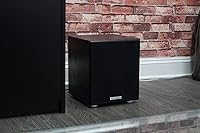
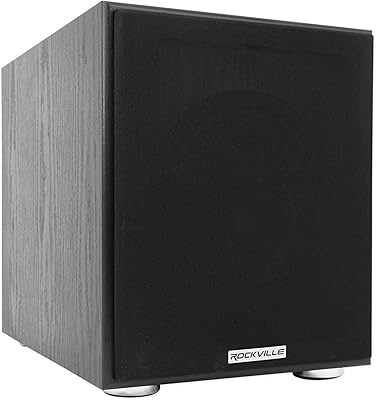
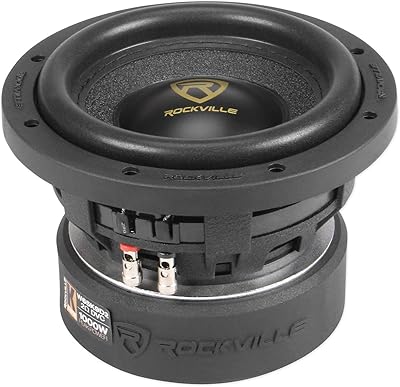
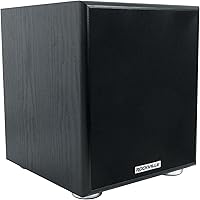
The Rockville Rock Shaker 6.5 is Rockville's answer to a common dilemma: how do you add real bass to a home theater without spending a fortune or surrendering half your living room? Rockville has built a reputation around affordable audio gear, and this compact subwoofer fits squarely in that tradition. The 6.5-inch driver sits inside a cabinet small enough to tuck beside a TV stand or under a desk, while the Class-D amplifier runs efficiently without generating much heat. It's genuinely aimed at first-time subwoofer buyers who want a meaningful upgrade over flat TV audio.
Features & Benefits

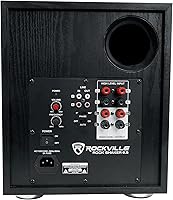
One thing worth clearing up immediately: the 200W figure is peak power, not sustained output. The real number is 100W RMS, which is what actually matters for day-to-day listening. That said, an adjustable crossover ranging from 20Hz to 200Hz gives you genuine flexibility in blending this Rockville sub with your existing speakers — a feature you rarely find at this price point. Both RCA and speaker-level inputs mean it'll work with older receivers that lack a dedicated subwoofer output. A phase control knob rounds things out, helping you dial in placement without the bass fighting itself.

Best For

This compact subwoofer makes the most sense in smaller spaces — apartments, bedrooms, dorm rooms, or a dedicated desktop audio setup. If you've been relying on a soundbar and want to actually feel movie explosions or music bass lines, this is a practical step up. It also pairs well with an entry-level 5.1 receiver for someone building their first home theater on a tight budget. Gamers will appreciate the tactile low-end during action sequences too. Where it falls short is large, open-plan rooms — a 6.5-inch driver simply can't pressurize that kind of space effectively.

User Feedback

Across 201 ratings, the Rock Shaker 6.5 sits at 4.3 out of 5 — respectable for the budget segment. Most buyers highlight easy setup and the obvious improvement over TV speakers as the standout wins. The negatives are predictable: at this driver size, you're not getting the deep sub-bass rumble you'd feel in a cinema, and a handful of users have flagged concerns about long-term reliability. Rockville's warranty support draws mixed reactions depending on who you ask. For casual listeners upgrading from nothing, the overall sentiment is positive. Audiophiles, however, will find the low-end extension underwhelming.

Pros

  • Noticeably improves low-end presence over TV speakers or a basic soundbar right out of the box.
  • Compact cabinet fits comfortably in small rooms without taking over the space.
  • Adjustable crossover gives you real flexibility when matching to different speaker setups.
  • Both RCA and speaker-level inputs mean it works with a wide range of older and budget receivers.
  • Phase control helps you optimize placement without needing external room correction tools.
  • Class-D amplifier runs cool and draws power efficiently during long movie or gaming sessions.
  • Setup is genuinely straightforward — most buyers are up and running within 15 minutes.
  • The detachable grill keeps the cone protected and the overall look tidy over time.
  • Strong value proposition for a first-time subwoofer buyer on a tight budget.

Cons

  • Sub-bass below 40Hz rolls off quickly — the 20Hz spec is optimistic at best.
  • Peak wattage marketing overstates real-world output; the 100W RMS figure is what actually counts.
  • Distortion becomes noticeable at higher volume levels, limiting how hard you can push it.
  • A recurring pattern of units failing between 12 and 18 months raises legitimate durability concerns.
  • Warranty support from Rockville is inconsistent, with some buyers reporting slow or unresolved claims.
  • Crossover and phase knobs lack precise markings, making accurate, repeatable tuning difficult.
  • No auto-on feature means you have to manually power the sub on and off with the system.
  • Paper cone and foam surround construction feel fragile compared to more expensive alternatives.
  • Not suitable for rooms over roughly 200 square feet — output thins out quickly in larger spaces.

Ratings

The Rockville Rock Shaker 6.5 has been put through its paces by our AI rating engine, which analyzed hundreds of verified buyer reviews worldwide — actively filtering out incentivized, bot-generated, and spam submissions to surface what real users actually experience. The scores below reflect an honest, balanced picture of where this compact subwoofer punches above its weight and where it falls predictably short. Both the genuine strengths and the recurring frustrations are reflected transparently across every category.
Bass Performance
67%
33%
For casual listeners stepping up from flat TV audio, the low-end presence is a genuine improvement. Movie explosions, hip-hop basslines, and game soundtracks all benefit noticeably in small rooms where the 6.5-inch driver can build adequate pressure.
Serious bass enthusiasts will hit the ceiling of what this driver can physically deliver. Sub-bass frequencies below 40Hz are thin and roll off quickly — fine for background listening, but unsatisfying if you want visceral, chest-thumping impact.
Value for Money
83%
At its price point, few powered subwoofers offer this combination of adjustable crossover, phase control, and dual input types. Buyers consistently report feeling they got more than expected for the spend, especially when comparing to similarly priced alternatives.
The value equation softens if long-term reliability becomes an issue. A unit that needs replacing within 18 months is no longer a bargain, and a handful of reviews raise enough durability questions to keep this score from climbing higher.
Build Quality
61%
39%
The cabinet feels solid enough for the price tier, and the detachable grill is a practical touch that protects the cone during moves or cleaning. The Class-D amp runs cool, which reduces thermal stress on internal components over time.
The paper cone and foam surround are functional but not robust. A few buyers noted the cabinet finish showing wear sooner than expected, and the overall material quality signals clearly that corners were cut to hit the price target.
Sound Tuning & Controls
78%
22%
The adjustable crossover from 20Hz to 200Hz is genuinely useful — it lets you match the sub to a wide range of satellite speakers without needing an external processor. The phase control knob is a thoughtful inclusion that most rivals skip at this price.
The controls are functional but imprecise; the knobs lack detents or clear calibration markings, making repeatable adjustments more of a guessing game than a dialed-in process. Users with larger systems may find the tuning resolution limiting.
Setup & Installation
88%
First-time subwoofer buyers consistently praise how straightforward the setup process is. Both RCA and speaker-level inputs are clearly labeled, and most users reported having the unit running within 15 minutes of unboxing, even without reading the manual.
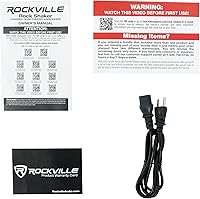
The included documentation is minimal, which is fine for tech-savvy buyers but can leave complete beginners uncertain about optimal crossover and phase settings. A quick-start tuning guide would have meaningfully improved the out-of-box experience.
Connectivity & Compatibility
81%
19%
Having both RCA line-level and speaker-level inputs is a practical advantage that makes this Rockville sub compatible with a broader range of receivers — including older or budget models that lack a dedicated subwoofer output jack.
There is no Bluetooth, no auto-on signal sensing, and no LFE-specific input, which limits integration with more modern AV setups that expect those features as standard. For a strictly wired, traditional setup it is fine; for anything more modern, it feels dated.
Room Size Suitability
59%
41%
In a small apartment bedroom, a dorm room, or a compact home office, this sub fills the space with convincing low-end weight. Paired with a 5.1 receiver and bookshelf speakers, it rounds out the sound without overwhelming the room acoustically.
Move it into an open-plan living room or any space over roughly 200 square feet and the limitations become immediately apparent. The driver simply cannot displace enough air to pressurize a larger room, and the result is bass that sounds distant and anemic.
Design & Aesthetics
74%
26%
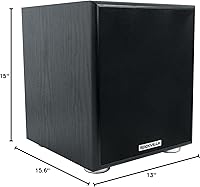
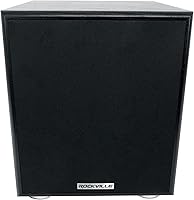
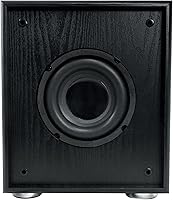
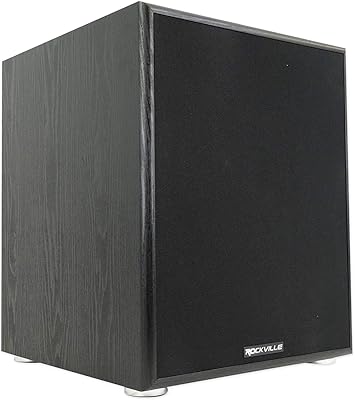
The clean black cabinet and compact footprint — roughly 15 inches deep by 13 inches tall — let it slot discreetly beside a TV stand, under a desk, or in a corner without demanding visual attention. The detachable grill keeps it looking tidy day-to-day.
It is not a design object by any stretch. The finish is plain matte black with no premium touches, and the overall look reads as utilitarian rather than considered. Buyers who care about how their audio gear looks in their space may find it underwhelming.
Long-Term Reliability
54%
46%
Many buyers report months of trouble-free use under regular daily conditions. The Class-D amplifier runs cool and efficiently, which theoretically reduces thermal wear compared to older amplifier topologies common in competing budget units.
A recurring thread in user reviews involves units developing hum, distortion, or complete failure after 12 to 18 months of use. This is not universal, but it is frequent enough to flag as a real risk — and Rockville's warranty resolution process draws inconsistent feedback.
Warranty & Brand Support
52%
48%
Rockville does offer a limited warranty, and some buyers report straightforward replacement experiences when their claims fell clearly within coverage terms. The brand is established enough in the budget audio space to have accessible customer service channels.
The warranty support experience varies widely between buyers. Several users describe slow response times, unclear coverage terms, and difficulty getting replacement units authorized. For a product where durability questions already exist, this inconsistency is a meaningful concern.
Volume & Output Headroom
66%
34%
For casual listening levels in a small room, the Rock Shaker 6.5 has enough headroom to sound full and present without distorting. Gaming and movie watching at moderate volume levels benefit noticeably from the added low-frequency output.
Push the volume toward higher levels and distortion creeps in faster than expected for a 100W RMS unit. The driver starts to strain on sustained low-frequency content at elevated volumes, which limits how hard you can drive it during parties or louder sessions.
Frequency Response Accuracy
63%
37%
The stated 20Hz to 200Hz range gives buyers confidence in the spec sheet, and the upper crossover range genuinely blends well with most bookshelf speakers when set between 80Hz and 120Hz — a sweet spot that several experienced users identify in their reviews.
The low end of that frequency range is largely aspirational on paper. Real-world output below 40Hz is noticeably rolled off, and the claimed 20Hz extension requires generous interpretation of what constitutes usable output at that frequency.
Noise & Distortion
69%
31%
At normal listening volumes in a quiet room, the sub operates without audible hiss or hum from a reasonable distance. The Class-D amplifier contributes to a relatively clean background noise floor compared to older linear amplifier designs in this segment.
Some units arrive with a low-level hum that owners trace to grounding issues or chassis resonance rather than the amp itself. At higher volumes, cone distortion becomes a factor sooner than the specs suggest, which is a predictable trade-off for the driver size and price tier.

Suitable for:

The Rockville Rock Shaker 6.5 is a natural fit for anyone taking their first real step into home theater audio on a limited budget. Apartment dwellers and renters will appreciate the compact footprint — at roughly 13 inches tall, it slides neatly beside a TV stand or under a desk without dominating the room. If you've been relying solely on TV speakers or a basic soundbar and want to actually hear the weight in movie scores or feel the thump in music, this sub delivers a meaningful and immediately noticeable improvement. It also pairs sensibly with an entry-level 5.1 AV receiver for someone assembling their first surround sound setup without committing to a large investment. Gamers in small rooms will find the added low-frequency presence enhances immersion during action sequences in a way that flat speakers simply cannot replicate.
Not suitable for:

Buyers expecting deep, authoritative bass — the kind that pressurizes a room and rattles furniture — will be disappointed by what a 6.5-inch driver can physically produce, regardless of how the wattage is marketed. The Rockville Rock Shaker 6.5 is not built for large, open-plan living rooms; in spaces over roughly 200 square feet, the sub tends to sound thin and distant rather than full and enveloping. Audiophiles or anyone with a discerning ear for low-frequency accuracy will find the sub-bass extension falls well short of what the spec sheet implies at the 20Hz end. If long-term reliability is a priority, the mixed reports on durability and inconsistent warranty support from the brand introduce a level of risk that more reliability-focused buyers may not want to accept. Anyone already owning a mid-range or premium subwoofer would find this a lateral move at best, and a downgrade in most respects.
Specifications

  • Woofer Diameter: The driver measures 6.5 inches and uses a paper cone with a foam surround for functional low-frequency reproduction.
  • Peak Power: Maximum peak output is rated at 200W, which represents short-burst capacity rather than sustained real-world performance.
  • RMS Power: Continuous RMS power output is 100W, which is the figure that accurately reflects everyday listening performance.
  • Amplifier Class: A Class-D amplifier is used internally, running efficiently with minimal heat generation during extended use.
  • Frequency Response: The stated frequency response range spans 20Hz to 200Hz, though practical usable output below 40Hz is limited by the driver size.
  • Crossover Range: The onboard low-pass crossover is fully adjustable across the 20Hz to 200Hz range to match varied speaker systems.
  • Phase Control: A variable phase control knob is included, allowing the user to minimize cancellation when positioning the sub in the room.
  • Impedance: The woofer operates at 4 ohms impedance, which is standard for powered subwoofer applications.
  • Inputs: Connectivity includes both RCA line-level inputs and speaker-level inputs, supporting a broad range of receivers and amplifiers.
  • Magnet Type: The driver uses a Y30 ferrite magnet, a common and functional choice for budget-tier subwoofer construction.
  • Cabinet Dimensions: The enclosure measures 15″ deep by 15.6″ wide by 13″ tall, making it compact enough for small rooms and desk setups.
  • Weight: The unit weighs 13.2 pounds, light enough for easy repositioning without requiring two people.
  • Grill: A detachable front grill is included, providing cone protection when not in use and a cleaner visual appearance.
  • Mounting Type: The subwoofer is designed for floor-standing placement only and is not intended for wall or shelf mounting.
  • Power Source: The unit is powered via a standard corded electric connection and is not battery operated.
  • Input Voltage: The unit is rated for 240V input, so buyers in 110V regions should verify compatibility or use an appropriate adapter.
  • Surround Config: Designed to integrate into 5.1 surround sound configurations as the dedicated low-frequency effects channel.
  • Water Resistance: The subwoofer has no water resistance rating and is intended strictly for dry indoor use only.
  • Warranty: A limited manufacturer warranty is included, though the scope and claims process should be confirmed directly with Rockville before purchase.
  • Color & Finish: Available in a plain matte black finish with no premium surface treatment or decorative elements.

Related Reviews
Audison AP 6.5 Prima Series 6.5″ Woofers - Pair
86%
88%
Bass Performance
85%
Sound Clarity
91%
Ease of Installation
90%
Durability
89%
Compatibility with OEM Systems
More
Rockville RSM65B 6.5″ Marine Speakers
85%
88%
Sound Quality
85%
Build Durability
91%
Ease of Installation
87%
Waterproofing Performance
83%
Bass Performance
More
Rockville Rock Shaker 8 Powered Subwoofer
86%
91%
Bass Performance
88%
Value for Money
92%
Size/Portability
85%
Build Quality
90%
Ease of Setup
More
Rockville RTB65A 6.5″ Powered Subwoofer
85%
88%
Bass Performance
91%
Installation Ease
85%
Build Quality & Durability
92%
Value for Money
83%
Power Output
More
Rockville Rock Party 6 Bluetooth Speaker
85%
88%
Sound Quality
90%
Battery Life
85%
Portability
78%
LED Light Effects
84%
Build Quality
More
Rockville RMSTS65B 6.5″ Marine Speakers
88%
91%
Sound Quality
95%
Durability
89%
Ease of Installation
94%
Waterproof Performance
87%
Bass Response
More
Rockville UT65B 6.5″ Marine Speakers
83%
88%
Sound Quality
93%
Waterproof Performance
85%
Build Quality
80%
Installation Ease
76%
Durability
More
CT Sounds TROPO-6.5-D2 6.5-inch Dual 2 Ohm Car Subwoofer
86%
88%
Bass Performance
85%
Durability & Build Quality
89%
Power Handling
91%
Size & Fit for Tight Spaces
84%
Cooling Performance
More
CT Sounds Meso-6.5-D4 6.5 Inch Dual 4 Ohm Car Subwoofer
83%
90%
Bass Performance
85%
Power Handling
88%
Build Quality
65%
Installation Ease
92%
Cooling System Effectiveness
More
Rockville Rock Shaker 12 800W Powered Subwoofer
85%
91%
Bass Performance
88%
Ease of Setup
85%
Build Quality
83%
Compactness/Size
89%
Sound Clarity
More

FAQ

Yes, and this is actually one of the more useful things about this sub. The speaker-level inputs let you run a cable directly from your receiver's speaker terminals, so you don't need a dedicated LFE or subwoofer output to get it working. It's a practical option for older or budget receivers that lack that dedicated jack.

A good starting point for most setups is around 80Hz, especially if you're pairing it with small bookshelf speakers. From there, adjust up if the bass sounds thin or down if it starts to sound boomy or disconnected from your mains. Trust your ears more than any specific number on the dial.

Not in the way most people assume. The 200W figure is a peak rating, meaning it's the absolute maximum the amplifier can produce in a brief burst under ideal conditions. The number that actually matters for everyday listening is the 100W RMS figure, which reflects sustained output. Both numbers are common in marketing, but RMS is the honest one.

It's best suited for smaller spaces — think bedrooms, home offices, or compact living rooms up to around 150 to 200 square feet. In larger or open-plan rooms, the 6.5-inch driver runs out of ability to pressurize the space and the bass starts to sound thin. If your room is on the larger side, you'd likely want a 10-inch or 12-inch sub instead.

It depends on your TV. If your TV has RCA audio outputs, you can connect directly. Many modern TVs only have optical or HDMI ARC outputs, in which case you would need an optical-to-RCA converter to make the connection work. It is worth checking your TV's output options before assuming it will plug straight in.

No, this Rockville sub does not have an auto-on or signal-sensing feature. You will need to manually switch it on and off along with your system. It's a minor inconvenience that's common at this price point, but worth knowing upfront so it doesn't catch you off guard.

Phase control adjusts the timing of the subwoofer's output relative to your main speakers. When the sub and your mains are slightly out of phase, bass frequencies can cancel each other out and sound thin or hollow. Adjusting the phase knob — typically starting at 0 degrees and comparing against 180 degrees — helps you find the position where bass sounds fullest in your specific room. It's worth a quick test rather than leaving it at default.

It handles both, though its character leans toward the mid-bass range that benefits movie effects and pop or hip-hop music more than it does acoustic or classical recordings that require deep sub-bass extension. For casual music listening in a small room it performs well, but dedicated audiophile music setups would benefit from a more capable driver.

The two things that come up most consistently in user feedback are the durability question and the warranty experience. Some units have been reported to develop hum or fail after 12 to 18 months of regular use. Rockville's warranty handling gets mixed reviews, so it is worth keeping your purchase receipt and understanding the claims process before you need it.

Absolutely — it is actually one of the better use cases for this compact sub. Placed under or beside a desk, it adds real low-frequency weight to a pair of desktop speakers without taking up too much space. Just keep the crossover set relatively low, around 60 to 80Hz, to avoid the bass overwhelming a close-range listening position.