Overview

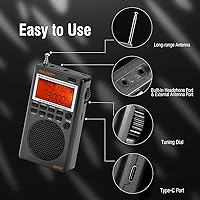
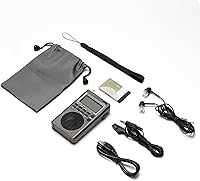
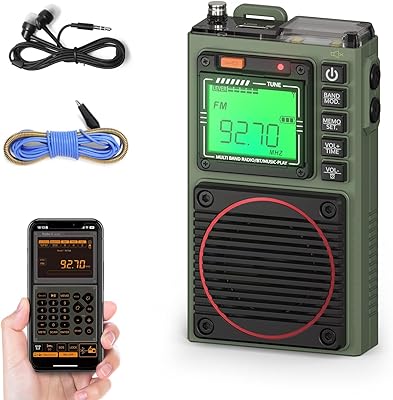
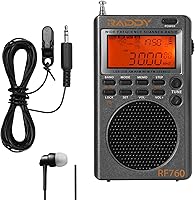
The Raddy RF760 Portable Shortwave Radio Receiver sits in an interesting spot in the market — compact enough to slip into a jacket pocket, yet capable enough to pull in signals that most portable radios completely ignore. It covers twelve bands, spanning standard AM and FM all the way through shortwave with SSB, CB, airband, VHF, UHF, and NOAA weather alerts. That kind of range is typically found on equipment costing significantly more. A rechargeable lithium battery with USB charging is a practical modern touch. The box also includes a wired earphone and a 9.7-foot external wire antenna — two accessories that actually get used.
Features & Benefits

SSB is where the RF760 separates itself from cheaper multi-band radios. Standard AM shortwave only picks up international broadcasters; SSB mode unlocks ham operators, maritime traffic, aeronautical stations, and utility transmissions — content most pocket radios completely miss. Worth clarifying: this is a receive-only device, so it listens to SSB signals but cannot transmit. The adjustable bandwidth control lets you narrow the filter in crowded conditions, which genuinely helps on busy shortwave segments. NOAA weather alert monitoring runs in the background and triggers automatically during hazard broadcasts — no manual intervention needed. Toss in airband reception covering 118 to 138 MHz and 700 station presets across all bands, and the feature set punches well above this price tier.

Best For

This portable multi-band radio makes the most sense for three overlapping groups: shortwave listeners who want SSB capability without spending on a dedicated communications receiver, emergency preparedness households that rely on NOAA alerts for real-time weather hazard warnings, and travelers or off-grid adventurers who need reliable worldwide reception without depending on internet access. Aviation hobbyists will appreciate the airband monitoring, and passive VHF/UHF listeners can explore those bands without buying a separate scanner. It is less suited to casual users who just want an FM radio — the menu system has a learning curve, and the value proposition only clicks once you actually use the multi-band capabilities.

User Feedback

Across nearly 300 reviews, the RF760 holds a 4.0-star rating — respectable, though not without genuine criticism. SSB sensitivity draws consistent praise from experienced listeners who have compared it against pricier alternatives, and the NOAA alert trigger is frequently highlighted as dependable during real storm events. The external wire antenna gets specific callouts for meaningfully boosting shortwave reception — the built-in antenna alone is underwhelming on weak signals. On the downside, the 1-watt speaker is quiet and thin; earphones are effectively required for serious listening, not just a preference. Menu navigation also frustrates new users, and the included manual does not always clarify the less obvious settings. Most buyers who push past that learning curve report genuine satisfaction.

Pros

  • SSB mode on shortwave unlocks ham, maritime, and utility stations that most portable radios in this price range completely ignore.
  • Automatic NOAA weather alert triggers the radio during hazard broadcasts, making it a practical emergency tool.
  • Twelve-band coverage — including airband and VHF/UHF — is rare at this price point and eliminates the need for a separate scanner.
  • The included 9.7-foot wire antenna noticeably boosts shortwave reception and connects via a standard 3.5mm jack.
  • Adjustable SSB bandwidth helps reduce interference on crowded shortwave frequencies for cleaner signal decoding.
  • Rechargeable lithium battery with USB charging means no constant AA battery expense on long trips.
  • The RF760 stores up to 700 station presets across all bands, with both auto-scan and manual fine-tuning available.
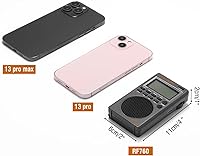
  • Physical size is genuinely compact — fits in a jacket pocket or slips easily into a bug-out bag without adding noticeable weight.
  • FM sensitivity is strong for a multi-band radio, with stereo and mono switching available.
  • At this price tier, the overall band sensitivity and SSB performance hold up well against radios costing noticeably more.

Cons

  • The built-in speaker is a 1-watt unit — thin and quiet, making earphones essentially mandatory for any serious listening session.
  • Menu navigation has a real learning curve, and the included manual does not always explain the less obvious settings clearly.
  • The internal antenna alone performs poorly on shortwave; the external wire antenna is needed for reliable weak-signal reception.
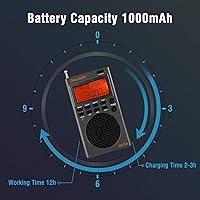
  • Battery capacity of 1000 mAh is modest — extended listening sessions, especially with the backlight active, drain it faster than expected.
  • No Bluetooth output, so wireless earphone users are out of luck without an adapter.
  • CB band bandwidth defaults may need manual adjustment to sound correct, which requires understanding the settings menu.
  • The radio has no carrying case or protective sleeve included, which feels like an oversight for a device marketed toward field use.
  • VHF and UHF bands are receive-only with NFM demodulation — useful for monitoring but limited compared to a purpose-built scanner.
  • Some users report the fine-tuning knob feels slightly loose, which can make precise SSB tuning fiddly in the field.
  • No real-time clock or sleep timer function, which is a common feature on competing radios at a similar price.

Ratings

Our AI rating system analyzed verified global user reviews for the Raddy RF760 Portable Shortwave Radio Receiver, actively filtering out incentivized, bot-generated, and outlier feedback to surface what genuine buyers consistently experience. The scores below reflect a transparent picture of both where this portable multi-band radio genuinely delivers and where it falls short — no spin, no cherry-picking.

SSB Reception Quality
83%
Experienced shortwave listeners consistently report that the RF760 punches above its price class when it comes to SSB sensitivity. On quiet evenings, users pulling in ham operators and maritime traffic from thousands of miles away note the signal clarity holds up well without excessive drift or noise floor issues.
Precise SSB tuning requires patience — the fine-tune knob, while functional, can make locking onto a sideband signal fiddly compared to radios with dedicated BFO controls. New users unfamiliar with USB and LSB distinctions often spend significant time getting a clean decode.
Band Coverage Breadth
91%
Covering twelve bands in a device this small is legitimately impressive, and buyers regularly cite the airband and VHF/UHF access as features that pushed them to choose the RF760 over simpler alternatives. Having one radio handle shortwave, aviation, NOAA, and FM without carrying multiple devices is a real practical advantage.
While the band count is exceptional, a few niche segments — particularly CB and UHF — have sensitivity limitations that become apparent when conditions are less than ideal. Dedicated scanners will outperform the RF760 on VHF/UHF in complex RF environments.
NOAA Weather Alert
88%
The automatic hazard alert function earns consistent praise from buyers in storm-prone regions. Multiple reviewers describe the radio waking itself during tornado and severe thunderstorm alerts in the middle of the night — exactly the scenario it is designed for and one that justifies its place in any emergency kit.
The alert sensitivity is not user-adjustable, which means occasional false triggers in areas with overlapping NOAA transmitters have been reported. A small number of users also note that initial setup of the alert mode is not clearly documented in the manual.
Portability & Form Factor
89%
At under 4.5 inches long and 8.8 ounces, the RF760 fits comfortably in a shirt pocket or the side pouch of a hiking pack without becoming a burden. Buyers who use it for travel or emergency bags specifically call out the size-to-capability ratio as one of the strongest arguments for choosing it.
The compact form factor requires some compromises in control layout — buttons are small and closely spaced, which can be frustrating when operating with gloves or in low-light conditions. A slightly larger chassis might have allowed for better ergonomics without meaningfully affecting portability.
Audio & Speaker Quality
52%
48%
For voice content like news broadcasts or SSB conversations, the speaker is intelligible enough in a quiet room at moderate volume. Users who primarily listen through the included earphone — or better quality aftermarket earphones — report a considerably more satisfying audio experience.
The 1-watt, 40mm speaker is the RF760's most consistent criticism. Volume headroom is limited, bass response is thin, and background noise in a kitchen or vehicle renders it nearly inaudible. This is a radio you realistically use with earphones, and buyers expecting room-filling sound will be disappointed.
Ease of Use & Menu System
58%
42%
Once the learning curve is cleared — usually after a few dedicated sessions with the manual and some online forum guidance — most users find the menu logic consistent and the tuning workflow manageable. The physical fine-tune knob is a genuine ergonomic asset that reduces reliance on button presses for everyday listening.
The initial setup experience is rough. The manual is thin on context, particularly around bandwidth settings and band-specific step sizes, and the menu hierarchy is not intuitive for newcomers. Several reviewers note spending hours troubleshooting settings that a better-written guide would have resolved in minutes.
Build Quality & Durability
71%
29%
The chassis feels solid for its weight class — no creaking panels or rattling components out of the box. The buttons have a tactile click, and the tuning knob, while lightweight, operates smoothly without wobble that would impair fine adjustments during a listening session.
The overall build is clearly plastic-forward, and a few users report that the fine-tune knob feels marginally loose after extended use. There is no water resistance or ruggedization, which limits confidence in genuinely harsh field environments despite the bug-out-bag marketing angle.
External Antenna Performance
84%
The included 9.7-foot wire antenna connects via a standard 3.5mm jack and delivers a consistent, well-documented improvement on shortwave bands. Buyers who drape it along a windowsill or tack it to a wall report pulling in stations that were completely inaudible on the internal telescopic antenna alone.
The antenna connection uses a 3.5mm jack rather than a traditional coaxial input, which limits compatibility with higher-grade external antennas without an adapter. The wire itself is functional but basic — no strain relief or mounting hardware is included.
Battery Life
63%
37%
USB charging via the standard BL-5C cell is a practical feature, and the battery is a user-replaceable standard format — a genuine long-term advantage over radios with sealed packs. Having a spare BL-5C on hand essentially eliminates downtime during extended outings.
The 1000 mAh capacity translates to roughly four to six hours of real-world listening, which falls short for all-day field use or overnight emergency monitoring. Users who run the backlight frequently or scan actively report the lower end of that estimate rather than the higher.
FM Reception
78%
22%
FM performance is clean and sensitive at 1.5 µV, with stereo and mono switching available — genuinely competitive with single-purpose pocket FM radios at a similar price. Travelers appreciate the three FM sub-band configurations that accommodate international FM frequency ranges.
Stereo separation through the speaker is negligible given the mono output of a single driver. FM is also not the primary use case this radio is built around, and buyers focused purely on FM performance would be better served by a dedicated FM receiver with superior audio hardware.
Value for Money
79%
21%
Measured against what SSB-capable radios typically cost, the RF760 offers a feature set that is hard to match at its price tier. Buyers who actively use the SSB, airband, and NOAA alert functions regularly describe it as one of the better purchases in their radio hobby, especially as a first SSB-capable receiver.
Buyers who only use FM and basic AM shortwave are essentially paying a significant premium for features they never touch. Compared to a sub-thirty-dollar Retekess for casual listening, the value equation only works if the multi-band and SSB capabilities are genuinely part of the use case.
Station Memory & Presets
74%
26%
Seven hundred preset slots spread across all bands is more than most users will ever fill, and the auto-scan function populates memories quickly during initial setup. Dedicated knob tuning alongside preset recall gives users flexible options depending on whether they are exploring or returning to known stations.
Managing 700 presets without a companion app or PC software can become tedious — deleting or reorganizing stored stations requires working through the menu system manually. Users who frequently switch listening regions report the preset management workflow as time-consuming.
Shortwave AM Performance
76%
24%
Standard AM shortwave coverage from 2 to 30 MHz is broad and performs reliably for international broadcasters, especially when the external wire antenna is in use. Evening listening sessions pulling in stations from Europe, Asia, and the Americas are achievable in most locations with minimal effort.
The 30 µV shortwave sensitivity under AM mode is adequate but not exceptional — competing radios at similar price points occasionally edge it out on very weak signals. Urban RF noise environments also affect performance more noticeably than on dedicated communications receivers with better front-end filtering.

Suitable for:

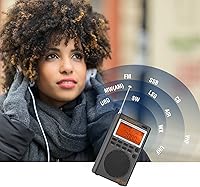
The Raddy RF760 Portable Shortwave Radio Receiver is a strong match for anyone who wants serious multi-band coverage in a genuinely pocketable package. Shortwave hobbyists who have outgrown basic AM/FM radios but are not ready to invest in a dedicated communications receiver will find the SSB capability alone worth the price of entry — it opens up ham radio, maritime, and utility traffic that standard shortwave modes simply cannot decode. Emergency preparedness households get real value from the automatic NOAA hazard alert, which triggers the radio without any manual action during severe weather warnings. Travelers heading somewhere with unreliable internet will appreciate the ability to tune in international broadcasters and local AM stations worldwide using just a 9.7-foot wire antenna draped near a window. Aviation enthusiasts and passive VHF/UHF listeners also get a surprisingly capable scanner-like experience without buying dedicated hardware.
Not suitable for:

The Raddy RF760 Portable Shortwave Radio Receiver is not the right choice for everyone, and being clear about that saves buyers real frustration. Anyone expecting to transmit on SSB or any other mode should stop here — this is a receive-only device, and no amount of menu-digging will change that. Casual listeners who primarily want FM radio for music or podcasts will find the price hard to justify against simpler, cheaper options from Sangean or Retekess that handle FM with better audio output and no complicated menu system. The built-in 1-watt speaker is genuinely underwhelming in louder environments; if earphone-free listening is important to you, this radio will disappoint. Users who are not comfortable spending time with a manual learning band-specific settings and bandwidth filters may find the experience more aggravating than rewarding, particularly in the first few weeks of ownership.

Specifications

  • Dimensions: The radio measures 4.37″ long by 2.36″ wide by 0.79″ thick, making it genuinely pocketable for everyday carry.
  • Weight: It weighs 8.8 oz (0.46 lbs), light enough to carry in a jacket pocket or pack without noticeable bulk.
  • Band Coverage: The unit covers 12 bands: FM, AM (MW), SW (2–30 MHz), CB, AIR (118–138 MHz), VHF, UHF, and WX/NOAA weather.
  • SSB Modes: Shortwave reception supports both Upper Sideband (USB) and Lower Sideband (LSB) demodulation for decoding ham and utility transmissions.
  • Battery: Power comes from a rechargeable BL-5C lithium-ion cell rated at 1000 mAh, 3.7V, charged via USB.
  • Speaker: The built-in speaker is a 40mm, 8-ohm, 1-watt unit — adequate for quiet environments but limited in louder conditions.
  • FM Sensitivity: FM sensitivity is rated at 1.5 µV with selectable stereo and mono demodulation modes.
  • SW Sensitivity: Shortwave sensitivity under AM mode is rated at 30 µV, with SSB performance consistently noted as strong by experienced users.
  • Station Memory: The radio stores up to 700 presets distributed across all bands: 100 each for FM, MW, SW, AIR, CB, VHF/UHF, and UBD.
  • Tuning: Both automatic scan and manual fine-tuning via a dedicated physical knob are supported across all bands.
  • Airband Range: Aviation band (AIR) covers 118–138 MHz using AM demodulation, allowing passive monitoring of aircraft and control tower communications.
  • VHF/UHF Range: VHF and UHF scanning spans 20–520 MHz using NFM demodulation, covering commercial, amateur, and maritime frequencies.
  • NOAA Alert: The NOAA weather alert function monitors WX frequencies (162.400–162.550 MHz) and triggers the radio automatically when a hazard broadcast is detected.
  • Accessory Ports: Two 3.5mm jacks are included — one for earphone output and one for connecting the external wire antenna.
  • Included Accessories: The box contains a wired earphone and a 9.7-foot external wire antenna with a 3.5mm connector for improved shortwave reception.
  • Bandwidth Control: SSB mode includes adjustable IF bandwidth filtering to reduce adjacent-channel interference on crowded shortwave segments.
  • Tuning Steps: Step sizes vary by band; SW supports steps as fine as 0.01 kHz for precise SSB frequency alignment.
  • VHF/UHF Sensitivity: VHF and UHF sensitivity is rated at -8 dBµV, suitable for monitoring local repeaters and maritime channels within reasonable range.

Related Reviews

Raddy RE40 Portable Shortwave Radio
83%
88%
Battery Life
91%
Portability
85%
Charging Options
94%
Weather Alerts
62%
Bluetooth Performance
More
Raddy RF75A Portable Shortwave Radio
84%
91%
Reception Quality
70%
Battery Life
95%
Portability
88%
Bluetooth Connectivity
84%
App Control Experience
More
Raddy RF320 Portable Multiband Shortwave Radio
79%
88%
Band Coverage
67%
Shortwave Reception
86%
FM & VHF Reception
83%
Aviation Band (AIR)
71%
App & Bluetooth Integration
More
Retekess TR113 Shortwave Radio Receiver
85%
88%
Reception Quality
91%
Battery Life
85%
Portability
89%
Bluetooth Connectivity
82%
App Control Usability
More
Raddy RF919 SSB Shortwave Radio
85%
89%
Performance
85%
Battery Life
83%
Ease of Use
92%
Bluetooth Connectivity
88%
Reception Quality
More
XHDATA D368 Portable Shortwave Radio
74%
84%
FM Reception Quality
71%
Shortwave Reception
58%
AM Reception Quality
66%
Build Quality & Durability
78%
Battery Life
More
Retekess TR110 Portable Shortwave Radio
83%
88%
Reception Quality
91%
Portability
85%
Battery Life
83%
Ease of Use
89%
Weather Alert Functionality
More
Retekess TR629 Portable Shortwave Radio
83%
88%
Reception & Signal Quality
83%
Ease of Use
91%
Portability & Design
85%
Recording Function
80%
Battery Life
More
Raddy RF886 Portable Digital Radio
85%
88%
Signal Reception
90%
Bluetooth Functionality
85%
Portability & Size
84%
Battery Life
91%
NOAA Weather Alerts
More
QODOSEN DX-286 Portable Shortwave Radio
76%
88%
Reception & Sensitivity
91%
Shortwave Band Performance
79%
AM & FM Everyday Usability
67%
Build Quality & Materials
62%
Battery Life
More

FAQ

No — the RF760 is strictly a receiver. It can decode SSB signals on shortwave, which lets you listen to ham operators, maritime stations, and utility transmissions, but it has no transmit capability whatsoever. If you need to transmit, you would need a licensed transceiver, which is a fundamentally different and more expensive category of equipment.

The alert function works automatically. You enable it in the settings and the radio monitors the NOAA weather frequencies in the background, then wakes itself and sounds an alarm when a hazard alert is broadcast. You do not need to manually tune to a weather channel and leave it there.

Yes, noticeably so. The built-in telescopic antenna is adequate for strong local signals, but on shortwave — especially for SSB — the 9.7-foot wire antenna makes a real difference. Draping it near a window or running it along a wall is usually enough to pull in signals that the internal antenna struggles with.

The Raddy RF760 Portable Shortwave Radio Receiver uses a BL-5C lithium-ion cell, which is a standard Nokia-format battery that has been widely available for years. It can be replaced if the original degrades over time, which is a practical advantage over radios with sealed internal batteries.

It takes some patience, especially if SSB is new to you. The menu system is functional but not immediately intuitive, and the included manual covers the basics without always explaining the why behind settings like bandwidth selection or tuning steps. Most new users report needing a few sessions with the manual and some online resources before things click, but it is not insurmountable.

It can, depending on your distance from the airport and local terrain. The airband covers 118–138 MHz in AM mode, which is the standard frequency range for civil aviation voice communications. Ground-level reception a few miles from a busy airport is typically achievable; range drops off significantly with distance or obstructions.

No, the RF760 has no Bluetooth output. Audio accessories connect via a 3.5mm wired jack only. If you prefer wireless listening, you would need a separate wired-to-Bluetooth adapter, which adds bulk and a charging dependency.

It depends heavily on your region. Many North American public safety agencies have migrated to digital trunked systems like P25, which this radio cannot decode — it only handles analog NFM on VHF and UHF. If your local agencies still operate on analog narrowband FM, reception is possible, but you should check your area before buying with that specific use case in mind.

Real-world battery life varies depending on volume level, backlight use, and which bands you are actively using, but most users report somewhere between four and eight hours of continuous listening. The 1000 mAh capacity is on the modest side, so carrying a small USB power bank is a sensible precaution for extended field use.

The main differentiator is SSB support and band count. Budget options from Retekess or entry-level Tecsun models typically cover AM, FM, and basic shortwave in AM mode only — useful for international broadcasters but nothing beyond that. The RF760 adds SSB, airband, VHF, UHF, CB, and automatic NOAA alerting, which is a substantially wider capability set. The trade-off is a steeper learning curve and a weaker speaker compared to some simpler alternatives that prioritize audio output over feature depth.

Where to Buy