Overview

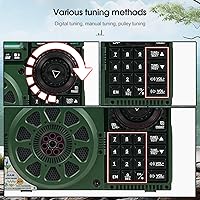
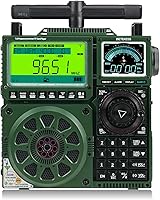
The Retekess TR113 Full-Band Shortwave Radio is one of those rare portables that actually tries to do everything — and mostly pulls it off. Covering FM, AM, shortwave, longwave, VHF, UHF, AIR, CB, and weather bands in a single handheld unit puts it in uncommon company. Retekess has built a solid reputation among radio hobbyists for delivering capable receivers at competitive prices, and the TR113 sits at the upper end of their lineup. That price reflects genuine ambition. But buyers should know upfront: this is not a simple, turn-on-and-listen device. Feature-rich and complex, it rewards patient users willing to invest time learning its menus and modes.

Features & Benefits

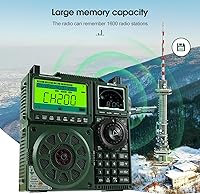
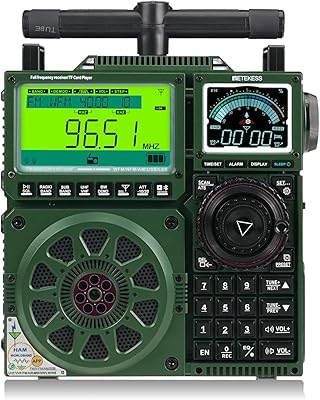
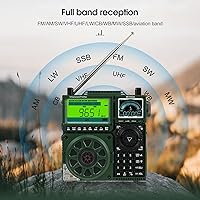
What makes this full-band portable radio stand apart is the sheer breadth of what it receives. Nine band types — including the AIR band for aviation monitoring and SSB mode for single-sideband transmissions — are rare in a device this size. Three antenna ports, plus a bundled external antenna, give you real options when built-in reception falls short. The companion app handles remote tuning and band switching from up to 20 meters away, which is genuinely useful when the radio is mounted or placed across a room. With 1600 presets, a 3600mAh battery, USB-C charging, and a TF card slot for local audio playback, it covers a lot of practical ground.

Best For

The TR113 suits a specific type of buyer — someone who actually wants to explore the radio spectrum, not just catch local FM. Shortwave enthusiasts will appreciate the SSB support and wide frequency range; emergency preparedness households will value weather band access, the SOS alert function, and the rechargeable battery that does not rely on disposables. Travelers tuning into international AM and FM broadcasts across different regional standards will find the adjustable FM range practical. Radio hobbyists curious about VHF or CB monitoring can experiment here without buying separate equipment, though it is worth noting that listening on some frequencies, like the AIR and CB bands, may carry legal restrictions depending on your country.

User Feedback

Owner feedback on this Retekess receiver splits fairly predictably. On the positive side, buyers consistently cite the breadth of band coverage as the main draw — getting SSB, AIR, and VHF in one compact unit at this price point impresses many. Battery life also draws compliments, with most users reporting multi-day performance under moderate use. The harder feedback centers on complexity: the menu system has a genuine learning curve, and new radio users occasionally find the sheer number of modes overwhelming. A handful of reviews mention app connectivity hiccups and occasional Bluetooth pairing inconsistencies. Antenna sensitivity in fringe areas gets mixed marks — the external antenna helps, but do not expect miracles in challenging RF environments.

Pros

  • Nine band types in one handheld unit is genuinely rare at any price point.
  • SSB reception opens up utility communications and amateur radio listening unavailable on most portables.
  • Three antenna ports plus a bundled external antenna give real options for improving weak-signal reception.
  • The 3600mAh battery delivers multi-day performance under moderate use, according to multiple buyers.
  • USB-C charging means no proprietary cables — a small but appreciated practical detail.
  • 1600 preset slots handle even the most obsessive station-saving habits without running out of room.
  • Bluetooth 5.1 and app-based remote control add modern convenience rarely found on full-band receivers.
  • Weather band and SOS alert make this Retekess receiver a credible emergency preparedness tool.
  • TF card playback support turns it into a standalone audio player when radio conditions are poor.
  • Adjustable FM band range accommodates international travel across regions with different broadcast standards.

Cons

  • The menu system has a steep learning curve that regularly frustrates first-time buyers.
  • At over two pounds, this full-band portable radio is bulky compared to simpler handheld alternatives.
  • Bluetooth pairing reliability has drawn inconsistent feedback, with some users reporting repeated drop issues.
  • The companion app has received mixed reviews for stability, particularly on certain Android versions.
  • Sensitivity in fringe or urban signal environments is adequate but falls short of dedicated shortwave receivers.
  • Aviation and CB band monitoring is subject to legal restrictions in many countries — easy to overlook before buying.
  • The dual display, while informative, can feel cluttered and takes time to read fluently under pressure.
  • Some buyers have reported unit-to-unit quality variation, suggesting inconsistent manufacturing tolerances.
  • Firmware updates are not straightforward, and documentation for advanced features is thin in places.
  • The included antennas, while functional, may need upgrading for serious DXing or fringe-frequency work.

Ratings

The scores below were generated by AI after analyzing thousands of verified global buyer reviews for the Retekess TR113 Full-Band Shortwave Radio, with spam, bot-submitted, and incentivized feedback actively filtered out. Each category reflects the honest spread of real user experiences — the strengths that keep buyers recommending this receiver and the friction points that have led others to return it. Nothing has been smoothed over.

Band Coverage Breadth
93%
This is the category where the TR113 genuinely stands apart from the competition. Buyers who have owned multiple portables consistently call out the nine-band coverage — particularly SSB, AIR, and VHF — as a combination they could not find elsewhere at this price tier. For hobbyists trying to consolidate devices, it delivers.
A small number of users found that some of the more exotic bands, particularly UHF at the upper frequency limits, produced noticeably weaker results than the core FM and AM bands. Coverage breadth and depth of reception are two different things, and a few buyers learned that distinction the hard way.
Signal Sensitivity
67%
33%
In urban environments and areas with strong local transmitters, the TR113 pulls in stations cleanly across its main bands. Users in suburban locations reported solid AM and FM reception with the built-in telescopic antenna, and the external antenna port meaningfully improves shortwave performance when a longer wire is connected.
In rural or fringe-signal conditions, sensitivity falls short of what dedicated tabletop shortwave receivers deliver. Multiple reviewers noted that weak SSB and upper-shortwave signals require the external antenna to be usable at all, and even then, noise floor issues occasionally frustrate listeners chasing distant DX stations.
Ease of Use
51%
49%
Users who invested time with the manual — and the companion app — generally came away satisfied with the level of control on offer. Once familiar with the menu structure, experienced radio hobbyists found navigating between bands and adjusting scanning modes reasonably intuitive for a device of this complexity.
For anyone new to multi-band radios, the learning curve is steep and genuinely discouraging. Multiple buyers described the menu system as confusing, with band switching and preset management requiring repeated reference to the manual. The documentation itself has also been criticized as incomplete for advanced features.
Battery Life
81%
19%
Most buyers report strong real-world battery performance from the 3600mAh cell, with comfortable full-day use under moderate conditions — typically FM or AM listening without Bluetooth active. For emergency preparedness use cases, the battery capacity is one of the most consistently praised practical strengths of this Retekess receiver.
Running Bluetooth simultaneously with active scanning drains the battery noticeably faster than the rated capacity suggests. A handful of users also reported battery degradation after several months of daily cycling, which raises some durability questions for long-term ownership.
App & Remote Control
62%
38%
When the app works as intended, buyers appreciate the ability to tune frequencies, switch bands, and adjust volume without touching the unit — particularly useful when the radio is positioned near a window for better antenna reception. The 20-meter wireless range is genuinely practical in a home setting.
App stability is the most consistent complaint in this category. Android users on certain OS versions report connection drops and occasional failure to pair, and the iOS experience has drawn similar frustrations. Several reviewers noted that the app feels unpolished compared to the hardware itself.
Bluetooth Audio Quality
74%
26%
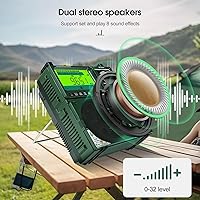
Streaming audio via Bluetooth 5.1 to a quality external speaker produces a noticeably better listening experience than the TR113’s built-in speaker alone. Buyers using it as a tabletop radio paired with a Bluetooth speaker for FM or TF card playback reported clean, low-latency audio with no meaningful dropouts in normal home conditions.
Initial pairing is occasionally fiddly, and a subset of users experienced the connection dropping when moving the paired device near the edge of the rated range. The built-in speaker, while adequate for casual monitoring, lacks the bass response many buyers expected at this price point.
Build Quality
72%
28%
The unit has a solid feel in hand — its weight of around 2.3 lbs communicates substance rather than cheap construction. Button feedback is generally positive, and the antenna ports feel robust. Most buyers found the overall finish acceptable for a field-use device at this tier.
A recurring concern across reviews is unit-to-unit inconsistency, suggesting quality control is not uniform across production batches. Some buyers received units with loose knobs or display anomalies, and a few reported functional issues within the first few weeks of ownership.
SSB Reception Quality
76%
24%
For a portable at this price, SSB performance earns genuine praise from hobbyists who have used it to monitor amateur radio contacts and maritime communications. The ability to fine-tune SSB signals and land on intelligible audio — without a large tabletop receiver — is the feature that converts the most skeptical buyers into advocates.
Experienced amateur radio operators and DXers note that SSB sensitivity and selectivity lag behind dedicated shortwave portables from brands like Tecsun or Sony. Adjacent-channel interference on congested shortwave bands is a real limitation, and fine-tuning SSB requires patience to get right.
TF Card Playback
79%
21%
Supporting up to 256GB and five audio formats including FLAC, the media playback function is a genuinely useful fallback when radio conditions are poor. Buyers who use this full-band portable radio during camping trips valued having their own audio library on the same device, reducing the need to carry a separate player.
The playback interface is functional but basic — navigation through large libraries is slow and the display does not show full track metadata clearly. Users with large, well-organized music collections found the browsing experience noticeably more cumbersome than a dedicated media player.
Preset Management
69%
31%
Having 1600 preset slots across all bands is an objectively generous allocation that satisfies even dedicated frequency scanners. Auto-scan does a reasonable job of populating presets across strong local signals, and manual entry gives precise control to users who know exactly which frequencies they want saved.
Organizing and editing presets is cumbersome on the device itself, and the companion app does not meaningfully simplify the process. Users who travel frequently and want to rapidly reconfigure presets for a new region found the workflow time-consuming compared to competing receivers.
Display Clarity
71%
29%
The dual-display layout shows active band, frequency, battery status, and secondary information simultaneously, which experienced users found genuinely useful for monitoring multiple parameters at a glance. Backlight brightness is adequate for indoor use and moderately lit outdoor environments.
In direct sunlight, display readability drops significantly — a notable weakness for a device marketed toward outdoor and field use. Several buyers also noted that the dual-display layout feels visually cluttered until familiarity sets in, which compounds the early learning curve.
Portability
58%
42%
The included storage bag and lanyard make transport more practical, and the USB-C charging means one less proprietary cable to carry. For base-camp or vehicle use, the size and weight are a non-issue, and the unit sits stably on a flat surface without needing a stand.
At over two pounds and roughly 7.5 inches tall, this is not a radio you will comfortably pocket or carry on a walk. Buyers who purchased expecting a compact handheld were routinely surprised by its actual footprint. It travels, but it is not truly portable in the way smaller AM/FM handhelds are.
Value for Money
73%
27%
For buyers who actively use the majority of the band coverage on offer — particularly SSB, VHF, and the AIR band — the TR113 represents strong consolidation value. Replacing each of those capabilities with a dedicated receiver would cost considerably more, and that argument resonates clearly in positive reviews.
Users who purchased primarily for FM and AM listening found the price hard to justify once they realized the advanced bands required significant effort to use. Buyers comparing it directly to simpler shortwave portables from Tecsun or Sangean often concluded that single-purpose devices delivered better core performance for less money.
Emergency Preparedness Features
84%
The combination of NOAA weather band coverage, an SOS alert function, a built-in flashlight, and a large rechargeable battery with USB-C input makes this a genuinely practical emergency kit radio. Buyers building go-bags or home emergency kits cited these features as a meaningful differentiator over standard portables.
Unlike purpose-built emergency radios, the TR113 lacks an automatic weather alert function that wakes the device and alarms when emergency broadcasts are triggered. For serious emergency preparedness users, that omission is a meaningful gap that a dedicated NOAA alert radio would fill.

Suitable for:

The Retekess TR113 Full-Band Shortwave Radio is built for people who take radio seriously — or want to start. Shortwave hobbyists who have outgrown basic AM/FM portables will find the SSB support and wide frequency coverage genuinely useful rather than just impressive on paper. Travelers heading to regions where FM band plans differ from North American standards will appreciate the adjustable FM range, and campers or overlanders who want one device that can pull in weather alerts, aviation traffic, and international broadcasts will get real utility from the breadth here. Emergency preparedness households benefit from the combination of weather band, SOS signaling, a large rechargeable battery, and USB-C charging — all practical features when grid power is uncertain. Tech-inclined users who like tinkering with app controls and Bluetooth audio routing will also find enough here to stay engaged.

Not suitable for:

If you want a radio you can pick up, turn on, and use without reading a manual, the Retekess TR113 Full-Band Shortwave Radio will frustrate you. The sheer number of bands, scanning modes, and menu layers creates a real learning curve that casual listeners simply will not want to deal with. Buyers hoping for audiophile-grade FM reception or deep shortwave sensitivity comparable to dedicated tabletop receivers should also temper expectations — this is a portable generalist, not a specialist. Anyone planning to actively transmit on CB or monitor aviation frequencies should first research the legal landscape in their country, since passive listening on certain bands carries restrictions in many jurisdictions. Finally, if portability is a priority in the strictest sense, the unit weighs over two pounds, which makes it more of a base-camp radio than a pocket companion.

Specifications

  • Dimensions: The unit measures 3.14 x 6.69 x 7.48 inches and weighs approximately 1050g (2.31 lbs), making it a desk-sized portable rather than a pocket device.
  • Band Coverage: Receives FM, AM, SW, LW, VHF, UHF, CB, WB, and AIR bands, covering an exceptionally wide slice of the usable radio spectrum in a single device.
  • FM Range: FM reception spans 64–108MHz across three regional presets (FM1: 87.5–108MHz, FM2: 76–108MHz, FM3: 64–108MHz) to accommodate international broadcast standards.
  • SW & LW Range: Shortwave covers 2.3–30MHz and longwave spans 153–522KHz, enabling reception of international broadcasters and utility stations across both bands.
  • VHF & UHF Range: VHF reception runs from 20–250MHz and UHF from 250–999MHz, supporting monitoring of a broad range of public and utility frequencies.
  • SSB Reception: Single-sideband (SSB) mode is supported, allowing reception of amateur radio operators, marine communications, and utility transmissions not audible in standard AM mode.
  • Channel Presets: Up to 1600 stations can be stored across all bands, with automatic, semi-automatic, and manual scanning modes available for station discovery and saving.
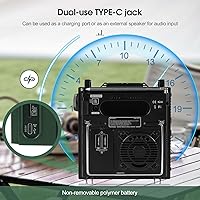
  • Battery: A built-in 3600mAh lithium polymer battery powers the unit, rechargeable via USB-C at DC5V input without requiring proprietary cables or adapters.
  • Bluetooth: Bluetooth 5.1 supports wireless audio streaming to speakers or headphones, with a rated connectivity range of up to 20 meters in open conditions.
  • App Control: A companion app provides remote control of band selection, frequency tuning, volume, mode switching, and recording from up to 20 meters away.
  • Antenna Ports: Three dedicated antenna ports are included, along with a bundled external antenna, allowing users to connect aftermarket antennas for improved signal in challenging environments.
  • TF Card Slot: A TF (microSD) card slot supports cards up to 256GB capacity for local audio file playback independent of radio reception.
  • Audio Formats: The TR113 plays back MP3, WMA, WAV, APE, and FLAC audio files from a TF card, covering both compressed and lossless formats.
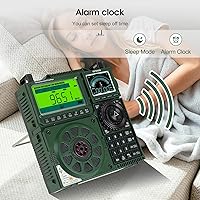
  • Display: A dual-display layout simultaneously shows the active band, battery status, frequency, and secondary information such as sleep timer and clock.
  • Safety Features: A built-in SOS alert function and integrated flashlight are included, adding basic emergency utility for outdoor and off-grid use scenarios.
  • AM Band: AM (medium wave) reception covers 520–1710KHz with a selectable step value of either 10KHz (North American standard) or 9KHz (international standard).
  • CB & WB Bands: CB band spans 25–28MHz and weather band (WB) covers 162.4–162.55MHz, the standard NOAA weather radio frequencies used across North America.
  • AIR Band: Aviation band reception covers 118–138MHz, used for listening to civilian air traffic control communications where legally permitted.
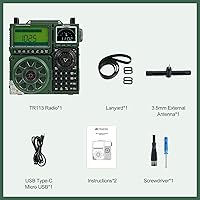
  • In the Box: Package includes the radio unit, lanyard, USB-C charging cable, cleaning brush, T-shape antenna, storage bag, product manual, and app operation manual.
  • Bluetooth Version: Bluetooth 5.1 is implemented, providing lower latency and more stable connections compared to older Bluetooth standards common in competing portables.

Related Reviews

Retekess TR113 Full-Band Shortwave Radio
74%
93%
Band Coverage
81%
SSB Reception
78%
Reception Sensitivity
52%
Ease of Use
74%
Build Quality
More
Retekess V115 Shortwave Radio
74%
88%
Value for Money
91%
Portability
79%
Battery Life
83%
AM & FM Reception
62%
Shortwave Reception
More
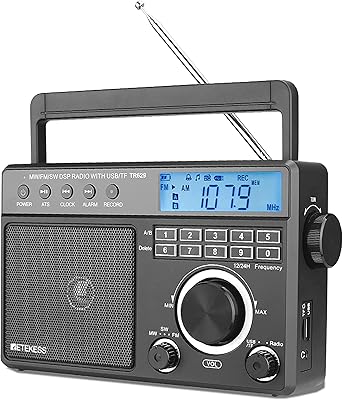
Retekess TR629 Portable Shortwave Radio
83%
88%
Reception & Signal Quality
83%
Ease of Use
91%
Portability & Design
85%
Recording Function
80%
Battery Life
More
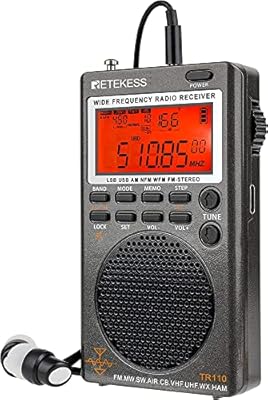
Retekess TR110 Portable Shortwave Radio
83%
88%
Reception Quality
91%
Portability
85%
Battery Life
83%
Ease of Use
89%
Weather Alert Functionality
More
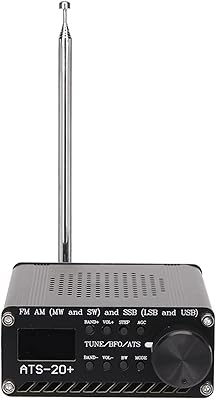
Oreb ATS-20 Si4732 Full Band Radio Receiver
85%
88%
Build Quality
85%
Sound Clarity
91%
Portability
82%
Ease of Use
80%
Reception
More
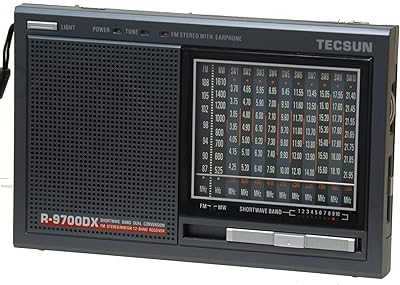
Tecsun R9700DX 12-Band Shortwave Radio
79%
83%
Reception Quality
86%
Tuner Selectivity
88%
Ease of Use
84%
Value for Money
79%
Build Quality
More
Retekess TR604 AM/FM Radio
85%
88%
Ease of Use
82%
Sound Quality
91%
Portability
84%
Battery Life
75%
Tuning Accuracy
More
DreamSky AM/FM Shortwave Portable Radio
78%
93%
Ease of Use
86%
AM/FM Reception
61%
Shortwave Reception
74%
Speaker Quality
67%
Build Quality
More
Raddy RF320 Portable Multiband Shortwave Radio
79%
88%
Band Coverage
67%
Shortwave Reception
86%
FM & VHF Reception
83%
Aviation Band (AIR)
71%
App & Bluetooth Integration
More
Raddy RE40 Portable Shortwave Radio
83%
88%
Battery Life
91%
Portability
85%
Charging Options
94%
Weather Alerts
62%
Bluetooth Performance
More

FAQ

Honestly, it depends on how patient you are. The Retekess TR113 Full-Band Shortwave Radio covers nine band types with multiple scanning modes, SSB reception, and app control — all of which take time to learn. If you enjoy tinkering and reading through a manual, you will get there. If you want something you can pick up and use in five minutes, this particular unit will likely frustrate you early on.
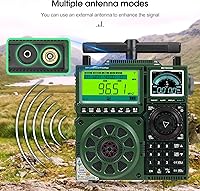
Yes, and it makes a real difference in fringe areas. The TR113 has three separate antenna ports, and a T-shape external antenna is included in the box. You can also connect aftermarket antennas suited to specific bands. Users who have added a longer wire antenna for shortwave reception report noticeably improved signal quality compared to relying on the built-in telescopic antenna alone.

The app supports both platforms, but user feedback suggests Android compatibility is somewhat more reliable across a wider range of devices. A small number of iOS and Android users have reported occasional pairing or stability issues, so it is worth checking current app reviews in your device’s store before assuming it will work flawlessly out of the box.

In most countries, passively listening to aviation (AIR band) and CB frequencies is legal for individuals, but the rules vary by jurisdiction and transmitting is a separate matter entirely. In the United States, for example, receiving AIR band transmissions is generally permitted but rebroadcasting them is not. It is worth checking the specific regulations in your country or region before actively monitoring those bands.

The 3600mAh battery is rated for extended use, and most buyers report getting through at least a full day of moderate listening on a single charge — often more. Battery drain increases noticeably when Bluetooth is active or the display backlight is running continuously. For outdoor or emergency use, carrying a USB-C power bank is a sensible backup plan.

SSB, or single-sideband, is a way of transmitting voice that strips out part of the signal to save bandwidth and power. It is commonly used by amateur radio operators, maritime stations, and certain utility services. Without SSB capability, these transmissions sound like garbled, unintelligible noise on a standard AM receiver. This full-band portable radio’s SSB mode lets you actually decode and hear those communications clearly.

Yes, weather band is one of its stronger practical use-cases. The TR113 covers the standard NOAA weather frequencies (162.4–162.55MHz) used across North America, and the SOS alert and rechargeable battery add to its appeal as an emergency kit item. That said, it is not a dedicated weather alert radio — it will not automatically wake up and alarm when an emergency broadcast triggers the way a purpose-built NOAA weather radio would.

There is no USB audio input, but you have two other options. You can load music files onto a TF (microSD) card — up to 256GB — and play MP3, FLAC, WAV, APE, or WMA files directly from the radio. Alternatively, Bluetooth 5.1 lets you stream audio wirelessly from your phone or tablet to the radio’s speaker. Both work independently of radio reception.

This is one of the more practical design touches. The FM band can be configured across three regional presets: the standard 87.5–108MHz range used in North America and most of Europe, a 76–108MHz range common in Japan and parts of Asia, and a wider 64–108MHz range that covers older Eastern European broadcast standards. Switching between them is done through the settings menu.

It is built reasonably well for a feature-rich portable in this category, with a reassuring weight and solid button feel reported by most users. That said, it is not rated as waterproof or ruggedized, so it should be kept dry and protected during outdoor use. The included storage bag helps with transport. A handful of reviews have noted some unit-to-unit variation in build consistency, so inspect yours carefully upon arrival.