Overview

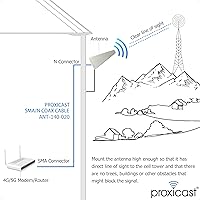
The Proxicast ANT-128-004 LPDA Directional Outdoor Antenna is built for one specific problem: you're in a fringe coverage area, your signal is unreliable, and a standard indoor antenna simply isn't cutting it. LPDA stands for Log-Periodic Dipole Array — a design that lets a single antenna capture a wide range of frequencies rather than being locked to one narrow band. This outdoor LPDA antenna covers 600 to 6000 MHz, spanning virtually every major 4G and 5G frequency used by US and Canadian carriers, plus outdoor WiFi and public safety radio systems. One thing to understand upfront: clear line of sight to your tower or remote antenna matters enormously. Without it, even the best directional antenna will underperform.
Features & Benefits

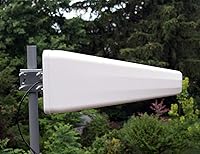
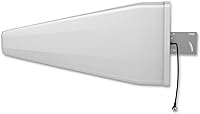
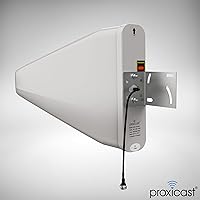
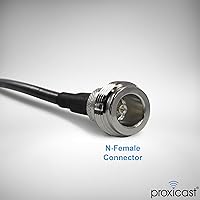
At its core, this directional antenna delivers 9 to 11 dBi of gain depending on frequency — a real, measurable improvement over what you'd get from a weaker or omnidirectional alternative. The focused beam pattern, 60° vertical by 90° horizontal, concentrates signal energy toward your target rather than spreading it in every direction, which is exactly what you want when pointing at a distant tower. The N-Female connector on the 12-inch LMR-195 pigtail is a solid, weatherproof interface that serious outdoor RF installs call for. The ABS housing handles everything from deep winter cold to summer heat without complaint, and pole or wall mounting hardware for up to 2-inch diameter masts is included right out of the box.

Best For

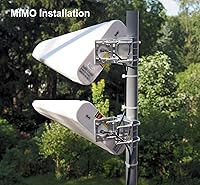
This outdoor LPDA antenna is a strong fit for rural homeowners and RV travelers on Verizon, AT&T, or T-Mobile who regularly deal with dropped calls or crawling data speeds. It also works well for installers deploying CBRS private LTE or FirstNet public safety networks, where broad frequency coverage is non-negotiable. For point-to-point outdoor WiFi links, its directional focus beats omnidirectional options handily. If you're planning a MIMO configuration — where two antennas work together for higher throughput — mounting a pair at 90 degrees to each other is the supported approach. Just remember: this antenna must be paired with a compatible modem, router, or signal booster. It does not amplify signal on its own.

User Feedback

With roughly 130 ratings averaging 3.9 out of 5 stars, the Proxicast wideband antenna earns solid but not unanimous praise. Buyers in rural areas with a clear tower sightline frequently report noticeable signal gains, and the physical build quality draws consistent compliments. The recurring frustration is around cable compatibility — the 12-inch pigtail is rarely long enough for real-world installs, meaning additional coax is often needed and not everyone anticipates that cost. A few reviewers found the MIMO setup guidance thin, and the mounting bracket draws occasional criticism for feeling less than heavy-duty. Satisfaction here closely tracks with proper antenna aiming and going in with realistic expectations about what this hardware can do.

Pros

  • Covers an exceptionally wide frequency range, handling 4G, 5G, CBRS, and outdoor WiFi with a single antenna.
  • Delivers real, measurable signal improvement for rural users with a clear line of sight to their carrier tower.
  • Weatherproof construction holds up through harsh winters and summer heat without performance degradation.
  • The N-Female connector is a professional-grade, low-loss interface that serious outdoor RF installs require.
  • Mounting hardware for pole or wall installation is included, reducing the number of separate parts to source.
  • Compatible with virtually all major US and Canadian carriers, including Verizon, AT&T, T-Mobile, and more.
  • Lightweight enough for solo installation on a standard mast without needing reinforced mounting hardware.
  • Works well as a donor antenna paired with popular cellular signal boosters from major brands.
  • Supports MIMO operation when two units are deployed, offering a path to improved throughput for advanced users.
  • Mid-range pricing makes serious outdoor RF performance accessible without enterprise-level expenditure.

Cons

  • The included 12-inch pigtail is far too short for most real-world installs, requiring additional coax purchases.
  • No meaningful aiming or alignment guide is included, leaving first-time installers to figure it out independently.
  • Results drop sharply without clear line of sight — terrain, trees, or buildings can render the antenna nearly ineffective.
  • The mounting bracket feels underbuilt relative to the antenna body, with reports of flex in high-wind conditions.
  • MIMO setup instructions are thin, making dual-antenna configurations frustrating for non-technical buyers.
  • Cable adapter compatibility is a recurring source of confusion, adding unexpected complexity to the install process.
  • Gain performance at the upper frequency ranges does not always match the rated figures in real-world testing.
  • Not a standalone solution — buyers must already own or separately purchase a compatible modem, router, or booster.

Ratings

Our scores for the Proxicast ANT-128-004 LPDA Directional Outdoor Antenna were built by an AI system that analyzed verified buyer feedback from multiple global sources, actively filtering out incentivized reviews, bot submissions, and outlier noise. The result is an honest, data-driven snapshot of what real installers, rural households, and network professionals actually experienced. Both where this antenna earns its price and where it falls short are reflected without sugarcoating.
Signal Improvement
83%
Buyers in rural and fringe-coverage areas consistently reported meaningful gains after installation — dropped calls became less frequent and mobile data speeds improved noticeably on networks like Verizon and AT&T. When aimed correctly at a tower with a clear sightline, the focused beam design does exactly what it promises.
Results vary significantly based on terrain and tower proximity. Users situated behind hills, dense trees, or buildings often saw minimal improvement, and a handful reported almost no change — reinforcing that this antenna rewards ideal placement, not just purchase.
Frequency Versatility
91%
The 600 to 6000 MHz coverage is genuinely broad — one antenna handles everything from low-band 4G to mid-band 5G, CBRS, FirstNet, and outdoor WiFi without needing a separate unit for each use case. Installers appreciated not having to stock multiple specialized antennas for different deployments.
At the very high end of the frequency range, gain performance dips compared to narrowband antennas tuned specifically for those bands. For highly specialized applications like dedicated 5.8 GHz WiFi bridging, a purpose-built antenna might edge it out.
Build Quality
78%
22%
The ABS housing feels solid and has held up well for most buyers through rain, snow, and temperature swings. The brass and aluminum internal components add confidence that this is not a flimsy consumer-grade unit, and the ivory finish resists fading better than expected outdoors.
The included mounting bracket draws recurring criticism for feeling undersized relative to the antenna body. A few users reported minor flex in the bracket under strong wind conditions, and some felt the U-bolt hardware could be heavier gauge for permanent rooftop installs.
Ease of Installation
69%
31%
The physical mounting process is straightforward for anyone with basic outdoor installation experience — the included U-bolts and bracket fit standard 2-inch masts, and the antenna body is light enough to handle solo. Most users had it physically mounted within 30 minutes.
Proper aiming is where things get complicated. Many buyers underestimated how much antenna orientation affects performance, and the included documentation offers limited guidance on aiming toward a tower. First-time installers frequently had to rely on third-party apps and trial-and-error.
Cable & Connector Setup
61%
39%
The N-Female connector is the right choice for a serious outdoor install — it is weatherproof, low-loss, and widely compatible with quality coax cables. Experienced RF installers appreciated the professional-grade termination rather than a cheaper SMA or F-type connector.
The 12-inch LMR-195 pigtail is far too short for most real installations, requiring buyers to source additional coax, connectors, and potentially adapters separately. This caught a number of buyers off guard, adding unexpected cost and complexity to what seemed like a complete package.
Weather Resistance
86%
Long-term outdoor exposure has not been a common complaint. Users in northern climates reported the antenna surviving harsh winters without cracking or deforming, and the connector area showed no obvious moisture ingress after extended outdoor use.
A small number of buyers noted that the mounting bracket showed surface corrosion faster than the antenna body itself, suggesting the bracket material or coating is a step below the main housing quality. Not a structural concern, but worth noting for coastal or high-humidity environments.
MIMO Compatibility
74%
26%
The ability to pair two of these antennas at 90 degrees to each other for MIMO operation is a genuine advantage for users looking to maximize throughput on LTE or 5G modems. Those who completed a dual-antenna setup generally reported stronger and more stable connections than a single-antenna configuration.
Setting up a proper MIMO pair requires careful physical separation and precise angular alignment, and the documentation does not walk buyers through this clearly. Several users reported inconsistent results when the angular offset was approximate rather than precise.
Value for Money
77%
23%
For users who get the installation right, the performance-to-price ratio holds up well against more expensive branded alternatives. The wideband coverage alone means this one antenna can replace what might otherwise require two or three narrower units.
For buyers who purchase without understanding the line-of-sight requirement or the need for additional cable, the effective cost quickly rises and perceived value drops sharply. It is not an antenna that delivers value passively — you have to invest time in proper setup to justify the price.
Gain Consistency Across Bands
72%
28%
In the core cellular bands — particularly 700 MHz through 2700 MHz where most 4G traffic lives — the gain figures are dependable and consistent with what the specs suggest. Users testing with signal meter apps saw the antenna perform close to its rated numbers in those ranges.
Toward the upper reaches of the band, particularly above 3500 MHz, some technically inclined users measured gain figures that fell short of the upper 11 dBi rating. The antenna is honestly better characterized as a strong mid-band performer than a flat wideband overachiever.
Compatibility with Signal Boosters
82%
18%
As a donor antenna feeding a cellular signal booster, this outdoor LPDA antenna is well-suited. Its 50-ohm impedance and N-Female connector match the input requirements of most popular boosters from WeBoost, Cel-Fi, and similar brands, making integration largely plug-and-play with the right coax.
The pigtail length issue becomes particularly frustrating in booster setups where the antenna needs to be mounted at roof height and the booster sits indoors. Buyers sometimes discover mid-install that they need a 20- to 50-foot coax run they had not budgeted for.
Aiming & Directionality
67%
33%
Once properly aimed, the narrow beam is a genuine asset — it rejects interference from off-axis sources and locks onto the target tower with focus that omnidirectional antennas simply cannot match. Users who took the time to use a compass and a cell tower mapping app reported the best outcomes.
The directional nature is a double-edged concept for less experienced buyers. If the nearest tower is not where they assume it is, or if multiple towers serve the area, aiming becomes genuinely confusing. Slight misalignment can noticeably reduce the received signal level.
Documentation & Support
53%
47%
Proxicast does provide some online resources, and a portion of buyers found the product page specifications detailed enough to plan their installation. The specs themselves are honest and accurately reflect real-world behavior for informed buyers.
The included printed documentation is minimal, and there is no step-by-step guide for aiming, MIMO setup, or booster integration. Multiple buyers flagged that better setup guidance would have prevented their initial frustration and likely improved their overall rating of the product.
Physical Footprint & Weight
88%
At around 510 grams without the bracket, this directional antenna is light enough to mount on a standard mast without requiring reinforced hardware. The 17-inch length is manageable and does not create excessive wind load on typical pole installations.
For RV or portable use, the size is slightly awkward — it is not a compact unit you can casually reposition. Users who wanted flexibility for travel found that the bracket system, while functional, is not optimized for repeated removal and remounting.

Suitable for:

The Proxicast ANT-128-004 LPDA Directional Outdoor Antenna is purpose-built for people who live or work where cellular coverage is genuinely marginal — think rural homeowners on the edge of a carrier's coverage map, remote cabins, or working farms where a single bar of LTE is a good day. It is equally well-suited to network installers and IT professionals deploying CBRS private LTE networks, FirstNet public safety systems, or point-to-point outdoor WiFi links where a focused directional signal beats a scattered omnidirectional one. RV travelers who frequently park in fringe-coverage campgrounds and need a reliable outdoor donor antenna to feed a cellular booster will also find this a capable and durable option. The key requirement across all these scenarios is the same: there must be a reasonably clear sightline to the tower or remote antenna you are targeting. If that condition is met, this outdoor LPDA antenna consistently delivers the kind of signal improvement that makes a practical difference in daily connectivity.
Not suitable for:

The Proxicast ANT-128-004 LPDA Directional Outdoor Antenna is not a good fit for buyers expecting a plug-and-play fix with no additional planning, hardware, or technical know-how involved. If your signal problem is caused by building materials, interior walls, or a location completely surrounded by terrain obstructions, a directional outdoor antenna will not solve it — signal boosters with interior antennas are a more appropriate solution in those cases. This outdoor LPDA antenna also does not amplify signal on its own; it must be connected to a compatible modem, router, or cellular booster, and buyers who overlook that will be disappointed. The short pigtail means additional coax cable and potentially adapters are almost always necessary, adding cost that some buyers do not anticipate. It is also not ideal for users who need a portable, easy-to-reposition solution — the bracket system is designed for semi-permanent fixed installs, not frequent relocation.
Specifications

  • Frequency Range: Covers 600 to 6000 MHz, spanning virtually all major 4G LTE and 5G cellular bands used by US and Canadian carriers, plus CBRS, FirstNet, and outdoor WiFi frequencies.
  • Antenna Gain: Provides 9 dBi at the lower end of the band and up to 11 dBi toward the mid-band range, delivering meaningful signal concentration compared to omnidirectional alternatives.
  • Antenna Type: Log-Periodic Dipole Array (LPDA) design enables consistent performance across a wide frequency span without needing to switch between antennas.
  • Beam Width: Radiates a focused beam of 60° vertically and 90° horizontally, concentrating signal pickup toward a specific direction rather than spreading it in all directions.
  • Polarization: Vertically polarized, which aligns with the standard orientation used by cellular base stations and most outdoor WiFi access points.
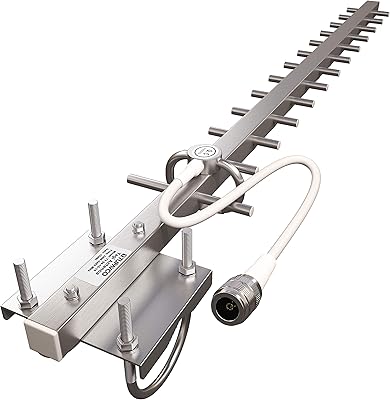
  • Connector: Terminated with an N-Female connector on a 12-inch LMR-195 pigtail, providing a low-loss, weatherproof connection point suitable for professional outdoor RF installations.
  • Impedance: Rated at 50 Ohms, matching the standard impedance of most cellular modems, signal boosters, and RF coaxial cables used in outdoor installations.
  • VSWR: Voltage Standing Wave Ratio is less than 1.8:1 across the operating band, indicating efficient power transfer with minimal signal reflection losses.
  • Max Input Power: Handles up to 50 Watts of input power, making it compatible with a wide range of transmit applications including two-way radio and CBRS base stations.
  • Housing Material: Constructed from ABS plastic for the outer shell, with brass and aluminum components internally, balancing weather resistance with structural durability.
  • Operating Temperature: Rated for continuous outdoor use between -40°C and +70°C, covering harsh winter climates as well as high-heat rooftop deployments in summer.
  • Dimensions: Measures 440 x 209 x 70 mm (17.3 x 8.2 x 2.8 inches) excluding the mounting bracket, making it a mid-sized unit manageable for a single-person installation.
  • Weight: Weighs approximately 510 grams (18 oz) without the mounting bracket, light enough for standard pole or wall mounts without requiring reinforced hardware.
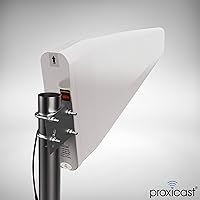
  • Mounting Style: Supports pole or wall mounting using the included U-bolts and bracket, compatible with mast diameters up to 2 inches.
  • Color: Finished in ivory, which blends reasonably well with exterior walls and light-colored rooflines for a less obtrusive outdoor appearance.
  • Compatible Networks: Designed to work with 4G LTE, 5G (sub-6 GHz), CBRS, FirstNet, 4.9 GHz public safety radio systems, and long-range outdoor WiFi deployments.
  • MIMO Support: Supports MIMO operation when two units are installed at 90 degrees to each other, allowing compatible modems and routers to use multiple signal paths simultaneously.
  • Pigtail Length: The factory-attached coaxial pigtail is 12 inches long, which is sufficient for direct connection to nearby equipment but typically requires an additional coax run for most installs.

Related Reviews
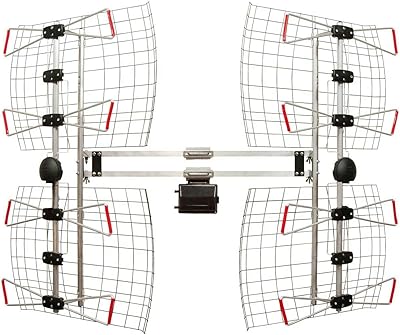
Antennas Direct DB8e Outdoor TV Antenna
73%
83%
Signal Reception
88%
Build Quality
86%
Weather Durability
58%
Ease of Installation
71%
Value for Money
More
1byone 360° Omni-Directional Outdoor TV Antenna
73%
74%
Signal Reception
91%
Ease of Installation
72%
Build Quality
68%
Amplifier Performance
63%
4G LTE Filtering
More
Antop AT-414BG Omni-Directional Outdoor TV Antenna
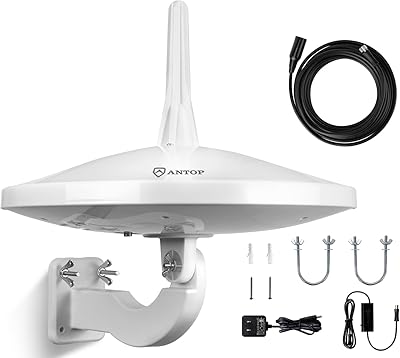
85%
90%
Reception Quality
88%
Ease of Installation
86%
Durability in Outdoor Conditions
92%
Value for Money
87%
Signal Range
More
Tupavco TP512 15dBi 2.4GHz Outdoor Directional WiFi Antenna
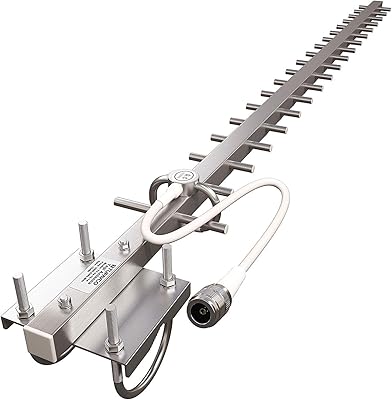
84%
89%
Signal Range & Performance
94%
Durability & Build Quality
75%
Ease of Setup
87%
Value for Money
80%
Compatibility & Flexibility
More
ANTOP AT-415B UFO Dual Omni-Directional Outdoor HDTV Antenna
84%
90%
Signal Reception
88%
Ease of Setup
85%
4K UHD Performance
82%
Build Quality
84%
Range (65 Miles)
More
Tupavco TP513 17dBi Yagi WiFi Antenna
73%
83%
Signal Gain Performance
88%
Build Quality
86%
Weatherproofing
54%
Ease of Alignment
61%
Connector Compatibility
More
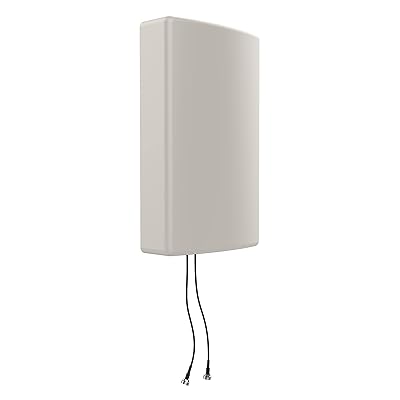
Proxicast ANT-129-001 4G/LTE/5G Cross-Polarized MIMO Panel Antenna
82%
88%
Performance in Weak Signal Areas
65%
Ease of Installation
90%
Signal Strength Improvement
92%
Weather Resistance
85%
Compatibility with Routers/Modems
More
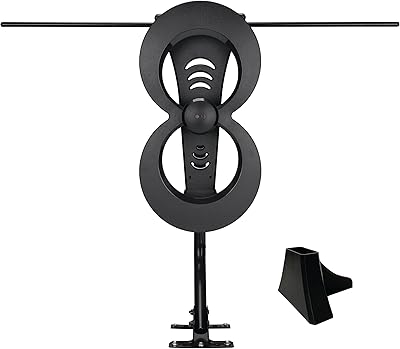
Antennas Direct ClearStream 4MAX TV Antenna
86%
88%
Performance in Rural Areas
93%
Ease of Installation
85%
Signal Strength
91%
Build Quality
89%
Indoor/Outdoor Versatility
More
Antennas Direct ClearStream 2MAX TV Antenna
76%
83%
Signal Reception Quality
67%
Range Accuracy
88%
Ease of Installation
84%
Build Quality
79%
Multi-Directional Performance
More
Antennas Direct ClearStream 2V TV Antenna
83%
88%
Signal Reception
91%
VHF Channel Coverage
84%
Build Quality
82%
Ease of Installation
79%
Value for Money
More

FAQ

Yes, as long as your router or modem has an external antenna port with an N-Female or compatible connector. This outdoor LPDA antenna covers all the frequency bands those carriers use for 4G and 5G, so it is a solid match. Just keep in mind you will likely need an additional coax cable run between the antenna and your indoor device, since the included pigtail is only 12 inches long.

The antenna itself does not amplify anything — it only focuses and directs the signal it receives. To actively boost signal strength indoors, you would need to pair it with a cellular signal booster. That said, many users find that connecting this directional antenna directly to a cellular modem with external antenna ports is enough to see significant improvement without a booster in the middle.

You want to aim it toward your nearest cell tower with as clear a line of sight as possible. A free app like OpenSignal or CellMapper can show you where towers are located relative to your address. Once you have a rough direction, connect the antenna to your modem and slowly rotate it while watching your signal strength indicator — the sweet spot usually becomes obvious within a few degrees.

The antenna terminates in an N-Female connector, so you will want LMR-400 or LMR-240 coaxial cable with N-Male connectors for longer runs, as these cable types minimize signal loss over distance. LMR-195 (the same type as the included pigtail) works for short extensions but loses more signal per foot, so for runs beyond 10 feet, the heavier LMR-400 is the better choice. Make sure to check whether your modem or booster uses a different connector type, as you may need an adapter.

It works for outdoor WiFi too. The frequency range extends up to 6000 MHz, which covers the 2.4 GHz and 5 GHz WiFi bands commonly used in point-to-point outdoor bridge setups. Just make sure your WiFi access point or bridge device has an N-Female antenna port to match.

It covers the sub-6 GHz bands that T-Mobile uses for both 4G LTE and 5G, including the important 600 MHz and 2.5 GHz bands. If your T-Mobile gateway has external antenna ports (like the Nokia or Arcadyan models), this directional antenna can be a strong upgrade for rural locations. Check your specific gateway model for antenna port availability before purchasing.

The physical mounting is pretty straightforward — the included U-bolts and bracket attach to any standard pole or wall surface, and the antenna itself is light enough to handle solo. A basic set of wrenches and a drill (for wall mounting) is all you need. The trickier part is aiming it accurately, which takes a bit of patience rather than any specialized tools.

Yes, MIMO is supported by mounting two units at exactly 90 degrees to each other — one vertically polarized and one horizontally polarized — and connecting each to a separate antenna port on a MIMO-capable modem or router. When done correctly, this allows your device to receive on two independent signal paths simultaneously, which can improve both throughput and connection stability. The setup requires a bit of precision in the mounting angle to work properly.

The housing is rated for temperatures from -40°C to +70°C and is built to live outdoors permanently. Most long-term users report no issues with cracking, fading, or moisture ingress on the antenna body itself. The one weak point noted by some buyers is the mounting bracket, which can show surface corrosion faster than the main unit, particularly in coastal or high-humidity climates.

Possibly, but with caveats. At 8 miles, you are at the edge of what most directional antennas can reliably work with, and partial obstructions like trees add meaningful signal loss. This outdoor LPDA antenna gives you the best realistic chance in that scenario compared to an omnidirectional antenna, but there is no guarantee of a usable signal if the path is heavily blocked. If you can mount it at rooftop height and get even a partial line of sight above the treeline, your odds improve significantly.

Where to Buy