Overview

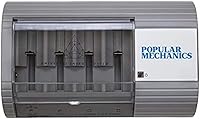
The Popular Mechanics 5-in-1 Universal Battery Charger occupies a genuinely rare niche: it handles both disposable alkaline cells and rechargeable NiMH batteries under one roof. For anyone who has ever kept three separate chargers in a drawer — or just tossed half-dead alkalines because there seemed to be no other option — that alone makes this worth a serious look. The brand name will resonate with practically minded buyers, and at its mid-range price the expectations are fair: solid everyday utility, not cutting-edge speed. Think of this battery charger as a capable generalist — broad in scope, deliberate in pace.
Features & Benefits

What sets this multi-chemistry charger apart from standard NiMH units is its ability to recharge alkaline batteries — a feature that sounds almost too good to be true, because in some ways it is. Alkaline cells can absorb a limited number of recharges before they become unreliable, so treat this as a useful extension of battery life, not an infinite loop. It covers five formats — AAA, AA, C, D, and 9V — plus chemistries including Titanium, RAM, and NiCd. One important note: 9V batteries must charge on their own; you cannot mix them with other sizes in the same session. The automatic shut-off and built-in battery tester round out a thoughtfully practical feature set.

Best For

This all-in-one charger makes the most sense in homes where batteries of all shapes and sizes are constantly in rotation — think kids' toys, TV remotes, flashlights, and smoke detectors all competing for fresh power. It will also appeal to anyone trying to cut down on battery waste: being able to squeeze a few more charge cycles out of an alkaline AA before tossing it is genuinely satisfying. Emergency preparedness folks will appreciate having a single versatile unit that handles nearly everything. That said, if you need batteries charged quickly, this is not your tool. Speed-conscious users should look elsewhere; this one rewards patience and practicality over raw performance.

User Feedback

Across roughly 545 ratings, this battery charger sits at 4.2 stars — a score that reflects genuine appreciation alongside some real-world caveats. Buyers consistently praise the battery tester as a practical bonus that saves them from guessing, and most confirm the alkaline charging works as described. The friction tends to come from two places: charging times are slow, which catches some users off guard, and a handful found the indicator display difficult to read in certain lighting. A recurring point of confusion involves the 9V restriction — more than a few buyers discovered mid-session that 9V cells need their own dedicated run. Worth knowing before you commit.

Pros

  • One of the very few chargers on the market that works with both disposable alkaline and rechargeable NiMH batteries.
  • Covers five battery sizes — AAA, AA, C, D, and 9V — reducing the need for multiple separate chargers.
  • The built-in battery tester helps you quickly identify dead cells versus ones worth recharging.
  • Automatic shut-off makes it safe to leave charging unattended without worrying about overheating.
  • Supports an unusually broad range of chemistries including Titanium, RAM, NiCd, and NiMH.
  • Compact enough to store in a kitchen drawer or emergency kit without taking up much space.
  • Extending the life of alkaline batteries reduces waste and cuts down on how often you need to buy replacements.
  • The included lithium polymer battery means it is ready to use right out of the box.
  • A practical, no-fuss tool that covers the battery needs of most average households in one unit.

Cons

  • Charging times are noticeably slow — not ideal when you need batteries ready within a few hours.
  • Alkaline cells can only be recharged a limited number of times before becoming unreliable or unsafe to reuse.
  • 9V batteries must be charged in isolation, which is inconvenient when you need to charge mixed sizes at once.
  • The charge indicator display can be difficult to read clearly in low-light or bright-light conditions.
  • No individual cell monitoring means you cannot tell at a glance if one slot is underperforming.
  • This multi-chemistry charger does not communicate how many recharge cycles an alkaline cell has already gone through.
  • Heavier than most compact chargers at just under two pounds, which may matter for travel use.
  • Some buyers report confusion in the setup process around the 9V charging restriction — instructions could be clearer.
  • Not well-suited for high-drain devices that burn through batteries quickly and need fast turnaround.

Ratings

The Popular Mechanics 5-in-1 Universal Battery Charger scores below are generated by AI after rigorously analyzing verified global buyer reviews, actively filtering out incentivized, spam, and bot-driven feedback to surface what real users actually experience. This all-in-one charger earned genuine praise in several areas — but also drew consistent criticism in others, and both sides are reflected transparently in every score below.

Battery Compatibility
91%
Buyers repeatedly call out the sheer range of supported formats as the charger's single biggest selling point — covering AAA through D and 9V in one unit is something few competitors can match. Households that deal with a rotating cast of battery sizes across smoke detectors, remote controls, kids' toys, and flashlights find this coverage genuinely liberating.
The 9V compatibility comes with a notable asterisk: those batteries cannot share a session with any other size, which adds friction when you need to charge a mixed batch. A small number of users only discovered this restriction after purchase, which led to frustration and lower ratings.
Alkaline Recharging
74%
26%
The ability to top up standard disposable alkaline batteries is legitimately rare, and users who understand its limits tend to be quite happy with the results. Eco-conscious buyers especially appreciate recovering usable charge from batteries they would otherwise discard, saving money and reducing waste over time.
Alkaline cells have a limited and unpredictable recharge lifespan — they are not designed for this purpose and will degrade faster than true rechargeables. Some buyers expected near-infinite recharge cycles and were disappointed when cells stopped holding charge after only a few sessions, leading to mixed reviews in this area.
Charging Speed
53%
47%
For users who plan ahead and load up the charger before bed, the slow pace is essentially a non-issue — they wake up to fully charged batteries without having thought about it. Casual users in low-drain scenarios, like charging remote control batteries once a month, rarely flag charging time as a problem.
This is the most frequently cited frustration across user reviews: charging times are genuinely slow compared to competing units in the same price range. Anyone who needs batteries back in service within a couple of hours — say, during a power outage or before a family event — will find this charger falls well short of expectations.
Built-in Battery Tester
88%
The integrated tester function earned some of the warmest praise in user reviews, particularly from people who habitually accumulate mystery batteries in junk drawers. Being able to drop a battery in and know within seconds whether it is worth charging or ready for recycling is a practical time-saver that buyers mention unprompted.
The tester gives a general indication of charge level rather than a precise voltage readout, which limits its usefulness for users who need accurate diagnostics on individual cells. A few technically inclined buyers found the feedback too coarse to be actionable for anything beyond a basic keep-or-toss decision.
Safety Features
86%
The automatic shut-off is consistently praised by buyers who leave batteries charging overnight or while away from home — knowing the unit will stop on its own when batteries are full gives real peace of mind. No reports of overheating or cell damage from extended charging sessions surfaced in verified reviews.
While the auto shut-off works as advertised, the charger offers no cell-level fault detection or indicator that a specific battery slot encountered an issue during charging. Users who placed worn or damaged alkaline cells in the unit occasionally received no warning that the battery had not charged properly.
Display & Indicators
61%
39%
The charge status display does its basic job, giving users a general sense of where batteries stand during a session without requiring any technical knowledge to interpret. For straightforward home use in normal lighting, most buyers find it adequate.
In bright ambient light or at certain viewing angles, the indicator becomes noticeably difficult to read — a complaint that surfaces regularly in user reviews. There is no backlight, no per-slot granularity, and no numerical display, which leaves users with less feedback than they might expect from a unit at this price point.
Build Quality
72%
28%
The physical construction feels solid enough for home use, and the footprint is stable on a flat surface without sliding around. Most buyers who use it regularly report no structural issues over months of normal operation.
The plastic housing has a somewhat utilitarian feel that some buyers describe as cheap relative to the asking price — it does not inspire the confidence of a premium product. A small number of users reported that battery slots felt loose over time, though this did not appear to affect charging performance in most cases.
Ease of Use
83%
Loading batteries is intuitive and requires no configuration — you insert the cells, plug in the unit, and it handles the rest. The tester function is equally straightforward, making this accessible even for buyers who are not comfortable with electronics.
The 9V solo-charging rule is not prominently communicated on the packaging or in the quick-start guide, and a recurring theme in negative reviews is buyers discovering this limitation through trial and error. Better labeling near the 9V slot would prevent a meaningful share of the setup confusion users report.
Chemistry Versatility
84%
Supporting five distinct battery chemistries — Alkaline, NiMH, NiCd, RAM, and Titanium — gives this multi-chemistry charger a breadth of compatibility that most household chargers cannot touch. Buyers who use a mix of battery types across different devices consistently highlight this as a core reason they chose it over more specialized options.
Lithium primary batteries are not supported, which catches some buyers off guard since lithium AAs are increasingly common in high-drain devices like digital cameras. The absence of any indication on the unit itself about which chemistries are safe to use adds a small but real risk for uninformed users.
Value for Money
76%
24%
For buyers who fully leverage the multi-format compatibility and especially the alkaline recharging function, the value proposition is genuinely strong — the ability to recover charge from disposable batteries pays back the purchase price in saved replacements over time. The included battery tester adds further utility without requiring a separate purchase.
Buyers who primarily need fast, reliable NiMH charging will find better-performing dedicated chargers at a similar or lower price point. The value calculation tilts heavily on whether you actually need the alkaline recharging capability — without it, the charger is harder to justify against the competition.
Size & Portability
69%
31%
At under nine inches wide and just over two inches tall, the charger fits comfortably in a kitchen drawer, on a utility shelf, or in a storage bin without dominating the space. Emergency kit builders in particular appreciate having a single compact unit that replaces what might otherwise be several separate chargers.
At just under two pounds, it is heavier than most compact chargers and is not well-suited for travel or carrying in a bag. The form factor is clearly optimized for stationary home use, and buyers who needed something lightweight for camping or travel expressed regret about the purchase.
Environmental Impact
82%
18%
The ability to extend the life of both alkaline and rechargeable batteries directly reduces how often those cells end up in landfills, a benefit that eco-conscious buyers mention frequently in their reviews. Several users noted that this charger meaningfully changed how they manage battery disposal in their households.
The alkaline recharging benefit is somewhat undermined by the unpredictable cycle life of alkaline cells — a battery recharged multiple times may leak or fail unpredictably, creating a different kind of disposal concern. The charger itself also requires a lithium polymer internal battery, which has its own environmental footprint at end of life.
Setup & Documentation
64%
36%
Out of the box, setup requires virtually no effort — the included lithium polymer battery means it does not even need to be plugged into a wall for basic operation, and most users are up and running within minutes. The simple slot-and-charge design keeps the learning curve minimal for everyday users.
The included documentation does a poor job of explaining the recharge limitations of alkaline batteries and the mandatory solo-charging rule for 9V cells. These two gaps in the user guide account for a disproportionate share of the negative reviews, suggesting the experience could be improved significantly with clearer printed instructions.

Suitable for:

The Popular Mechanics 5-in-1 Universal Battery Charger was built for households where batteries are a constant logistical headache — families cycling through AA cells in toys, remotes, and handheld games while also keeping 9V batteries fresh in smoke detectors and flashlights. If you regularly find yourself with a drawer full of partially used alkalines and no way to tell what is still viable, the built-in tester alone earns its keep. Eco-minded buyers who bristle at throwing away batteries that might have some life left will appreciate being able to squeeze additional cycles out of alkaline cells before finally recycling them. It is also a smart pick for emergency preparedness kits, where having one compact unit that handles nearly every common battery format is more valuable than raw charging speed. Casual, patient users who simply want a reliable all-rounder and do not mind overnight charging times will get genuine, everyday value out of this all-in-one charger.

Not suitable for:

The Popular Mechanics 5-in-1 Universal Battery Charger is not the right tool for anyone who needs batteries back in action quickly — it is a slow charger by design, and impatient users will find that frustrating in a pinch. Hobbyists or photographers who rely heavily on high-drain rechargeable batteries and need precise, fast replenishment will be better served by a dedicated NiMH charger with individual cell monitoring and faster output. The alkaline recharging capability, while genuinely useful, is not a magic trick — alkaline cells have a finite and unpredictable number of recharge cycles, so buyers expecting to revive disposable batteries indefinitely will be disappointed. Anyone who uses 9V batteries frequently should also know they cannot be charged alongside other sizes, which adds an extra step when juggling multiple battery types at once. If your battery needs are narrow and predictable — say, only rechargeable AAs — a simpler, purpose-built charger will likely do the job more efficiently and for less money.

Specifications

  • Brand: Manufactured and sold under the Popular Mechanics brand, known for practical, tool-oriented consumer products.
  • Compatible Sizes: Charges AAA, AA, C, D, and 9V battery formats, covering the most commonly used household battery sizes.
  • Chemistries Supported: Works with Alkaline, NiMH, NiCd, RAM, and Titanium battery chemistries, making it one of the broadest-compatibility chargers in its class.
  • Dimensions: The unit measures 8.86″ wide by 5.51″ deep by 2.17″ tall, fitting comfortably on a shelf or in a kitchen drawer.
  • Weight: Weighs 1.92 pounds, which is moderate for a multi-format charger but still manageable for home storage and occasional transport.
  • Output Voltage: Delivers an output of 9V DC to power the charging circuits across all supported battery types.
  • Auto Shut-Off: Features a built-in automatic shut-off mechanism that stops charging once batteries reach full capacity to prevent overheating or overcharging.
  • Battery Tester: Includes an integrated battery tester function that allows users to check the remaining charge level in a battery before deciding to recharge or discard it.
  • 9V Charging Rule: 9V batteries must be charged independently and cannot be charged simultaneously with AAA, AA, C, or D batteries in the same session.
  • Power Source: Requires one lithium polymer battery to operate, which is included in the box so the unit is ready to use immediately after unboxing.
  • Color: Available in a neutral grey finish that blends into most home or workshop environments without drawing attention.
  • Simultaneous Charging: AAA, AA, C, and D batteries can all be charged at the same time within a single session, provided no 9V batteries are loaded.
  • Alkaline Recharging: Supports recharging of standard disposable alkaline batteries, though the number of effective recharge cycles per alkaline cell is limited and varies by brand and condition.
  • First Available: The product was first listed for sale in October 2020, giving it several years of real-world buyer feedback to draw from.
  • Average Rating: Holds a 4.2-out-of-5-star average rating across approximately 545 customer ratings on Amazon as of the time of review.
  • Certifications: Sold under a patented 5-in-1 design, indicating proprietary technology covering its multi-chemistry and multi-format charging approach.

Related Reviews
Tenergy TN486U 5-Bay Universal Battery Charger

80%
91%
Versatility
88%
USB Connectivity
84%
LCD Display
87%
Safety Features
58%
Charging Speed
More
Tenergy TN299 Universal Battery Charger
74%
83%
Chemistry Compatibility
88%
Slot Independence
71%
Ease of Use
81%
Display & Monitoring
62%
Battery Fit & Compatibility
More
Intelligence 8 Bay Universal Battery Charger
86%
90%
Charging Speed
88%
Usability
93%
Safety Features
85%
Display Clarity
87%
Build Quality
More
Tenergy TN456 Universal Battery Charger
82%
93%
Battery Chemistry Compatibility
91%
Independent Slot Operation
88%
LCD Display & Data Readouts
86%
Capacity TEST Mode
79%
Charging Speed & Current Control
More
AVIDGRAM AG5SW51X 5-Port HDMI 2.1 Switch
80%
91%
Signal Integrity
86%
Build Quality
72%
Auto-Switching Reliability
63%
IR Remote Performance
89%
HDR & Format Compatibility
More
MiBOXER C8 8-Bay Battery Charger
82%
88%
Charging Performance
91%
Battery Compatibility
93%
LCD Display Clarity
86%
Internal Resistance Measurement
89%
Safety Features
More
Olay Super Serum 1.7 Oz Face Serum
80%
93%
Texture & Absorption
88%
Brightening Effect
91%
Hydration Performance
81%
Tone Correction
67%
Anti-Aging & Firming
More
Cinema Secrets Ultimate Corrector 5-In-1 Palette
74%
83%
Color Correction Effectiveness
79%
Pigmentation & Payoff
81%
Blendability
54%
Shade Range Inclusivity
72%
Wear Longevity
More
Opus BT-C2400 Battery Charger Analyzer
77%
91%
Measurement Accuracy
88%
Internal Resistance Testing
93%
Channel Independence
54%
Charging Speed
83%
Refresh Mode Effectiveness
More
MSI MPG A1250GS 1250W Power Supply
85%
91%
Build Quality
93%
Power Delivery
86%
Efficiency
84%
Cable Quality
82%
Noise Level
More

FAQ

It genuinely does recharge alkaline batteries, and that is what makes the Popular Mechanics 5-in-1 Universal Battery Charger unusual compared to most chargers on the market. That said, it is important to keep expectations realistic — alkaline cells are not designed for repeated recharging, so they will not last as many cycles as a dedicated NiMH rechargeable. Think of it as a way to extend the life of a battery you would otherwise throw away, not a permanent replacement for buying rechargeables.

There is no fixed number, and that is the honest answer. The cycle life of a recharged alkaline battery depends on the brand, its original charge level when you start, and how it has been stored. Most alkaline cells tolerate somewhere between a handful and a few dozen partial recharges before capacity drops off significantly. Once a battery no longer holds a charge or starts leaking, it is time to recycle it.

No — that is one of the key limitations to know before you buy. The 9V slots operate on a separate circuit, and the charger requires that 9V batteries be charged on their own, without any AAA, AA, C, or D batteries loaded at the same time. If you regularly need to charge a mix of sizes including 9V, just plan to do two separate sessions.

Charging times on this all-in-one charger run longer than most buyers expect — typically several hours for a full charge, and potentially overnight depending on the battery type and starting charge level. If you need batteries ready within an hour or two, this is not the right charger for that use case. It is best suited to situations where you can simply load the batteries before bed and retrieve them in the morning.

Yes, the built-in automatic shut-off is specifically designed for this scenario. Once the batteries reach full capacity, the charger stops on its own, which eliminates the risk of overcharging or overheating from an unattended session. That said, as with any electrical device, it is sensible to keep it on a hard, ventilated surface and away from flammable materials.

Yes — the tester function works independently of the charging function, so you can drop any compatible battery into the slot and get a quick read on its remaining charge level. This is particularly handy for sorting through a drawer full of mixed batteries to separate the dead ones from the ones still worth keeping or recharging.

No. Lithium primary batteries — the non-rechargeable kind often used in cameras and outdoor devices — should never be placed in a charger not specifically rated for them. This multi-chemistry charger supports Alkaline, NiMH, NiCd, RAM, and Titanium chemistries, but lithium primary cells are not on that list. Attempting to charge them could be dangerous.

A few users have noted the same thing, particularly in bright light or certain viewing angles. Try positioning the charger slightly away from direct overhead lighting, and view the display straight on rather than from an angle. The display is not a bright backlit screen, so it reads better in moderate ambient light than in full daylight.

The product listing does not specify dual-voltage or international compatibility, and based on available data it appears designed for standard US outlet use. If you plan to use it outside of North America, you would need to verify the input voltage rating on the unit itself and use an appropriate adapter or converter. Using it on an incompatible voltage without a converter could damage the charger or the batteries.

It is a solid fit for that purpose. The ability to cover AAA, AA, C, D, and 9V formats in a single unit means you can maintain almost every common battery type used in flashlights, radios, and detectors without carrying multiple chargers. The included lithium polymer battery means it powers itself, and the compact footprint does not take up much room in a storage bin or shelf. Just keep in mind that charging speed is slow, so it works best as a maintenance tool rather than an emergency fast-charger.