Overview

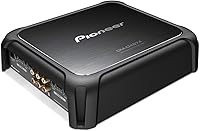
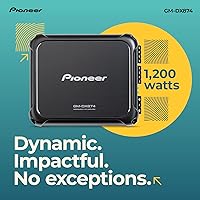
The Pioneer GM-DX874 4-Channel Car Amplifier has been a steady presence in the mid-range car audio market since its 2019 debut, and with good reason. Pioneer's reputation carries real weight here — this isn't a fly-by-night brand padding specs to compete. As a Class D amplifier, it runs cooler and draws less current than older Class A/B designs, which genuinely matters when you're fitting electronics under a seat or in a cramped cargo area. Think of it as a capable all-rounder rather than a boutique audiophile piece. One honest caveat upfront: the 1,200-watt figure is peak, not continuous RMS — and that distinction is the number that actually matters for real-world listening.

Features & Benefits

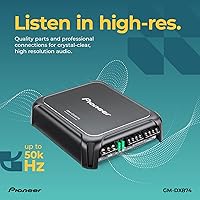
What helps the GM-DX874 stand out in its class is the combination of practical engineering and a few thoughtful extras. The variable low-pass filter, adjustable between 40 and 500 Hz, gives you meaningful control over subwoofer integration — a range that wide is genuinely useful across different driver preferences and enclosure types. The frequency response stretches to 50,000 Hz, which covers Hi-Res Audio territory, though how much benefit you actually hear depends heavily on your source unit and speakers. Gold-plated RCA inputs and an aluminum chassis suggest the build quality punches slightly above its price tier. The included remote bass boost knob is a small but practical touch for anyone who adjusts bass feel on the daily commute.

Best For

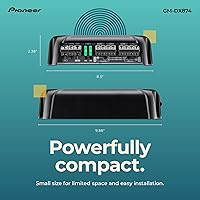
This Pioneer amp is a natural fit for anyone stepping up from a stock head unit and wanting real improvement without a complex install. Its compact footprint — roughly the size of a thick hardcover book — makes under-seat mounting a realistic option, opening up installs in smaller cars and trucks where trunk real estate is limited. Bridging two channels to a subwoofer while running the other two for front speakers is a common, effective configuration here. Hi-Res Audio listeners can put this hardware to use, but quality speakers and a capable source unit need to come first. First-time buyers will particularly appreciate the clear terminal labeling and the straightforward documentation included in the box.

User Feedback

Across nearly 950 ratings, this 4-channel amplifier holds a 4.3-star average — a figure that reflects consistent satisfaction rather than a honeymoon-period spike. Buyers most often call out sound clarity and punch as the standout improvement over factory systems, and the install experience earns frequent praise for being approachable without much prior experience. On the critical side, a portion of users report heat buildup during extended high-volume sessions, especially when the unit is tucked into a sealed or poorly ventilated space — adequate airflow addresses this in most cases. A small number of early units showed quality-control inconsistencies, but owners who installed correctly generally report dependable performance well beyond the two-year mark.

Pros

  • Pioneer brand reliability gives this amp credibility that generic alternatives at the same price simply cannot match.
  • Class D design runs cooler and draws less current, reducing strain on your vehicle electrical system.
  • The compact chassis fits under most car seats, opening up clean installs even in smaller vehicles.
  • Variable low-pass filter spanning 40 to 500 Hz gives real flexibility when dialing in subwoofer integration.
  • Gold-plated RCA inputs and solid build quality feel more premium than the price tier suggests.
  • The remote bass boost knob is a practical daily-use feature, not just a spec sheet checkbox.
  • Labeled terminals and included hardware make installation approachable for first-timers.
  • Frequency response up to 50,000 Hz covers Hi-Res Audio playback when paired with the right source and speakers.
  • Built-in protection circuitry guards against voltage spikes, overcurrent, and thermal overload during tough installs.
  • A 4.3-star average across nearly 950 reviews points to consistent real-world satisfaction over multiple years.

Cons

  • The 1,200-watt peak rating is misleading for buyers who do not understand the difference from RMS continuous output.
  • Heat buildup during extended high-volume sessions can be a problem if ventilation around the unit is inadequate.
  • Bridged output power may not satisfy owners of larger, more demanding subwoofers expecting true high-wattage performance.
  • No onboard DSP or time alignment controls limit fine-tuning options for critical listeners.
  • Occasional quality-control inconsistencies have been flagged in a portion of owner reviews over the years.
  • The included documentation, while functional, may leave more advanced installers wanting deeper technical detail.
  • At six pounds in a compact chassis, the mounting hardware requirements deserve attention to avoid vibration noise over rough roads.

Ratings

The scores below reflect our AI-driven analysis of verified global buyer reviews for the Pioneer GM-DX874 4-Channel Car Amplifier, with spam, bot activity, and incentivized submissions actively filtered out before any scoring was applied. Each category captures both what real owners celebrated and where frustrations surfaced, giving you an honest picture of what this amp actually delivers day to day.

Sound Quality
86%
Owners consistently describe a noticeable and immediate improvement over factory systems, with cleaner mids and tighter bass response that holds up on long highway drives. At this price tier, the clarity this Pioneer amp delivers — particularly on vocals and acoustic tracks — earns it genuine praise from daily listeners.
At very high volumes, some reviewers note a subtle compression in the upper frequencies that more discerning ears can detect. It is not an audiophile-grade amp, and listeners expecting reference-quality sound without pairing it with excellent speakers will be disappointed.
Value for Money
88%
For buyers upgrading from a stock setup, the GM-DX874 represents a compelling return on investment — the jump in audio quality relative to what you spend is one of the most praised aspects across hundreds of reviews. The Pioneer name adds brand reassurance that cheaper alternatives simply cannot offer.
Buyers who later discover the gap between the peak wattage marketing and the real-world RMS output often feel the spec sheet overpromises. If you factor in the cost of a proper install — wiring kit, LOC if needed, mounting hardware — the total outlay climbs noticeably above the sticker price.
Installation Ease
84%
Labeled terminals, a logical layout, and a well-written manual make this one of the more approachable amps for first-time installers. Many owners report completing the full install in an afternoon without professional help, which is a meaningful plus for a 4-channel unit.
Owners without a head unit that has RCA preamp outputs will need a line output converter, and that added step catches some buyers off guard. A small number of users also found the included hardware just barely sufficient, requiring a supplemental trip to the parts store.
Build Quality
81%
19%
The aluminum chassis feels solid and purposeful — not lightweight or hollow like some competing amps in this segment. Gold-plated RCA inputs and clean internal soldering, visible in teardown photos shared by enthusiasts online, back up the premium build impression.
A portion of long-term reviews mention minor cosmetic issues like scratched finish on arrival or slightly uneven terminal spacing that makes torquing connections feel less precise than expected. Occasional quality-control inconsistencies have surfaced across a small but notable share of units.
Thermal Management
67%
33%
The onboard protection circuit does its job reliably — owners report that when the amp does get hot, it throttles back cleanly rather than failing outright. For installs with good airflow, such as under a perforated seat bracket or in an open trunk corner, heat is a non-issue.
This is the most consistently flagged pain point in critical reviews. Owners who mount the GM-DX874 in sealed enclosures or tight custom builds without ventilation report the protection circuit triggering during extended high-volume sessions, which interrupts listening and indicates the amp is working harder than its cooling can handle.
Power Output Accuracy
62%
38%
Pioneer does comply with the CTA-2006 standard, which at least ensures the RMS figures reported on the spec sheet are measured honestly rather than inflated. For moderate speaker loads, the real-world output is more than adequate for a full four-speaker plus subwoofer setup.
The 1,200-watt peak headline is aggressive marketing, and many buyers feel misled once they dig into the actual continuous output figures. Owners running power-hungry subwoofers expecting near-peak performance are the most vocal critics, as the amp simply cannot sustain that kind of delivery.
Compact Design
91%
The footprint is genuinely one of this amp's strongest real-world selling points — at under 8.5 inches long and barely over 2 inches tall, it slides cleanly under most front seats and disappears from view. Installers in compact sedans and crossovers consistently praise how little space it demands.
The slim profile that makes it easy to hide also limits passive heat dissipation, which feeds directly into the thermal management concerns noted by some owners. There is an inherent trade-off between compactness and airflow that buyers should factor into their mounting plan.
Filter Flexibility
83%
The variable low-pass filter covering 40 to 500 Hz is wider than what many competitors offer at this price, giving installers real room to tune the crossover point to match different subwoofer enclosure types and personal preferences. The high-pass filter adds further flexibility for full-range speaker protection.
There is no onboard bass EQ curve shaping or subsonic filter, which more experienced installers sometimes want when running ported subwoofer enclosures. For a basic setup the filters are more than adequate, but the controls stop short of what a dedicated DSP or higher-end amplifier would provide.
Remote Bass Control
78%
22%
The wired remote knob is a practical convenience that daily drivers genuinely use — being able to dial back the bass for talk radio or podcasts and crank it for music without touching the amp itself is a quality-of-life improvement that earns consistent appreciation in reviews.
The remote cable, while functional, is not particularly long, which limits placement options in larger vehicles or unusual dash configurations. A handful of users also report that the knob feels slightly loose over time, though it continues to function accurately even as the mechanical feel degrades.
Hi-Res Audio Support
73%
27%
The extended frequency response up to 50,000 Hz positions this 4-channel amplifier as a legitimate option for owners using Hi-Res Audio source units and high-quality component speakers. In well-matched systems, owners notice improved definition and airiness on well-recorded tracks compared to standard amps.
The Hi-Res Audio benefit is entirely dependent on every other component in the chain — a factory head unit with a mediocre DAC will completely negate this capability. Many buyers who purchased partly for this feature admit they cannot reliably hear the difference in their actual vehicle environment.
Long-Term Reliability
79%
21%
Owners who have run the GM-DX874 for two or more years without issues form a consistent and vocal group in the review base, with most citing stable performance as long as the install was done correctly. Pioneer's track record in car audio gives buyers reasonable confidence in component longevity.
The reliability narrative has a meaningful caveat: units that were installed in poor thermal conditions or with inadequate grounding show a higher rate of early failure. Reliability is not unconditional — it depends heavily on a correct install, which not every buyer delivers.
Compatibility
82%
18%
The amp works across a wide range of vehicle types and head unit brands, and the 4-ohm and 2-ohm stable operation covers most common speaker impedance configurations without issue. This broad compatibility is part of what makes the GM-DX874 a practical choice for a variety of upgrade scenarios.
Factory head units without preamp outputs require a line output converter, adding cost and a step that some buyers do not anticipate at purchase. Owners running low-impedance speaker loads in bridged mode also need to check the minimum impedance spec carefully to avoid protection mode triggers.
Packaging & Unboxing
74%
26%
The retail box is sturdy and the amp arrives well-protected in most reported cases, with the remote bass boost controller and mounting hardware organized and easy to locate. The overall unboxing experience feels in line with what you would expect from a reputable brand.
A small number of buyers have reported cosmetic damage that appears to have occurred before packaging, suggesting some pre-shipment handling inconsistency. The included accessory hardware is minimal — sufficient for a basic install but leaving buyers with more complex mounting needs to source additional components independently.

Suitable for:

The Pioneer GM-DX874 4-Channel Car Amplifier is an excellent choice for everyday drivers who want a meaningful audio upgrade without diving into professional-grade complexity or cost. It fits particularly well for someone replacing a factory system in a compact car, SUV, or truck where under-seat space is tight — the small chassis makes mounting genuinely practical rather than a compromise. If your goal is running front and rear speakers cleanly while bridging two channels to power a subwoofer, this amp handles that common configuration with room to spare. First-time installers will appreciate how approachable the wiring process is, with clearly labeled terminals and a logical layout that reduces the chance of costly mistakes. Listeners who care about Hi-Res Audio playback will find the frequency response adequate, provided they pair it with a capable head unit and quality speakers — the amp won't be the bottleneck in that chain.

Not suitable for:

The Pioneer GM-DX874 4-Channel Car Amplifier is not the right tool for serious competition audio builds or anyone chasing maximum continuous power output for large, demanding speaker systems. The 1,200-watt figure is a peak rating, and buyers expecting that number to reflect sustained, real-world output will likely be disappointed — RMS performance is considerably more modest, which matters when driving power-hungry subwoofers at high volumes. Installers planning to mount this unit in a fully sealed enclosure with little airflow should look elsewhere or budget for proper ventilation solutions, as heat management under extended stress is a documented concern. If you are running a dedicated two-channel setup for high-end front speakers only, a two-channel amplifier of equivalent quality would likely serve you better and at lower cost. This 4-channel amplifier is also not aimed at professional installers or audiophiles who demand granular signal processing beyond the onboard filter controls — those users will want an amp with an integrated DSP or a separate processor in the chain.

Specifications

  • Model Number: The manufacturer model number for this amplifier is GM-DX874.
  • Amplifier Class: This unit uses Class D topology, which prioritizes power efficiency and lower heat output compared to traditional Class A/B designs.
  • Peak Output: The amplifier is rated at a maximum peak output of 1,200 watts across all four channels combined.
  • Channels: The amp features 4 channels, supporting full front and rear speaker configurations or bridged subwoofer setups.
  • Dimensions: The chassis measures 8.5 x 9.88 x 2.38 inches, making it compact enough for under-seat or tight-space installations.
  • Weight: The unit weighs 6 pounds, which is typical for an aluminum-chassis amplifier in this output class.
  • Frequency Response: The frequency response extends up to 50,000 Hz, enabling compatibility with Hi-Res Audio sources and high-resolution playback.
  • Low-Pass Filter: The variable low-pass filter is adjustable across a wide 40 to 500 Hz range, allowing precise subwoofer tuning.
  • Operating Voltage: The amplifier operates on 12 Volts DC with a maximum supply voltage of 14.4 Volts, standard for automotive electrical systems.
  • Chassis Material: The enclosure is constructed from aluminum, which aids heat dissipation and contributes to the unit's structural rigidity.
  • RCA Connections: Input connections use gold-plated RCA terminals, which resist corrosion and help maintain a clean signal over time.
  • Mounting Type: The GM-DX874 is designed for surface mounting and ships with hardware to support standard vehicle installation scenarios.
  • Compliance: This amplifier meets the CTA-2006 specification, which is the industry standard for transparent and honest power output measurement.
  • Remote Bass Boost: A wired remote bass boost control is included in the box, allowing the driver to adjust bass levels from the front cabin.
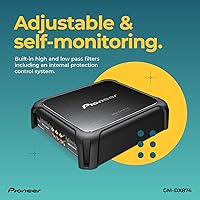
  • Protection System: Onboard protection circuitry continuously monitors input voltage, current draw, and operating temperature to prevent damage during demanding use.
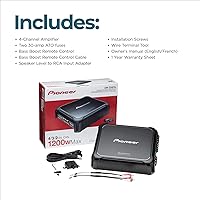
  • What's Included: The retail package contains the 4-channel amplifier unit, the remote bass boost controller, and standard installation hardware.

Related Reviews
Pioneer GM-A6704 4-Channel Car Amplifier
77%
83%
Sound Quality
71%
Power Delivery
81%
Installation Ease
74%
Build Quality
62%
Thermal Management
More
Pioneer GM-DX975 5-Channel Car Amplifier
81%
88%
Sound Quality
83%
Power Delivery
81%
Build Quality
71%
Thermal Management
74%
Ease of Installation
More
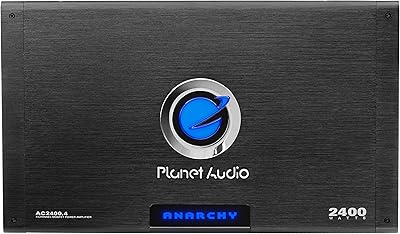
Planet Audio AC2400.4 4-Channel Car Amplifier
84%
95%
Power Output
89%
Sound Clarity
87%
Bass Performance
82%
Ease of Installation
65%
Thermals/Heat Management
More
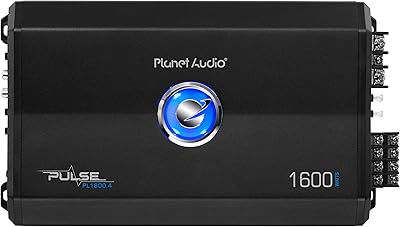
Planet Audio PL1600.4 4-Channel Car Amplifier
72%
88%
Value for Money
84%
Ease of Installation
74%
Sound Quality
58%
Power Output (Real-World)
61%
Build Quality
More
Recoil DI800.4 4-Channel Car Amplifier
75%
88%
Value for Money
51%
Power Accuracy
63%
Build Quality
79%
Thermal Management
86%
Ease of Installation
More
Recoil DI550.4 4-Channel Car Audio Amplifier
74%
91%
Value for Money
78%
Power Output
86%
Ease of Installation
74%
Sound Quality
67%
Build Quality
More
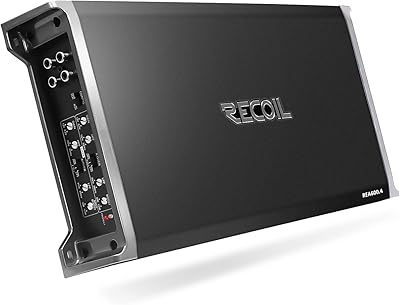
Recoil REA600.4 4-Channel Car Audio Amplifier
84%
89%
Audio Performance
91%
Ease of Installation
85%
Sound Quality at High Volumes
62%
Heat Management
90%
Power Output
More
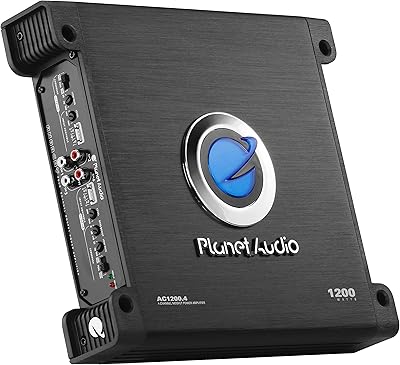
Planet Audio AC1200.4 4-Channel Car Amplifier
73%
88%
Value for Money
67%
Power Output
83%
Installation Ease
74%
Sound Quality
61%
Build Quality
More
Soundfy SA 400.4 4-Channel Car Amplifier
71%
78%
Value for Money
72%
Sound Quality
63%
Power Output
58%
Build Quality
81%
Thermal Management
More
Planet Audio AC1600.4 Anarchy Series 4-Channel Car Amplifier
82%
94%
Power Output
88%
Sound Quality
70%
Ease of Installation
92%
Value for Money
85%
Build Quality
More

FAQ

This is one of the most important questions to ask about any amplifier. The 1,200-watt figure is a peak rating measured under ideal, momentary conditions. For real-world listening, you should focus on the RMS continuous output, which will be significantly lower. Pioneer certifies this amp to the CTA-2006 standard, which does require honest RMS reporting — check the spec sheet for the per-channel RMS figure before building your speaker system around it.

In most cases, yes. The chassis measures just under 8.5 inches long and under 2.5 inches tall, which clears the floor clearance under the front seats in the majority of sedans, SUVs, and trucks. That said, measure your specific vehicle before ordering — some low-profile sport seats leave very little room. Many owners install it this way successfully, and it keeps the trunk free.

Yes, that is actually one of the most popular configurations for this amp. You bridge channels 3 and 4 together to drive a single subwoofer with more power, while channels 1 and 2 handle your front door speakers independently. It is a clean, efficient setup and well within what this amplifier is designed to handle.

It can work with a factory head unit, but you may need a line output converter to adapt the speaker-level outputs to RCA inputs the amp can accept. Many installers add an LOC as part of the same job. If your factory unit already has RCA preamp outputs, you can connect directly without any adapter.

Heat is a real consideration with any amplifier, but it is manageable. The built-in thermal protection will throttle or shut the unit down before damage occurs, which is reassuring. The main thing to avoid is mounting it in a completely sealed, unventilated enclosure with no airflow at all. Under a seat with some air circulation, most owners report no problems even during long drives.

Technically yes — the frequency response extends to 50,000 Hz, which covers the Hi-Res Audio range. In practice, how much improvement you actually hear depends far more on your source unit and speakers than on the amp. If your head unit outputs a high-resolution signal and your speakers can reproduce it, this 4-channel amplifier will not be the weak link.

For an amplifier in this power class, most installers use 4-gauge power wire from the battery to the amp. Some go with 8-gauge for shorter runs, but 4-gauge is the safer choice if you want to be sure you are not limiting current delivery, especially if the wire run is longer than about 12 feet. Always fuse the power wire close to the battery.

Yes, you can bridge the amp into two bridged pairs — channels 1 and 2 bridged for one subwoofer, channels 3 and 4 bridged for another. Just make sure your subwoofers present a minimum impedance load that is within the bridged spec for this amp; running too low an impedance in bridged mode is a common cause of amplifier failure and is not covered under warranty.

The included remote is a small wired knob that mounts within reach of the driver, typically near the head unit or on the center console. It connects to a dedicated port on the GM-DX874 and lets you dial the bass boost up or down on the fly without touching the amp itself. It is a practical convenience feature, especially if you listen to different genres throughout the day.

First, do not panic — protection mode exists to prevent real damage. Check the basics: confirm the ground wire is solid and making clean metal-to-metal contact, verify the speakers are wired correctly with no shorts, and make sure the impedance load is within spec. Overheating is another common trigger, so give the unit time to cool and check ventilation. If it repeatedly enters protection mode without an obvious cause, contact Pioneer support before continuing to use it.

Where to Buy