Overview

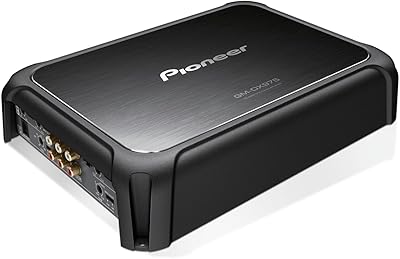
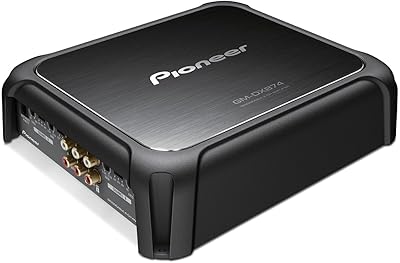
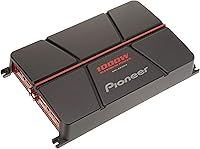
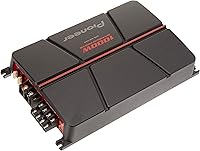
The Pioneer GM-A6704 4-Channel Car Amplifier sits squarely in the mid-range segment, built for drivers who want a real upgrade from factory audio without spending professional-installer money. Pioneer has been in car audio long enough that the name carries genuine weight, but what actually matters here is the CEA-2006 compliance — a legitimate industry standard that keeps power ratings honest rather than inflated. The metal chassis measures 15 x 4 x 9 inches and weighs just over a pound, so it tucks under a seat or into a trunk without much fuss. Automatic signal sensing handles turn-on duties, keeping the wiring simpler right from the start.
Features & Benefits

This Pioneer amp packs a bridgeable 4-channel layout, meaning you can run four full-range speakers and then combine two channels to drive a subwoofer — no need to buy a separate mono amp right away. The variable high-pass filter is genuinely useful; it stops low frequencies from reaching your door speakers, protecting them while keeping the midrange cleaner. There is also an adjustable bass boost built in, handy for a quick low-end tweak, though it is not a replacement for a proper equalizer. One important clarification on power: the 1000W figure is peak, not RMS. Continuous RMS output will be considerably lower, so match your speaker ratings accordingly before buying.

Best For

The GM-A6704 is a natural fit for anyone jumping from stock head-unit power to a dedicated amplifier for the first time. It handles a standard four-speaker setup with ease, and the bridging option makes it practical for those who plan to add a subwoofer later without spending more on additional hardware. Compact enough to hide under most seats, it works particularly well in smaller vehicles where trunk space is limited. If you have never installed an amp before, the automatic turn-on feature simplifies the process — though anyone unfamiliar with wiring and grounding basics should still consider having a professional handle the installation.

User Feedback

Most owners are satisfied with this 4-channel amplifier, and the strong average rating across several hundred reviews reflects that — the noticeable jump in sound quality over factory audio is the most commonly praised outcome. Installation also earns positive marks, with many users reporting the signal-sensing turn-on works reliably without extra effort. On the less positive side, heat under load comes up occasionally; running the amp hard for extended periods in a poorly ventilated space concerns some owners. A handful of buyers felt the overall build quality did not quite match their expectations for the brand. Long-term durability feedback skews positive, though a few multi-year owners note it is not indestructible.

Pros

  • CEA-2006 compliance keeps the power rating honest, unlike many competitors that only advertise inflated peak figures.
  • The bridgeable channel design adds real flexibility, letting you integrate a subwoofer without buying a second amplifier.
  • At just over a pound and compact in size, this Pioneer amp fits neatly under seats or in tight trunk corners.
  • Automatic signal sensing simplifies installation significantly, especially in vehicles where running a remote wire is inconvenient.
  • RCA inputs mean it pairs with virtually any aftermarket head unit without adapter headaches.
  • The variable high-pass filter actively protects your speakers from frequencies they were not built to handle.
  • Pioneer's brand reliability gives buyers confidence in long-term durability that off-brand alternatives rarely offer.
  • The sound improvement over factory power is consistently praised by owners as immediately noticeable.
  • The adjustable bass boost provides a quick low-end tweak without needing a separate component.
  • Overall user satisfaction is strong, with the vast majority of owners reporting it delivers solid value for the price.

Cons

  • Peak power figures are prominently advertised, but real continuous RMS output is considerably lower — a common source of buyer disappointment.
  • Heat buildup under sustained high-volume use has been flagged by some owners, requiring careful attention to mounting location and airflow.
  • The bass boost is a blunt instrument at best — anyone wanting proper tonal control will still need a dedicated equalizer.
  • Wiring and grounding complexity can catch first-time installers off guard, and mistakes can damage the unit or connected speakers.
  • Not powerful enough to satisfy enthusiasts running demanding subwoofers or high-impedance component speaker sets.
  • Some owners feel the physical build quality does not fully reflect what the Pioneer name implies at this price tier.
  • The GM-A6704 lacks more advanced tuning inputs like an optical connection or a variable low-pass filter for subwoofer channels.
  • Installation difficulty varies significantly by vehicle — oddly routed wiring runs can turn a simple job into a frustrating afternoon.

Ratings

The scores below reflect our AI-powered analysis of verified global user reviews for the Pioneer GM-A6704 4-Channel Car Amplifier, with spam, incentivized, and bot-generated feedback actively filtered out before scoring. We evaluated real ownership experiences across categories that matter most to car audio buyers — from installation ease to long-term reliability — and the results capture both the genuine strengths and the honest frustrations owners have reported. Nothing is glossed over: where this amp earns its praise, the scores show it, and where real-world trade-offs exist, they are reflected just as clearly.

Sound Quality
83%
Owners consistently describe the jump from factory power to this Pioneer amp as immediately obvious — voices sound clearer, instruments have more definition, and the overall soundstage feels wider even with budget speakers. For daily commuters and casual listeners, the improvement in clarity at moderate volumes is one of the most-praised outcomes across hundreds of reviews.
At higher volumes, a small portion of users notice the sound can lose some refinement, particularly in the midrange. Audiophiles with matched component speakers and high expectations may find the GM-A6704 reaches its performance ceiling sooner than they would like.
Power Delivery
71%
29%
For a mid-range amp, the GM-A6704 delivers clean, consistent power at everyday listening levels, and the CEA-2006 compliance means the RMS figures Pioneer publishes are grounded in a real measurement standard rather than inflated claims. Owners building modest systems report it handles four speakers without strain.
The 1000W peak rating creates expectations that the actual continuous RMS output cannot always meet, and buyers who did not research the distinction beforehand have expressed frustration. Anyone expecting near-four-figure wattage in practice will be disappointed — the real-world output is solid but considerably more modest.
Installation Ease
81%
19%
The automatic signal-sensing turn-on is a genuine time-saver during installation, removing the need to hunt for or run a dedicated remote wire in many vehicle setups. First-time installers in particular have praised how approachable the wiring process feels compared to older or more complex amplifier designs.
Installation difficulty varies widely depending on the vehicle, and a few owners without prior wiring experience ran into grounding and power cable routing challenges that required professional help. The documentation included in the box is functional but not detailed enough to guide complete beginners through tricky vehicle-specific scenarios.
Build Quality
74%
26%
The metal chassis feels substantially more durable than plastic-bodied alternatives in the same price range, and most owners report no rattling, flex, or loose components after installation. For a mid-tier product, the physical construction is solid enough to earn trust for everyday use.
A portion of reviewers feel the overall fit and finish does not quite live up to what the Pioneer name implies at this price point, noting that some terminal connections and knobs feel less premium than expected. Long-term owners who push the amp hard also occasionally note cosmetic wear around the heat-dissipating surfaces.
Thermal Management
62%
38%
Under normal listening conditions — moderate volume, reasonable ventilation, typical daily commuting — the GM-A6704 runs at perfectly acceptable temperatures and owners report no automatic shutoffs or thermal warnings during standard use. Casual listeners rarely encounter heat as an issue at all.
Running the amp hard for extended periods, especially in enclosed or poorly ventilated mounting locations, generates enough heat to trigger thermal protection cutoffs for some users. This is one of the more consistently recurring criticisms across long-form reviews, and it limits how aggressively the amp can be used in warm climates or during long road trips.
Value for Money
86%
At its price point in the competitive mid-range segment, the GM-A6704 offers brand credibility, CEA-2006 verified specs, and a bridgeable 4-channel configuration that would cost meaningfully more from premium competitors. Buyers looking for a reliable name-brand amp without stepping up to a professional tier consistently cite value as a key reason for choosing it.
A handful of buyers who purchased expecting premium performance were left feeling the price should have bought more refinement, particularly in terms of thermal handling and power output. The value proposition is strong for realistic mid-range expectations, but weakens if your system demands push beyond what this amp is designed to do.
Compatibility
89%
RCA input connectivity means this 4-channel amplifier works out of the box with virtually every aftermarket head unit on the market, and the wide operating voltage range of 3V to 26V gives it flexibility across different vehicle electrical systems. Owners rarely report compatibility problems when pairing it with standard aftermarket components.
Factory head units without RCA preamp outputs require an additional line output converter, which adds cost and complexity that some buyers did not anticipate. Users with OEM head units who did not plan for this extra step have flagged it as an unexpected installation hurdle.
Bass Boost Utility
67%
33%
For casual listeners who want a quick low-end adjustment without adding separate components, the built-in adjustable bass boost does the job simply and effectively. It is particularly appreciated by owners who do not have a dedicated equalizer and just want a bit more warmth or punch from their subwoofer output.
Anyone expecting the bass boost to function as a proper equalizer will find it too blunt — it adds low-end energy broadly rather than allowing precise frequency targeting. A few users have also noted that pushing the boost too far introduces audible distortion, particularly at high volumes.
Channel Flexibility
88%
The bridgeable design is one of the most practically useful features for buyers who plan to grow their system over time — running four speakers today and bridging two channels for a subwoofer tomorrow requires no additional hardware. This adaptability is frequently mentioned as a deciding factor by buyers comparing this amp to non-bridgeable competitors.
While bridging does increase output for a subwoofer channel, the resulting power is still modest relative to a dedicated mono subwoofer amplifier, which may underwhelm buyers expecting deep, room-filling bass from the bridged output alone.
Size & Fitment
84%
At 15 x 4 x 9 inches and just over a pound, this is one of the more vehicle-friendly amplifiers in its class, fitting neatly under the passenger seat in most compact and mid-size cars without requiring custom mounting solutions. Owners with limited trunk space particularly appreciate the ability to keep the amp hidden and out of the way.
A small number of owners with especially low seat clearances or unusual floorpan designs found the dimensions just slightly too large for a clean under-seat installation. In those cases, alternate mounting locations like the trunk floor or rear panel are typically the solution, but it can add wiring complexity.
High-Pass Filter Performance
78%
22%
The variable high-pass filter has earned appreciation from owners who understand its purpose — protecting door speakers from low frequencies that cause distortion and long-term damage. When properly tuned, it noticeably reduces muddiness in the midrange and helps speakers perform closer to their design intent.
Buyers unfamiliar with crossover tuning have occasionally set the filter incorrectly, resulting in thin-sounding audio that leaves them thinking the amp is underperforming. The controls are functional but lack the precision markings that would help less experienced users dial in optimal settings with confidence.
Long-Term Reliability
76%
24%
A meaningful portion of long-term owners — those who have run the GM-A6704 for one to two or more years — report that it continues to perform consistently when installed correctly with proper grounding, fusing, and ventilation. Pioneer's reputation for durability in this product category appears to hold up across a reasonable ownership window.
Units that were installed with poor ventilation or incorrect grounding have shown a higher rate of early failure, and some owners report issues that emerged after six to twelve months of heavy use. The amp rewards careful installation, but does not forgive shortcuts as readily as some buyers expected from a mid-range product.
Signal-Sensing Reliability
73%
27%
For the majority of owners, the automatic signal-sensing turn-on works exactly as advertised — the amp wakes up when music plays and powers down when it stops, with no manual switching required. This is especially convenient in vehicles where running a remote turn-on wire would have been complicated.
A recurring minority complaint involves occasional false triggering — the amp powering on due to electrical noise rather than an actual audio signal — or failing to wake up reliably with certain low-output head units. In those situations, falling back to a traditional remote wire connection is the most dependable fix.
Packaging & Unboxing
69%
31%
Most buyers report the amplifier arrives securely packaged with no transit damage, and the standard accessories included in the box cover the basic needs for a straightforward installation. For a product at this price tier, the initial unboxing impression is generally adequate.
The accessory kit is described as minimal by experienced installers — no wiring harness, no mounting hardware beyond basics, and no wiring guide detailed enough for true beginners. Buyers need to budget for a separate wiring kit, which is not always made clear in the product listing.

Suitable for:

The Pioneer GM-A6704 4-Channel Car Amplifier is an excellent match for drivers who are tired of flat, lifeless factory audio and want a meaningful upgrade without committing to a high-end build. It works particularly well for someone setting up a full four-speaker system for the first time, especially since the bridgeable design leaves the door open for adding a subwoofer later without buying additional hardware. Compact enough to fit under most seats, it is a practical choice for smaller vehicles or anyone working with tight installation spaces. The automatic signal-sensing turn-on makes the wiring side less intimidating for less experienced installers. If you need a reliable, brand-name amp in the mid-range price bracket that backs its power ratings with a real industry standard like CEA-2006, this one checks that box without overcomplicating the decision.
Not suitable for:

The Pioneer GM-A6704 4-Channel Car Amplifier is not the right tool for audiophiles or experienced builders who need precise, high-output power for a demanding system. The 1000W figure on the box is a peak rating — real-world continuous RMS output is significantly lower, which matters a great deal if you are trying to push high-performance speakers or a power-hungry subwoofer. Anyone building a dedicated bass-heavy setup would be better served by pairing a separate mono subwoofer amplifier with a more capable full-range unit. The built-in bass boost is a convenience knob, not a true tone-shaping tool, so buyers expecting sophisticated equalization will be disappointed. Users who plan to run the amp hard for long stretches — think loud music on road trips in hot climates — should also be aware that heat management can become an issue if ventilation around the unit is poor.
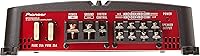
Specifications

  • Brand: Manufactured by Pioneer, a long-established name in consumer and professional audio electronics.
  • Model Number: The exact model designation is GM-A6704, used to identify this unit across retailers and documentation.
  • Channels: This amplifier operates with 4 channels, each capable of driving an individual speaker or combined in bridged pairs.
  • Max Power: Peak output is rated at 1000W total; note that continuous RMS output per channel will be substantially lower under real operating conditions.
  • Power Standard: The unit is CEA-2006 compliant, meaning its power ratings are verified against an independent industry measurement standard.
  • Dimensions: The chassis measures 15″ long by 4″ wide by 9″ tall, making it compact enough for under-seat or trunk mounting in most vehicles.
  • Weight: The amplifier weighs 1.1 pounds, keeping installation physically manageable even in restricted spaces.
  • Material: The outer housing is constructed from metal, providing structural rigidity and basic heat dissipation during operation.
  • Operating Voltage: The unit is designed for a standard 12V vehicle electrical system, with an accepted input range spanning 3V to 26V.
  • Mounting Type: Surface mount installation is supported, allowing the amp to be secured to a flat surface such as trunk flooring or a custom board.
  • Connectivity: Input connections are made via RCA cables, which are compatible with virtually all aftermarket car head units on the market.
  • Turn-On Method: The amplifier features automatic signal sensing, which powers the unit on when an audio signal is detected, eliminating the need for a dedicated remote wire in many installations.
  • High-Pass Filter: A variable high-pass filter is included, allowing the user to set a frequency cutoff that blocks damaging low-frequency signals from reaching full-range speakers.
  • Bass Boost: An adjustable bass boost control is built in, offering a convenient way to add low-end emphasis without requiring a separate equalizer component.
  • Configuration: Channels can be bridged in pairs, enabling two channels to be combined into a single higher-output channel for driving a subwoofer.
  • Compliance: The GM-A6704 meets CEA-2006 specifications, ensuring that advertised performance figures reflect a standardized and reproducible measurement methodology.
  • In the Box: The package includes the amplifier unit along with standard accessories; additional wiring kits are typically purchased separately.

Related Reviews

Pioneer GM-DX975 5-Channel Car Amplifier
81%
88%
Sound Quality
83%
Power Delivery
81%
Build Quality
71%
Thermal Management
74%
Ease of Installation
More
Pioneer GM-DX874 1,200 Watts 4-Channel Amplifier
86%
90%
Power Output
91%
Sound Quality
87%
Build Quality
83%
Ease of Installation
95%
Size & Portability
More
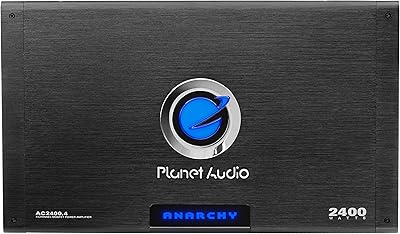
Planet Audio AC2400.4 4-Channel Car Amplifier
84%
95%
Power Output
89%
Sound Clarity
87%
Bass Performance
82%
Ease of Installation
65%
Thermals/Heat Management
More
Recoil REA600.4 4-Channel Car Audio Amplifier
84%
89%
Audio Performance
91%
Ease of Installation
85%
Sound Quality at High Volumes
62%
Heat Management
90%
Power Output
More
Recoil DI800.4 4-Channel Car Audio Amplifier
83%
88%
Sound Quality
92%
Power Output
65%
Thermal Management
84%
Build Quality
91%
Ease of Installation
More
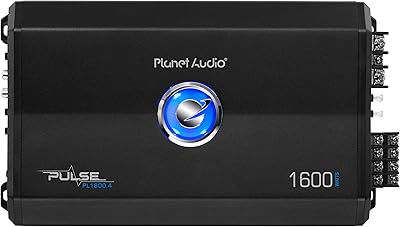
Planet Audio PL1600.4 4-Channel Car Amplifier
72%
88%
Value for Money
84%
Ease of Installation
74%
Sound Quality
58%
Power Output (Real-World)
61%
Build Quality
More
Recoil DI550.4 4-Channel Car Audio Amplifier
74%
91%
Value for Money
78%
Power Output
86%
Ease of Installation
74%
Sound Quality
67%
Build Quality
More
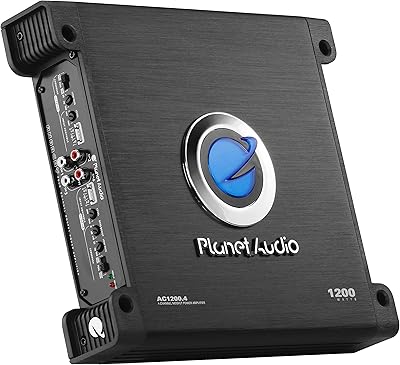
Planet Audio AC1200.4 4-Channel Car Amplifier
73%
88%
Value for Money
67%
Power Output
83%
Installation Ease
74%
Sound Quality
61%
Build Quality
More
Soundfy SA 400.4 4-Channel Car Amplifier
71%
78%
Value for Money
72%
Sound Quality
63%
Power Output
58%
Build Quality
81%
Thermal Management
More
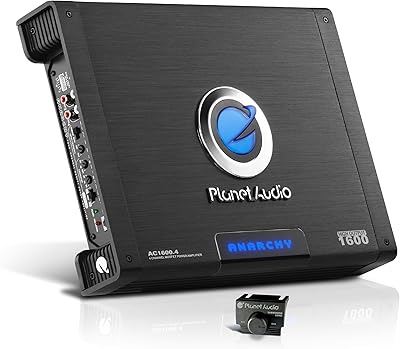
Planet Audio AC1600.4 Anarchy Series 4-Channel Car Amplifier
82%
94%
Power Output
88%
Sound Quality
70%
Ease of Installation
92%
Value for Money
85%
Build Quality
More

FAQ

Not necessarily. The GM-A6704 includes automatic signal sensing, which detects an audio signal from your head unit and powers the amp on automatically. That said, if your setup involves unusual wiring or a head unit that outputs a weak signal, a traditional remote wire connection may still give you more reliable results.

Yes, and this is actually one of the more practical things about this 4-channel amplifier. You can run all four channels to your speakers normally, or bridge two of the channels together to create a higher-output feed specifically for a subwoofer. It gives you some flexibility without needing to buy two separate amps right away.

That 1000W figure is the peak rating, which represents a brief maximum burst rather than sustained output. The real number to pay attention to is the continuous RMS wattage per channel, which will be considerably lower. The good news is this Pioneer amp is CEA-2006 compliant, so the actual RMS spec published by Pioneer for this model reflects a standardized measurement rather than a made-up marketing figure.

It likely will in most vehicles. The chassis is 15″ long and only about 4″ wide, and weighs just over a pound. Compact sedans and SUVs typically have enough clearance under the front passenger seat to accommodate it, though you should measure your specific vehicle before committing, since seat rail designs vary.

Any aftermarket head unit with RCA preamp outputs will connect to this amplifier without any adapters. If your factory head unit lacks RCA outputs, you would need either a line output converter or an aftermarket head unit to use the GM-A6704 properly.

The Pioneer GM-A6704 4-Channel Car Amplifier is genuinely beginner-friendly in several respects — the signal-sensing turn-on removes one wiring step, and the compact size makes placement easier. That said, no amplifier installation is completely foolproof. If you are not comfortable with running power cable from the battery, grounding to bare metal, or basic speaker wiring, having a professional do the install is worth the peace of mind and protects your gear.
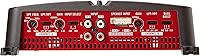
Some heat is normal for any amplifier working under load. Where a few owners have reported issues is when the unit is run at high volume for extended periods in a poorly ventilated spot. To avoid this, make sure there is at least an inch or two of airflow around the chassis, and avoid mounting it directly against carpet or sealed enclosures with no air circulation.

Not really — it is better thought of as a simple trim control for a bit of extra warmth or punch at the low end. It works fine for casual adjustments, but if you want precise frequency shaping or the ability to tune multiple bands, a dedicated equalizer is the right tool for that job.

When bridging two channels together to drive a subwoofer, most amplifiers in this class require a minimum 4-ohm load on the bridged output to operate safely. Running a lower-impedance subwoofer in bridged mode can cause overheating or damage. Check Pioneer's official documentation for the GM-A6704 to confirm the exact bridged impedance spec before wiring your subwoofer.

Durability feedback from long-term owners is generally positive, with many reporting consistent performance after a year or more of regular use. Like any amplifier, longevity depends heavily on installation quality — proper grounding, appropriate fusing, and adequate ventilation all extend the lifespan significantly. Units that run hot frequently due to poor airflow tend to fail earlier than those installed with care.

Where to Buy