Overview

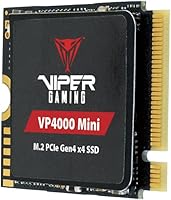
The Patriot Memory Viper VP4000 Mini 2TB M.2 2230 SSD arrived in early 2024 at a time when handheld gaming upgrades were becoming a serious hobby for a lot of PC enthusiasts. The M.2 2230 form factor is a niche that most big-name SSD brands still underserve, so a high-capacity Gen4 option here genuinely fills a gap. Patriot's Viper line has always leaned toward performance without pushing into boutique pricing territory, and this drive carries that same philosophy. With over 240 buyers weighing in at 4.6 stars, early real-world reception has been consistently positive without any obvious outlier issues clouding the picture.
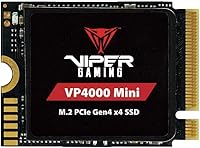
Features & Benefits

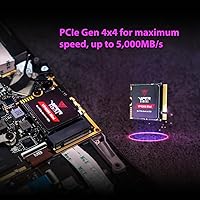
At the core of this compact NVMe drive is a PCIe Gen4 x4 interface capable of sequential reads up to 5,000 MB/s and writes up to 3,500 MB/s — numbers that matter most when your host device actually supports Gen4 throughput. The 2230 footprint is roughly 30mm long versus the standard 80mm of a typical desktop SSD, which is precisely what Steam Deck and ROG Ally slots require. NVMe 1.4 compliance brings lower latency and slightly better power handling, both relevant for battery-dependent handhelds. Hitting 2TB in this form factor is genuinely notable — most 2230 drives cap out far lower. The drive weighs under half an ounce and barely takes up physical space inside any chassis.

Best For

This 2230 SSD is an obvious pick for Steam Deck owners who have exhausted their base storage and want room for a large game library without hunting through menus to uninstall titles. ROG Ally users benefit similarly, especially those who want the bandwidth headroom Gen4 provides even if the handheld itself doesn't fully saturate it today. Mini-PC and compact desktop builders who physically cannot fit a 2280 drive also have a practical reason to consider the VP4000 Mini over a longer alternative. Anyone stepping up from an older or slower 2230 Gen3 drive will notice the difference in large file transfers and install times right away.

User Feedback

Buyers consistently highlight how straightforward the installation process is, whether they are doing a fresh OS install or cloning an existing drive onto the VP4000 Mini inside a Steam Deck or ROG Ally. Transfer speeds in real-world use track closely with the advertised figures according to several user benchmarks shared in reviews. On the cautionary side, a handful of users note that sustained writes in thermally constrained, fanless enclosures can lead to some speed throttling over extended sessions — not unusual for high-performance 2230 drives but worth knowing. Compared to rival options in this size class, most reviewers consider it a strong value, with few reporting compatibility problems across different host devices.

Pros

  • 2TB in the compact 2230 form factor is genuinely rare and solves a real problem for handheld gaming upgrades.
  • PCIe Gen4 speeds mean noticeably faster game installs and large file transfers compared to older Gen3 2230 drives.
  • Installation in Steam Deck and ROG Ally is straightforward, with no compatibility surprises reported by most users.
  • Drive cloning and fresh OS installs both work reliably according to consistent buyer feedback.
  • NVMe 1.4 compliance contributes to lower latency and slightly more efficient power draw, relevant for battery-powered devices.
  • At under half an ounce, the VP4000 Mini adds virtually no weight to any build.
  • Broad compatibility extends to desktops and laptops with 2230 slots, not just gaming handhelds.
  • A 4.6-star rating across over 240 buyers suggests the drive delivers on its core promises for most people.
  • The Viper branding reflects a performance-tuned product without the inflated cost of boutique SSD labels.
  • Few competing drives combine this capacity and interface speed in the 2230 form factor at a comparable price point.

Cons

  • Sustained write speeds can throttle in fanless or thermally constrained enclosures during long continuous transfers.
  • Gen4 bandwidth is partially wasted on devices that top out at Gen3 throughput, limiting the real-world speed advantage.
  • The 2230 form factor means fewer aftermarket heatsink or cooling accessory options if thermals become a concern.
  • Patriot Memory carries less brand recognition than Samsung or WD, which may give some buyers pause on long-term reliability data.
  • No included cloning software or adapter is bundled, so first-time upgraders need to source those tools separately.
  • Pricing reflects the niche 2230 premium, meaning buyers who do not specifically need this form factor pay more than necessary.
  • Limited independent long-term endurance data is available given the drive launched only in early 2024.
  • Users in regions with limited Patriot Memory distribution may face slower or more expensive RMA processes.

Ratings

The scores below reflect an AI-driven analysis of verified global buyer reviews for the Patriot Memory Viper VP4000 Mini 2TB M.2 2230 SSD, with spam, bot-generated, and incentivized feedback actively filtered out before scoring. Each category captures what real users experienced after installing this compact NVMe drive in their Steam Decks, ROG Ally handhelds, and mini-PCs — not what the spec sheet promises. Both standout strengths and genuine frustrations are reflected honestly in every score.

Read Speed Performance
88%
Users running CrystalDiskMark and real-world game installs on Gen4-capable devices consistently reported speeds that matched or came close to the advertised 5,000 MB/s ceiling. Steam Deck owners noticed a clear reduction in load times compared to the stock drive, which was one of the most frequently cited positive surprises.
Buyers using the drive in devices limited to PCIe Gen3 bandwidth naturally saw lower throughput, and a few felt misled by top-line marketing figures that only apply under ideal Gen4 conditions. Managing expectations around host-device limitations would prevent some of this disappointment.
Write Speed Performance
81%
19%
Sequential write speeds held up well during game installs and large file migrations for most users, with 3,500 MB/s figures largely confirmed in short-burst benchmark scenarios. For the typical Steam Deck use case of loading and saving games, write performance felt snappy and responsive in daily use.
Sustained write workloads — like transferring a 100GB+ library in a single session inside a fanless enclosure — produced noticeable throttling for a subset of users, with speeds dropping significantly as the drive warmed up. This is a thermal management issue common to high-performance 2230 drives, not unique to this model, but it is a real limitation worth knowing.
Form Factor Fit
94%
The 2230 footprint dropped into Steam Deck and ROG Ally slots cleanly for nearly every buyer who attempted the swap, with no reports of physical fitment issues or connector alignment problems. For mini-PC builders who struggled to find a high-capacity 2230 option, the precise sizing was called out as a genuine relief.
A small number of users working with less common mini-PC chassis noted that the drive sat loosely without a retaining screw, which is a chassis design issue rather than a drive defect but still caused anxiety during installation. No physical accessories like a thermal pad or retaining clip are included in the box.
Installation Experience
91%
The swap process was described as approachable even by first-timers, with the majority of Steam Deck owners completing the hardware install in under ten minutes using just a small screwdriver. Cloning an existing drive to the VP4000 Mini using free tools went smoothly for most, with no compatibility errors or failed boot attempts reported in the bulk of feedback.
Patriot does not include any cloning software or USB adapter in the package, which means total beginners have to source and figure out those tools independently before they can migrate their data. A handful of users found this gap frustrating compared to brands that bundle a migration utility with the drive.
Compatibility
89%
Beyond the headline Steam Deck and ROG Ally use cases, buyers confirmed the drive worked without issue in a range of mini-PCs, ultrabooks, and even secondary M.2 slots on full-size motherboards. No one reported driver conflicts or OS recognition failures across Windows 10, Windows 11, or SteamOS installations.
The drive is strictly limited to devices with an M.2 2230 slot, which excludes the vast majority of standard laptops and desktops that use the longer 2280 format. Buyers who did not confirm their slot type before purchasing had to return the drive, a preventable issue that generated a small but consistent thread of negative feedback.
Thermal Management
67%
33%
For typical gaming sessions on the Steam Deck — loading titles, saving progress, and streaming assets from storage — the drive stayed within normal operating temperatures and did not produce any perceptible heat complaints from users. Moderate workloads on the ROG Ally were handled without thermal incidents in the majority of reported use cases.
Under sustained heavy writes in enclosed, passively cooled spaces, thermal throttling was confirmed by multiple users who tested with continuous large transfers. The drive has no included heatsink or thermal interface material, and the tight 2230 cavity in most handhelds leaves little room for aftermarket cooling solutions.
Value for Money
83%
Buyers consistently framed the VP4000 Mini as the most practical high-capacity 2230 Gen4 option at its price point, particularly given how few 2TB competitors exist in this niche form factor. For Steam Deck owners who see the drive as a one-time upgrade that doubles or quadruples their storage, the cost-per-gigabyte was considered fair.
Compared to 2280 drives of the same capacity, the 2230 niche tax is real — buyers who do not specifically need the shorter form factor are paying a premium purely for the size constraint. A few users felt the price should reflect a bundled migration solution given the target audience of handheld gamers who may be newer to DIY storage swaps.
Build Quality
79%
21%
The drive feels solid for its size and weight, and no users reported physical defects, delamination, or connector damage out of the box in the reviewed feedback pool. The minimalist black PCB design is clean and unobtrusive inside any device.
There is no heatspreader or label-based thermal interface, which some users from the enthusiast community flagged as a missed opportunity at this performance tier. Long-term durability data is still limited given the January 2024 launch window, so multi-year reliability remains an open question.
Brand Reliability
74%
26%
Patriot Memory has a long enough track record in the storage market that most buyers felt confident making the purchase, and no widespread failure clusters emerged in the reviewed feedback within the first year of the drive being available. The Viper sub-brand carries enough name recognition to inspire baseline confidence.
Patriot does not command the same trust ceiling as Samsung or Western Digital in the eyes of a significant portion of buyers, and some users explicitly noted they would have preferred a more established name at this price point. RMA experience reports were limited but mixed, with a few international buyers citing slow support response times.
Capacity Availability
92%
Getting 2TB into a 2230 drive is a meaningful engineering achievement, and buyers repeatedly noted that this capacity tier simply was not accessible to them in this form factor before this drive launched. For Steam Deck users with large libraries of modern titles, having that headroom completely changed how they managed their device.
The 2TB variant is the focus of most positive sentiment, but buyers seeking a more affordable entry point noted that lower capacity options in the VP4000 Mini line offer less differentiation from competing drives. The value argument is strongest specifically at the 2TB tier.
Real-World Load Times
84%
Game loading on the Steam Deck improved noticeably after swapping to this compact NVMe drive, with users citing shorter initial boot sequences and faster level transitions in open-world titles. The improvement over the stock eMMC or slower SATA-based M.2 alternatives was tangible enough to be mentioned unprompted in many reviews.
Buyers upgrading from another Gen4 2230 drive rather than a slower baseline reported smaller gains, as expected. A few users noted that game engine streaming bottlenecks — not storage speed — became the next performance ceiling after the upgrade, which is a realistic caveat for any SSD upgrade at this tier.
Power Efficiency
78%
22%
NVMe 1.4 compliance contributes to better idle power states, which matters for handheld gaming where every milliwatt of draw affects battery runtime. Several Steam Deck users reported no perceptible battery life regression after the swap, which was a concern going in.
Under sustained sequential operations the drive draws more power than a SATA M.2 alternative, and in theory could contribute to slightly shorter play sessions during write-heavy workloads. This is a minor real-world concern for most gaming use cases but relevant for users who also store and edit files directly on their handheld.
Packaging & Unboxing
63%
37%
The drive arrives securely packaged with no damage reported in transit across the reviewed buyer pool, and the retail presentation is clean and professional without excessive plastic waste.
The package contains only the bare drive — no thermal pad, no adapter, no documentation beyond a basic insert. For a product targeting handheld gamers who are often first-time upgraders, the lack of any supplementary materials or even a QR code pointing to an install guide felt like a missed opportunity across multiple buyer comments.
Documentation & Support
58%
42%
Patriot Memory maintains a support page and warranty process that resolved issues for some buyers without major friction, and the broader online community around Steam Deck upgrades filled in most of the guidance gaps effectively.
Official installation documentation is minimal, and reaching Patriot support for technical questions was described as slow or unhelpful by a recurring segment of buyers. Users outside North America in particular reported difficulty navigating warranty claims, which pulled this score down relative to the drive's otherwise solid hardware performance.

Suitable for:

The Patriot Memory Viper VP4000 Mini 2TB M.2 2230 SSD was built for a very specific kind of buyer, and those buyers will find it hard to beat at this size. Steam Deck owners are the most obvious fit — the base storage on Valve's handheld fills up fast, and swapping in a 2TB Gen4 drive means carrying a serious game library without constant juggling. ROG Ally users in the same boat benefit equally, gaining both capacity and the bandwidth headroom that Gen4 provides as software and drivers continue to mature. Beyond handhelds, anyone building or upgrading a mini-PC or compact desktop where a standard 2280 drive physically will not fit gets a genuinely high-performance option that was scarce in the 2230 segment not long ago. If you are stepping up from a slower Gen3 2230 drive, the jump in transfer speeds during large installs and game loads is noticeable enough to justify the upgrade.
Not suitable for:

The Patriot Memory Viper VP4000 Mini 2TB M.2 2230 SSD is not the right call for every storage upgrade situation, and it is worth being clear-eyed about that. If your device uses a standard M.2 2280 slot — which covers most mainstream laptops and full-size desktop motherboards — this compact drive offers no advantage over longer, often cheaper 2280 alternatives with similar or better sustained performance. Buyers who run heavy, continuous workloads like video editing or large database operations in a thermally limited enclosure should be aware that sustained write speeds can drop under prolonged load, a trade-off common to high-performance drives in tight spaces. It is also not the best pick for someone chasing absolute peak NVMe performance at any cost, since top-tier 2280 Gen4 drives still hold an edge in sustained throughput benchmarks. Budget-focused buyers who only need 512GB or 1TB will likely find better value elsewhere, as the premium here is tied directly to the combination of capacity and form factor.
Specifications

  • Form Factor: This drive uses the M.2 2230 format, measuring approximately 1.18 x 0.87 x 0.09 inches — roughly 30mm in length, which is required by handheld devices like the Steam Deck and ROG Ally.
  • Interface: It connects via PCIe Gen4 x4, the current mainstream high-performance standard that offers roughly double the bandwidth ceiling of the previous Gen3 interface.
  • Protocol: The drive is compliant with NVMe 1.4, which supports lower command latency and improved power management compared to older NVMe revisions.
  • Capacity: Total usable storage is 2TB, one of the highest capacities available in the constrained 2230 form factor as of its January 2024 release.
  • Sequential Read: Rated sequential read speed reaches up to 5,000 MB/s under controlled benchmark conditions using tools like CrystalDiskMark.
  • Sequential Write: Rated sequential write speed reaches up to 3,500 MB/s, though real-world sustained writes in thermally limited enclosures may be lower.
  • Weight: The drive weighs 0.353 oz (approximately 10 grams), adding negligible mass to any host device.
  • Dimensions: Physical dimensions are 1.18 x 0.87 x 0.09 inches (length x width x thickness), conforming to the standard M.2 2230 specification.
  • Color: The drive is finished in black and has no external heatsink or thermal pad included in the retail package.
  • Compatible Devices: Officially supported host devices include the Steam Deck, ROG Ally, standard desktops, and laptops equipped with an M.2 2230-compatible slot.
  • Installation Type: This is an internal storage drive requiring physical installation inside a compatible device; it is not a plug-and-play external solution.
  • Brand Series: The VP4000 Mini belongs to Patriot Memory's Viper performance line, positioned as a speed-focused product without premium flagship pricing.
  • Availability: The drive was first listed for sale in January 2024, making it a relatively recent release within the Gen4 2230 SSD category.
  • Seller Rank: As of available data, the drive holds a Best Sellers Rank of approximately #506 in the Internal Solid State Drives category on Amazon.
  • Buyer Rating: The drive carries a 4.6 out of 5 star average rating based on 241 customer ratings, reflecting strong overall satisfaction across early adopters.

Related Reviews
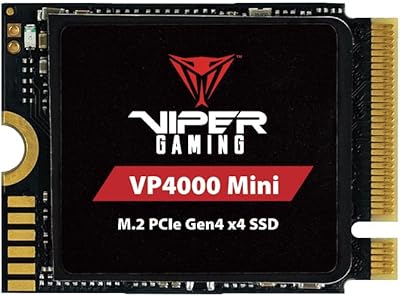
Patriot Memory Viper VP4000 Mini 500GB M.2 2230 PCIe Gen4 x4 SSD
86%
94%
Performance
92%
Speed (Read/Write)
88%
Compatibility with Gaming Devices
85%
Ease of Installation
76%
Size/Form Factor (M.2 2230)
More
Patriot Memory Viper VP4300 Lite 2TB M.2 PCIe Gen4 x4 SSD
86%
94%
Performance (Speed)
89%
Ease of Installation
78%
Thermal Management
91%
Compatibility with PS5
88%
Compatibility with PCs
More
INLAND QN446 2TB M.2 2230 SSD
88%
94%
Performance
93%
Speed (Read/Write)
89%
Ease of Installation
86%
Build Quality
91%
Power Efficiency
More
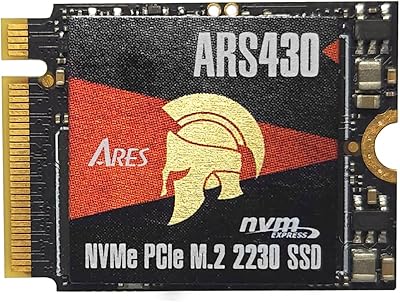
DATO ARS430 2TB M.2 2230 SSD
86%
94%
Performance
92%
Value for Money
88%
Thermal Management
70%
Ease of Installation
82%
Compatibility with Steam Deck
More
KINGDATA M.2 2230 2TB NVMe SSD
88%
91%
Performance
93%
Read Speed
89%
Write Speed
85%
Durability
88%
Temperature Management
More
Fikwot FX953 2TB M.2 2230 NVMe SSD
88%
92%
Performance
89%
Value for Money
74%
Thermals/Heat Management
94%
Read Speed
89%
Write Speed
More
MMOMENT 2TB MX44 M.2 2230 NVMe SSD
88%
91%
Performance
93%
Speed (Read/Write)
88%
Ease of Installation
85%
Durability (Shock & Dust Resistance)
89%
Capacity (2TB)
More
fanxiang S630 2TB M.2 2230 NVMe SSD
87%
89%
Performance
90%
Speed (Read/Write)
88%
Thermal Management
85%
Ease of Installation
92%
Build Quality
More
Satechi ST-E2230M M.2 NVMe 2230 SSD Enclosure
82%
91%
Build Quality
88%
Transfer Speed
86%
Active Cooling Effectiveness
67%
Fan Noise Level
94%
Portability & Size
More
Micron 2400 2TB M.2 2230 NVMe SSD
88%
93%
Read & Write Performance
97%
Storage Capacity
96%
Form Factor Compatibility
91%
Installation Experience
89%
Build & Endurance
More

FAQ

Yes, the Steam Deck uses an M.2 2230 slot and this drive is built specifically for that footprint. It is one of the few 2TB options that physically fits without any modification. Just make sure you have the right screwdriver — a small Phillips head is all you need.

The ROG Ally does support PCIe Gen4 on its M.2 slot, so you will get meaningful use out of the Gen4 bandwidth here. That said, real-world gaming load times and in-game streaming depend on more than raw interface speed, so the practical gains are noticeable but not transformative for everyday gaming.

It works in any device with an M.2 2230-keyed slot, including certain ultrabooks, mini-PCs, and desktop motherboards that include a secondary 2230 slot. The catch is that many standard laptops use the longer 2280 format, so check your device specs before buying.

Yes, it works with Windows 11 without any special drivers — the operating system handles NVMe drives natively. A fresh install or a cloned migration both work reliably based on consistent buyer reports.

In normal gaming use the drive stays within acceptable temperature ranges, but like most high-performance NVMe drives, sustained heavy writes in a sealed fanless enclosure can cause some thermal throttling. For typical game loading and normal play sessions, heat is rarely a practical concern.

Patriot does not bundle cloning software in the box, so you will need a free third-party tool like Macrium Reflect or Clonezilla, plus a USB-to-M.2 adapter to connect the new drive during the process. It is a common workflow and well-documented in the Steam Deck community with step-by-step guides available.

The VP4000 Mini competes closely with those drives on paper and in benchmarks, sitting at roughly similar sequential speeds. The main differentiator for most buyers is availability and pricing at the time of purchase rather than a dramatic performance gap — all three are solid Gen4 2230 options.

Modern AAA games can easily top 50–100GB each, and if you keep a varied library of titles, 2TB fills up faster than you might expect. For most dedicated Steam Deck users, having the headroom means never having to uninstall a game mid-session to make space — which is a real quality-of-life improvement.

Patriot Memory typically offers a limited warranty on their Viper SSD line, but warranty terms can vary by region and retailer. It is worth checking Patriot's official website or your purchase documentation directly for the exact coverage period and RMA process applicable to your location.

Yes, NVMe SSDs are backward compatible, so the drive will function in a Gen3 slot. You will not hit the Gen4 speed ceiling in that case — throughput will be capped at Gen3 levels — but the drive will still work correctly and reliably as a storage upgrade.

Where to Buy