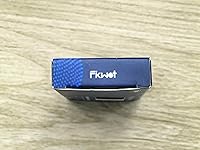
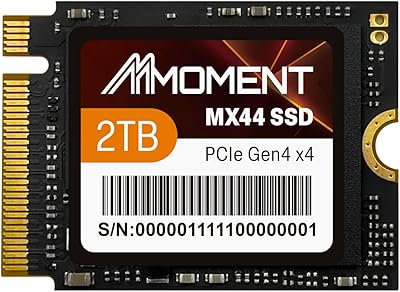
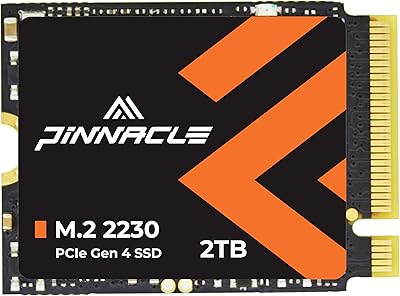
Overview

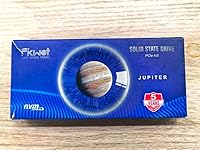
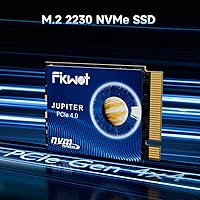
The Fikwot FX953 2TB M.2 2230 NVMe SSD arrived in mid-2024 targeting a very specific gap in the market: compact, high-capacity storage for handheld gaming devices and ultra-thin laptops. The 2230 form factor — just 30mm long — is what makes this drive relevant; without that size constraint, most standard M.2 drives simply won't fit in a Steam Deck or ROG Ally. Fikwot isn't a household name, and that's worth acknowledging upfront. What this 2230 NVMe drive brings to the table instead is a PCIe Gen 4 interface at a price point that doesn't demand flagship-brand faith. Think of it as a practical upgrade, not a prestige purchase.
Features & Benefits

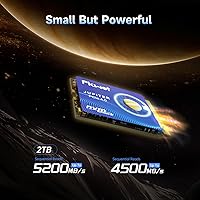
At its core, this compact Gen 4 upgrade runs on a PCIe 4.0 x4 interface with peak sequential reads around 5,200 MB/s and writes near 4,500 MB/s — roughly double what Gen 3 drives can sustain. In a handheld device, you won't always hit those ceiling numbers under sustained load, but the difference in game load times and file transfers is tangible. The drive ships with a graphite heat-dissipation layer bonded directly to its surface, which helps manage thermals in tight enclosures without adding meaningful bulk. Rated for 640 TBW endurance and backed by a five-year warranty, the FX953 SSD holds up well on paper for long-term use. It also drops back to Gen 3 speeds on older hardware, making it broadly compatible.

Best For

This 2230 NVMe drive makes the most sense for Steam Deck owners who've outgrown the factory storage and want a meaningful capacity bump without hunting for rare components. ROG Ally users benefit equally — the 2230 slot is the only option in that chassis, and moving to 2TB at Gen 4 speeds is a noticeable improvement over entry-level configurations. Surface Pro users on 2230-equipped models will appreciate the 2TB headroom for a thin device that can't accommodate a second drive. Mini PC builders working within tight board constraints also fit the profile. If you already own a Gen 3 device and want to future-proof slightly, this compact Gen 4 upgrade still delivers value — just don't expect to saturate its full bandwidth on older hardware.

User Feedback

With around 97 ratings and a 4.4-star average, the FX953 SSD has earned a reasonably strong early reception. Most buyers highlight the straightforward installation process and a genuine speed improvement over the stock drives in Steam Deck and ROG Ally units. Real-world read speeds frequently match or come close to advertised figures in benchmark tests, though sustained write performance can dip under prolonged thermal load — a physics reality in any compact enclosure, not unique to this drive. The recurring hesitation is brand familiarity: Fikwot doesn't carry the same name recognition as WD or Samsung. That said, the five-year warranty and solid TBW rating give cautious buyers something concrete to lean on. Long-term reliability data is still accumulating, so early adopters should weigh that accordingly.

Pros

  • PCIe Gen 4 speeds deliver noticeably faster game load times compared to the stock drives in Steam Deck and ROG Ally.
  • 2TB of storage is genuinely roomy for large modern game libraries on handheld devices.
  • The 2230 form factor fits devices where no standard M.2 drive will physically work.
  • An integrated graphite layer helps manage thermals passively without adding thickness.
  • A five-year warranty and 640 TBW endurance rating provide meaningful long-term assurance.
  • Backward compatibility with Gen 3 slots makes this compact Gen 4 upgrade usable across a wider range of hardware.
  • Real-world read speeds reported by buyers closely match the advertised figures in benchmark tests.
  • Installation is straightforward, with most users completing the swap without any technical hurdles.
  • The pricing sits well below flagship-tier SSD alternatives offering similar specs.

Cons

  • Fikwot has limited brand history, and long-term reliability data is still thin compared to established names.
  • Sustained write speeds can drop noticeably under prolonged thermal load inside tight device enclosures.
  • Handheld devices like the Steam Deck do not fully saturate Gen 4 bandwidth, so peak specs are partly theoretical in practice.
  • The review base is still relatively small, making it harder to spot reliability patterns across diverse use cases.
  • Users on Gen 3-only devices get a working drive but pay for performance they cannot access.
  • No included cloning software or migration tools means extra setup steps for less experienced users.
  • Compatibility edge cases with specific device firmware versions have been flagged by a small number of buyers.
  • The 2230 size limits this drive to a narrow range of compatible devices, reducing its versatility as a general-purpose upgrade.

Ratings

The scores below reflect our AI-driven analysis of verified global user reviews for the Fikwot FX953 2TB M.2 2230 NVMe SSD, with spam, bot-submitted, and incentivized feedback actively filtered out before scoring. Each category is weighted against real-world usage patterns reported by buyers across Steam Deck upgrades, ROG Ally installations, and Surface Pro expansions. Both the strengths that made buyers recommend this drive and the friction points that gave others pause are transparently represented in every score.

Read Speed Performance
83%
Users running CrystalDiskMark and similar tools consistently reported sequential reads landing within a reasonable margin of the advertised ceiling, which is a better result than many budget-tier Gen 4 drives manage. For gaming, this translates to snappier shader pre-compilation and quicker boot times on both Steam Deck and ROG Ally compared to stock hardware.
The Steam Deck and ROG Ally cannot fully saturate Gen 4 bandwidth due to their interface constraints, so the headline read figure is something of a theoretical ceiling for handheld users specifically. A handful of reviewers noted that real-world sequential reads in their devices landed measurably below desktop benchmarks, which is expected but still worth flagging.
Write Speed Performance
71%
29%
For typical gaming workloads — installing titles, saving game states, moving files — the FX953 SSD delivers write speeds that feel meaningfully faster than the entry-level drives it commonly replaces. Short burst writes are handled cleanly, and users doing occasional large file transfers reported acceptable real-world times.
Sustained write performance is where this compact Gen 4 upgrade shows its limitations most clearly. During prolonged large transfers inside a thermally constrained enclosure, speeds can drop as the drive heats up and the controller throttles to protect itself — a reality that applies to the 2230 category broadly, not just this model.
Thermal Management
74%
26%
The built-in graphite sticker does genuine work during typical gaming sessions, and most users reported no thermal throttling during normal play. It is a practical solution for a device where adding a traditional heatsink simply is not an option due to physical constraints.
Under heavy sustained workloads — prolonged downloads, large game installations, or back-to-back intensive sessions — temperatures do climb, and the thin graphite layer has a finite heat capacity. Users who stress the drive heavily in short succession noticed more pronounced performance dips than those who used it for standard gaming.
Installation Experience
91%
This was one of the most consistently praised aspects across user reviews. Buyers who had never opened a Steam Deck before described the physical installation as straightforward once they had the right screwdriver, and the drive seated without any force or fitment issues. No adapters, no brackets — it just goes in.
The installation experience beyond the hardware swap is less polished. There is no bundled software, no cloning utility, and no quick-start guide for OS reinstallation, which left less experienced users searching for community guides on their own. For technically confident buyers this is a non-issue, but it is a gap nonetheless.
Device Compatibility
78%
22%
Verified compatibility across Steam Deck, ASUS ROG Ally, select Surface Pro configurations, and various Mini PC platforms gives this 2230 NVMe drive genuine versatility within the 2230 ecosystem. Backward compatibility with Gen 3 slots extends its reach further, making it a reasonable choice even for older hardware.
A small subset of reviewers flagged compatibility hiccups tied to specific device firmware versions rather than the drive itself, but those edge cases created enough friction to mention. The drive is also irrelevant to anyone with a standard 2280 slot, which limits its addressable audience considerably.
Build Quality
76%
24%
The physical construction feels solid for the price tier, and the graphite thermal layer is applied evenly without the bubbling or peeling that cheaper thermal stickers sometimes exhibit out of the box. The PCB itself is compact and well-finished for a drive in this category.
Fikwot does not publish detailed controller or NAND sourcing information publicly, which makes it difficult to independently assess component quality beyond what buyers observe. At this price point, the build quality appears appropriate, but there is less transparency here than enthusiasts accustomed to established brands might expect.
Long-term Reliability
63%
37%
The 640 TBW endurance rating is competitive and reasonable for the 2TB capacity class, suggesting the drive is not cutting corners on rated lifespan. Users who have owned the drive since its mid-2024 launch have reported stable operation with no early failures surfacing in the review pool.
The honest limitation here is that the review base is still young and relatively small — fewer than 100 verified ratings does not provide the longitudinal data needed to assess long-term durability with confidence. Buyers who prioritize proven multi-year reliability from thousands of owners should note this gap.
Warranty & Support
79%
21%
A five-year limited warranty is a strong commitment for a drive at this price point and goes a meaningful distance toward offsetting brand familiarity concerns. Having a multi-year coverage window gives buyers a concrete safety net that specs alone cannot provide.
Real-world warranty claim experiences are not yet well-documented in the user review pool, so it is unclear how responsive Fikwot's support process is in practice. Buyers should keep their purchase receipts and documentation carefully, as warranty enforcement with smaller brands can vary.
Value for Money
84%
For buyers who specifically need a 2230 Gen 4 drive at 2TB capacity, the pricing lands at a noticeably lower point than equivalent offerings from household-name brands. Users consistently described it as one of the more affordable ways to get genuine Gen 4 performance in the 2230 slot without significant compromise on core specs.
If brand confidence and long-term peace of mind have a dollar value for you, the savings over established competitors may feel less compelling. A portion of buyers noted they would have paid a modest premium for a more recognizable name, suggesting value perception is partly tied to risk tolerance.
Capacity Satisfaction
88%
2TB in a 2230 drive is still far from universal in this category, and users upgrading from 256GB or 512GB stock drives described the jump as transformative for their game library management. The ability to keep a large installed library on-device without constant juggling was a recurring highlight.
A minority of buyers noted that usable formatted capacity comes in slightly below the marketed 2TB figure, which is standard across the industry but still caught a few less experienced buyers off-guard. This is an industry-wide formatting convention, not a defect specific to this drive.
Noise & Vibration
94%
As a solid-state drive with no moving parts, the FX953 SSD operates in complete silence — a genuine quality-of-life improvement for users who previously used mechanical storage in Mini PCs or older portable devices. Users noted zero audible operation under any workload.
There is essentially nothing to criticize in this category for any NVMe SSD. The score reflects the expected excellence of flash storage rather than anything uniquely exceptional about this specific drive.
Power Efficiency
72%
28%
Users reported no unusual battery drain patterns on Steam Deck or ROG Ally after installation, suggesting the drive operates within expected power envelopes for Gen 4 NVMe. For handheld users where battery life matters, this is an important baseline to clear.
Gen 4 NVMe drives inherently consume more power than Gen 3 equivalents, and in battery-powered handhelds this is a real trade-off. Some users reported marginally shorter battery windows compared to their previous Gen 3 drives, though the difference was described as minor rather than deal-breaking.
Brand Confidence
58%
42%
Buyers who researched the drive before purchasing generally came away satisfied, pointing to the warranty terms and competitive TBW rating as evidence that Fikwot is not simply cutting corners. Early adopters who have used the drive for several months have largely reported no issues.
Fikwot simply does not carry the accumulated trust of brands with a decade-plus of public reliability data behind them, and that gap is real for buyers who weight brand reputation heavily in purchasing decisions. The limited review volume compounds this, making it genuinely harder to build a statistically robust picture of the brand's quality consistency.
Packaging & Presentation
66%
34%
The drive arrives adequately protected and in acceptable condition according to most buyers. For a component that goes directly into a device and never needs to be seen again, the packaging does its primary job without incident.
The unboxing experience is minimal, with no accessories, no installation guide, and no cloning utility included — a contrast to some competing drives that bundle at least basic documentation. For first-time upgraders, the lack of any supporting materials is a notable gap in the overall package.

Suitable for:

The Fikwot FX953 2TB M.2 2230 NVMe SSD was built for a very specific audience, and if you fall into one of these groups, it's a compelling option. Steam Deck owners who have burned through their stock storage on a library of large titles will find 2TB of Gen 4 NVMe storage a significant quality-of-life improvement. ROG Ally users face the same 2230 slot constraint and will benefit from both the capacity bump and the faster load times this compact Gen 4 upgrade delivers. Surface Pro owners on models equipped with a 2230 slot can finally stop juggling external drives for everyday work. Mini PC builders working with space-constrained boards will also appreciate having a high-endurance, Gen 4 option in the 2230 size. Anyone who wants a capable internal upgrade without committing to flagship-brand pricing will find this 2230 NVMe drive hits a practical sweet spot.
Not suitable for:

The Fikwot FX953 2TB M.2 2230 NVMe SSD is not the right call for everyone. Buyers who need a standard M.2 2280 drive for a desktop or full-size laptop will find no advantage here — the 2230 form factor is a constraint-driven choice, not a universal upgrade. If brand heritage and years of proven reliability data are non-negotiable for you, Fikwot's relatively short track record may feel uncomfortable, regardless of what the warranty paperwork says. Users expecting to sustain peak sequential write speeds continuously — say, during long video captures or large data migrations inside a thermally limited handheld chassis — should temper expectations, as sustained write performance in compact enclosures rarely matches burst benchmarks. And if your device only supports PCIe Gen 3, you will get a functional drive, but you are paying for Gen 4 headroom you simply cannot use.
Specifications

  • Capacity: The drive offers 2TB of usable storage, providing ample room for large game libraries and media collections on compact devices.
  • Form Factor: Built to the M.2 2230 standard at 22mm wide and 30mm long, making it one of the shortest NVMe drives available for space-constrained slots.
  • Interface: Connects via PCIe Gen 4.0 x4 NVMe, the current high-bandwidth standard for consumer SSDs, with backward compatibility for Gen 3 slots.
  • Sequential Read: Peak sequential read speed reaches up to 5,200 MB/s under optimal, lightly loaded conditions.
  • Sequential Write: Peak sequential write speed is rated up to 4,500 MB/s, though sustained writes in thermally constrained enclosures may fall below this ceiling.
  • NAND Type: Uses 3D NAND Flash memory, which stacks memory cells vertically to improve density, endurance, and power efficiency compared to planar NAND.
  • Endurance: Rated for 640 TBW (terabytes written), which represents the total volume of data that can be written before the drive approaches its wear limit.
  • Warranty: Covered by a five-year limited warranty from Fikwot, with technical support included for the duration of the coverage period.
  • Thermal Solution: Ships with an integrated graphite heat-dissipation sticker bonded to the drive surface, functioning as an ultra-thin passive heatsink to reduce operating temperatures.
  • Dimensions: Measures 0.87 x 1.18 x 0.11 inches, keeping the physical footprint minimal enough for installation in handheld gaming devices and ultra-thin laptops.
  • Weight: The drive weighs approximately 1.06 ounces, adding negligible mass to any host device after installation.
  • OS Support: Compatible with both Linux-based operating systems (including SteamOS) and standard Windows PC environments.
  • Compatible Devices: Designed to work with Steam Deck, ASUS ROG Ally, Microsoft Surface Pro models with a 2230 slot, and select Mini PCs using the same form factor.
  • Gen 3 Compatibility: The drive is backward compatible with PCIe Gen 3 x4 slots, operating at reduced but still capable speeds on older hardware.
  • Availability: First listed for sale in July 2024, making this a relatively recent entry into the competitive 2230 NVMe upgrade market.

Related Reviews
Fikwot FX991 2TB NVMe SSD
78%
88%
Sequential Read Performance
61%
Sustained Write Speed
93%
PS5 Compatibility
91%
Value for Money
82%
Thermal Management
More
KINGDATA 2TB M.2 2230 NVMe SSD
75%
81%
Real-World Speed
93%
Form Factor Fit
78%
Installation Experience
84%
Value for Money
62%
Brand Reliability Confidence
More
Fikwot FX910 2TB M.2 NVMe SSD
80%
88%
Read/Write Performance
91%
Thermal Management
93%
Installation Ease
84%
PS5 Compatibility
87%
Value for Money
More
MMOMENT 2TB MX44 M.2 2230 NVMe SSD
88%
91%
Performance
93%
Speed (Read/Write)
88%
Ease of Installation
85%
Durability (Shock & Dust Resistance)
89%
Capacity (2TB)
More
fanxiang S630 2TB M.2 2230 NVMe SSD
79%
88%
Read Speed Performance
71%
Sustained Write Speed
93%
Form Factor Compatibility
79%
Thermal Management
86%
Installation Experience
More
Micron 2400 2TB M.2 2230 NVMe SSD
88%
93%
Read & Write Performance
97%
Storage Capacity
96%
Form Factor Compatibility
91%
Installation Experience
89%
Build & Endurance
More
Timetec 2TB M.2 2230 NVMe Gen4 SSD
79%
88%
Read Performance
82%
Write Performance
93%
Form Factor Fit
86%
Device Compatibility
67%
Thermal Behavior
More
XPC Technologies SN740 2TB M.2 2230 NVMe SSD
87%
92%
Performance
88%
Installation Ease
94%
Compatibility with Steam Deck
89%
Write Speed
91%
Read Speed
More
SanDisk 2TB SSD Plus M.2 NVMe SSD
86%
89%
Performance
92%
Ease of Installation
88%
Reliability
91%
Value for Money
90%
Capacity
More
Fikwot FX660 2TB NVMe SSD
79%
88%
Sequential Read Performance
63%
Sustained Write Speed
71%
Thermal Management
91%
PS5 Compatibility
89%
Value for Money
More

FAQ

Yes, the 2230 form factor is exactly what the Steam Deck requires for its internal M.2 slot. No modifications or adapters are needed — it drops in where your existing drive sits. Just make sure to follow a reputable disassembly guide and use the correct screwdriver, as the internal screws are small.

It works with both. The ROG Ally also uses an M.2 2230 slot, so this compact Gen 4 upgrade is a direct fit. Real-world users have installed it in both devices without reported hardware conflicts.

In most cases, yes — since this is a blank drive, you will need to reinstall your operating system or restore from a backup image. For Steam Deck users, Valve provides an official recovery image that makes the process relatively painless. ROG Ally users can use ASUS recovery tools or a Windows installation USB.

Probably not at that exact ceiling. The Steam Deck's interface can bottleneck peak Gen 4 throughput, so benchmark results inside the device will typically land lower than what you would see in a desktop PCIe 4.0 system. That said, you will still see a meaningful improvement over the stock drive, particularly in game load times and shader compilation speeds.

Most Surface Pro models from the Surface Pro 7+ onward use soldered or proprietary storage, but some configurations do include an accessible M.2 2230 slot. Check your specific model's teardown guides on iFixit or similar resources before purchasing, as this varies by Surface Pro generation and SKU.

It is fair to be cautious. Fikwot does not have the decades-long track record of brands like Samsung or Western Digital. What you can lean on concretely is the five-year warranty and the 640 TBW endurance rating, both of which are competitive figures. The review base is still growing, so if established brand history is critical for your peace of mind, that is worth factoring into your decision.

No bundled cloning or migration software is included. If you want to transfer your existing installation rather than start fresh, you will need a third-party solution like Macrium Reflect or Clonezilla, plus an external USB-to-M.2 adapter to connect both drives simultaneously.

The integrated graphite sticker helps, but in a sealed handheld device thermal headroom is always limited. Users have generally reported stable operation without throttling during typical gaming sessions, though intensive sustained workloads — like large file transfers — can push temperatures higher. The drive is designed with this environment in mind, which is why the passive thermal layer is built in rather than optional.

Technically yes, if your board has an M.2 2230 slot — some compact laptops and mini-ITX motherboards include one. However, most full-size laptops and desktops use the longer 2280 form factor, so this 2230 NVMe drive would not be the right choice for a standard build unless you have confirmed your system supports the shorter length.

SSD endurance ratings describe the point at which the manufacturer no longer guarantees write reliability, not the point where the drive suddenly fails. In practice, most consumer drives continue functioning beyond their rated TBW. For typical gaming and everyday use, 640 TBW represents many years of normal operation before you would realistically approach that threshold.