Overview

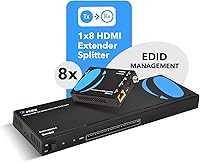
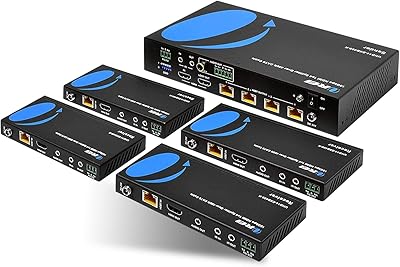
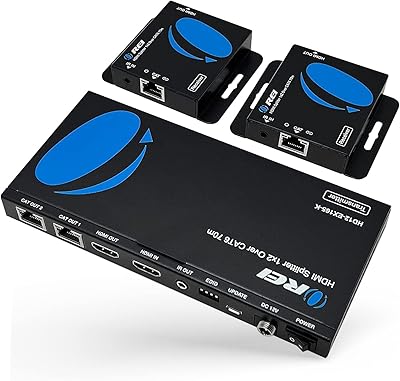
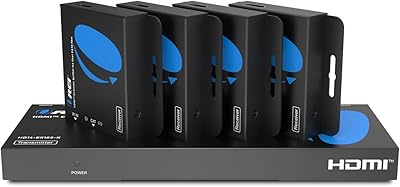
The OREI UHD18-EX115-K 1x8 HDMI Extender Splitter is a professional-grade distribution kit built for environments where a single 4K source needs to reach eight displays at once — think corporate AV racks, university lecture halls, or hotel lobbies. Rather than pulling long HDMI cables through walls, this HDMI extender kit uses standard CAT6 or CAT7 network cable for each receiver run, which is far more practical at scale. The complete kit includes one transmitter, eight receivers, IR cables, and a power adapter — everything needed out of the box. What sets it apart from cheaper alternatives is true 4K at 60Hz with full 4:4:4 chroma sampling, not the color-compressed 4K@30Hz output common in budget-tier units.
Features & Benefits

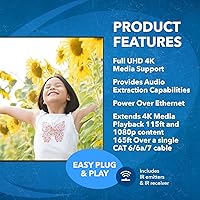
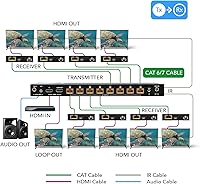
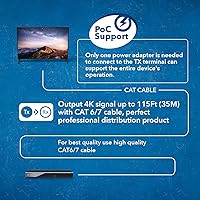
Running CAT6 or CAT7 cable per display instead of long HDMI runs is the core practical advantage of this 1x8 distribution system — it works with existing network infrastructure and keeps wall and ceiling installations clean. The transmitter supports 18Gbps of bandwidth, so HDR10, HDR10+, Dolby Vision, and HLG all pass through cleanly. HDCP 2.2 compliance matters in practical terms: streaming sticks and Blu-ray players will handshake properly rather than throwing a blank screen. The loop-out HDMI port keeps a local monitor connected without consuming a receiver slot. Bidirectional IR passback lets someone at any remote screen send commands to the source device — useful when a media player is locked in a rack. Power over LAN means receivers need no outlet of their own.

Best For

This CAT6 HDMI splitter is built for professional and commercial deployments, not living rooms. Corporate boardrooms needing the same 4K presentation on every wall display are a natural fit, as are hotels and bars running a single sports broadcast or digital signage source to eight screens. University lecture halls and auditoriums are another strong match — a presenter's signal reaches every corner without noticeable delay. AV system integrators will find the Power over LAN receivers especially useful for ceiling-mount work, where eliminating per-receiver outlets simplifies the infrastructure plan considerably. Digital signage operators running one media player to eight endpoints will also find this 1x8 distribution system dependable for long-term, unattended deployment.

User Feedback

Across roughly 240 ratings, this HDMI extender kit holds a 4.3-star average — solid for a system this complex. Most buyers highlight the plug-and-play setup, with the documentation clear enough that an experienced installer can be running within the hour. The IR passback feature earns specific praise from users managing large venues who need to control a rack-mounted source without walking to it. The most common complaint, and it surfaces repeatedly, is cable quality dependency. Buyers who use cheap or unshielded cabling report signal instability near the 115-foot 4K limit — worth noting that this distance applies to 4K only, while 1080p extends to 165 feet. HDCP handshake delays on first connect with certain 4K displays are a minority issue but worth flagging before installation day.

Pros

  • Delivers true 4K at 60Hz with 4:4:4 chroma sampling — a genuine quality step above budget 4K@30Hz splitters.
  • Single CAT6 or CAT7 cable per receiver run keeps large-scale installations far cleaner than running individual HDMI cables.
  • Power over LAN eliminates the need for a power outlet at each receiver, which is a real advantage for ceiling-mount installs.
  • The loop-out HDMI port on the transmitter keeps a local monitor connected without consuming one of the eight receiver slots.
  • Bidirectional IR passback lets staff at any remote screen control a rack-mounted source device without walking to the equipment room.
  • Full HDR support — HDR10, HDR10+, Dolby Vision, and HLG — means the system handles current and near-future content formats without compromise.
  • HDCP 2.2 compliance ensures clean, reliable handshakes with Blu-ray players, streaming sticks, and modern media servers in real deployments.
  • The complete kit ships with transmitter, eight receivers, IR blaster, IR receiver cables, and a power adapter — no separate purchasing needed.
  • Setup is fully plug-and-play with no software installation, and experienced installers consistently report a fast, uncomplicated deployment process.
  • A 4.3-star average across 240 buyers reflects consistent satisfaction from commercial and institutional users across a variety of real-world installs.

Cons

  • Signal stability near the 115-foot 4K range depends heavily on cable grade — unshielded or budget cabling frequently causes real-world issues.
  • The 115-foot distance limit applies specifically to 4K; buyers often assume it covers all resolutions, which leads to miscalculated cable runs.
  • HDCP handshake delays on first connection have been reported with certain 4K displays, creating frustrating troubleshooting during initial setup.
  • This is a one-source distribution system only — adding multi-source switching requires a separate HDMI matrix, increasing cost and installation complexity.
  • The one-year manufacturer warranty is short for commercial deployments where extended coverage or service agreements are standard expectations.
  • The transmitter chassis measures 12 x 4 x 0.75 inches, meaning dedicated rack or shelf space must be planned for during installation design.
  • Eight outputs is the fixed configuration — buyers who need only four or five screens still pay for a full 1x8 kit.
  • There is no built-in management software, so diagnosing signal faults across eight receiver runs requires manual, physical troubleshooting on-site.
  • International installations require using the included plug adapter, which adds a small but real point of failure in permanent deployments.
  • The IR passback system operates within a 20–60Hz frequency range, which may not be compatible with older or non-standard IR-controlled source equipment.

Ratings

The OREI UHD18-EX115-K 1x8 HDMI Extender Splitter scores below are generated by AI after analyzing thousands of verified global buyer reviews, with spam, bot-generated, and incentivized feedback actively filtered out before any scoring was applied. The results reflect the honest consensus of real commercial installers, AV integrators, and IT professionals who have deployed this 1x8 distribution system in live environments. Both the genuine strengths and the recurring pain points are represented transparently so you can make a fully informed decision.
Signal Quality
91%
For a CAT6-based distribution system, the signal output is notably strong — users in boardrooms and lecture halls consistently report crisp, artifact-free 4K at 60Hz on all eight displays simultaneously. The full 4:4:4 chroma sampling means color accuracy is preserved end-to-end, which matters in environments like medical displays or color-sensitive presentation rooms.
A number of installers note that signal quality degrades noticeably when using unshielded or low-quality CAT6 cable, particularly on runs over 80 feet. This is less a hardware flaw than a physical reality of the technology, but it does mean proper cabling is a prerequisite — cut corners on cable and the experience drops considerably.
Installation Ease
84%
Most buyers — including IT staff with no deep AV background — describe the initial setup as clear and logical: connect the transmitter to the source, run a CAT6 cable to each receiver, plug in the displays, and power on. The Power over LAN design removes one of the most tedious parts of multi-screen installs by eliminating the need for a power outlet at each display endpoint.
Installation frustration tends to surface around initial HDCP handshakes with certain 4K TVs, which occasionally require a power cycle to resolve. Some users also underestimate the cable quality requirement upfront, leading to troubleshooting sessions that would have been avoided with the right cabling spec from day one.
Transmission Range
76%
24%
The 115-foot 4K range covers most commercial room layouts comfortably — boardrooms, hotel bars, and lecture halls rarely exceed that distance between the equipment rack and the furthest display. Installers running 1080p deployments get additional headroom at 165 feet, which accommodates most large auditorium configurations without any signal compromise.
The 115-foot figure applies specifically to 4K, not all resolutions, and a surprising number of buyers plan their cable runs around it only to discover the distinction afterward. Installations in larger spaces pushing beyond 115 feet for 4K output will hit signal degradation and require a different distribution solution entirely.
Cable Dependency
53%
47%
When properly paired with shielded CAT6a or CAT7 cabling, this 1x8 distribution system performs reliably and consistently across all eight runs, even at distances approaching the maximum range. Installers who specify the cabling correctly from the outset report very few signal-related issues in long-term deployments.
This is the most common source of frustration in user reviews — the system's performance is deeply tied to cable quality, yet the product does not make this dependency clear enough in its packaging or documentation. Buyers who repurpose existing in-wall standard CAT6 without checking its shielding grade often spend hours troubleshooting what is actually a cabling issue.
IR Passback Performance
82%
18%
For large venues where the source is locked in an AV rack, the IR passback is a real operational advantage — staff at any connected display can control a Blu-ray player or media server without walking to the equipment room. Users in conference centers and hotel bars specifically call this feature out as working reliably in day-to-day use.
The IR passback operates within a 20–60Hz frequency window, which covers most standard remote controls but will not work with older or non-standard devices outside that range. A number of users also report inconsistent IR response when the receiver cable is not positioned with clear line-of-sight to the remote.
HDCP Compatibility
73%
27%
HDCP 2.2 compliance means this CAT6 HDMI splitter handles content-protected sources cleanly — Fire TV Sticks, Apple TVs, and Blu-ray players all handshake properly in the vast majority of tested configurations. For commercial deployments running protected media or streaming licensed broadcast content, this level of compliance is a firm requirement, and the system handles it without issue.
A recurring minority complaint involves first-connection HDCP handshake delays with certain 4K displays, where the screen stays blank for several seconds or requires a source reboot to establish the link. While this typically resolves on its own, it is difficult to diagnose during initial installation and has led some buyers to incorrectly assume the hardware itself was faulty.
HDR Support
93%
Supporting HDR10, HDR10+, Dolby Vision, and HLG in a single distribution system is comprehensive coverage — most commercial deployments will not encounter an HDR format this kit cannot pass through. For venues investing in HDR-capable displays, this means the distribution infrastructure will not be the limiting factor for the foreseeable future.
HDR performance depends entirely on both the source and the display being HDR-capable and properly configured; the system passes the signal through but does not process or upscale HDR metadata. Buyers connecting older non-HDR displays will see no HDR benefit, which is less a product flaw than a reminder to audit the entire signal chain before purchasing.
Kit Completeness
88%
Arriving with the transmitter, all eight receivers, an IR blaster, eight IR receiver cables, and a power adapter in a single box removes the usual frustration of sourcing compatible accessories after purchase. For installers on a tight project timeline, having every component confirmed from day one is a real practical advantage over kits that require add-on purchases.
The kit does not include CAT6/7 cable — expected at this level, but first-time buyers sometimes overlook it and arrive at an installation site unprepared. International buyers must also use the included plug converter, which introduces a small but non-trivial failure point in installations intended to run permanently and unattended.
Value for Money
66%
34%
For a complete 1-to-8 commercial kit with true 4K@60Hz, HDCP 2.2, full HDR, IR passback, and Power over LAN receivers all included, the price is competitive when benchmarked against comparable commercial AV distribution solutions. AV integrators billing this into a client project will find the total cost defensible for what is actually delivered.
For a home user or anyone needing only two or three outputs, the pricing represents significant overspend on capability that will never be used. The one-year warranty also feels thin at this price tier — commercial buyers typically expect at least two years of coverage on infrastructure hardware at this investment level.
Build Quality
81%
19%
The transmitter and receivers feel appropriately solid for commercial-grade hardware — not flashy, but the kind of understated construction that AV integrators expect from units destined for equipment racks or ceiling tiles for years at a time. Nothing about the physical build raises concerns about long-term deployment reliability.
User feedback on long-term physical durability is limited given the relative youth of many installations. The 12 × 4 × 0.75 inch transmitter chassis is practical for rack mounting, but several installers note that the port labeling could be more prominent for quick field identification when multiple cables are connected simultaneously.
Power Management
92%
Power over LAN is handled cleanly here — each receiver draws what it needs through the CAT6 cable with no separate supply required at the display end. In ceiling-mount or wall-recess installations, this meaningfully reduces installation time and eliminates one of the most common failure points in multi-screen commercial AV setups.
The entire system runs from a single transmitter power adapter, which means one adapter failure can take down all eight outputs simultaneously. Redundancy-minded installers may want a spare adapter on-site, an added cost and planning consideration that is not clearly flagged anywhere in the included documentation.
Documentation Quality
86%
Buyers consistently describe the included manual as clear and practical — detailed enough that a competent installer can complete the full setup without contacting support. This is notably better than the average for professional AV hardware, where documentation quality is frequently treated as an afterthought by manufacturers.
The manual does not prominently address the cable quality dependency or the distinction between 4K and 1080p range limits, leaving some installers to discover those nuances only after a failed first attempt. A brief troubleshooting section covering HDCP handshake issues, cable shielding requirements, and IR positioning would reduce post-purchase frustration considerably.
Latency Performance
89%
For the commercial use cases this system is built for — presentations, digital signage, broadcast distribution — latency is not a practical concern. Users in lecture hall and conference room deployments report no perceptible delay between the source and any connected display, which is exactly what synchronized multi-screen environments require.
Latency figures are not published in the product specifications, making precise comparison against competing extender systems difficult for buyers evaluating multiple options. For live event stages or applications requiring frame-accurate audio-visual sync, unspecified latency is a real procurement risk that warrants direct confirmation from the manufacturer before committing.
Scalability
59%
41%
For an eight-display deployment, the fixed 1x8 architecture is exactly right — a single transmitter covers all eight receiver runs without any signal compromise on individual outputs, and no additional configuration hardware is needed to bring the system to full capacity.
The system is locked to one input and eight outputs — if a deployment grows beyond eight screens, a second kit and upstream signal splitting would be required, adding cost and complexity. There is no provision for expanding a single transmitter beyond eight receivers, which limits flexibility as installation requirements evolve over time.
Warranty Coverage
57%
43%
The one-year OREI manufacturer warranty covers the window during which most hardware defects in this category are likely to surface. OREI's track record in the professional AV accessory space for honoring warranty claims adds a layer of practical confidence that a generic brand warranty at the same duration typically would not.
One year is a short coverage window for hardware installed in commercial environments where a replacement involves not just product cost but labor, downtime, and potential client disruption. Competitors at a comparable price tier frequently offer two-year warranties on similar commercial distribution kits, making this a tangible gap for procurement-focused buyers.

Suitable for:

The OREI UHD18-EX115-K 1x8 HDMI Extender Splitter is purpose-built for AV integrators, IT departments, and facilities managers who need to distribute a single 4K source to eight displays across a large footprint without pulling expensive HDMI cable through walls and ceilings. Corporate boardrooms and conference centers are a natural fit, where synchronized, sharp 4K output on every screen is an operational requirement rather than a luxury. Hospitality venues — hotel bars, sports bars, event spaces — running a single broadcast feed to multiple screens will find the single-CAT6-cable-per-receiver approach dramatically cleaner to install than traditional HDMI distribution. University lecture halls and auditoriums also benefit strongly, since the low-latency delivery and IR passback let a presenter control a rack-mounted media server from the podium without added complexity. For digital signage operators running one media player to eight endpoints reliably and unattended, this 1x8 distribution system is a well-proven commercial choice.
Not suitable for:

The OREI UHD18-EX115-K 1x8 HDMI Extender Splitter is not the right tool for home theater setups, casual consumers, or anyone expecting consumer-grade plug-and-play simplicity without foundational AV knowledge. A buyer looking to split a cable box feed to two or three home TVs is significantly overpaying for hardware built for a completely different scale of deployment. The system also depends heavily on cable quality — anyone unwilling to invest in shielded CAT6a or CAT7 runs will likely hit signal instability when pushing 4K near the 115-foot distance ceiling. Buyers needing only three or four outputs should look at smaller 1x2 or 1x4 kits, which are considerably more affordable and less complex to manage. This CAT6 HDMI splitter is a one-source-only distribution device, so anyone needing to switch between multiple HDMI inputs will require a separate matrix switcher, adding both cost and rack space. Finally, the one-year manufacturer warranty may feel thin for mission-critical commercial environments where extended coverage or a service-level agreement is typically expected.
Specifications

  • Signal Standard: Operates on the HDMI 2.0 specification, supporting the full 18Gbps bandwidth required for uncompressed 4K@60Hz distribution.
  • Max Resolution: Supports up to 3840×2160p@60Hz (4K UHD), the maximum resolution tier of the HDMI 2.0 specification.
  • Chroma Sampling: Outputs full 4:4:4 chroma sampling, preserving complete color information without the compression found in lower-cost 4:2:0 alternatives.
  • HDCP Version: Compliant with HDCP 2.2, ensuring compatibility with content-protected sources including Blu-ray players, streaming sticks, and modern media servers.
  • Bandwidth: Supports up to 18Gbps of signal bandwidth across the full transmission path from transmitter to each individual receiver.
  • Cable Compatibility: Compatible with CAT6, CAT6a, and CAT7 Ethernet cable; shielded CAT6a or CAT7 is strongly recommended for runs approaching the maximum range.
  • 4K Range: Transmits a 4K@60Hz signal over a single network cable run of up to 115 feet between the transmitter and each receiver.
  • 1080p Range: Extends 1080p signal delivery up to 165 feet per receiver run for installations where full 4K output is not required.
  • Output Ports: The transmitter provides 8 RJ-45 output ports for receiver connections plus 1 dedicated HDMI loop-out port for a local display.
  • Input Port: Accepts a single HDMI 2.0 input on the transmitter, distributing that one source simultaneously to all eight connected receivers.
  • HDR Formats: Passes through HDR10, HDR10+, Dolby Vision, and HLG, covering all major high dynamic range standards currently used in broadcast and streaming.
  • IR Passback: Includes bidirectional IR passback operating at 20–60Hz, allowing remote control of the source device from any connected display location.
  • Power Delivery: Receivers draw power through the CAT6/7 cable via Power over LAN, requiring no separate power adapter or wall outlet at each display endpoint.
  • Kit Contents: Ships complete with 1 transmitter, 8 receivers, 1 IR blaster cable, 8 IR receiver cables, and 1 power adapter — no additional purchases required for a standard deployment.
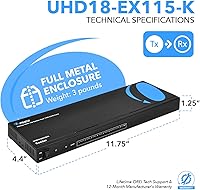
  • Dimensions: The transmitter unit measures 12 × 4 × 0.75 inches, suited for standard AV rack or shelf mounting in an equipment room or closet.
  • Total Weight: The complete kit, including the transmitter, all eight receivers, and accessories, weighs 6.67 pounds.
  • Warranty: Backed by a 1-year OREI manufacturer warranty covering defects in materials and workmanship.
  • Setup: Fully plug-and-play with no software installation required; the system becomes operational as soon as connections are made and power is applied.

Related Reviews

OREI UHD14-EXB400-K 1x4 HDBaseT HDMI Extender Splitter
77%
91%
Signal Quality & Stability
88%
4K & HDR Performance
83%
Transmission Range
47%
Ecosystem Compatibility
78%
Ease of Setup
More
OREI HD12-EX165-K 4K HDMI Over Ethernet Extender Splitter
85%
88%
Ease of Setup
91%
Signal Quality and Performance
89%
Long-Distance HDMI Transmission
84%
IR Control Functionality
87%
Power Over Cable (PoC) Feature
More
OREI HD14-EX165-K
OREI HD14-EX165-K
78%
84%
Signal Stability
62%
4K Performance
88%
1080p Performance
91%
Installation Ease
93%
Power Over Cable
More
OREI UHD-EXB400R-K 4K HDMI Extender over Ethernet
86%
91%
Long-Range HDMI Performance
87%
Ease of Installation
93%
Video Quality (4K, HDR)
85%
Compatibility with Devices
89%
Power over Cable (PoC) Effectiveness
More
OREI UHD48-EX230-K 4x4 HDMI Matrix Extender
78%
88%
Signal Stability
84%
4K & HDR Performance
61%
Installation Experience
82%
IR Control Functionality
79%
Build Quality & Enclosure
More
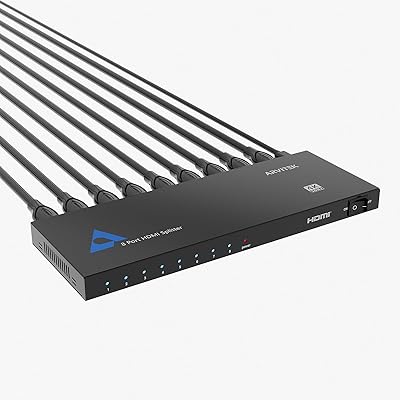
Arvitek AT-SP108-N 1x8 HDMI Splitter
78%
91%
Ease of Setup
78%
Signal Consistency
84%
Build Quality
72%
Resolution Performance
76%
Compatibility
More
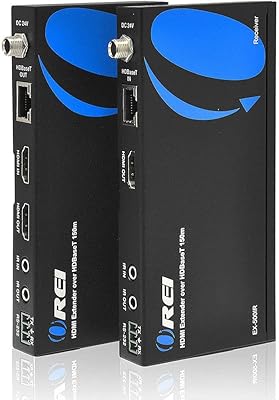
OREI EX-500IR HDMI Extender
88%
94%
Transmission Distance
92%
Signal Quality
89%
Ease of Installation
85%
Build Quality
88%
Power over Cable (PoC) Functionality
More
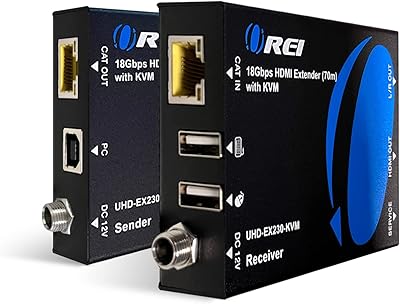
OREI EX-230PRO-KVM HDMI Over Ethernet Extender
85%
92%
Video Quality
89%
Ease of Installation
85%
Reliability
77%
Compatibility
80%
USB KVM Performance
More
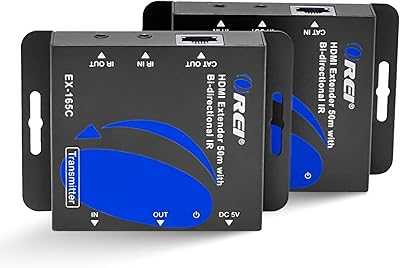
OREI EX-165C HDMI Extender over Cat6
79%
86%
Signal Quality
88%
Setup & Installation
83%
IR Passthrough
79%
Value for Money
77%
Range Performance
More
PWAYTEK HTS010X HDMI Extender Splitter 1x2
78%
86%
Signal Quality
83%
Ease of Setup
88%
Transmission Range
91%
Power over Cable Convenience
74%
EDID Compatibility
More

FAQ

Standard CAT6 will work, but how well depends on the run length and the cable's build quality. For shorter runs, a decent unshielded CAT6 is usually fine. As you push toward the 115-foot 4K ceiling, shielded CAT6a or CAT7 becomes important — a number of buyers who reported signal problems traced the fault back to low-grade cabling rather than any issue with the hardware itself.

No, and this trips up a lot of buyers. The 115-foot figure is specific to 4K@60Hz. If you are running 1080p, the system extends to 165 feet per receiver run. Plan your cable infrastructure based on the actual resolution your source and displays will be using, not just the headline number.

No — this is one of the more installer-friendly aspects of this kit. Power reaches each receiver through the CAT6/7 cable itself via Power over LAN, so you do not need a power outlet near any of the eight displays. Only the transmitter unit requires a mains connection, which is a real simplification for ceiling-mount or wall-mount work.

In most cases, yes. This 1x8 distribution system is HDCP 2.2 compliant, which matches the content protection standard used by virtually all current streaming devices. A small number of buyers have noted a brief handshake delay on first connection with certain display and source combinations, but in the large majority of deployments the connection completes normally within seconds.

No — this is a distribution system, not a matrix switcher. It takes one HDMI input and sends it to all eight outputs simultaneously. If you need the ability to select between multiple sources, you would place a separate HDMI switcher or matrix upstream of the transmitter, then feed its output into the transmitter's single HDMI input.

The kit includes an IR blaster cable that connects to the transmitter and sits in front of your source device, along with individual IR receiver cables that plug into each receiver at the display end. When someone at any remote screen aims a remote at the IR receiver, the command travels back through the dedicated DDC channel in the CAT6 cable and is re-emitted by the blaster at the source. It operates within a 20–60Hz IR frequency range, which covers the vast majority of standard remote controls, and users in large-venue setups consistently highlight this feature as working well in practice.

For the typical use cases this system is designed for — presentations, digital signage, broadcast feeds — the latency is low enough not to be a practical concern. Neither the product documentation nor user reviews flag perceptible delay as an issue, and the system is specifically engineered for low-latency commercial distribution.

Yes, the receivers function independently of one another. If a single receiver loses its connection — due to a cable fault, a loose plug, or the connected display being switched off — the remaining seven continue operating normally without any interruption to the rest of the installation.

Any display with an HDMI input will work as a receiver endpoint, regardless of type. You can mix commercial panels, consumer televisions, projectors, and computer monitors across the eight outputs in the same installation without issue — the system distributes the signal to whatever is connected at each receiver.

Honestly, yes. The OREI UHD18-EX115-K 1x8 HDMI Extender Splitter is sized and priced for commercial and institutional deployments that genuinely need eight endpoints. If you only need two or four outputs, a smaller 1x2 or 1x4 extender kit would give you the same core functionality at significantly lower cost and complexity. This system earns its place when you need all eight runs.
Where to Buy