Overview

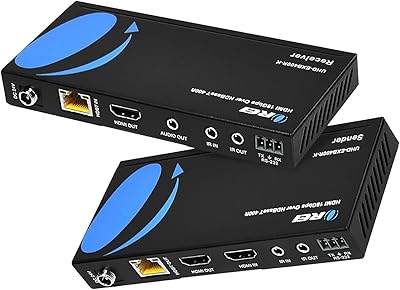
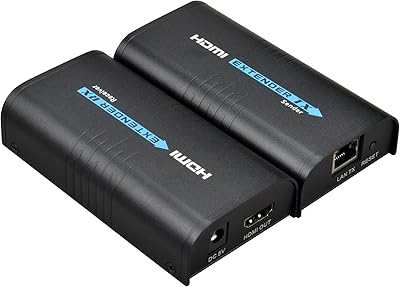
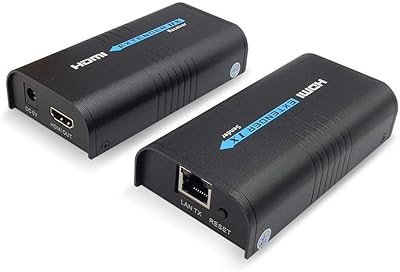
The OREI EX-165C HDMI Extender over Cat6 is a transmitter-and-receiver kit built to push an HDMI signal up to 165 feet through a single Cat5e or Cat6 ethernet cable — a practical fix for installations where a long HDMI run simply isn't an option. On the market since 2016, it has accumulated over 1,100 ratings and a solid track record that shorter-lived alternatives just can't match. At its mid-range price, this HDMI extender kit occupies a sensible middle ground between budget units and serious pro-AV gear, making it viable for home installers and IT teams alike. A dual-voltage power supply and international adapter come included, so cross-region deployments are covered. A composite rating of 4.2 out of 5 signals broad satisfaction, though it isn't a perfect score — which tells you something honest about its limitations.

Features & Benefits

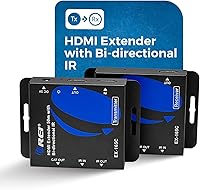
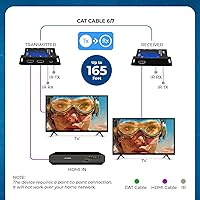
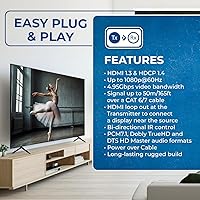
At its core, this Cat6 signal extender delivers stable 1080p Full HD over a single ethernet cable run up to 165 feet. Worth stating clearly — this is not a 4K solution. If your source or display operates at 4K, the signal will downscale or behave inconsistently, so check your setup before buying. For 1080p content, performance holds up well. The IR passthrough works by transmitting remote control signals from the receiver end back toward the source, letting you operate a Blu-ray player or cable box from the far room without line-of-sight. A local loop-out at the transmitter keeps a second display active at the source end simultaneously. EDID management handles display handshaking automatically, and POC lets the receiver draw power through the cable itself, removing the need for a second wall adapter.

Best For

This HDMI extender kit is well-suited to anyone dealing with a distance problem HDMI cable alone can't solve. Home theater enthusiasts routing a signal through walls or ceilings to a projector or TV in another room are the obvious fit — particularly when Cat6 is already run through the building. Conference rooms, training spaces, and classrooms benefit from the clean, cable-efficient setup without visible video lag or quality loss at the display end. IT professionals managing equipment racks or test benches will appreciate both the plug-and-play setup and the IR control, since those environments often demand remote source operation without being physically present at the transmitter. If you need 4K support or HDR, though, look elsewhere — the OREI extender tops out at 1080p.

User Feedback

Across the review base, a consistent pattern emerges. Buyers who pair this Cat6 signal extender with quality Cat6 cable report clean, reliable video over the full 165-foot range — the keyword being quality cable, since inferior ethernet is a common culprit behind negative reviews. The IR passthrough gets singled out repeatedly as a deciding factor, especially by home theater buyers. On the downside, several users report trouble with 4K-capable sources that don't negotiate resolution cleanly, producing no signal or a flickering display. That 1080p ceiling is a hard one. A small number of users also mention needing a power cycle during initial setup, which is a minor but real quirk to plan for.

Pros

  • Delivers clean, stable 1080p video over runs up to 165 feet on quality Cat6 cable.
  • IR passthrough lets you control source devices from the display end — a feature many competing kits skip.
  • The local loop-out port allows a second monitor to stay active at the source end simultaneously.
  • POC support means the receiver can draw power through the ethernet cable, reducing adapter clutter.
  • EDID management handles display handshaking automatically — no manual configuration required.
  • Plug-and-play setup has been confirmed by hundreds of buyers; no driver installation needed.
  • Metal enclosure provides EMI and RFI shielding, suitable for busy IT or rack environments.
  • Dual-voltage power supply with international adapter included covers cross-region deployments out of the box.
  • FCC, CE, and RoHS certified, passing the compliance bar for both commercial and home installations.
  • A long market history since 2016 means well-documented real-world performance across a wide range of setups.

Cons

  • Strictly limited to 1080p — not suitable for 4K sources or displays expecting higher resolution signals.
  • Some 4K-capable source devices fail to downscale cleanly, resulting in no signal at all.
  • Full 165-foot range is only reliable on quality Cat6; Cat5e users may experience signal instability near the limit.
  • A small but notable share of buyers report needing a power cycle before the connection initializes properly.
  • No support for HDMI audio return channel (ARC), which limits use with certain soundbar setups.
  • The receiver still requires its own power in most setups unless POC is fully supported end-to-end.
  • The kit only supports point-to-point extension; reaching multiple remote displays requires additional hardware.
  • No HDR or advanced color space support — picture quality improvements beyond standard 1080p SDR are not possible.

Ratings

Our scores for the OREI EX-165C HDMI Extender over Cat6 were generated by AI after analyzing thousands of verified purchase reviews from global buyers, actively filtering out suspected spam, bot-generated responses, and incentivized feedback. Each score reflects the real distribution of buyer experiences — genuine strengths and recurring frustrations are both weighted into every number. Whether you are sizing it up for a home theater build, a conference room install, or an IT rack setup, the ratings below give you an unvarnished look at how this Cat6 signal extender actually performs.

Signal Quality
86%
For users running quality Cat6 cable at 1080p, the signal arriving at the far display is clean and consistent — no visible compression artifacts, color banding, or flicker. Home theater owners connecting a Blu-ray player or satellite receiver to a distant TV reported no perceptible drop in picture quality across full-length content.
The hard ceiling at 1080p means anyone with a newer 4K display expecting automatic downscaling will often be disappointed. Several buyers found their 4K streaming boxes produced no signal at all rather than stepping down gracefully, requiring manual source resolution changes — an extra step that catches many buyers off guard.
Setup & Installation
88%
The plug-and-play experience is about as close to effortless as this category gets — connect the cable, power both units, and the signal appears within seconds in the vast majority of installs. IT staff and home installers alike appreciated the absence of drivers, configuration menus, or software dependencies.
A recurring complaint involves first-boot initialization failures where the display stays blank until both units are power cycled in the correct order — transmitter first, receiver second. While not a dealbreaker, it is an undocumented quirk that creates unnecessary confusion during what should be a straightforward initial setup.
IR Passthrough
83%
Buyers who purchased this kit specifically for IR control were overwhelmingly satisfied — it is the feature most commonly cited in five-star reviews. For conference room setups or home theaters where the source device is locked in a cabinet, being able to use a standard remote from the screen end solved a real practical problem.
The IR sensor placement and range at the receiver end is not clearly documented, and some users found it needed careful positioning to pick up remote signals reliably. A small number of users also reported inconsistency with certain IR protocols from less common remotes, suggesting the passthrough does not support all signal formats equally.
Value for Money
79%
21%
At its mid-range price point, this Cat6 signal extender offers a feature set — IR passthrough, local loop-out, POC, EDID management — that budget-tier alternatives rarely bundle together. For home theater owners or small business AV setups, it avoids the significant cost jump into dedicated HDBaseT hardware while covering most practical needs.
Buyers with 4K setups will find the value proposition weakens considerably, since the 1080p limitation means the kit may need replacing sooner as 4K content becomes standard. A handful of reviewers also felt the build quality did not quite justify the price compared to cheaper alternatives that performed comparably on shorter runs.
Range Performance
77%
23%
When tested with certified Cat6 cable at distances between 50 and 130 feet — the sweet spot most residential and light commercial installs fall into — performance is consistently reported as reliable. Wall-run installations in home theaters and classroom AV setups within this range bracket see very few signal complaints.
At or near the 165-foot maximum, performance becomes heavily dependent on cable quality and condition — cable routed through walls with multiple bends introduces signal loss that pushes the extender beyond its stable operating envelope. Users attempting to push Cat5e to its limits at 150-plus feet report noticeably higher failure rates.
Build Quality
82%
18%
The metal enclosures on both transmitter and receiver units give the kit a noticeably sturdier feel than plastic-bodied competitors at similar prices. Users in rack environments and under-desk IT setups praised the surface-mount housing design, which keeps units stable and prevents the connector stress that wears out cheaper plastic units.
A few users noted that the HDMI ports felt slightly loose after extended use, particularly on units handled frequently during test bench rotations. The surface-mount bracket design, while useful, does not accommodate standard rack-mount rails, meaning a dedicated rack installation still requires improvised mounting solutions.
EDID Management
84%
Automatic EDID handling saves considerable troubleshooting time — the source reads the actual display capabilities without the user having to force a resolution manually. In multi-device setups where the source is switched between different displays, EDID management consistently prevents the mismatched resolution handshakes that plague simpler extenders.
A minority of users with unusual display configurations — particularly older projectors or non-standard commercial monitors — reported that the EDID passthrough relayed incorrect capabilities, causing the source to output a resolution the display could not render. These edge cases are uncommon but worth noting for anyone running non-standard display equipment.
Device Compatibility
67%
33%
For standard 1080p source devices — streaming boxes set to 1080p output, Blu-ray players, gaming consoles, and cable boxes — compatibility is broad and reliable. Users with conventional home theater equipment reported very few connection or handshake issues once resolution settings were confirmed on the source side.
Modern 4K-capable devices — including current-generation streaming sticks, UHD Blu-ray players, and newer gaming consoles — are a consistent source of compatibility complaints. When these devices attempt to negotiate a 4K or HDR handshake, the extender frequently returns no signal rather than defaulting gracefully to 1080p, requiring manual source-side intervention.
POC Support
73%
27%
POC support is genuinely useful for in-wall installations where running power to the receiver location is inconvenient or expensive — many users in finished basement or ceiling projector setups cited it as the feature that made their installation practically feasible. When it works, it eliminates a power outlet requirement and simplifies cable management significantly.
POC reliability is not universal — some users with longer cable runs or lower-quality cable found the receiver would not power up through the cable and required its own adapter regardless. The lack of clear specification on exactly which conditions guarantee POC operation leaves users planning for a fallback outlet just in case.
Loop-Out Port
78%
22%
The local loop-out port earns consistent appreciation from users who need to monitor the source feed at the transmitter end while simultaneously sending signal to a remote display. Classroom setups and event production teams particularly valued this, as it lets a presenter watch the same feed at their desk that appears on the wall screen.
The loop-out mirrors the signal only — it cannot independently display different content from the remote end. A handful of users also noted minor signal degradation on the loop-out feed when the main cable run was already near the 165-foot maximum, suggesting bandwidth is shared rather than duplicated at full strength.
EMI Resistance
81%
19%
The metal housing provides meaningful shielding in environments where radio frequency interference is a real concern — particularly in server rooms, equipment closets, and data centers running multiple devices in close proximity. Several IT professionals noted that competing plastic-encased extenders introduced interference artifacts in similar setups that this kit did not.
In typical residential installations — living rooms, home offices, finished basements — EMI shielding is largely a non-issue, meaning many home buyers are paying for a feature they will never need. The metal casing also adds minor weight and bulk compared to lighter plastic alternatives, which can complicate mounting in tight spaces.
Long-term Reliability
76%
24%
With a product history stretching back to 2016 and over 1,100 verified ratings, this HDMI extender kit has a longevity record few competitors can match at its price tier. Buyers who installed it years ago and revisited their reviews reported the units were still performing without issue in permanent home theater and commercial AV installs.
A small cluster of buyers reported intermittent signal dropout after six to twelve months of continuous use, most commonly at the HDMI connector points rather than signal-processing failure. The absence of any clearly stated manufacturer warranty in the product documentation leaves buyers with limited recourse if units degrade over time.
Cable Dependency
71%
29%
For users who invest in quality, shielded Cat6 cable — the kind commonly used in structured home wiring or commercial data installations — the extender rewards that investment with consistent, reliable performance across the full claimed range. Installers who pre-ran Cat6 in walls for networking found the kit integrated into existing infrastructure without friction.
Performance is strongly contingent on cable quality in a way that is not adequately communicated upfront — buyers using bargain ethernet cable from big-box stores make up a significant portion of the negative review base. There is no built-in signal diagnostic to help users distinguish a bad cable from a defective unit.
Audio Quality
74%
26%
Standard multi-channel audio embedded in the HDMI signal travels through the ethernet run without any perceptible sync issues or quality degradation under typical conditions. Home theater users with 5.1 receiver setups reported clean audio delivery with no lip-sync offset requiring adjustment through the display or receiver settings.
The lack of ARC support is a meaningful limitation for users who rely on it to pipe TV audio back to a soundbar or AV receiver. Buyers who discovered this after purchase — expecting full HDMI feature parity — were among the more frustrated reviewers, particularly in living room setups centered around a smart TV and soundbar.

Suitable for:

The OREI EX-165C HDMI Extender over Cat6 is a strong pick for anyone who needs to bridge a serious distance between an HDMI source and a display without ripping out walls to run new cable. Home theater owners who already have Cat6 ethernet installed — or who are willing to run it — will find it a clean, low-fuss solution for feeding a projector or TV in a room far removed from a media rack or set-top box. It also fits naturally into small business environments: conference rooms, training centers, and classrooms where a consistent 1080p video feed needs to reach a wall display from a source at the instructor's desk or AV cabinet. IT professionals managing equipment racks or test benches will appreciate both the hands-off EDID handling and the IR passthrough, which lets them operate source devices remotely without walking to the other end of the room. If your content is 1080p and your run is under 165 feet on quality Cat6, this kit reliably does exactly what it promises.

Not suitable for:

Anyone running a 4K display or working with a 4K-capable source device should look elsewhere — the OREI EX-165C HDMI Extender over Cat6 tops out at 1080p Full HD, and sources that try to negotiate a higher resolution can produce a blank screen or an unstable signal. If your setup exceeds the 165-foot distance, this kit simply will not cover it without a signal booster or a different product class entirely. Users planning to rely on Cat5e cable should also temper expectations: the full 165-foot range is best guaranteed on true Cat6, and Cat5e runs approaching that distance can introduce signal instability. Anyone expecting a 4K TV to reliably auto-downscale the signal will likely run into compatibility headaches that most buyers are not prepared for. It is also not the right choice for anyone who needs to distribute to more than two displays simultaneously, or for setups that depend on HDMI audio return channel functionality.

Specifications

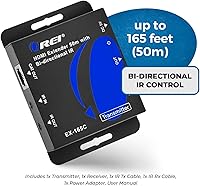
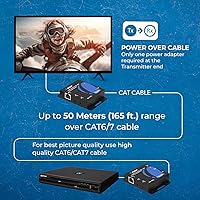
  • Maximum Range: The kit extends an HDMI signal up to 165 feet (50 meters) over a single ethernet cable run.
  • Video Resolution: Maximum supported resolution is 1080p Full HD; 4K and HDR are not supported by this hardware.
  • Cable Compatibility: Works with Cat5e or Cat6 ethernet cable, though Cat6 is strongly recommended for runs near the 165-foot limit.
  • Kit Contents: Includes one transmitter (TX) unit, one receiver (RX) unit, power adapters, and an international plug adapter.
  • IR Passthrough: Supports IR remote control passthrough, relaying signals from the display end back to the source device.
  • Loop-Out Port: A local HDMI loop-out port on the transmitter keeps a second display active at the source location simultaneously.
  • EDID Management: Built-in EDID handling automatically communicates supported display capabilities to the source device without manual configuration.
  • Power over Cable: POC functionality allows the receiver unit to draw operating power through the ethernet cable from the transmitter end.
  • Power Supply: Ships with a dual-voltage power adapter (100–240V) and an international plug converter for cross-region installations.
  • Housing Material: Both units feature surface-mountable metal enclosures designed to reduce EMI and RFI interference in dense AV or IT environments.
  • Certifications: FCC, CE, and RoHS certified, meeting compliance requirements for residential and commercial use in multiple regions.
  • Data Bandwidth: Supports up to 10.2 Gbps of data throughput, sufficient to carry uncompressed 1080p HDMI signals.
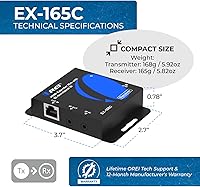
  • Unit Dimensions: Each unit measures 5 x 2 x 5 inches, compact enough for rack shelves, wall mounts, or enclosed AV cabinets.
  • Total Kit Weight: The complete kit — both units and accessories — weighs approximately 1 pound.
  • Setup Method: Installation is fully plug-and-play; no drivers, software, or network configuration are required.
  • Model Reference: Manufactured by Orei Products under model number EX-165C, available since June 2016.

Related Reviews
OREI EX-500IR HDMI Extender
88%
94%
Transmission Distance
92%
Signal Quality
89%
Ease of Installation
85%
Build Quality
88%
Power over Cable (PoC) Functionality
More
OREI EX-230PRO-KVM HDMI Over Ethernet Extender
85%
92%
Video Quality
89%
Ease of Installation
85%
Reliability
77%
Compatibility
80%
USB KVM Performance
More
OREI UHD14-EXB400-K 1x4 HDBaseT HDMI Extender Splitter
77%
91%
Signal Quality & Stability
88%
4K & HDR Performance
83%
Transmission Range
47%
Ecosystem Compatibility
78%
Ease of Setup
More
OREI UHD-EXB400R-K 4K HDMI Extender over Ethernet
86%
91%
Long-Range HDMI Performance
87%
Ease of Installation
93%
Video Quality (4K, HDR)
85%
Compatibility with Devices
89%
Power over Cable (PoC) Effectiveness
More
OREI HD14-EX165-K
OREI HD14-EX165-K
78%
84%
Signal Stability
62%
4K Performance
88%
1080p Performance
91%
Installation Ease
93%
Power Over Cable
More
OREI UHD48-EX230-K 4x4 HDMI Matrix Extender
78%
88%
Signal Stability
84%
4K & HDR Performance
61%
Installation Experience
82%
IR Control Functionality
79%
Build Quality & Enclosure
More
OREI UHD18-EX115-K 1x8 HDMI Extender Splitter
78%
91%
Signal Quality
84%
Installation Ease
76%
Transmission Range
53%
Cable Dependency
82%
IR Passback Performance
More
OREI HD12-EX165-K 4K HDMI Over Ethernet Extender Splitter
85%
88%
Ease of Setup
91%
Signal Quality and Performance
89%
Long-Distance HDMI Transmission
84%
IR Control Functionality
87%
Power Over Cable (PoC) Feature
More
Mirabox HDMI Extender 400ft
85%
94%
Signal Quality
85%
Ease of Setup
90%
Build Quality
91%
Transmission Range
89%
Audio Performance
More
AGPTEK LKV373A 1080P HDMI Extender
86%
93%
Signal Reliability
88%
Installation Ease
89%
Compatibility with Devices
85%
Build Quality
91%
Value for Money
More

FAQ

Not reliably. The OREI EX-165C HDMI Extender over Cat6 is a 1080p device, full stop. Some 4K-capable sources will attempt to negotiate a higher resolution on connection and simply produce no signal or an unstable picture. If you have a 4K display, you can still use it, but your source must be set to output at 1080p manually before connecting.

You can use existing cable as long as it is Cat5e or Cat6 and is a dedicated, unpatched run between the two endpoints. The cable cannot be connected to a live network switch or router — this extender uses the ethernet cable purely as a signal conductor, not as actual network infrastructure. Also, for runs close to the 165-foot limit, Cat6 is the safer choice over Cat5e.

The IR passthrough works in one direction: from the receiver end back toward the source. So if your Blu-ray player or cable box is at one end and your TV is 100 feet away, you can point your remote at a small IR sensor near the TV and the signal gets relayed back to operate the source device. It does not let you control the display itself from the source end.

POC — Power over Cable — can supply power to the receiver through the ethernet cable itself, which is genuinely useful when running cable through walls where adding a power outlet near the display is not practical. That said, POC behavior can vary depending on the specific cable quality and run length, so it is worth having a nearby outlet as a backup plan if the receiver does not power on reliably.

Cat5e will work at shorter distances, but for anything approaching the 165-foot maximum, Cat6 is strongly recommended. Cat5e has lower crosstalk tolerance, and at longer runs you are more likely to see signal degradation or intermittent dropouts. If your run is under 100 feet and you already have Cat5e in place, it is worth testing — just do not be surprised if a longer Cat5e run causes issues.

The signal will likely degrade noticeably or fail entirely past the rated distance. There is no graceful fallback — HDMI over ethernet is a binary proposition at the hardware level. If your run exceeds 165 feet, you would need to look at an active signal booster, a different extender rated for longer distances, or consider an HDBaseT solution which can reach considerably further.

Yes, that is exactly what the loop-out is designed for. The transmitter has a local HDMI output that mirrors the signal being sent over the cable, so you can have one display next to the source and a second display up to 165 feet away, both showing the same content simultaneously. Keep in mind both displays will show the same image — this is mirroring, not independent output.

It carries both. Audio embedded in the HDMI signal — including standard stereo and multi-channel formats — travels through the ethernet cable along with the video. What it does not support is HDMI ARC (Audio Return Channel), so if your soundbar or receiver relies on ARC to pull audio back from the TV, that particular path will not work with this extender.

Start with a power cycle — unplug both the transmitter and receiver, wait about 10 seconds, then power the transmitter first and the receiver second. A fair number of users find this resolves the initial handshake issue. If that does not work, check the cable: try a known-good Cat6 patch cable directly between the two units to rule out wiring as the culprit. Also confirm your source is outputting 1080p and not attempting 4K.

The metal housings are surface-mountable and designed for relatively enclosed environments, so an AV cabinet is fine. Mounting inside a finished wall cavity is not recommended since you would lose access for troubleshooting and the units do generate a small amount of heat. A vented rack shelf or an open cabinet position is the practical sweet spot for most installations.

Where to Buy