Overview

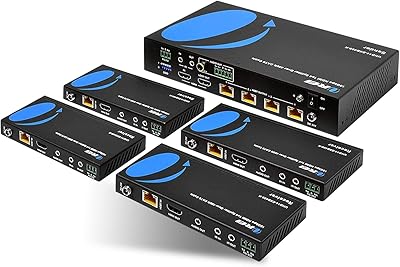
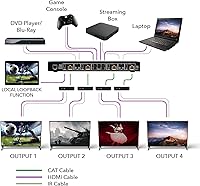
The OREI UHD48-EX230-K 4x4 HDMI Matrix Extender sits firmly in the mid-to-professional tier of AV distribution — the kind of hardware you'd find in a well-planned home theater install or a small commercial deployment, not on a casual hobbyist's shelf. At its core, it routes any of four HDMI sources to any of four remote displays independently, all over a single CAT5e/6/7 cable run stretching up to 230 feet. Pair that with 4K 60Hz signal support and a bundle of four receivers, IR cables, and a remote included in the box, and the value proposition becomes clear. Just go in knowing this is infrastructure gear — it rewards planning and patience over instant plug-and-play.
Features & Benefits

What makes this HDMI matrix extender genuinely useful in real installations is how its features work together rather than in isolation. The 4x4 matrix switching means every display can show a different source simultaneously — one room gets the Blu-ray, another the console, a third the media player, all independently. Running 4K 60Hz at full 4:4:4 chroma with HDR and HDCP 2.2 ensures picture quality isn't compromised on the long run. A single CAT cable per receiver keeps wall runs clean and cost-effective. Bidirectional IR pass-through lets you control source devices from the far end of the house, and the RS-232 port opens integration with Crestron or AMX control systems for professional builds.

Best For

This AV distribution unit makes the most sense for multi-room residential installs — a homeowner distributing a 4K media player, game console, cable box, and streaming device to four different rooms at once. It performs equally well in small commercial settings like conference suites or bar environments where display flexibility matters but a dedicated AV technician isn't always on-site. Installers who already have CAT6 cabling in the walls will find the transition especially cost-efficient. The 1080p downscale handles mixed-resolution setups gracefully, removing the need for separate converters on older displays. If you only need a single source feeding one screen, however, this is considerably more hardware than the job calls for.

User Feedback

Buyers consistently praise signal stability on longer cable runs, with many reporting clean 4K output near the full 230-foot limit over quality CAT6 — a genuine test of any extender's internals. The metal enclosure earns positive marks for durability compared to cheaper plastic-chassis alternatives. The most common criticism centers on setup complexity: documentation leaves something to be desired, and users without prior AV installation experience report a steeper learning curve than expected. The included remote works adequately but feels basic to some. A recurring edge case involves inconsistent signal quality when mixing different CAT cable grades across the same run, so sticking to one cable spec throughout is strongly advisable.

Pros

  • Routes any of four HDMI sources to any of four remote displays independently and simultaneously.
  • Delivers 4K 60Hz HDR over a single CAT cable run up to 230 feet — no bulky HDMI cables through walls.
  • Power over CAT means receivers draw power through the cable itself, eliminating four separate power supplies.
  • Bidirectional IR lets you control source devices from the far end of the house without a second remote system.
  • RS-232 support makes this AV distribution unit compatible with professional control platforms like Crestron and AMX.
  • Metal chassis stays cool during continuous operation and outlasts cheap plastic-bodied competitors in the same price range.
  • Built-in 1080p downscaling handles mixed display environments without needing external scalers on older screens.
  • Full 7.1-channel audio pass-through supports Dolby TrueHD and DTS-HD Master Audio without degradation.
  • Four receivers, IR cables, blasters, and a remote are all included — most basic installs need nothing extra.
  • Advanced EDID management prevents common resolution handshake failures across mismatched source and display combinations.

Cons

  • Setup documentation is thin and leaves non-professional users without enough guidance for first-time configuration.
  • EDID management controls, while powerful, are confusing to navigate without prior AV integration experience.
  • Source switching introduces a visible blank-screen delay that makes it unsuitable for live event or seamless-transition use cases.
  • CEC behavior across mixed TV brands is inconsistent and can cause unintended cross-zone command interference.
  • The entire system depends on a single power adapter — no redundancy option if that adapter fails.
  • No audio extraction means a separate device is required to feed audio to independent zone amplifiers or soundbars.
  • The included remote lacks backlit keys, making it awkward to use in dim rack rooms or equipment closets.
  • Signal reliability near the 230-foot maximum is noticeably sensitive to cable grade — lower-quality CAT5e increases dropout risk.
  • Mixing different CAT cable grades across a single run is a recurring source of signal problems that the manual does not adequately warn against.
  • IR blaster placement requires precise line-of-sight to source device receivers, which can be tricky inside enclosed AV cabinets.

Ratings

The OREI UHD48-EX230-K 4x4 HDMI Matrix Extender scores below are generated by AI after systematically analyzing verified purchase reviews from buyers worldwide, with spam, bot-submitted, and incentivized feedback actively filtered out. This unit attracted reviewers ranging from DIY home theater builders to professional AV installers, giving us a wide and realistic picture of real-world performance. Both the standout strengths and the genuine friction points are reflected transparently in each category score.
Signal Stability
88%
The majority of buyers report rock-solid 4K output across long CAT6 runs, with very few dropped signals or flickering issues under normal operating conditions. Installers running cables through walls in multi-story homes noted that the signal held cleanly even at distances approaching the rated maximum.
A subset of users pushing close to the 230-foot ceiling with lower-grade CAT5e reported intermittent signal dropout, particularly with high-bandwidth HDR content. Mixing cable grades across a single run amplified these issues noticeably.
4K & HDR Performance
84%
Buyers using 4K HDR sources like UHD Blu-ray players and current-gen consoles praised the accurate color reproduction and smooth 60Hz delivery on compatible displays. The full 4:4:4 chroma subsampling support meant no visible color fringing on high-contrast content.
A handful of users experienced HDCP 2.2 handshake delays when switching sources, causing a brief black screen on some display combinations. This was more common with budget 4K TVs that handle HDCP negotiation slowly.
Installation Experience
61%
39%
For experienced AV installers, the physical setup is straightforward — the labeled ports and included cable bundle reduce time on-site considerably. Those who planned their CAT cabling runs in advance reported a relatively smooth commissioning process.
Non-professional users consistently flagged the documentation as thin and difficult to follow, with the quick-start guide lacking enough detail for first-time matrix installs. Several reviewers spent hours troubleshooting EDID settings that a clearer manual would have resolved quickly.
IR Control Functionality
82%
18%
The bidirectional IR pass-through works reliably in practice — users controlling a satellite receiver or Blu-ray player from a bedroom display reported accurate, responsive command forwarding without noticeable lag. The wideband coverage meant compatibility across most remote controls without adjustments.
A few buyers noted that IR blaster placement is fussier than expected and requires direct line-of-sight to the source device's IR receiver window. In cabinets with glass doors, reflection occasionally caused erratic command behavior.
Build Quality & Enclosure
79%
21%
The all-metal chassis drew consistent praise from installers who compared it favorably to similarly priced plastic-bodied competitors. It feels dense and purposeful in the rack, and reviewers noted it stays cool even during extended continuous operation.
Some buyers felt the finish quality on the enclosure edges was rough, with minor sharp spots reported on the chassis corners. At this price point, a few expected cleaner manufacturing tolerances inside the connector panel.
Matrix Switching Speed
76%
24%
Source switching via the included remote is responsive enough for most use cases, with the majority of users reporting a clean transition within a couple of seconds. In office and conference room environments, this was considered perfectly acceptable.
The switching speed is not instant — there is a visible blank period on the display during source changes, which bothered users in live event or presentation settings where seamless transitions matter. RS-232 control via automation systems did not appear to significantly reduce this delay.
RS-232 & Control System Integration
83%
Professional installers integrating the OREI 4x4 matrix into Crestron and AMX environments reported that the RS-232 command set was well-documented by comparison to some competing brands. The four-channel bypass kept control wiring tidy in multi-zone builds.
A small number of integrators noted inconsistencies in command acknowledgment responses under rapid sequential switching commands. This required adding small delays in control system logic, which is a minor but real friction point for programmers.
1080p Downscaling
74%
26%
Users with mixed display environments — a 4K set in the living room and older 1080p screens in bedrooms — appreciated not needing separate scalers for each legacy display. The downscale output was described as clean with no obvious softness or artifacting on standard HD content.
The downscaling is limited to 1080p and does not offer intermediate resolution output like 1440p, which matters for some PC monitor users in the mix. A couple of reviewers also noted that the downscaled output through HDR sources occasionally required manual EDID adjustment to display correctly.
Audio Performance
81%
19%
Buyers using AV receivers downstream praised the clean pass-through of Dolby TrueHD and DTS-HD Master Audio bitstreams, with no audible degradation reported over the CAT cable run. 7.1-channel LPCM worked without issue in the home theater setups that tested it.
This unit does not include audio extraction, so users who need to break out audio to a separate zone amplifier or soundbar directly from the matrix will need an additional device. That limitation ruled it out for a portion of buyers with audio-distributed installations.
Included Accessories & Bundle Value
77%
23%
Having four receivers, IR cables, blasters, a remote, and an RS-232 cable included out of the box means most basic installs require no additional purchases. Buyers upgrading from bare-bones matrix switches found the bundled kit noticeably more complete than expected.
The included remote feels inexpensive relative to the overall package — it works but lacks backlit keys, making it awkward in dim equipment rooms. Some users also wished longer IR extension cables were included, as the provided lengths were tight in deeper rack or cabinet setups.
EDID Management
72%
28%
Advanced EDID management gives experienced users fine-grained control over how sources and displays communicate their capabilities, which is essential for preventing resolution handshake failures across mismatched AV equipment. Installers praised this feature as a genuine differentiator in the mid-tier segment.
For buyers unfamiliar with EDID concepts, the available controls add confusion rather than clarity. The interface for managing EDID profiles was described as unintuitive, and the documentation offers minimal guidance on when and how to apply custom EDID settings.
Power & Heat Management
86%
Power over CAT (POC) on all receiver ports means the four receivers draw power through the cable itself rather than requiring individual power supplies at each display location — a practical advantage that simplifies remote installs considerably. The unit remained cool in continuous 24/7 deployments.
There is only one power adapter included, and if it fails the entire system goes down. A few users in commercial deployments noted they would have preferred a redundant power input option or at least an easier-to-source replacement adapter specification.
CEC Control
67%
33%
CEC support allows compatible TVs and source devices to communicate basic on/off and input-switching commands through the matrix, reducing the number of remote controls needed in simple setups. Users with newer smart TVs reported it worked reliably for basic functions.
CEC behavior is notoriously inconsistent across TV brands, and this unit is no exception — several reviewers found that CEC commands from one display unexpectedly affected other zones. Most experienced installers ended up disabling CEC entirely to avoid unpredictable cross-zone behavior.
Value for Money
78%
22%
Considering the all-in bundle, 4K 60Hz support, metal build, and professional control features like RS-232 and bidirectional IR, buyers with genuine multi-room distribution needs felt the pricing was competitive against comparable matrix extenders. Professional installers noted the total cost of deployment was lower than assembling equivalent functionality from separate components.
For users who only need basic switching without remote control or long-distance extension, the price feels steep. Buyers who later realized they did not need the extender functionality — just a simple matrix switch — felt they overpaid for features that went entirely unused.

Suitable for:

The OREI UHD48-EX230-K 4x4 HDMI Matrix Extender was built for people who need to distribute multiple HDMI sources across multiple rooms — not just split one signal, but truly route any source to any screen independently. It fits best in homes where a Blu-ray player, game console, cable box, and streaming device all need to reach different rooms simultaneously, each display showing something different. Homeowners who already have CAT6 cabling running through walls will find it especially cost-efficient, since each receiver only needs a single cable run rather than a dedicated HDMI line. Small commercial environments — think a bar routing sports feeds, a hotel distributing programming, or a conference facility with displays in separate meeting rooms — are also natural fits. Integrators building systems around Crestron or AMX control platforms will appreciate the RS-232 support and bidirectional IR, which reduce the need for additional control hardware at each endpoint. If you have a mix of 4K and older 1080p displays across your installation, the built-in downscaling removes the need for separate scalers at each legacy screen.
Not suitable for:

If your goal is simply connecting one source to one display at a distance, the OREI UHD48-EX230-K 4x4 HDMI Matrix Extender is far more hardware than you need, and the price reflects that. Buyers without prior AV installation experience should go in with realistic expectations — the documentation is thin, EDID configuration can be confusing, and troubleshooting handshake issues between sources and displays requires some technical patience. This is not a device you unbox, connect, and forget in ten minutes. It also lacks audio extraction, so anyone planning to route audio to a separate zone amplifier or feed an independent speaker system from the matrix output will need additional equipment. Users whose cable infrastructure mixes different CAT grades across runs should be cautious — inconsistent cabling is one of the most commonly cited causes of signal problems near longer distances. And if budget is tight and you only need two inputs or two outputs, there are more economical alternatives that do not carry the overhead of a full 4x4 system.
Specifications

  • Resolution: Supports up to 4K 60Hz at full 4:4:4 chroma subsampling for accurate color reproduction on compatible displays.
  • HDR Support: Passes HDR metadata through the signal chain, preserving high dynamic range content from compatible source devices.
  • HDCP Compliance: Fully compatible with HDCP 2.2 and HDCP 1.4, ensuring protected content from 4K Blu-ray players and streaming devices passes without errors.
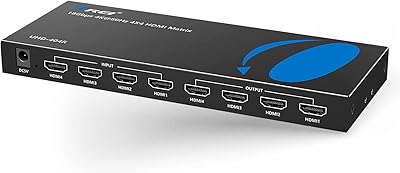
  • HDMI Inputs: Equipped with 4 HDMI 2.0 input ports on the main matrix unit for connecting up to four source devices simultaneously.
  • HDMI Loop Outputs: Includes 4 HDMI loop-out ports on the main unit, allowing local display connections in addition to the remote receiver outputs.
  • CAT Outputs: Features 4 CAT output ports that each carry signal, IR, and power to a remote receiver over a single CAT5e/6/7 cable run.
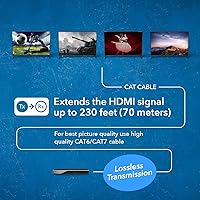
  • Max Distance: Extends HDMI signals up to 230 feet (approximately 70 meters) over a single CAT5e, CAT6, or CAT7 cable per receiver run.
  • Downscaling: Built-in 1080p downscaling allows 4K source signals to be displayed on older 1080p screens without a separate scaler device.
  • Audio Support: Passes up to 7.1-channel HD audio including LPCM, Dolby TrueHD, and DTS-HD Master Audio without compression or conversion.
  • IR Control: Supports bidirectional, wideband IR in the 30–60kHz range, allowing remote control of source devices from any receiver location.
  • RS-232 Control: Includes a 4-channel RS-232 bypass port for integration with professional control systems such as Crestron, AMX, or Control4.
  • CEC Support: CEC pass-through enables basic device communication between compatible TVs and sources, such as coordinated power on/off commands.
  • EDID Management: Advanced EDID management allows manual configuration of display capability data to prevent resolution handshake failures across mixed AV equipment.
  • Power Delivery: Power over CAT (POC) is active on all four CAT output ports, supplying power to each receiver through the same cable that carries signal and IR.
  • Power Supply: Operates from a single included 12V DC power adapter — the main unit powers all four receivers through the CAT cable runs.
  • Enclosure: Housed in a full metal chassis designed for passive heat dissipation, suitable for rack mounting or shelf installation in equipment rooms.
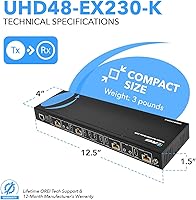
  • Dimensions: The main matrix unit measures 12.5 x 4 x 1.5 inches, making it compatible with standard 1U rack shelves in AV installations.
  • Weight: The main unit weighs 3 pounds, which is typical for a metal-chassis matrix extender in this performance class.
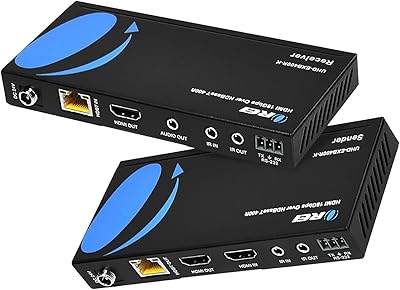
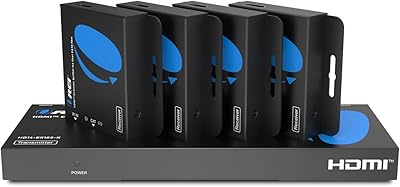
  • Receivers Included: Four remote receivers are included in the box, one for each CAT output, so no additional receiver purchases are needed for a full four-zone install.
  • Box Contents: Package includes the main matrix unit, 4 receivers, 1 power adapter, 4 IR receiver cables, 4 IR blaster cables, 1 HDMI remote control, and 1 RS-232 cable.

Related Reviews

OREI UHD-EXB400R-K 4K HDMI Extender over Ethernet
86%
91%
Long-Range HDMI Performance
87%
Ease of Installation
93%
Video Quality (4K, HDR)
85%
Compatibility with Devices
89%
Power over Cable (PoC) Effectiveness
More
OREI UHD14-EXB400-K HDMI Extender Splitter 4K
86%
91%
Video Quality
88%
Ease of Setup
85%
Build Quality
89%
Compatibility with Cables
93%
Signal Range
More
OREI UHD-404R 4x4 HDMI Matrix Switcher
81%
88%
Signal Reliability
86%
4K Performance
91%
Downscaling Capability
79%
HDR & Audio Passthrough
84%
Setup & Ease of Use
More
OREI UHD18-EX115-K 4K 1x8 HDMI Extender Splitter
84%
88%
Performance
91%
Signal Quality
93%
Installation & Setup
85%
Range & Connectivity
68%
IR Control Range
More
OREI HD12-EX165-K 4K HDMI Over Ethernet Extender Splitter
85%
88%
Ease of Setup
91%
Signal Quality and Performance
89%
Long-Distance HDMI Transmission
84%
IR Control Functionality
87%
Power Over Cable (PoC) Feature
More
OREI HD14-EX165-K
OREI HD14-EX165-K
78%
84%
Signal Stability
62%
4K Performance
88%
1080p Performance
91%
Installation Ease
93%
Power Over Cable
More
OREI EX-500IR HDMI Extender
88%
94%
Transmission Distance
92%
Signal Quality
89%
Ease of Installation
85%
Build Quality
88%
Power over Cable (PoC) Functionality
More
Yinker 4K HDMI Matrix Switch 4x4
83%
82%
Performance and Signal Stability
88%
Ease of Use
85%
Flexibility in Control Options
79%
Build Quality
90%
Setup and Installation
More
MT-VIKI 4x4 HDMI Matrix Switch
86%
88%
Performance
91%
Build Quality
85%
Ease of Setup
72%
Remote Control Responsiveness
90%
Audio Extraction Quality
More
OREI BK-402A 8K eARC HDMI Matrix Switch 4x2
80%
88%
Signal Reliability & Handshake
84%
Audio Extraction Quality
91%
Routing Flexibility
82%
EDID Management
89%
Value for Money
More

FAQ

Each display can show a completely different source independently and simultaneously — that is the core advantage of a matrix extender over a standard splitter. You can have one room watching a game console, another a Blu-ray player, and a third a cable box, all at the same time with no interference between zones.

No, and this is one of the more practical aspects of this unit. Power is delivered to each receiver through the same CAT cable that carries the video and IR signal, using a feature called Power over CAT. You only need to plug in the single power adapter at the main matrix unit — nothing needs to be powered at the display end.

Yes, the OREI UHD48-EX230-K 4x4 HDMI Matrix Extender supports HDCP 2.2 and HDR pass-through, which are the two requirements for 4K Blu-ray playback to work without signal errors. Just make sure your display and the receiver are connected properly and that EDID is configured to reflect the display's actual HDR capability — mismatched EDID settings are the most common cause of HDR not engaging correctly.
CAT6 is the strongly recommended choice for any run over around 150 feet, especially if you are pushing 4K HDR content. CAT5e can technically work at shorter distances, but users who push toward the 230-foot limit on CAT5e report a higher chance of signal instability. More importantly, avoid mixing cable grades within a single run — a consistent cable type throughout the entire path from the matrix to the receiver makes a significant difference in reliability.

Yes, that is exactly what it is designed for. Each receiver includes an IR sensor that picks up your remote control commands at the TV location, and those commands are sent back through the CAT cable to an IR blaster positioned near the source device at the main unit end. The blaster re-emits the signal to the source device as if you were standing in front of it. It works well as long as the IR blaster has a clear line of sight to the source device's IR window.

Honestly, it has a learning curve. The physical connections are straightforward, but configuring EDID settings and getting all four zones to behave correctly across different display and source combinations takes patience. The included documentation is minimal, and if you hit a resolution handshake issue or an IR problem, you will likely need to dig into online resources or contact OREI support. If you have never worked with a matrix extender before, budget extra time for the first setup.

Yes, the RS-232 port with four-channel bypass is specifically included for this purpose. Professional installers routinely integrate this AV distribution unit into Crestron, AMX, and Control4 environments using the RS-232 command set. One practical note: some integrators have found it necessary to add small timing delays between sequential switching commands to ensure reliable command acknowledgment from the unit.

Yes, the built-in downscaling handles this automatically on the outputs routed to your 1080p displays. You do not need external scalers or converters. The output to each display can be configured independently, so your 4K TVs receive the full 4K signal while the older screens get a clean 1080p downscale. Getting the EDID configuration right for each zone is the key step to making this work smoothly.

There is a noticeable blank-screen pause during source switches — typically a few seconds as the display re-establishes the HDCP handshake with the new source. It is not instant. For home theater and multi-room residential use this is generally acceptable, but if you need seamless or near-instant switching for a live event or broadcast environment, this unit is not the right tool for that application.

No, you can use any combination of the four receiver outputs independently. If you only need two zones active, simply connect receivers to the two CAT outputs you need and leave the others unused. The matrix will operate normally on the active ports. This also makes the unit a reasonable option if you are starting with two zones and plan to expand later without replacing the hardware.