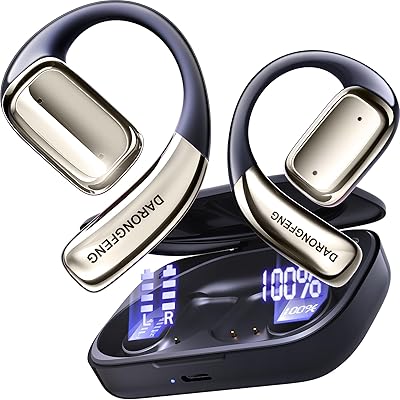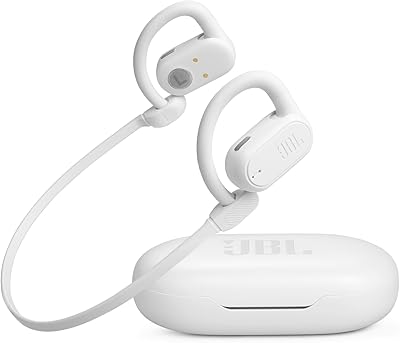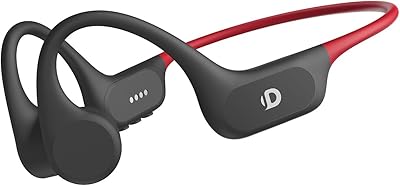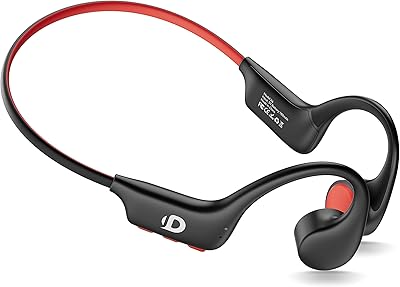


Overview

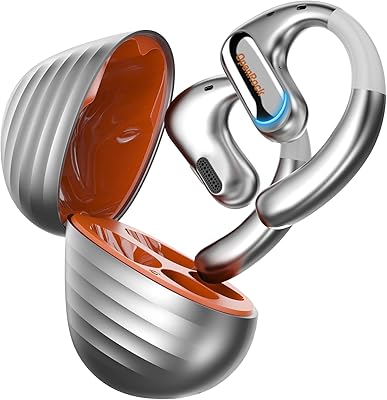
The OJW Open Ear Wireless Sport Headphones enter a crowded mid-range market with one genuinely unusual idea: a swappable battery system that lets you hot-swap power cells instead of hunting for a charging cable. Built around the OWS open-wearable stereo form factor, these earphones sit outside your ear canal rather than inside it, keeping you aware of traffic, trail conditions, or nearby conversation. Bluetooth 5.4 keeps the connection modern and stable. Just know going in that open-ear designs trade audio isolation for environmental awareness — if deep, immersive sound is your priority, these are not built for that.

Features & Benefits

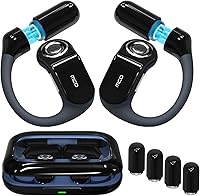
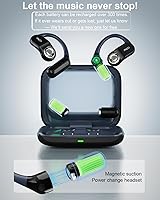
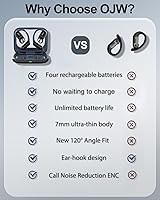
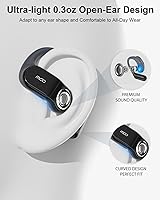
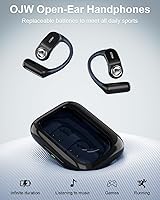
The headline feature is the swappable battery system. Each pair comes with two batteries; when one dies, you pop in the fresh one and keep going. Each battery recharges in about 1.5 hours and can be cycled up to five times before replacement. That near-continuous runtime figure advertised represents total cumulative use across multiple swaps, not a single charge. Beyond power, the IPX7 waterproof nano-coating handles rain and heavy sweat without complaint. The 13.2mm dynamic drivers perform reasonably well for an open-ear design, and the dual ENC microphones do a solid job reducing wind noise on calls. At 0.3oz per bud with a flexible titanium-core hook, comfort over hours is rarely an issue.

Best For

These open-ear sport earphones make the most sense for outdoor runners and cyclists who need to hear what is around them — car horns, trail hazards, another person calling out. The open design is also a genuine relief if you have grown tired of the plugged-up feeling from in-ear buds after an hour. Long-distance athletes and daily commuters will particularly appreciate the swappable battery approach, since you are never stuck mid-run waiting on a charge. Call-heavy users benefit from the dual-mic setup in windy conditions. And if you regularly jump between an iPhone, a laptop, and a smartwatch, the broad device compatibility across iOS, Android, Mac, and PC makes switching far less painful.

User Feedback

With around 225 ratings sitting at 4.2 stars, the reception is broadly positive, though the feedback tells a more specific story. Buyers consistently praise all-day comfort — many mention wearing the OJW earbuds through full workday shifts or multi-hour runs without ear fatigue. The battery swap mechanic earns genuine enthusiasm from people who have had it rescue a long ride. On the flip side, a handful of users report that the touch controls misfire during intense movement, worth knowing if you run with a heavy arm swing. Bass expectations also surface — open-ear audio is naturally thinner at the low end, and buyers expecting punchy bass were occasionally let down. Case durability feedback is mostly favorable.

Pros

  • Swappable batteries mean you can keep going on long runs or rides without hunting for a charger.
  • IPX7 waterproofing handles heavy sweat, rain, and brief submersion without any fuss.
  • The open-ear hook design stays put during high-movement workouts without causing ear fatigue.
  • At 0.3oz per bud, the OJW earbuds are light enough to forget you are wearing them over several hours.
  • Dual ENC microphones perform reliably on calls even in windy outdoor conditions.
  • Bluetooth 5.4 offers a stable, low-latency connection across a wide range of devices.
  • Compatible with iPhone, Android, PC, Mac, and smartwatches without complicated switching.
  • The compact carrying case protects the earphones and stores spare batteries neatly.
  • Open-ear awareness makes these genuinely safer for road running and urban cycling.
  • USB-C charging keeps things convenient and consistent with modern device cables.

Cons

  • Bass response is noticeably thin — the open-ear format is simply not designed for low-end punch.
  • Touch controls can misfire during intense movement, which gets irritating mid-run.
  • Each battery only recharges up to five times before needing replacement, adding a long-term cost.
  • The 32.8-foot Bluetooth range is short — leaving your phone behind at the gym is not practical.
  • No active noise cancellation means loud environments like trains or open-plan offices remain distracting.
  • The advertised near-100-hour runtime is cumulative across multiple battery swaps, not a single charge figure.
  • Open-ear fit may feel less secure for users with less common ear shapes despite the flexible hooks.
  • No IP rating transparency beyond waterproofing — long-term dust resistance in dry, gritty environments is unclear.

Ratings

The scores below for the OJW Open Ear Wireless Sport Headphones were generated by AI after systematically analyzing verified buyer reviews from global markets, with spam, bot-submitted, and incentivized feedback actively filtered out. Each category reflects the honest balance of praise and frustration found across hundreds of real-world user experiences — nothing has been softened or inflated. Where this headset genuinely impresses, the scores show it; where buyers have run into consistent friction, that is reflected too.

Battery Innovation
93%
The swappable battery mechanic is the standout feature buyers mention most enthusiastically — marathon runners, long-haul cyclists, and all-day commuters consistently describe it as a practical breakthrough. Being able to pop in a fresh cell mid-ride without hunting for an outlet genuinely changes how people plan longer sessions.
A small but vocal group of users found the battery swap fiddly in cold weather or with gloves on, and the five-cycle recharge limit per cell means replacement costs are a real long-term consideration that first-time buyers sometimes overlook.
Wearing Comfort
88%
Buyers who have worn in-ear buds for years consistently report that these open-ear earphones feel dramatically lighter and less fatiguing over multi-hour sessions. The flexible titanium-core hooks conform well enough that many users forget they are wearing them through full workday shifts or lengthy training runs.
Fit is not universal — a handful of reviewers with smaller or less typical ear shapes found the hooks either too loose to feel secure or slightly uncomfortable after extended periods, and there are no interchangeable tip sizes included to address this.
Waterproofing
86%
The IPX7 nano-coating gives outdoor athletes genuine confidence across demanding conditions — heavy rain rides, drenching summer runs, and gym sessions soaked in sweat have all been tested by real buyers without any reported failure. The protection feels robust rather than token.
A few users noted that the charging contacts and battery swap compartment require drying before use after significant water exposure, and long-term durability of the nano-coating under repeated submersion has not yet been proven across a wide user base.
Workout Stability
84%
The majority of active buyers — runners, cyclists, and gym users — report that the OJW earbuds stay firmly in place through high-intensity movement, which is the fundamental test for any sport-oriented earphone. The hook design distributes weight around the outer ear rather than relying on canal pressure to hold.
A minority of reviewers with specific ear geometries found the fit less reliable at a full sprint or during exercises involving rapid head movement, suggesting the titanium hook adjustment process may need more trial-and-error than most buyers anticipate.
Audio Clarity
74%
26%
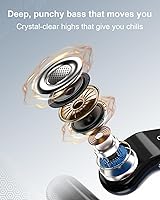
For an open-ear design, vocal clarity and midrange reproduction are respectable — podcasts, spoken audio, and melodic genres like rock or acoustic come through with enough definition to be genuinely enjoyable. The 13.2mm drivers deliver more presence than the form factor might suggest.
Open-ear physics are unforgiving: low-end frequencies simply cannot build the way they do in sealed formats, and buyers who primarily listen to bass-heavy genres like hip-hop or EDM often find the sound noticeably thin and unsatisfying compared to even entry-level in-ear alternatives.
Bass Performance
52%
48%
Within the specific constraints of the open-ear format, the bass that does come through is clean and undistorted — there is no muddiness or artificial boosting that can sometimes make budget drivers unpleasant. Buyers who listen to spoken content or classical music rarely raise bass as a concern.
For most music listeners, bass output is the single biggest disappointment with these earphones — it is the inherent cost of the open-ear design and no amount of driver engineering fully overcomes it at this price tier. Buyers expecting punchy low-end from the spec sheet are routinely let down.
Microphone Quality
81%
19%
Call quality in everyday outdoor conditions earns consistent praise — riders commuting through city traffic and runners on busy paths both report that the person on the other end can hear them clearly. The dual ENC setup handles moderate wind better than many competing open-ear options at this price.
In genuinely harsh wind or very loud environments, ambient noise does bleed through noticeably, and the 90% noise reduction claim reads as optimistic under those extreme conditions. A few buyers also flagged occasional mic cut-outs during rapid movement, though this appears intermittent.
Touch Controls
63%
37%
In calm, everyday use — commuting, walking, or light gym sessions — the touch panels are responsive and covering the full range of playback, volume, and call functions from both earpieces is genuinely convenient. Voice assistant activation works reliably according to the majority of reviewers.
Accidental activation during intense movement is a recurring complaint: mid-sprint track skips and unintended volume changes appear in multiple independent reviews, pointing to sensitivity calibration that does not fully account for high-impact exercise. This is a real friction point for competitive athletes.
Bluetooth Connectivity
83%
Bluetooth 5.4 delivers a noticeably stable connection in most real-world environments — buyers report clean audio during urban commutes, gym sessions with numerous competing signals, and outdoor training without the dropouts that plagued older-spec earphones. Pairing is fast and consistent across devices.
The 32.8-foot range is one of the shorter figures in the sport earphone category, and users who like to leave their phone in a bag or across a room while training will occasionally hit the boundary. Multi-device switching requires manual reconnection rather than automatic multipoint pairing.
Build Quality
77%
23%
The overall construction feels sturdy enough for daily sport use — the titanium core, plastic housing, and silicone contact points combine to give an impression of durability that buyers consistently describe as appropriate for the price tier. The carrying case earns specific praise for protecting the earphones and batteries during transit.
A few reviewers noted that the plastic case hinges and battery compartment covers feel less premium than the earphones themselves, and there is some concern about how the nano-coating holds up aesthetically after many months of heavy use — scratching and surface wear appear in longer-term ownership reviews.
Ambient Awareness
91%
This is arguably where the open-ear format pays off most clearly: cyclists and runners repeatedly describe a qualitative safety improvement over sealed earphones, able to hear vehicle approach, trail hazards, and other people without removing anything. The natural soundstage of environmental audio is fully preserved.
In inherently loud environments like busy urban streets or windy coastal paths, the ambient audio blends with the music in ways that some users find harder to manage than they expected — there is no adjustable transparency mode to tune the balance, so you get whatever the environment gives you.
Device Compatibility
87%
The breadth of compatible devices — iPhone, Android, Mac, PC, and smartwatches — covers the vast majority of buyer setups, and real-world pairing reports across iOS and Android are uniformly trouble-free. Buyers who rotate between work laptops and personal phones appreciate not having to carry separate earphones.
There is no confirmed multipoint simultaneous connection, so users who want audio from a laptop and call alerts from a phone at the same time will need to manually switch. Buyers coming from premium earphones with automatic device-switching may find this workflow step noticeably more manual.
Value for Money
79%
21%
The swappable battery concept is genuinely unique at this market tier and justifies the pricing for buyers to whom runtime flexibility is a primary concern. Most owners feel the combination of waterproofing, open-ear comfort, and call performance delivers fair value relative to competing open-ear alternatives.
Buyers who do not specifically need the battery swap feature may find the overall audio performance per dollar underwhelming compared to sealed in-ear alternatives at a similar price point. The limited battery cell lifespan also introduces a replacement cost over time that slightly erodes the long-term value equation.

Suitable for:

The OJW Open Ear Wireless Sport Headphones are a strong match for outdoor athletes — particularly runners, cyclists, and hikers — who need to stay aware of their surroundings while still enjoying audio. The open-ear design means you never lose track of approaching traffic, trail hazards, or a training partner calling out, which is something no in-ear bud can genuinely replicate. Long-distance athletes and all-day commuters will find particular value in the swappable battery mechanic: carry a charged spare, and you never have to pause your day for a recharge. If you make a lot of calls on the move, the dual ENC microphone setup handles wind and ambient noise well enough to be genuinely useful. People who have struggled with ear fatigue or discomfort from traditional in-ear buds will also appreciate how lightly these sit on the ear over several hours.

Not suitable for:

The OJW Open Ear Wireless Sport Headphones are not the right call for anyone who values deep, immersive sound — the open-ear format physically cannot deliver strong bass or block out environmental noise the way in-ear or over-ear headphones do. If you commute on loud trains or work in a noisy office and need to block the world out, this design will frustrate you. Audiophiles or anyone who listens critically to music should look elsewhere; the 13.2mm drivers are adequate for sport use but not built for nuanced listening. The touch controls have drawn complaints about misfiring during high-movement activities, so if precise on-the-go control matters to you, this is a real friction point worth weighing. Finally, the limited Bluetooth range of around 32 feet means leaving your phone in a locker while you train is not a realistic option.

Specifications

  • Bluetooth Version: These earphones use Bluetooth 5.4, one of the more current wireless standards available, offering stable connectivity and efficient power use.
  • Bluetooth Range: Wireless range extends up to 32.8 feet (10 meters) under typical conditions.
  • Driver Size: Each earbud houses a 13.2mm dynamic audio driver designed to maximize output clarity within an open-ear form factor.
  • Sensitivity: Driver sensitivity is rated at 128dB, helping maintain audible volume levels despite the open-ear design's lack of passive isolation.
  • Impedance: Impedance is 32 Ohm, compatible with standard Bluetooth amplification in smartphones and portable devices.
  • Microphones: Dual ENC (Environmental Noise Cancellation) microphones are built in, with the manufacturer claiming up to 90% reduction in ambient noise during calls.
  • Water Resistance: IPX7-rated waterproofing with reinforced nano-coating protects against rain, heavy sweat, and brief full submersion.
  • Earbud Weight: Each earbud weighs approximately 0.3oz (8.5g), with a flexible titanium-core ear hook to accommodate a range of ear shapes.
  • Total Weight: The complete earbud unit (both buds) weighs 18.8 grams according to the manufacturer specification.
  • Battery System: Two swappable batteries are included; each charges via the case in approximately 1.5 hours and supports up to 5 recharge cycles before replacement is recommended.
  • Runtime Claim: The advertised runtime figure represents total cumulative playtime across all battery swaps combined, not a single continuous charge.
  • Charging: Batteries charge via USB-C, and a USB-C cable is included in the box.
  • Carrying Case: The included plastic carrying case measures 3.54 x 2.75 x 0.78 inches and weighs 1.41oz, with internal storage for spare batteries.
  • Controls: Touch-sensitive panels on both the left and right earbuds allow control of playback, volume, call management, and voice assistant activation.
  • Voice Assistants: Both Siri and Google Assistant can be activated via the touch controls, depending on the paired device.
  • Compatibility: These earphones are compatible with iPhone, Android, Mac, PC, and smartwatches over standard Bluetooth.
  • Materials: Construction uses a combination of metal (titanium core), plastic housing, and silicone contact points for comfort and durability.
  • Ear Form Factor: OWS (open-wearable stereo) open-ear hook design sits outside the ear canal, preserving ambient sound awareness during use.
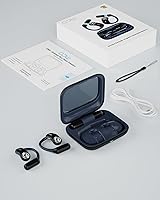
  • Box Contents: The package includes one pair of earbuds, two swappable batteries, a charging case, a USB-C cable, and a user manual.
  • Noise Control: Noise management is passive only on the listening side; active noise cancellation is not featured in this model.

Related Reviews
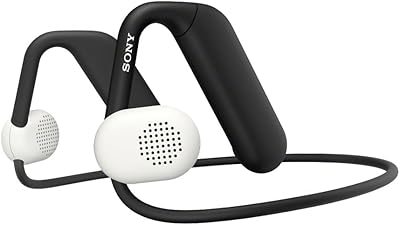
Sony Float Run Open-Ear Sport Headphones
77%
91%
Wearing Comfort
94%
Situational Awareness
83%
Fit Stability
61%
Audio Quality
78%
Battery Life
More
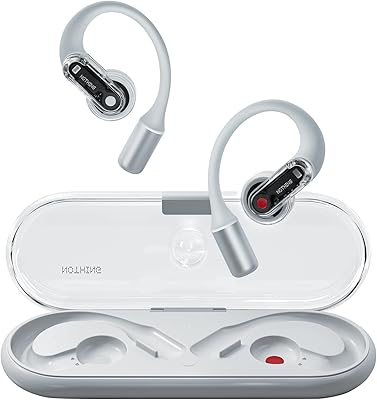
Nothing Ear (Open) Open-Ear Earbuds
79%
91%
Wearing Comfort
83%
Workout Stability
74%
Sound Quality
77%
Call Quality
49%
Sound Leakage
More
nwm ONE
nwm ONE
84%
94%
Comfort & Ergonomics
89%
Microphone & Call Clarity
88%
Sound Leakage Control
86%
Sound Quality (Mids & Highs)
62%
Bass Response
More
DARONGFENG G303S
DARONGFENG G303S
78%
91%
Wearing Comfort
67%
Sound Quality
83%
Battery Life
71%
Call Quality
94%
Situational Awareness
More
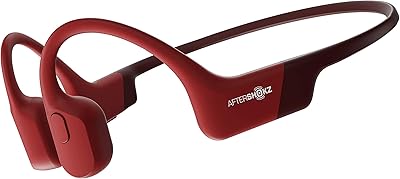
AfterShokz Aeropex Open-Ear Bone Conduction Headphones
78%
93%
Comfort & Wearability
96%
Situational Awareness
61%
Sound Quality
54%
Sound Leakage
84%
Build Quality & Durability
More
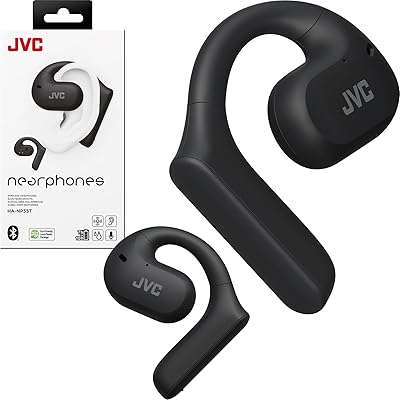
JVC HANP35TW Open Ear Wireless Headphones
73%
88%
Wearing Comfort
93%
Ambient Awareness
61%
Sound Quality
86%
Battery Life
58%
Call Quality
More
JBL SoundGear Sense True Wireless Open-Ear Headphones
85%
80%
Sound Quality
87%
Comfort and Fit
90%
Battery Life
92%
Quick Charging Feature
85%
Build Quality
More
DEMICEA LibreRun Pro X13 Open-Ear Headphones
79%
88%
Comfort & Fit
91%
Waterproof Performance
62%
Sound Quality
84%
Battery Life
57%
Charging System
More
AfterShokz Air AS650 Bone Conduction Headphones
75%
91%
Wearing Comfort
94%
Situational Awareness
54%
Audio Quality
88%
Secure Fit During Activity
58%
Sound Leakage
More
OpenRock Pro Bluetooth 5.2 Wireless Open-Ear Headphones
85%
83%
Sound Quality
91%
Comfort for Long Use
90%
Battery Life
88%
Water Resistance (IPX5)
75%
Fit and Stability During Exercise
More

FAQ

Each earbud has a small compartment that holds a removable battery cell. When the active battery runs out, you open the case, slide the depleted cell out, and replace it with the charged spare — the whole swap takes a few seconds. The backup battery ships inside the case compartment by default, so you have a fresh one ready from day one. It is a genuinely practical solution for long sessions where stopping to charge is not an option.

Not in one sitting. That figure represents the total cumulative runtime you can get by cycling through both batteries across multiple recharge sessions over the lifespan of the cells. Each battery delivers a portion of that total per charge, and each cell supports up to five recharge cycles before OJW recommends replacing it. Think of it as a long-term capacity figure rather than a single-use claim.

Most users report that the flexible titanium-core ear hooks hold well during running, cycling, and gym sessions. The hook wraps around the outer ear rather than inserting into the canal, so fit depends on ear shape — the titanium core can be gently bent to adjust the curve if needed. A small number of users with unusually shaped ears have found the fit less secure, so if possible, try a short test run before committing to a long session.

Open-ear hook-style earphones of this type are generally designed to be worn as a pair, but many users do wear a single bud when they need one ear completely free. Check the manual for any specific mono-mode pairing instructions, as behavior can vary by firmware.

This is one area where buyer feedback is mixed. The touch panels work reliably in everyday use, but several reviewers have noted accidental triggers during high-intensity movement — an unintended tap skipping a track or adjusting volume mid-sprint. It is a known trade-off with touch-sensitive sport earphones generally, and worth factoring in if precise control during hard workouts is important to you.

IPX7 means the OJW Open Ear Wireless Sport Headphones can handle brief submersion in water up to one meter for about 30 minutes, which covers rain, splashing, and very sweaty sessions comfortably. That said, they are not designed for lap swimming or continuous underwater use — the open-ear form factor and moving water do not mix well practically, even if the electronics are protected.

The dual ENC microphones are one of the stronger points of these earphones for outdoor use. The manufacturer claims 90% ambient noise reduction on calls, and real-world buyer feedback generally backs this up for wind and general outdoor noise. Extreme wind or very loud environments will still bleed through, but for most outdoor commuting and exercise scenarios, call clarity is solid.

Honest answer: bass is the open-ear design's biggest limitation. Because the drivers sit outside the ear canal rather than sealing against it, low-end frequencies escape into the air rather than reaching your ear with full impact. The 13.2mm drivers perform well for their format, but if punchy, deep bass is central to your listening experience, these earphones will likely disappoint. They work best for genres where clarity in the mids and highs matters more — podcasts, vocals, rock, and acoustic music all fare better.

The OJW earbuds connect via standard Bluetooth, which typically supports one active connection at a time on most implementations. You can pair them to multiple devices and manually switch between them, but simultaneous dual-device connection (multipoint) is not a confirmed feature for this model. Check the user manual or product page for the latest firmware notes on this.

The box includes one pair of earbuds, two swappable battery cells, the plastic carrying case, a USB-C charging cable, and a user manual. Replacement battery cells are the main accessory you might eventually need, since each cell supports a limited number of recharge cycles — but that is a longer-term consideration rather than an immediate purchase.