Overview

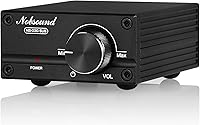
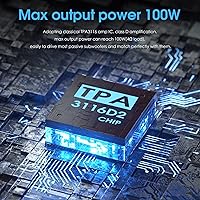
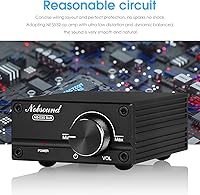
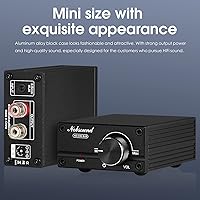
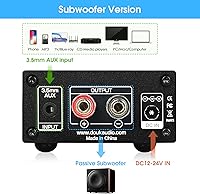
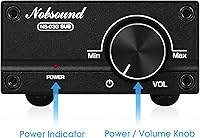
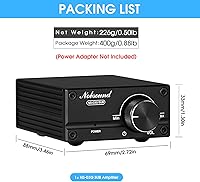
The Nobsound NS-03G is a mono subwoofer amplifier built for one specific job: driving a passive subwoofer with clean, focused bass. Before anything else, understand that this mini sub amp is strictly incompatible with active or powered subwoofers — that single compatibility detail trips up a surprising number of buyers. Inside the metal shell, a TPA3116D2 chip paired with an NE5532 op-amp handles the signal work. The whole unit measures just 68.5 x 33 x 90mm, small enough to sit on top of the sub itself. One important heads-up: no power supply included, so budget for a separate DC adapter rated at 12–24V and at least 3A.

Features & Benefits

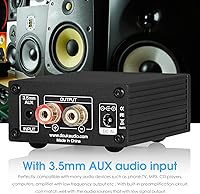
The headline spec is 100W peak into 4 ohms, though real-world output will land noticeably lower if you are running a modest power supply — do not expect full rated power on 12V. What the spec sheet does deliver reliably is a frequency range of 20–200Hz, keeping this strictly in sub territory with no attempt to reproduce mids or highs. A 3.5mm AUX input handles the source connection, so plugging in a phone, laptop, or TV takes seconds. Speaker wiring uses banana plug terminals, which makes for a tidy, secure connection without needing to strip and clamp bare wire every time. With an SNR above 98dB and THD under 0.04%, the bass stays clean even at higher output levels.

Best For

This little bass amp makes the most sense for DIY audio hobbyists who already have a passive subwoofer driver sitting around and need a simple, affordable way to power it. Desktop setups benefit too — if your PC speakers or TV soundbar leave the low end feeling thin, adding a dedicated passive sub driven by this amp can fill that gap without buying a full AV receiver. It also fits neatly into budget home theater builds where the main amplifier handles mids and highs, leaving bass duties to a separate channel. If you already own a suitable DC power supply, setup is straightforward. It also suits those experimenting with active crossover configurations, where precise per-driver amplification is the goal.

User Feedback

Across nearly 850 ratings, the Nobsound subwoofer amplifier holds a 4.0 average, and the praise is fairly consistent: buyers are repeatedly surprised by how much bass comes out of something this small. Build quality gets a fair amount of credit too — the all-metal enclosure feels sturdier than most expect at this price. On the critical side, confusion about the passive-only requirement accounts for a chunk of the one-star reviews. Some owners also flag that the volume knob feels slightly loose and can make precise low-level adjustments tricky. Power supply incompatibility is another sticking point for buyers who did not read the spec carefully. Those who go in with the right setup tend to walk away genuinely satisfied.

Pros

  • Delivers genuinely punchy, clean bass from a chassis smaller than most TV remotes.
  • The all-metal enclosure feels far more solid than the price suggests it should.
  • Banana plug terminals make wiring fast, tidy, and repeatable without any tools.
  • TPA3116D2 chip keeps distortion low, with THD under 0.04% and SNR above 98dB.
  • Wide power input range of 8–25V DC gives flexibility when choosing a compatible adapter.
  • Handles speaker impedances from 2 to 8 ohms, covering most passive subwoofer drivers.
  • Sits directly on top of a subwoofer enclosure, keeping the desktop clean and cable runs short.
  • Runs cool during extended use thanks to efficient Class D amplification.
  • For DIY builders already owning a suitable power supply, setup takes only a few minutes.

Cons

  • No power supply included, and the listing does not make the required spec obvious enough.
  • The volume knob feels imprecise and slightly wobbly, making fine bass-blending adjustments frustrating.
  • Peak power rating is misleading — real output depends heavily on the supply voltage used.
  • Only one input available, with no RCA option for users connecting from an AV receiver.
  • Passive-only compatibility is buried in the specs, causing repeated buyer errors with powered subs.
  • No mounting solution provided, so the unit simply rests in place rather than staying fixed.
  • Long-term warranty and after-sales support details are unclear, making failure a full-replacement scenario.
  • Minor voltage spec inconsistencies appear across the product listing, adding unnecessary confusion during setup.

Ratings

The Nobsood NS-03G scores below are generated by AI after analyzing verified global buyer reviews, with spam, bot activity, and incentivized feedback actively filtered out. Our model evaluates the Nobsound NS-03G across every dimension real buyers care about — from bass clarity to setup friction — surfacing both the genuine strengths and the frustrations that show up repeatedly in honest user accounts.

Bass Output Quality
83%
For a unit this compact and affordable, the low-frequency punch it delivers consistently surprises buyers. Users running it with a 4-ohm passive driver on a 19V supply report tight, controlled bass that holds together well at moderate listening volumes without sounding muddy or bloated.
At lower supply voltages like 12V, output drops noticeably and the bass can feel underwhelming compared to expectations set by the 100W headline spec. It is not built for high-SPL applications, so anyone expecting room-shaking output will be disappointed.
Value for Money
91%
At its price point, it is hard to find a dedicated mono subwoofer amp that pairs a proper Class D chip with a metal enclosure. DIY builders consistently call it one of the best-value passive sub amp options available, especially when repurposing an existing speaker driver.
The missing power supply adds to the real total cost, and if you have to buy one specifically for this unit, the value equation shrinks a bit. Budget buyers who overlook that extra spend sometimes feel misled by the initial listing price.
Build Quality
78%
22%
The all-metal shell is the first thing buyers comment on positively — it feels deliberately overbuilt for something so small and inexpensive. Terminals and the input jack feel solid during initial setup, and there are no reports of the chassis flexing or rattling under operation.
The volume knob is the weak point. Multiple users describe it as slightly wobbly and difficult to land on a precise setting, which matters more than it sounds when you are fine-tuning bass blend with a main system. It is functional but not refined.
Ease of Setup
74%
26%
For anyone with basic DIY audio experience, setup is genuinely quick — plug in the AUX source, connect banana plugs to the sub driver, attach a compatible DC adapter, and you have bass. The banana plug terminals in particular make wiring clean and repeatable without any tools.
The power supply requirement catches a significant number of buyers off guard. Without one included or a clear in-box guide, first-timers sometimes grab the wrong adapter spec and get no output or weak performance, leading to frustration that could easily have been avoided.
Compatibility Clarity
44%
56%
For buyers who read the listing carefully, this amp does exactly what it claims — it powers passive subwoofer drivers reliably and without fuss. When used as intended, there are virtually no compatibility issues with passive drivers between 2 and 8 ohms.
This is the single biggest pain point in the review pool. A meaningful portion of negative reviews come from users who connected it to powered or active subwoofers, causing confusion and sometimes equipment damage. The passive-only limitation is not prominent enough in the product presentation.
Audio Clarity & Distortion
86%
The TPA3116D2 chip combined with the NE5532 op-amp keeps distortion genuinely low. Buyers using it in quiet desktop setups report clean, grain-free bass with no audible hum or noise floor issues, which is not a given at this price tier.
At higher gain settings or with a borderline power supply, a faint background hiss has been reported by a small number of users with sensitive drivers. It is not a widespread complaint, but those running high-efficiency subwoofer drivers in a quiet room may notice it.
Size & Portability
93%
The footprint is genuinely remarkable. Users regularly mention being able to mount it directly on top of their subwoofer enclosure or tuck it behind a monitor without any cable management headaches. For desktop builds, that kind of spatial efficiency is a real practical benefit.
The compact size does mean there is no room for additional inputs or a phono-level input, so users with more complex source setups will need an external mixer or switcher. There is also no mounting provision, so it just sits in place rather than being firmly fixed.
Power Supply Situation
51%
49%
Once you source the right adapter — 19V at 4A or higher is the sweet spot most experienced users recommend — the amp performs reliably and without thermal issues even during extended listening sessions. The wide input range of 8–25V DC gives flexibility in adapter selection.
Not including a power supply is a legitimate friction point, especially for casual buyers. There is no bundled recommendation in the box, and the voltage range listed across different parts of the product page contains minor inconsistencies that add to confusion.
Volume Control Usability
57%
43%
Having a physical knob rather than relying entirely on source-level control is appreciated by users integrating this into a dedicated subwoofer channel. It lets you set a baseline bass level independently of your main system volume, which is genuinely useful in practice.
The knob's imprecision at the lower end of the range is a consistent complaint. Users trying to blend sub output carefully with a stereo system find it difficult to make small adjustments without overshooting, which undermines what should be one of the more useful features.
Frequency Range Suitability
88%
The 20–200Hz range is well-matched to real subwoofer use cases. Buyers using it with home theater setups crossed over around 80–120Hz report that it handles the handoff cleanly without audible discontinuities, which speaks to the op-amp stage doing its job properly.
The limited bandwidth is by design, but it does mean this amp is completely useless for anything other than sub duty. Users who hoped to run a small full-range driver through it as a workaround will get poor results, and that expectation mismatch shows up in reviews occasionally.
Thermal Performance
81%
19%
Class D efficiency means the unit barely gets warm under normal use. Several users running it in enclosed spaces or semi-enclosed enclosures report no heat-related shutdowns or performance degradation even during multi-hour listening sessions.
There are no ventilation slots or a heatsink visible on the exterior, and a small number of users pushing it hard with lower-impedance drivers on higher supply voltages have noted the shell becoming uncomfortably warm. It is not a common failure point, but worth monitoring.
Input Flexibility
59%
41%
A 3.5mm AUX input covers the majority of everyday source connections — phone, laptop, tablet, TV headphone out — without any adapters. For the typical desktop or casual home theater user, that covers virtually every scenario they will actually encounter.
There is only one input, and it is line-level only. Users wanting to connect multiple sources simultaneously, or those working with RCA outputs from an AV receiver, need an external adapter or switcher. A single RCA input as an alternative would have meaningfully broadened the appeal.
Longevity & Reliability
72%
28%
Many owners report using the unit for one to two years without any degradation in output or sudden failures. The Class D topology runs cool and places less thermal stress on components over time compared to traditional analog amp designs at similar power levels.
Long-term reliability data is limited given the product age and price tier. A handful of users report the unit stopped working after several months of use, and given there is no warranty clarity in the listing, replacements require a full repurchase rather than a service resolution.

Suitable for:

The Nobsound NS-03G is a natural fit for DIY audio enthusiasts who have a passive subwoofer driver on hand — whether salvaged from an old system, bought bare, or part of a custom enclosure build — and need a compact, affordable amp to bring it to life. Desktop PC users whose satellite speakers lack real low-end presence will find this mini sub amp a practical and space-efficient way to add a dedicated bass channel without investing in a full AV receiver. It also slots in well for budget home theater builders who want to bi-amp their setup, running a separate sub channel independently from their main stereo amplification. If you already own a 19V DC adapter from an old laptop or similar device, setup friction drops considerably and the overall value proposition gets even stronger. Audio hobbyists experimenting with active crossover configurations or multi-driver arrangements will appreciate having a clean, single-channel amp purpose-built for the 20–200Hz range.

Not suitable for:

Anyone shopping for an amp to drive an active or powered subwoofer should stop here — the Nobsound NS-03G is strictly for passive drivers, and connecting it to a powered sub is the single most common source of buyer frustration and negative reviews. Casual buyers who want a complete out-of-the-box solution will find the missing power supply an immediate obstacle, and sourcing the right DC adapter adds both cost and research time that some buyers are not prepared for. Those expecting genuine 100W of output should temper expectations: real-world power at commonly available supply voltages lands well short of the peak rating, making this little bass amp unsuitable for larger rooms or high-SPL applications. Users who need multiple source inputs, RCA connectivity, or remote volume control will find the single 3.5mm AUX input and manual knob limiting. It is also not the right choice for anyone who wants a truly plug-and-play experience or lacks basic familiarity with passive speaker wiring.

Specifications

  • Amplifier Chip: The unit uses a TPA3116D2 Class D amplifier chip paired with an NE5532 op-amp for low-noise signal processing.
  • Max Power Output: Peak output is rated at 100W into a 4-ohm load; real-world power will be lower depending on the supply voltage used.
  • Channels: Single-channel mono output, designed to drive one passive subwoofer driver at a time.
  • Speaker Impedance: Compatible with passive subwoofer drivers rated between 2 and 8 ohms.
  • Frequency Range: Operates across 20–200Hz, limiting its function strictly to subwoofer-range bass reproduction.
  • Audio Input: One 3.5mm AUX stereo input for connecting phones, laptops, televisions, CD players, or other line-level sources.
  • Speaker Output: Banana plug binding posts provide a secure, tool-free connection to passive subwoofer speaker terminals.
  • Signal-to-Noise Ratio: SNR is rated at 98dB or higher, indicating a low noise floor during normal operation.
  • Distortion: Total harmonic distortion is specified at 0.04% or lower, reflecting clean bass output at rated conditions.
  • Power Input: Requires an external DC power supply rated between 8 and 25 volts with a minimum current of 3A; no supply is included.
  • Recommended Supply: Nobsound recommends a 12–24V DC adapter at 4A or higher for best performance, with 19V being the most commonly cited sweet spot by users.
  • Dimensions: The unit measures 68.5 x 33 x 90mm (not including terminals), making it one of the smallest dedicated subwoofer amplifiers available.
  • Weight: Net weight is 0.35kg (approximately 0.77 lbs), or 0.2kg without packaging.
  • Enclosure: The shell is an all-metal construction, providing durability and passive heat dissipation without a dedicated heatsink or fan.
  • Volume Control: A single analog volume knob on the unit allows manual gain adjustment with no remote control option.
  • Mounting: Designed for desktop placement; no built-in mounting brackets or wall-mount provisions are included.
  • Compatibility: Works exclusively with passive (unpowered) subwoofer drivers; it is not compatible with active or self-powered subwoofer enclosures.
  • Brand: Manufactured by Nobsound, a Chinese audio electronics brand known for budget-oriented Class D amplifier products.

Related Reviews
Yamaha NS-333
Yamaha NS-333
79%
88%
Sound Clarity
86%
Soundstage & Imaging
58%
Bass Performance
84%
High-Frequency Performance
83%
Build Quality
More
Nobsound G2
Nobsound G2
80%
88%
Audio Clarity
74%
Build Quality
92%
Value for Money
71%
Ease of Setup
89%
Bass Performance
More
Yamaha NS-AW294BL Outdoor Speakers
86%
88%
Sound Quality
92%
Durability
83%
Ease of Installation
90%
Water Resistance
89%
Build Quality
More
Yamaha NS-F210BL Floorstanding Speaker
84%
88%
Sound Quality
91%
Design & Aesthetics
85%
Build Quality
82%
Setup & Installation
90%
Value for Money
More
Yamaha NS-P150 Speaker Package
84%
85%
Sound Quality
90%
Ease of Setup
88%
Design & Build Quality
92%
Value for Money
87%
Dialogue Clarity
More
Yamaha NS-F150 Floor Standing Speaker
86%
88%
Sound Quality
92%
Build Quality
85%
Bass Performance
91%
Ease of Setup
90%
Aesthetic Design
More
Yamaha NS-SW100BL 10″ Powered Subwoofer
86%
92%
Sound Performance
90%
Bass Quality
85%
Ease of Setup
88%
Compact Design
87%
Build Quality
More
Yamaha NS-C210BL Center Channel Speaker
85%
88%
Sound Quality
92%
Dialogue Clarity
75%
Bass Performance
85%
Build Quality
91%
Size and Portability
More
Ubiquiti NanoStation AC NS-5AC-US
82%
91%
Performance
70%
Ease of Setup
85%
Build Quality
94%
Range & Connectivity
88%
Value for Money
More
Nobsound AK2515
Nobsound AK2515
88%
96%
Display Sharpness
88%
Ambient MIC Sensitivity
92%
Customization Depth
87%
AGC Performance
93%
Clock Precision
More

FAQ

No, and this is the most important thing to check before buying. The Nobsound NS-03G is designed only for passive subwoofer drivers — bare speaker drivers that have no built-in amplification. If your subwoofer has its own power cable and amp inside, this unit is not compatible with it.

You need a DC power supply rated between 12 and 24 volts with at least 3A of current output. Most experienced users recommend going with 19V at 4A or higher for the best balance of output power and stability. A 19V laptop-style adapter with the correct barrel connector size works well and is widely available.

The 100W rating is a peak figure measured at 4 ohms with a 25V supply, so treat it as a ceiling rather than a constant output. At 19V you are realistically looking at somewhere in the 50–70W range, and at 12V considerably less. For a desktop or small room setup that is still more than adequate, but do not expect it to fill a large space with deep bass.

Yes, any device with a 3.5mm headphone or line-out port connects directly to the AUX input. For a TV, check whether the headphone output allows independent volume control, as that will affect how you manage the overall bass level alongside the knob on the amp itself.

This mini sub amp does not include an active crossover. Its frequency range tops out at 200Hz, which provides a natural rolloff at the high end, but it passes everything below that. If you need a precise crossover point — say 80Hz for a home theater blend — you will want an external crossover unit or to rely on crossover filtering in your source or main amp.

The speaker output uses standard banana plug binding posts, which accept both banana plugs and bare wire. Banana plugs are the cleaner option since they grip securely without tools, but bare wire wrapped and tightened into the posts works fine too.

Most users report a quiet noise floor with no audible hum under normal conditions. A small number of users with high-efficiency drivers and quiet listening environments have noted a faint background hiss at higher gain settings. Using a quality power supply and keeping the volume knob at a moderate baseline helps keep noise non-issues.

Technically it will produce sound through a full-range driver, but the 20–200Hz frequency range means everything above 200Hz will be heavily rolled off. You would get bass-only reproduction with no mids or highs, so this little bass amp is genuinely not suited for that purpose. Stick to subwoofer drivers only for satisfying results.

The Class D design runs efficiently, so under normal desktop use the metal shell becomes slightly warm but not hot. Users running it for several hours continuously report it staying well within comfortable handling temperature. If you are pushing it hard with a low-impedance driver on a high-voltage supply, monitor the shell temperature for the first few sessions.

If you understand the difference between a passive and active subwoofer, setup is straightforward — connect your source via the 3.5mm cable, wire your passive driver using banana plugs, attach your DC adapter, and adjust the volume knob to taste. Where beginners run into trouble is the power supply step, since nothing is included and the spec requirements are not prominently explained in the box.