Overview

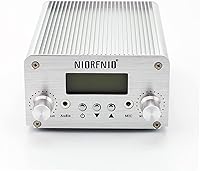
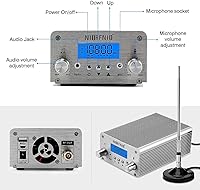
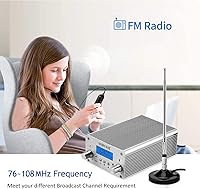
The NIORFNIO T15B 15W FM Transmitter sits in a practical middle ground — capable enough for real small-venue broadcasting, yet accessible to operators who aren't radio engineers. It covers the full 87–108 MHz FM band with PLL frequency stabilization, which keeps the signal locked and clean rather than drifting over time. The unit carries FCC certification (ID: 2AQIX-T15B), a meaningful distinction when so many budget transmitters on the market lack any compliance documentation. Bluetooth input and PC control via USB add real flexibility, while the aluminum alloy shell and dual ball-bearing fan suggest the designers were thinking about units running for hours, not minutes.

Features & Benefits

At the core of what makes this FM transmitter useful is its adjustable 15W output, which can realistically cover 1–2 km through typical suburban environments — expect less than the advertised 3–4 km once buildings and trees enter the picture. Bluetooth pairing is quick and stable, letting you push audio from a phone or tablet without routing cables across a room. The PC scheduling feature is genuinely useful for unattended broadcasts, though the bundled software has a noticeable learning curve and Windows compatibility quirks worth anticipating. Operators can also switch between stereo and mono modes, and the built-in audio processing — limiter, pre-emphasis, low-pass filter — keeps output consistent even with variable source levels.

Best For

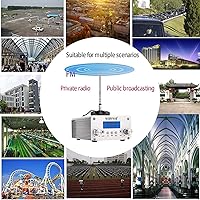
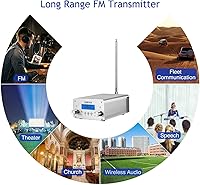
This low-power broadcaster is a natural fit for small churches running drive-in FM services — the kind where congregants tune in from the parking lot during overflow or outdoor events. Car dealerships, drive-through venues, and campus operators will find the localized broadcast range more than adequate for their needs. Event organizers who need audio distribution without relying on Wi-Fi or long cable runs will appreciate the simplicity of picking a clear FM frequency and going. One important note: anyone planning to operate this desktop broadcasting unit should verify local regulations first, as Part 15 rules in the US strictly limit unlicensed FM broadcasting to specific power thresholds.

User Feedback

Buyers generally respond well to this desktop broadcasting unit, with consistent praise for how quickly Bluetooth pairs and how reliably the frequency lock holds across sessions. Antenna placement turns out to matter quite a bit — users who move it outdoors or near a window report noticeably better range than those who leave it sitting indoors on a desk. On the downside, the PC control software draws repeated criticism for its dated interface and occasional Windows compatibility issues, so less technical users should budget some extra setup time. Fan noise comes up occasionally but rarely as a dealbreaker. Most buyers seem satisfied once range and software expectations are set realistically.

Pros

  • FCC certification provides genuine regulatory credibility that many competing units at this price level lack.
  • Bluetooth pairing is quick and stable, making it easy to push audio wirelessly from a phone or tablet.
  • Adjustable power output gives operators flexibility to dial back transmission when full range isn't needed.
  • The magnetic suction-cup antenna mounts easily on metal surfaces and can be repositioned without tools.
  • Switching between stereo and mono modes lets you optimize signal quality based on actual receiver distance.
  • Built-in audio processing — limiter, pre-emphasis, and low-pass filter — keeps output consistent across varied source levels.
  • The aluminum alloy shell and dual fan hold up well during extended broadcast sessions without overheating.
  • PC scheduling support enables fully unattended playback, a genuine time-saver for recurring broadcast needs.
  • Covers the full 87–108 MHz band with PLL stabilization, so frequency drift is rarely an issue.

Cons

  • Real-world range is noticeably shorter than advertised once buildings, trees, or indoor walls enter the equation.
  • The bundled broadcast software has a dated interface and recurring Windows compatibility complaints from users.
  • Setup complexity is higher than expected for buyers coming from basic consumer FM transmitters.
  • Antenna placement has a major impact on performance, but the manual offers limited practical guidance on positioning.
  • Fan noise, while generally minor, can be a nuisance in quiet environments during long unattended operation.
  • No Mac-compatible software is offered, locking PC control functionality to Windows users only.
  • The unit is relatively bulky and heavy at over 3 pounds, making it less practical for truly mobile setups.
  • Buyers unfamiliar with Part 15 regulations may unknowingly misconfigure output power and create compliance issues.

Ratings

The NIORFNIO T15B 15W FM Transmitter has been evaluated by our AI system after parsing verified buyer reviews from multiple global markets, with spam, bot-generated, and incentivized feedback actively filtered out before scoring. Ratings reflect the honest distribution of real-world experiences — covering everything from drive-in church setups to hobbyist campus broadcasts — and both the strengths and the recurring frustrations are transparently baked into every score.

Signal Stability
83%
Buyers consistently report that once the frequency is locked in, the PLL stabilization keeps it there — no drifting mid-service or mid-event. For church parking-lot operators who set it and walk away, that reliability over a 90-minute broadcast is exactly what they need.
A small but vocal group of users noted occasional signal instability when operating near other RF-dense environments, like shopping centers with competing wireless systems. Interference from neighboring FM stations on crowded urban band segments is a genuine factor that the unit can't fully overcome.
Bluetooth Connectivity
88%
Pairing with phones and tablets is quick and the connection holds reliably across a session — users running background audio for retail stores or lecture halls rarely report dropouts. The ability to stream directly from a playlist app without routing cables is a practical everyday advantage.
Bluetooth range between the source device and the transmitter itself is limited, as expected for this class of hardware, so the audio source needs to stay reasonably close. A few users flagged occasional re-pairing requirements after the unit had been powered off and restarted.
Broadcast Range
61%
39%
In genuinely open conditions — a flat rural property, a large open parking lot — this low-power broadcaster can push audio across a surprisingly wide zone, and several drive-in operators confirm solid reception at 1–1.5 km without any antenna tricks.
The advertised 3–4 km figure is largely a best-case scenario that most buyers won't experience. In suburban or semi-urban environments with buildings, foliage, and competing signals, effective range drops considerably, and this has generated the most consistent disappointment across user reviews.
PC Software & Scheduling
54%
46%
For users who get it working, the scheduling software unlocks genuinely useful functionality — automated playback, timed switching, unattended overnight broadcasts. Organizations running recurring FM announcements find real operational value once the system is dialed in.
The setup process is a recurring headache, particularly on Windows 10 and 11 where driver recognition and software compatibility issues surface frequently. The interface itself is dated and poorly documented in English, which means non-technical users often spend hours troubleshooting before getting a single scheduled broadcast to fire correctly.
Build Quality
79%
21%
The aluminum alloy shell gives the unit a solid, durable feel that stands out among plastic-bodied competitors at a similar price point. Users who run it continuously in a fixed installation — mounted on a shelf or equipment rack — report no structural issues after months of operation.
The fan ventilation slots and antenna port feel slightly less refined than the main chassis, and a few buyers noted that the micro USB port for PC connection feels looser than it should after repeated plugging and unplugging. It's sturdy overall, but not precision-engineered.
Thermal Management
76%
24%
The dual ball-bearing fan combined with the aluminum enclosure keeps internal temperatures in check during extended broadcasts — users running 4–6 hour sessions without interruption rarely report thermal shutdowns or degraded performance due to heat.
Fan noise is the trade-off. In quiet indoor environments — a small office, a library reading room, a recording-adjacent setup — the fan hum is noticeable enough to be mildly distracting. It's not loud by any measure, but it's consistently present.
Antenna Performance
71%
29%
The magnetic suction-cup base makes repositioning fast and tool-free, which matters when experimenting with antenna placement to maximize coverage. Users who move it to an exterior window ledge or rooftop report meaningful gains in effective range.
The included antenna is functional but not exceptional — the unit's range potential is often limited more by antenna placement than by the transmitter itself, yet the manual provides almost no practical guidance on optimal positioning. First-time users tend to underperform the hardware simply by leaving the antenna on a desk.
Audio Output Quality
81%
19%
The built-in limiter and low-pass filter do their job well — audio comes through FM receivers sounding clean and consistent, without the over-compressed or tinny character that cheaper transmitters often produce. Stereo separation is solid for the broadcast class.
At the outer edges of effective range, audio quality degrades into static rather than gracefully fading, which can frustrate listeners in fringe-coverage zones. Mono mode helps extend usable range slightly but at the obvious cost of stereo experience.
Ease of Setup
63%
37%
The core hardware setup — mounting the antenna, selecting a frequency, pairing Bluetooth — is genuinely straightforward and most users have audio broadcasting within 15–20 minutes of unboxing. For basic use cases, the hardware side is accessible even without a technical background.
The moment PC control and scheduling software enter the picture, the ease rating collapses. Driver installation, Windows compatibility, and a non-intuitive software interface mean that the full feature set requires a level of technical patience that many buyers underestimate going in.
FCC Compliance
86%
Having a legitimate FCC certification (ID: 2AQIX-T15B) provides meaningful peace of mind compared to the flood of uncertified gray-market alternatives. For organizations like churches or schools where compliance and accountability matter, this is a real differentiator.
FCC certification covers the device's design, not how it's operated — buyers who run the unit at maximum power for unlicensed broadcasting may still be outside Part 15 limits. The product documentation doesn't clearly walk users through the regulatory boundaries, which creates risk for buyers who assume certification equals full legal authorization.
Value for Money
67%
33%
For buyers who need FCC-certified hardware with Bluetooth, PC scheduling, and adjustable power — and who find a use case that fits the realistic range — the price is justifiable against the feature set. There are few direct competitors offering this combination at this tier.
Buyers who expected the full advertised range or a polished software experience often feel the price is hard to justify after the fact. If either of those two factors matters significantly to you, the value proposition weakens quickly.
Documentation & Support
48%
52%
The physical unit and its core FM broadcasting functions are intuitive enough that many users navigate initial setup without consulting the manual at all. Community-sourced tips on antenna placement and software configuration have helped fill some of the official documentation gaps.
The included manual is thin, partly in non-fluent English, and offers almost nothing on software troubleshooting or regulatory guidance. Manufacturer support response times are inconsistent, and buyers who run into software or driver issues are largely on their own.
Portability
72%
28%
At 3.27 pounds with a compact footprint, this desktop broadcasting unit is light enough to transport between locations — event organizers have used it across multiple venues without dedicated equipment cases. The magnetic antenna makes re-mounting at a new site quick.
It's not designed for truly mobile or handheld use — it needs a stable surface, a power outlet, and some setup time at each new location. Users expecting to move it daily will find the setup-per-use overhead mildly tedious compared to simpler one-purpose transmitters.

Suitable for:

The NIORFNIO T15B 15W FM Transmitter is a strong fit for small organizations that need a reliable, localized FM broadcast solution without the complexity or cost of professional broadcast equipment. Small churches running drive-in or parking-lot services will find the range and Bluetooth input particularly practical — stream audio from a tablet directly to congregants tuned in from their cars. Car dealerships, drive-through venues, and outdoor event organizers benefit from the same setup: pick a clear frequency, mount the magnetic antenna somewhere elevated, and you have a working audio zone in minutes. Campus radio hobbyists and community groups exploring low-power FM will appreciate having FCC certification behind the unit, which removes a significant compliance headache. Anyone who needs scheduled or unattended playback — a shopping mall looping background audio, a lecture hall running automated announcements — will get real mileage out of the PC control and broadcast software once it's configured properly.

Not suitable for:

The NIORFNIO T15B 15W FM Transmitter is not the right tool for buyers expecting wide-area or professional-grade coverage. Real-world range through urban environments with buildings, trees, and interference will fall well short of the advertised 3–4 km figure, so anyone planning to cover a large campus, a sprawling outdoor festival, or multiple city blocks should look at licensed, higher-power solutions instead. The bundled PC software is functional but dated, and users who aren't comfortable troubleshooting Windows compatibility issues or navigating a non-intuitive interface will find the scheduling features frustrating rather than helpful. This low-power broadcaster also operates under strict regulatory limits — in the US, unlicensed FM transmission falls under FCC Part 15 rules, which cap effective radiated power significantly, so buyers with ambitions beyond a tightly defined local zone need to research licensing requirements before purchasing. Finally, anyone expecting plug-and-play simplicity on par with a consumer Bluetooth speaker will be disappointed by the setup investment this desktop broadcasting unit requires.

Specifications

  • Model Number: The unit is designated model T15B, manufactured by Baile/Guangzhou Liannuo Electronic Technology Co., Ltd.
  • Output Power: Transmission power is adjustable up to 15W, allowing operators to reduce output when full range is unnecessary.
  • Frequency Range: The unit covers the full FM broadcast band from 87 to 108 MHz with PLL-stabilized frequency control to prevent signal drift.
  • FCC Certification: This transmitter carries FCC certification under ID 2AQIX-T15B, confirming it meets US regulatory standards for intentional radio frequency emitters.
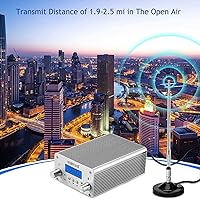
  • Broadcast Range: Open-air transmission range is rated at approximately 3–4 km (1.9–2.5 mi), though real-world range will vary with terrain and obstacles.
  • Connectivity: Audio input is supported via Bluetooth wireless pairing and USB connection to a PC for software-controlled broadcast management.
  • Audio Modes: Operators can switch between stereo and mono output modes depending on signal distance and receiver compatibility requirements.
  • Audio Processing: The unit includes built-in audio pre-emphasis, a limiter, and a low-pass filter circuit to maintain consistent and clean output levels.
  • Antenna Type: A 1/4-wavelength antenna with a magnetic suction-cup base is included, designed to mount securely on car roofs or any flat metal surface.
  • Cooling System: Thermal management is handled by a dual ball-bearing fan housed within an aluminum alloy shell that also aids passive heat dissipation.
  • PC Control: The unit connects to a Windows PC via micro USB and supports unattended broadcast scheduling through bundled intelligent broadcasting software.
  • Shell Material: The outer enclosure is constructed from aluminum alloy, which contributes to both durability and passive cooling during extended operation.
  • Surround Config: Audio output is configured as 2.0 stereo, with no multi-channel or surround processing included.
  • Dimensions: The unit measures 11.97 × 7.83 × 3.11 inches, making it a compact desktop device suited for fixed or semi-permanent installations.
  • Item Weight: The transmitter weighs 3.27 pounds, inclusive of its aluminum alloy enclosure but exclusive of packaging materials.

Related Reviews
Retekess TR508 FM Transmitter
71%
83%
Audio Clarity
67%
Broadcast Range
81%
Ease of Setup
72%
Dual Input & Mixing
91%
FCC Compliance & Legality
More
Retekess FT11 Portable FM Broadcast Transmitter
78%
93%
Ease of Setup
62%
Transmission Range
81%
Audio Clarity
88%
Battery Life
74%
Microphone Quality
More
Retekess TR509 FM Broadcast Transmitter
75%
83%
Signal Stability
61%
Broadcast Range
88%
Ease of Setup
72%
Audio Quality
79%
Build Quality
More
FMUSER GP100 FM Ground Plane Antenna
80%
88%
Signal Performance
91%
Build Quality
84%
Weatherproofing
93%
Ease of Installation
89%
VSWR Stability
More
Retekess TR604 AM/FM Radio
85%
88%
Ease of Use
82%
Sound Quality
91%
Portability
84%
Battery Life
75%
Tuning Accuracy
More
DreamSky AM/FM Shortwave Portable Radio
78%
93%
Ease of Use
86%
AM/FM Reception
61%
Shortwave Reception
74%
Speaker Quality
67%
Build Quality
More
Audiocrazy AM FM NOAA Emergency Weather Radio
67%
83%
NOAA Reception
61%
Battery Life
58%
Build Quality
79%
Value for Money
62%
Bluetooth Performance
More
Jazmm T16 AM FM Portable Radio
76%
88%
AM Reception Quality
67%
FM Reception Quality
83%
Speaker Volume & Clarity
93%
Ease of Use
74%
Build Quality
More
August MR285 Bluetooth Transmitter Receiver
78%
83%
Ease of Setup
76%
Bluetooth Connectivity Stability
78%
NFC Pairing Performance
79%
Audio Quality
72%
Latency Performance
More
Facmogu Si4730 FM Radio Receiver
79%
83%
Reception Quality
78%
Antenna Performance
86%
Build Quality
71%
Ease of Use
81%
Setup & Installation
More

FAQ

The advertised 3–4 km range applies to open-air conditions with minimal obstructions. In a typical parking lot surrounded by buildings or trees, expect effective coverage closer to 1–2 km. Raising the antenna — mounting it on a rooftop or near a window — makes a meaningful difference.

PC control and the bundled broadcast scheduling software are Windows-only. Mac users can still use the unit for standard Bluetooth or USB audio input, but the automated scheduling and unattended playback features won't be accessible without a Windows machine.

The NIORFNIO T15B 15W FM Transmitter carries FCC certification, but operating it at full power for unlicensed broadcasting may still conflict with FCC Part 15 rules, which strictly limit the effective radiated power of unlicensed FM devices. Before running this unit at higher output levels, check current FCC Part 15 guidelines or consult a broadcast attorney if you plan to use it regularly or commercially.

Yes, the unit supports Bluetooth pairing and works with both iOS and Android devices. Once paired, you can stream audio wirelessly from any app — music, podcasts, or a service like Spotify — directly to the transmitter.

Most users describe the fan as noticeable but not disruptive — roughly comparable to a quiet desktop computer. In an outdoor setup or a moderately sized room it's unlikely to cause issues, but in a very quiet indoor environment like a small office it may be mildly distracting during long sessions.

It has a definite learning curve. The interface is dated and not particularly intuitive, and some users run into driver or compatibility hiccups on newer versions of Windows. Budget an hour or two for initial setup, and check the manufacturer's support resources or user forums if you hit a wall — others have likely solved the same issue.

The antenna can be used indoors, but performance will be noticeably better if you position it near a window or route it outside. The magnetic base makes it easy to temporarily mount on a metal surface near an exterior wall, which tends to be a practical middle ground for most setups.

Beyond Bluetooth, the unit accepts audio input via USB when connected to a PC running the broadcast software. For direct analog line-in connections, check the physical inputs on the unit itself — the specification sheet references USB connectivity as the primary wired input path.

It's well-suited for exactly that use case. A parking lot with 30–40 cars spread across a typical church property falls comfortably within the effective range of this low-power broadcaster, especially with the antenna positioned at elevation. Several buyers have reported using it precisely for this purpose with reliable results.

You'll get interference, which typically sounds like overlapping audio or static on the receiving end. The fix is straightforward: scan for a clear, unused frequency in your area before you set up, and lock the unit to that frequency. Most suburban and rural areas have several open spots in the 87–108 MHz band to choose from.