Overview

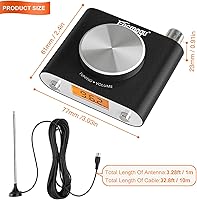
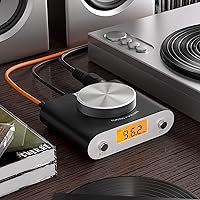
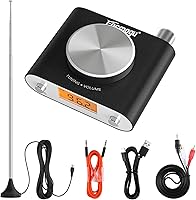
The Facmogu Si4730 FM Radio Receiver is a compact desktop tuner built for people who already own a decent amplifier or speaker setup and simply want to add FM capability without buying an entirely new unit. It runs off USB-C power, so there is no wall-wart hunting involved. The black alloy enclosure feels noticeably more solid than the plastic-shell dongles this category is littered with — pick it up and it has actual heft. What really sets it apart at this price point is the included 33-foot retractable antenna with a magnetic base, which gives you real flexibility in positioning for better signal rather than leaving you stuck with a short, stubby wire.
Features & Benefits

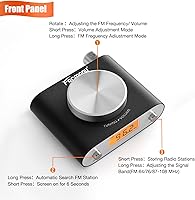
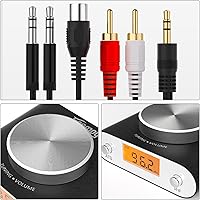
The heart of this FM receiver is the Si4730 tuner chip, which is a meaningful step up from the generic ICs stuffed into cheaper alternatives — it handles electrical noise better and locks onto weaker stations more reliably. Three selectable frequency ranges cover the FM bands used across North America, Europe, and most of Asia, so it travels well. Controls are stripped down to a single rotary knob and two buttons: hold the knob to tune manually, tap it to adjust volume, or hold the ATS button to let the unit scan automatically. Station memory stores your regular channels for quick recall, and output options include a 3.5mm jack and an AV cable, covering most amplifier and speaker inputs.

Best For

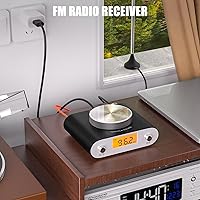
This desktop radio module makes the most sense for home hi-fi owners who already have a capable amplifier or a set of powered bookshelf speakers and just want to pipe in FM without overhauling their setup. It is also a practical pick for listeners in suburban or rural fringe areas — the long antenna gives you something to work with when a standard short aerial would struggle. Switchable frequency bands make it genuinely useful for international travel with audio gear. Minimalists will appreciate the clutter-free control layout. It is less suited to anyone expecting a standalone radio experience; external speakers or an amp are non-negotiable, and that is worth understanding before purchasing.

User Feedback

Buyers who pair the Si4730 tuner with quality amplifiers tend to come away satisfied with reception, particularly when the antenna reaches a window — most report clean station lock-in without significant drift in typical home environments. The alloy case earns consistent praise; people note it feels more substantial than expected. That said, the single-knob interface trips up some first-time users who find the long-press and short-press functions unintuitive until they read the manual. A handful of buyers also wish the included USB-C cable were longer. Complaints are minor overall, but anyone expecting instant plug-and-play without glancing at the instructions may feel briefly frustrated during the initial setup session.

Pros

  • The Si4730 chip delivers noticeably cleaner reception than budget tuner sticks, especially in moderate-signal environments.
  • A long retractable antenna with a magnetic base gives real placement flexibility — a rare inclusion at this price tier.
  • The alloy enclosure feels genuinely solid and looks at home on a proper hi-fi shelf.
  • Switching between regional FM band standards is fast and reliable, making this FM receiver practical for international use.
  • USB-C power keeps the setup tidy and eliminates the need for a proprietary wall adapter.
  • Auto-scan and manual tuning are both accessible from a single knob once you spend a few minutes with the manual.
  • Station memory retains your saved presets across power cycles without any fuss.
  • Multiple cable types in the box — 3.5mm, AV, USB-C — mean most users can connect immediately without extra purchases.
  • The compact footprint fits unobtrusively into existing rack or shelf setups without demanding dedicated space.
  • Clean line output pairs well with amplifiers and powered speakers without audible hum or ground noise.

Cons

  • The included USB-C power cable is too short, limiting placement options near many setups.
  • The single-knob control logic takes real trial and error to learn — a quick-reference card is missing from the box.
  • No digital audio output rules it out for anyone running a DAC-based listening chain.
  • Auto-scan occasionally skips low-power or community stations that manual tuning can find.
  • The rotary knob has a slightly loose feel that undercuts the otherwise solid build impression.
  • Long-term reliability data is thin given the product is relatively new to market.
  • Urban buyers with heavy RF congestion may experience occasional drift on weaker stations despite the better chip.
  • There is no Bluetooth or wireless output option for those wanting to connect to a wireless speaker system.
  • Cable quality across the included accessories is adequate but unremarkable — nothing feels built to last years.
  • The AV cable connection can fit loosely in certain amplifier inputs, causing intermittent audio contact issues.

Ratings

The Facmogu Si4730 FM Radio Receiver has been scored by our AI engine after systematically analyzing verified buyer reviews from global markets, with spam, bot-generated, and incentivized feedback actively filtered out. Scores reflect the full spectrum of real ownership experiences — not just satisfied early adopters — so both the strengths and the friction points are weighted honestly. The result is a balanced picture of where this desktop tuner genuinely delivers and where it asks for patience.
Reception Quality
83%
Buyers in suburban and semi-rural areas consistently report cleaner station lock-in than they got from cheaper tuner sticks, with noticeably less background hiss on moderate-signal stations. The Si4730 chip's noise rejection holds up well in typical home environments where router interference and switching power supplies are nearby.
In dense urban areas with heavy RF congestion, a handful of users report occasional signal drift on weaker community stations. Reception is good but not infallible — those in genuine fringe zones still need to invest time positioning the antenna carefully.
Antenna Performance
78%
22%
The extra-long retractable cable is a real advantage for anyone whose listening room sits far from an exterior wall. Being able to run the antenna to a windowsill or magnetic-mount it on a metal surface makes a tangible difference for users who previously struggled with a short stubby wire.
Some buyers find that they only need a fraction of the full cable length, making the remaining coil a minor cable-management annoyance. A small number of users in concrete-heavy apartment buildings report the antenna still falls short of pulling in the weakest stations even at full extension.
Build Quality
86%
The alloy enclosure stands out immediately when you pick it up — it has a density and rigidity that plastic-bodied alternatives in this category simply do not match. Several buyers specifically mention it feels more like a piece of audio equipment than a consumer gadget.
A few owners note that while the main shell feels solid, the rotary knob has a slightly loose wobble that does not inspire the same confidence. The overall finish is good, but close inspection reveals some minor inconsistencies around the port cutouts on certain units.
Ease of Use
71%
29%
Once you have spent ten minutes with the manual, the single-knob system starts to feel intuitive — short press for volume, long press for tuning, and a separate button for auto-scan. Minimalists who dislike button-heavy remotes genuinely appreciate the uncluttered front panel.
The learning curve is real for the first session. Several buyers admit they accidentally changed the frequency band or triggered an unintended function before understanding the long-press versus short-press logic. A printed quick-reference card bundled in the box would help significantly.
Setup & Installation
81%
19%
USB-C power means most buyers already have a compatible cable lying around, and connecting to an amplifier or powered speakers via the 3.5mm jack takes under two minutes. There is no software, no pairing process, and no driver installation involved.
The included USB-C cable is on the short side, which limits placement flexibility for users whose USB power source sits some distance from the unit. A few buyers also wished the manual were slightly more detailed for first-time FM receiver owners.
Global Frequency Flexibility
88%
Frequent travellers and users outside North America rate this feature highly — switching between the three regional band presets takes a single long press and works exactly as described. Buyers who have used it across Japan, Europe, and North America confirm it handles the transition without any configuration headaches.
The band-switching process is not immediately obvious without reading the instructions, so travellers who grab the unit and go may spend a frustrated few minutes before locating the right button sequence. This is a minor gripe, but it surfaces consistently in international buyer reviews.
Audio Output Quality
74%
26%
Paired with a decent amplifier, the line output is clean with no audible hum or ground noise reported by the majority of buyers. The 3.5mm signal is adequate for both stereo amplifiers and powered desktop speakers without any additional conditioning.
This is a tuner module, not a high-end DAC, and the audio quality ceiling is ultimately the FM broadcast itself. Buyers expecting hi-fi performance beyond what the radio signal can deliver will find the output unremarkable — the unit is honest rather than embellished.
Value for Money
82%
18%
Compared to standalone FM tuner units at twice the price, this receiver covers most practical needs without the bulk or complexity. The inclusion of multiple cables and a long antenna in the box makes the overall package feel well-considered for the asking price.
Budget-oriented buyers who compare it purely against cheaper no-name USB tuner sticks may question the premium. The value argument is strongest when you factor in the chip quality and antenna — but that context is easy to miss if you are shopping purely on price.
Included Accessories
69%
31%
The box includes a USB-C cable, a 3.5mm audio cable, an AV cable, the retractable antenna, and a user manual — covering most connection scenarios without an additional purchase. Buyers appreciate not having to source a separate audio cable on day one.
Cable quality is functional rather than impressive. The USB-C cable length limits placement options, and at least a few buyers found the AV cable connection slightly loose in their specific amplifier inputs. Nothing is unusable, but none of the accessories feel premium.
Size & Form Factor
91%
The compact footprint means it disappears neatly on a shelf or desk without demanding attention. Buyers integrating it into existing hi-fi racks or small desk setups consistently praise how little space it occupies compared to full-size tuner decks.
For users with larger hands or visual impairments, the small control surface can be fiddly, particularly when trying to press the smaller secondary buttons precisely. The compact design is a deliberate trade-off rather than a flaw, but it is worth acknowledging.
Connectivity Options
77%
23%
Offering both a 3.5mm stereo jack and an AV cable output covers the two most common ways people connect to amplifiers and home theatre receivers. USB-C for power is a modern choice that keeps the cable situation clean on a contemporary desk setup.
There is no digital output — no optical, no coaxial — which rules this out for buyers wanting to feed a standalone DAC or a digital-input receiver. Bluetooth output is also absent, limiting it strictly to wired speaker and amplifier pairings.
Station Memory & Scanning
79%
21%
Auto-scan works reliably in most tested environments, populating a station list without manual intervention in a couple of minutes. Buyers who commute between two cities note the memory function saves their home-city presets safely across power cycles.
The memory capacity is adequate but not expansive — users in markets with many active stations may find they need to be selective about what they store. There are occasional reports of the auto-scan skipping very low-power community stations that manual tuning can find.
Thermal & Long-term Reliability
73%
27%
Most buyers who have owned the unit for several months report no unexpected shutdowns or degradation in tuning accuracy. The alloy shell likely contributes to passive heat dissipation during extended listening sessions.
Long-term data is limited given the product's relatively recent market debut. A small number of buyers report intermittent issues after several weeks of daily use, though it is unclear whether these are unit-specific defects or a pattern. Durability over years remains unverified.

Suitable for:

The Facmogu Si4730 FM Radio Receiver is purpose-built for people who already own a capable amplifier, stereo receiver, or powered bookshelf speakers and simply want to add FM radio without replacing any of their existing gear. It slots neatly into a hi-fi shelf, connects via a 3.5mm cable or AV output in minutes, and stays out of the way — which makes it particularly appealing to minimalists and vintage stereo enthusiasts who want modern USB-C convenience without a cluttered control panel. Listeners in suburban or semi-rural fringe areas will find the long retractable antenna a genuine practical advantage, since it can be routed across a room and stuck magnetically near a window where signal is strongest. International buyers and frequent travellers who carry audio equipment across regions will also appreciate the ability to switch between the major worldwide FM band standards with a single button hold, covering North America, Europe, and most of Asia without any reconfiguration headaches. If you run a small home studio, a study setup, or a retro-inspired listening corner, this desktop radio module fits the brief well.
Not suitable for:

The Facmogu Si4730 FM Radio Receiver is the wrong choice if you are looking for a self-contained radio experience — it produces no sound on its own and requires external amplification to be useful at all, which is a dealbreaker for anyone expecting a plug-in-and-listen device straight out of the box. Buyers in dense urban environments with heavy RF interference should temper expectations, as even a quality tuner chip cannot fully compensate for a hostile signal environment, and some community or low-power stations may remain difficult to lock in reliably. If you want digital audio outputs — optical or coaxial — to feed a standalone DAC or a digital-input receiver, this unit offers neither, making it incompatible with higher-end digital signal chains. Those who want Bluetooth or wireless output to a speaker system will also need to look elsewhere, as connectivity is strictly wired. Finally, buyers who expect premium-grade included cables or a longer USB-C power lead may find the bundled accessories just functional enough but not impressive.
Specifications

  • Tuner Chip: Built around the Silicon Laboratories Si4730 IC, which provides higher sensitivity and better electrical noise rejection than generic FM tuner chips.
  • Frequency Bands: Supports three selectable FM band ranges — 64 to 108 MHz, 76 to 108 MHz, and 87 to 108 MHz — covering the standard broadcast bands used across North America, Europe, and Asia.
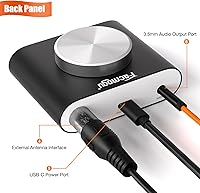
  • Antenna: Includes a 10-metre (approximately 33ft) retractable coaxial cable antenna with a magnetic base for flexible positioning on metal surfaces such as windowsills or rooftop fixtures.
  • Power Input: Powered via a USB-C port, drawing power from any standard USB-C source such as a phone charger, USB hub, or computer port.
  • Audio Output: Provides a 3.5mm stereo headphone-style jack output and an AV (RCA-compatible) cable output for connecting to amplifiers, receivers, and powered speakers.
  • Dimensions: The unit measures 3.03″ in length, 2.91″ in width, and 1.30″ in height, making it compact enough to fit on a standard hi-fi shelf or desktop without occupying significant space.
  • Weight: The receiver weighs 13.4 oz, reflecting the density of the alloy enclosure rather than lightweight plastic construction.
  • Enclosure Material: The outer shell is constructed from black-finished aluminium alloy, providing structural rigidity and passive heat dissipation during extended use.
  • Controls: User interface consists of one multi-function rotary knob and two dedicated buttons (ATS for auto-scan and VHF for band and memory selection).
  • Tuning Modes: Supports both automatic station scanning (ATS) and manual frequency tuning, accessible through the rotary knob using short-press and long-press combinations.
  • Station Memory: Allows users to store favourite stations for instant recall, with presets retained across power cycles.
  • Band Selection: Global frequency band is selectable via a long press of the VHF button, cycling through three regional presets to match local broadcast standards.
  • Included Cables: Box contains one USB-C power cable, one 3.5mm stereo audio cable, one AV cable, and the retractable antenna — covering most common connection scenarios.
  • Documentation: A printed user manual is included, detailing the long-press and short-press control combinations required to access all tuning and memory functions.
  • Brand & Model: Manufactured by Mo-gu under the Facmogu brand, with the model identifier A18409-MG-US.
  • Connectivity Type: Entirely wired — the unit offers no Bluetooth, Wi-Fi, or any wireless audio output capability.
  • Digital Output: No digital audio output is provided; the unit does not include optical, coaxial, or USB audio output connections.
  • Form Factor: Designed as a stationary desktop or shelf-mount module intended for permanent integration into an existing wired audio system rather than portable handheld use.

Related Reviews

Retekess TR604 AM/FM Radio
85%
88%
Ease of Use
82%
Sound Quality
91%
Portability
84%
Battery Life
75%
Tuning Accuracy
More
DreamSky AM FM Shortwave Radio
84%
88%
Reception Performance
84%
Sound Quality
90%
Ease of Use
87%
Portability
81%
Battery Life
More
Yewrich Portable AM/FM Radio with Bluetooth
81%
85%
Sound Quality
88%
Reception Performance
91%
Bluetooth Connectivity
80%
Ease of Use
89%
Portability
More
Panasonic RF-2400 AM/FM Radio
82%
91%
Portability & Weight
88%
Ease of Use
85%
FM Reception
80%
Battery Life
72%
Sound Quality
More
Sangean LB-100 AM/FM Radio
87%
93%
Build Quality & Durability
86%
Sound Quality
91%
Ease of Use
88%
Portability & Size
85%
Battery Life & Power Flexibility
More
TECSUN 2P3 AM Radio Receiver Kit
82%
78%
Ease of Assembly
85%
Radio Performance
80%
Portability
88%
Educational Value
82%
Customization Options
More
VOXXBASS Bluetooth Marine Radio Receiver
86%
92%
Durability and Waterproofing
87%
Sound Quality
90%
Bluetooth Connectivity
75%
Ease of Installation
85%
Compatibility with Devices
More
Bingxue Small AM/FM Bluetooth Radio
85%
89%
Ease of Use
91%
Portability
86%
Bluetooth Connectivity
78%
Signal Reception
85%
Battery Life
More
GPX R602B Portable AM/FM Radio
82%
88%
Value for Money
91%
Portability
80%
Sound Quality
85%
Ease of Use
82%
Reception
More
Jazmm T16 AM FM Portable Radio
86%
85%
Sound Quality
88%
Reception Strength
90%
Battery Life
83%
Build Durability
87%
Ease of Use
More

FAQ

In most cases, no. The box includes a 3.5mm audio cable, an AV cable, a USB-C power cable, and the antenna, so you should be able to connect directly to an amplifier or powered speakers right away. The only scenario where you might need something extra is if your amplifier uses a specific input type not covered by a 3.5mm or AV connection.

It will not produce any sound on its own — the Facmogu Si4730 FM Radio Receiver is a tuner module only, with no built-in amplifier or speaker. You must connect it to powered speakers, a stereo amplifier, or a home theatre receiver to hear anything. Think of it the same way you would a CD transport: it handles the signal, but something else handles the sound.
Yes, that is one of the more practical features of this tuner. You can switch between three frequency band presets that cover the different FM standards used in North America, Europe, Japan, and most of Asia. A long press of the VHF button cycles through the options, so changing regions takes a few seconds once you know the control.

You often do not need to deploy the full ten metres — most users find that positioning the antenna near a window, even with a few metres of cable, is sufficient for good reception in suburban or moderately rural areas. The magnetic base helps you stick it to a metal window frame or shelf bracket without tape. In very weak signal areas or dense urban environments with lots of RF interference, extending more of the cable and placing it higher up does help noticeably.

It is simpler than it looks once you spend a few minutes with it. Short-pressing the knob switches between volume and tuning mode, then rotating adjusts whichever one is active. Long-pressing the knob enters manual frequency tuning directly. The two smaller buttons handle auto-scan and band selection via their own long-press and short-press combinations. Reading the manual once before starting saves a lot of frustration.

Unfortunately, no. This desktop radio module is strictly a wired device — it outputs audio through a 3.5mm jack or an AV cable only. There is no Bluetooth transmitter or wireless output built in. If you want to use it with a Bluetooth speaker, you would need a separate wired-to-Bluetooth adapter in between.

Some mild warmth from the alloy casing during extended use is normal and by design — the metal shell dissipates heat passively. It should never get uncomfortably hot to the touch under typical conditions. If you notice excessive heat or the unit shutting off unexpectedly, check that the USB-C power source is delivering stable power.

Once you have tuned to a station you want to keep, a short press of the VHF button saves it to memory. The manual covers the exact sequence, and it is worth bookmarking that page since the process is not immediately obvious from the button labels alone.

The alloy shell does genuinely feel more substantial than most plastic-bodied tuners in this category — it has real weight and does not flex or creak. The main area where build quality falls slightly short of expectations is the rotary knob, which has a marginally loose action compared to the firmness of the case itself. It is functional, just not as tight as the enclosure suggests it might be.

Start by repositioning the antenna as close to a window or exterior wall as possible, since building materials absorb FM signals significantly. The magnetic base makes this easy on metal window frames. If static persists, try extending more of the retractable cable rather than leaving it coiled, as coiling can reduce effective antenna length. Also, keep the antenna cable away from power cables and USB chargers, which can introduce their own interference.