Overview

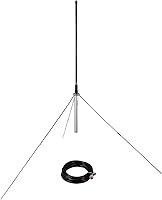
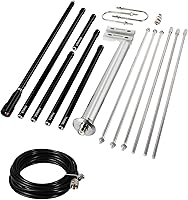
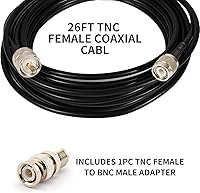
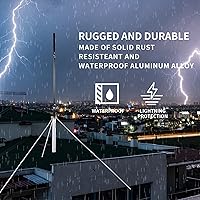
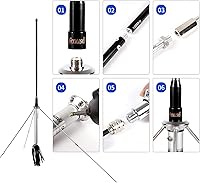
The FMUSER GP100 FM Ground Plane Antenna is a practical, mid-range outdoor antenna built for small FM broadcast operations — think community radio stations, hobbyist setups, and low-power FM licensees rather than commercial towers. Its 1/4 wave ground plane design produces a low-angle radiation pattern, which means you get solid horizontal coverage even when the antenna isn't mounted particularly high. The body is aluminum alloy, the connectors are weatherproofed, and the whole assembly is meant to live outside year-round without babysitting. It ships with a 26ft coaxial cable and a TNC-to-BNC adapter, so most buyers can connect and go without hunting for extra parts. Just set your expectations accordingly — this is a capable tool for modest broadcast ranges, not a high-power tower solution.

Features & Benefits

The GP100's omnidirectional radiation pattern is one of its most practical qualities — signal spreads in all directions equally, so you never have to aim or reposition based on where your listeners are. Where it really earns its keep is in how it protects your transmitter: the VSWR sits below 1.1, meaning almost no power bounces back into your equipment, which matters a lot for long-term reliability. The 3dB gain is modest but real — you'll notice the difference compared to a basic whip antenna, especially at lower mounting heights. Power handling spans under a watt up to 100W, and the waterproof aluminum build won't degrade after seasons of rain and UV exposure. The included TNC-to-BNC adapter is a small but appreciated detail.

Best For

This FM broadcast antenna is squarely aimed at operators running low-power FM setups — LPFM licensees, Part 15 hobbyists, and community stations that need reliable outdoor coverage without spending heavily on professional-grade hardware. Schools, churches, and campgrounds that want to distribute audio over a short FM range will find it a sensible fit. It also suits ham radio enthusiasts who want to experiment within legal broadcast parameters. Practically speaking, if your transmitter has a TNC or BNC output, you're ready to connect right out of the box. The pre-terminated 26ft cable covers most rooftop-to-transmitter runs without needing extensions. Anyone who values easy installation over a highly customizable setup will appreciate how little assembly this actually demands.

User Feedback

Across a solid base of reviews, buyers rate this ground plane antenna highly, with most praising solid build quality and noticeable range improvement over whatever they had before. Assembly consistently comes up as a strength — most people had it mounted and running within minutes. That said, a few users noted the included cable felt slightly thin for permanent outdoor installs, and some in denser urban environments found the range gains less dramatic than expected, which is really more a function of local RF congestion than the antenna itself. The 26ft cable length works for most rooftop setups but can fall short in taller buildings. Reports from buyers running it at higher wattages suggest it handles the load without issues, which is encouraging for those pushing closer to the 100W ceiling.

Pros

  • Quick, tool-minimal installation means most buyers are up and running in under 30 minutes.
  • The omnidirectional pattern gives you full 360-degree coverage without any alignment guesswork.
  • Low VSWR under 1.1 protects your transmitter from reflected power, reducing long-term wear.
  • Aluminum alloy body and waterproof connectors hold up well through rain, heat, and UV exposure.
  • Handles transmitters from under a watt up to 100W, making it versatile across different setups.
  • The included TNC-to-BNC adapter adds immediate compatibility with a wide range of transmitters.
  • Buyers consistently report a noticeable range improvement over basic whip or stock antennas.
  • At 2 pounds, the GP100 is light enough to mount on modest masts without structural concerns.
  • The 88.1-108MHz coverage spans the full commercial FM band with no frequency gaps.
  • Overall build quality earns praise well above what the price point might suggest.

Cons

  • The included coaxial cable feels thin for permanent outdoor installs where durability is critical.
  • At 26ft, the cable run can fall short for taller buildings or attic-to-rooftop configurations.
  • Range gains in dense urban areas are noticeably reduced by local RF interference — not a flaw, but worth knowing.
  • No mounting hardware is included, so buyers need to source a mast or bracket separately.
  • The product documentation is minimal, which can frustrate first-time antenna installers.
  • Connector quality at the cable ends has drawn occasional criticism for feeling less robust than the antenna body itself.
  • Not suited for directional broadcast needs — the omnidirectional design cannot be adjusted or focused.
  • Users running the antenna in high-humidity coastal environments have noted some concern about long-term connector corrosion despite the waterproofing.

Ratings

Our AI-driven scoring for the FMUSER GP100 FM Ground Plane Antenna was built by analyzing verified buyer reviews from multiple global markets, with spam, incentivized, and bot-generated feedback actively filtered out before scoring. The result is a transparent, balanced picture of where this FM broadcast antenna genuinely delivers and where real-world users have run into friction. Both standout strengths and recurring pain points are reflected directly in the scores below.

Signal Performance
88%
Users consistently report a meaningful jump in coverage range after switching from stock or basic whip antennas — particularly noticeable in open suburban and rural settings where the 3dB gain has room to work. The omnidirectional pattern means the signal holds up evenly across all directions without any dead zones.
In dense urban environments with heavy RF congestion, the real-world range gains shrink noticeably, which has disappointed a subset of buyers who expected coverage improvements regardless of location. Performance is genuinely terrain-dependent and can feel inconsistent depending on your broadcast environment.
Build Quality
91%
The aluminum alloy construction earns consistent praise from buyers who have handled cheaper plastic alternatives. The antenna feels solid and purposeful out of the box, and the physical finish inspires confidence for permanent outdoor deployment rather than temporary setups.
A few users noted that the build quality of the included coaxial cable does not quite match the antenna body itself, with the cable feeling noticeably lighter and less robust than the main assembly. This mismatch can be jarring when the antenna itself sets a high physical standard.
Weatherproofing
84%
Buyers who have left the GP100 mounted through full seasonal cycles — including heavy rain, summer heat, and freezing temperatures — generally report no degradation in performance or physical condition. The waterproofed connectors hold up well for most standard outdoor climates.
Users in coastal or high-humidity environments have raised concerns about connector longevity over extended periods, suggesting the weatherproofing may be adequate for average conditions but not truly heavy-duty for harsh salt-air or tropical climates without additional sealing.
Ease of Installation
93%
This is consistently one of the most praised aspects across the review pool. Most buyers describe a genuine plug-and-play experience, with the pre-terminated cable and included adapter eliminating the usual compatibility headaches. Many report being fully operational within 15 to 20 minutes of opening the box.
The lack of any included mounting hardware means buyers without a pre-existing mast or pipe setup need to source one separately, which adds a step that a few first-time installers found unexpectedly disruptive to an otherwise smooth setup process.
VSWR Stability
89%
Users running FM transmitters who understand what VSWR means tend to be particularly pleased here — the sub-1.1 standing wave ratio translates practically into a transmitter that runs cooler, draws less reflected power, and shows fewer stress indicators during extended broadcasts. Several LPFM operators specifically called this out as a deciding factor.
Non-technical buyers have little visibility into this metric and cannot easily verify it without RF test equipment, so the benefit remains somewhat invisible to a portion of the user base. A small number of advanced users also noted they would have appreciated third-party VSWR test data to validate the specification.
Cable Quality
62%
38%
The included 26ft TNC coaxial cable is perfectly functional for getting started and covers the majority of standard rooftop-to-transmitter runs without needing an immediate replacement. For temporary testing or short-term setups, it does the job adequately and saves an initial extra purchase.
This is the most recurring criticism in the review pool. Multiple buyers describe the cable as feeling thin and underbuilt relative to a permanent outdoor installation, and several have proactively replaced it with heavier LMR or RG8-type coaxial shortly after setup. It reads more like a starter cable than a long-term solution.
Connector Compatibility
86%
The bundled TNC-to-BNC adapter is a genuinely useful inclusion that broadens the antenna's compatibility to cover the two most common FM transmitter output standards without any additional purchases. Users with both connector types in their setups appreciated not having to order an adapter separately.
A small number of buyers found the adapter fit to be slightly loose on certain transmitter models, raising minor concerns about contact reliability over time. Those using the antenna in high-vibration or wind-exposed environments mentioned the adapter connection deserves periodic checking.
Value for Money
82%
18%
Within the mid-range outdoor FM antenna segment, the GP100 delivers a competitive package — solid construction, included cable, and a dual-connector adapter at a price point that undercuts many comparable alternatives without sacrificing core RF performance. LPFM operators on tight budgets frequently highlight this favorably.
Buyers who factor in the likely cost of upgrading the included cable to a more durable option post-installation may feel the effective total cost edges higher than the initial price suggests. For buyers who need long-term reliability from day one, the cable situation slightly erodes the overall value proposition.
Range Consistency
71%
29%
In favorable conditions — open terrain, moderate transmit power, low local RF interference — users report stable and predictable signal reach that meaningfully outperforms basic whip antennas. The consistent omnidirectional pattern means coverage is uniform, which simplifies broadcast planning for small stations.
Range results vary considerably based on environment, and a portion of buyers in urban or semi-urban areas express disappointment when results fall short of their expectations. The antenna cannot compensate for interference-heavy RF landscapes, and the product communication around realistic range expectations could be clearer.
Transmitter Protection
87%
The low VSWR directly reduces the stress placed on connected FM transmitters by minimizing reflected power — buyers who have experienced transmitter failures with poorly matched antennas in the past specifically note the GP100 as a more transmitter-safe option. Extended broadcast sessions show fewer thermal stress indicators on compatible transmitters.
There is no built-in surge or lightning protection, which is a separate consideration for outdoor broadcast setups exposed to storm risk. Buyers in lightning-prone regions should budget for an external lightning arrestor regardless of antenna choice.
High-Power Handling
83%
Users running transmitters at higher wattages — in the 50W to 100W range — generally report the antenna handles the load without issues, with no reported cases of physical degradation or signal quality loss at elevated power. This gives higher-power LPFM operators genuine confidence in the antenna's headroom.
The included cable becomes a more significant weak point at higher power levels, where connector quality and cable shielding matter considerably more. Buyers pushing toward the 100W ceiling are strongly advised to upgrade the cable before sustained high-power operation.
Mounting Flexibility
68%
32%
The compact dimensions and light 2-pound weight make the GP100 physically adaptable to a range of mast types and diameters, and the relatively modest size means it does not require heavy-duty structural support. This flexibility suits community stations and hobbyists working with improvised or lightweight mounting solutions.
No mounting hardware is included, which is a notable gap given that the antenna is marketed as a near-complete outdoor broadcast solution. First-time buyers who do not already own a compatible mast or pipe often discover this requirement only after the antenna arrives.
Documentation & Support
57%
43%
The physical installation is intuitive enough that most experienced users do not need documentation at all, and the pre-terminated cable and labeled connectors reduce the chance of basic wiring mistakes during setup.
The included documentation is minimal, and buyers who are new to FM antenna installation have frequently noted the lack of clear guidance around grounding, cable routing, or mast selection. FMUSER's direct customer support response times have also drawn mixed feedback from buyers seeking post-purchase technical assistance.

Suitable for:

The FMUSER GP100 FM Ground Plane Antenna is a strong fit for anyone operating within the low-power FM broadcasting space — LPFM licensees, Part 15 hobbyists, and small community radio operators who need a reliable outdoor antenna without the complexity or cost of professional-grade equipment. Schools, churches, and campgrounds that want to distribute audio over a short FM range will find this a particularly sensible choice, since it handles the job without requiring an RF engineer to set it up. Ham radio enthusiasts experimenting with FM broadcast frequencies will also appreciate how little friction there is between unboxing and actually transmitting. The pre-terminated 26ft coaxial cable and included TNC-to-BNC adapter mean most buyers can connect directly to their existing transmitter without sourcing additional hardware. If your transmitter outputs anywhere from under a watt up to 100W and uses a TNC or BNC connector, this antenna covers that range comfortably.

Not suitable for:

The FMUSER GP100 FM Ground Plane Antenna is not the right tool for high-power commercial broadcast operations or anyone expecting wide-area coverage across a dense urban environment. Its 3dB gain is genuinely useful for modest setups, but buyers hoping to cover several miles or punch through significant RF congestion will hit a ceiling quickly. The included cable, while convenient, has drawn some criticism for feeling lightweight relative to permanent outdoor installs where heavier-duty coaxial might be more appropriate for long-term weathering. Anyone planning a rooftop install on a tall building may also find the 26ft cable run falls short, requiring an additional extension purchase. If you need directional signal control — say, pointing your broadcast toward a specific neighborhood — the omnidirectional design works against you here, since it radiates equally in all directions by intent.

Specifications

  • Antenna Type: 1/4 wave ground plane design with low-angle omnidirectional radiation pattern across the full FM broadcast band.
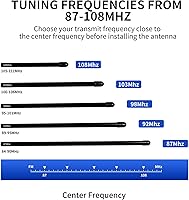
  • Frequency Range: Covers 88.1–108MHz, spanning the entire standard FM broadcast band with no gaps.
  • Gain: Provides 3dB of omnidirectional gain, improving coverage in all horizontal directions equally compared to a basic whip antenna.
  • Max Power Input: Rated for a maximum continuous power input of 100W, suitable for a wide range of low-power FM transmitters.
  • Min Power Input: Operates reliably from as low as 0.5W, making it compatible with even the smallest legal Part 15 transmitters.
  • VSWR: Standing wave ratio is rated at less than 1.1, meaning minimal reflected power returns to the transmitter under normal operating conditions.
  • Impedance: Standard 50-ohm impedance, matching the output of the vast majority of FM broadcast and amateur radio transmitters.
  • Cable Length: Includes a pre-terminated 26ft TNC coaxial cable suitable for most standard rooftop-to-transmitter installation runs.
  • Connector Types: Compatible with both TNC and BNC female connectors via the included TNC-to-BNC adapter, requiring no additional hardware for most setups.
  • Body Material: Constructed from aluminum alloy, providing a balance of light weight and structural resistance to outdoor environmental stress.
  • Weatherproofing: Connectors are waterproofed for permanent outdoor installation, designed to resist rain, humidity, and UV degradation over time.
  • Dimensions: Measures 16.54 x 3.94 x 1.97 inches, compact enough to mount on a standard short-to-medium height outdoor mast.
  • Weight: Complete antenna assembly weighs 2 pounds, light enough for mounting on modest mast structures without additional reinforcement.
  • Included Adapter: Ships with a TNC-to-BNC adapter, broadening compatibility across different transmitter output connector standards out of the box.
  • Manufacturer: Designed and sold by FMUSER, a manufacturer specializing in FM broadcast transmission equipment and accessories.
  • Radiation Pattern: Omnidirectional horizontal pattern ensures equal signal distribution in all compass directions without requiring antenna aiming or repositioning.
  • Recommended Mount: Best deployed on a short-to-medium height outdoor mast; mast hardware is not included and must be sourced separately.
  • Center Frequencies: Factory-optimized center frequency options include 87, 92, 98, 103, and 108MHz to cover common LPFM and hobbyist broadcast assignments.

Related Reviews
TERK Amplified AM/FM Stereo Indoor Antenna TOWER
82%
88%
FM Reception Quality
93%
Ease of Setup
84%
Signal Boost Performance
80%
Build Quality
91%
Compactness/Design
More
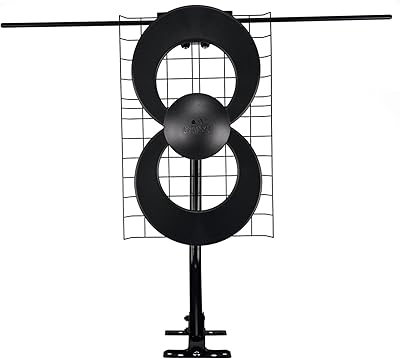
Antennas Direct ClearStream 2MAX TV Antenna
76%
83%
Signal Reception Quality
67%
Range Accuracy
88%
Ease of Installation
84%
Build Quality
79%
Multi-Directional Performance
More
Antennas Direct ClearStream 4V TV Antenna
74%
88%
Signal Reception
84%
Build Quality
81%
Multi-Directional Performance
67%
Ease of Installation
74%
Value for Money
More
Antennas Direct ClearStream 4MAX TV Antenna
86%
88%
Performance in Rural Areas
93%
Ease of Installation
85%
Signal Strength
91%
Build Quality
89%
Indoor/Outdoor Versatility
More
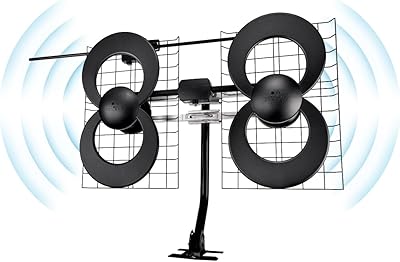
Antennas Direct ClearStream 2V TV Antenna
83%
88%
Signal Reception
91%
VHF Channel Coverage
84%
Build Quality
82%
Ease of Installation
79%
Value for Money
More
Antennas Direct ClearStream MAX-V TV Antenna
76%
78%
Signal Reception
61%
Range Accuracy
84%
Installation Ease
82%
Build Quality
79%
Value for Money
More
Diamond Antenna X30A Dual-Band Base Antenna
80%
91%
Signal Performance
88%
Build Quality
86%
Weatherproofing
84%
Ease of Installation
89%
SWR Consistency
More
Wilson T5000 Center Loaded Mobile CB Antenna
82%
92%
Signal Performance
89%
Build Quality
94%
Power Handling
71%
Ease of Installation
76%
Mounting Flexibility
More
Antennas Direct ClearStream Eclipse Indoor TV Antenna
77%
74%
Signal Reception
67%
Amplifier Performance
93%
Design & Profile
91%
Ease of Setup
62%
Cable Length
More
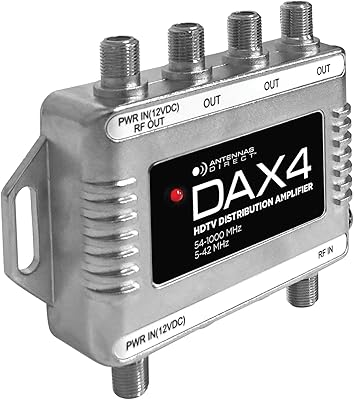
Antennas Direct DAX4 4-Output TV Antenna Distribution Amplifier
86%
87%
Signal Quality & Performance
91%
Ease of Installation
85%
Build Quality & Durability
92%
Value for Money
78%
Weather Resistance
More

FAQ

For most setups, yes. The GP100 ships with a 26ft pre-terminated TNC coaxial cable and a TNC-to-BNC adapter, so if your transmitter has either a TNC or BNC female output, you can connect directly without buying extra parts. The one thing not included is any mast or mounting bracket, so you will need to sort that separately.

Honest answer: it depends heavily on your transmitter power, terrain, and local RF environment. In open rural areas with a few watts of transmit power, you can expect solid coverage over several hundred feet to potentially a mile or more. In dense urban neighborhoods with competing signals and buildings blocking propagation, expect noticeably shorter effective range. The antenna does its job well, but it cannot overcome physics or interference.

It is rated for up to 100W continuous input, and buyers who have tested it at higher wattages generally report it holds up without issues. That said, make sure your coaxial cable connections are tight and weatherproofed if you are running near the top of that power range, since connector quality matters more at higher power levels.

The connectors are described as waterproofed, and the aluminum alloy body itself is naturally corrosion-resistant. It is designed for permanent outdoor installation and handles rain and humidity well. That said, in very harsh coastal or salt-air environments, it is worth applying additional weatherproofing tape around cable connections just to be safe over the long term.

It is genuinely one of the better entry-to-mid options for that application. The VSWR is very low, which protects your transmitter, the installation is straightforward, and the 3dB gain is a real improvement over most stock or basic whip antennas. For a small community station or LPFM operation, it covers the essentials without overcomplicating the setup.

For a typical single-story or two-story building where the transmitter is close to the roofline access point, 26ft usually works out fine. If you are dealing with a taller structure or need to route the cable through walls and around obstacles, you may find yourself a few feet short. In that case, a coaxial extension with proper connectors is the straightforward fix.

No, and that is one of its practical strengths. The ground plane design radiates signal equally in all horizontal directions, so once it is mounted vertically and connected, you are done. There is no alignment process, which simplifies installation considerably.

The antenna is compact and light at 2 pounds, so it does not require anything heavy-duty. A standard 1-to-1.5 inch diameter pipe or antenna mast works well. The key is keeping it as vertical as possible and as high as your situation allows, since height generally helps with FM propagation more than almost any other single factor.

The frequency range covers the standard FM broadcast band from 88.1 to 108MHz, which overlaps with some amateur radio operations but is not a general-purpose ham antenna. It is purpose-built for FM broadcast use, so it works well for LPFM, Part 15 broadcasting, and ham operators working in that specific frequency range, but it is not a substitute for a broadband ham antenna.

That concern comes up occasionally in buyer feedback, and it is a fair one. The included cable is functional and convenient for getting started, but if you are planning a permanent outdoor install where the cable will be exposed to the elements year-round, upgrading to a higher-quality RG8 or LMR-type coaxial cable with proper weatherproofing at the connections is worth the extra investment for long-term reliability.