Overview

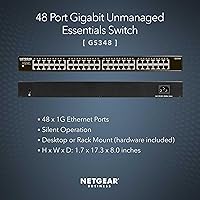
The NETGEAR GS348 48-Port Gigabit Unmanaged Switch has been a dependable workhorse in the networking world since its 2017 introduction, and the sheer volume of satisfied buyers it has accumulated over that time speaks for itself. What sets it apart from most competitors at this port count is its completely fanless design — dead silent under any load, which is rarer than you might expect in this category. It handles straightforward network expansion without any configuration headaches: no software, no setup screens, just plug in your cables and you are running. For anyone who needs 48 wired gigabit ports without touching a command line, this switch delivers exactly that promise.
Features & Benefits

Pull this 48-port gigabit switch out of the box and the build quality is immediately noticeable — a solid metal chassis that feels like it belongs in a proper rack. Every one of the 48 RJ45 ports runs at full 1 Gbps throughput, and the IEEE 802.3az compliance means it dials back power consumption when ports sit idle, which adds up meaningfully in a busy office over time. The box includes both rack ears and rubber footpads, so you can go desktop or 1U rackmount without a separate hardware order. Backing it all is a three-year limited warranty — substantial for an unmanaged switch and a clear sign that NETGEAR stands behind the hardware long-term.

Best For

This unmanaged desktop switch fits a specific need well, and knowing whether that matches yours saves a lot of second-guessing. It is an ideal pick for small to medium businesses that want to expand wired connections fast without hiring someone to configure VLANs or QoS policies. Home lab builders and prosumers who need a high-port-count, silent switch for a basement or closet rack will find it equally compelling. IT admins often deploy it as an access-layer switch sitting behind a managed core, keeping things tidy without added complexity. Schools and open-plan offices where fan noise is genuinely disruptive also make for a natural fit.

User Feedback

Across tens of thousands of verified ratings, the pattern is consistent: people who buy the NETGEAR GS348 for the right reasons tend to be happy with it for years. Silent operation and instant setup draw the most praise, and long-term reliability comes up repeatedly in longer reviews. That said, the honest trade-offs deserve attention. The chassis runs noticeably warm under sustained load — passive cooling works fine, but do not expect it to feel cool to the touch. More critically, no PoE support means anyone powering IP cameras, VoIP phones, or access points will need separate injectors or a dedicated PoE switch. And with zero management features, buyers who need VLANs or traffic monitoring should look elsewhere.

Pros

  • All 48 ports run at full gigabit speed with no bottlenecks or shared bandwidth caveats.
  • Completely fanless operation makes this 48-port gigabit switch genuinely silent in any environment.
  • Plug-and-play setup means you are connected in minutes with no software, drivers, or configuration required.
  • IEEE 802.3az compliance trims power consumption during idle periods, which adds up over time in a busy office.
  • Ships with both rack mounting hardware and desktop footpads, so installation fits your existing setup.
  • Solid metal chassis handles years of continuous operation without the wear risk of fan-based cooling.
  • A three-year limited warranty is a meaningful commitment for a switch at this port count.
  • Thousands of long-term buyers report years of trouble-free, set-it-and-forget-it reliability.
  • Consolidating multiple smaller switches into one unit cleans up cabling and reduces failure points.
  • Strong port-count-to-cost ratio compared to managed alternatives with features most buyers will never use.

Cons

  • No PoE support on any port means separate injectors or a second switch are needed for cameras and phones.
  • Zero management features make it impossible to create VLANs, set QoS rules, or monitor traffic.
  • The chassis runs noticeably warm under sustained load, requiring adequate ventilation in the deployment space.
  • No 10G uplink ports limits high-speed connectivity to upstream managed switches or NAS devices.
  • Restricted to US and Canadian power standards, making it unsuitable for international deployments.
  • No link aggregation support means you cannot bond ports for increased throughput to a single device.
  • Physical port status LEDs are the only diagnostic tool — troubleshooting network issues requires external equipment.
  • No console or web interface means there is no way to check switch health, uptime, or traffic statistics.

Ratings

The NETGEAR GS348 48-Port Gigabit Unmanaged Switch has been scored by our AI engine after processing thousands of verified global buyer reviews, with spam, bot-generated feedback, and incentivized reviews actively filtered out before analysis. The scores below reflect real-world usage patterns across home labs, small business deployments, and professional rack environments — both the standout strengths and the genuine frustrations are represented transparently.
Noise Level
97%
Among buyers who specifically sought a silent switch for home offices, open-plan workspaces, or recording studios, the fanless design earns near-universal praise. Many report that after years of use, they have never once heard a sound from the unit — a rare distinction at this port count.
A small number of buyers noted that the warm chassis under heavy load occasionally prompted concern about long-term heat management, even if the silence itself was never an issue. There is no way to audit fan health over time simply because there is nothing to monitor.
Ease of Setup
94%
Non-technical buyers repeatedly highlight how little time passes between opening the box and having a fully operational network — often just minutes. IT pros appreciate that there is nothing to misconfigure, making it a dependable option when speed of deployment matters.
A handful of buyers expected at least a basic status page or indicator light system beyond simple port LEDs, finding the complete absence of any feedback interface slightly limiting when troubleshooting connectivity issues on a specific port.
Build Quality
89%
The all-metal chassis feels noticeably more substantial than similarly priced plastic competitors, and buyers deploying it in rackmount environments consistently comment on how well it fits and holds up over years of continuous operation. The solid construction inspires long-term confidence.
Some buyers noted that the chassis runs warm — even hot — to the touch during peak load, which is an expected trade-off for passive cooling but can feel unsettling if you are not familiar with how fanless hardware manages thermals. Ventilation in the deployment space is non-negotiable.
Long-Term Reliability
93%
Multi-year ownership reviews are disproportionately positive for this switch, with buyers regularly reporting three, four, and five years of continuous uptime without a single port failure. The absence of fans removes one of the most common mechanical failure points in networking hardware.
Because the switch is unmanaged, there is no way to monitor port health, error rates, or uptime statistics proactively — if something does eventually degrade, you are likely to discover it reactively through a connected device losing connectivity rather than through any alert.
Value for Money
86%
Buyers consistently frame the port-count-to-cost ratio as compelling, particularly when comparing it to managed alternatives that include features most small business and home lab users will never configure. The included rack hardware and three-year warranty add tangible value without extra cost.
A segment of buyers who later discovered they needed PoE or VLAN support felt the purchase was ultimately wasted, not because the switch underdelivered on its promises but because their requirements evolved beyond what an unmanaged unit can ever provide. Scoping your needs upfront is critical.
Port Performance
91%
All 48 ports consistently deliver full gigabit throughput, and buyers running NAS backups, large file transfers, and video streaming across multiple simultaneous connections report no degradation or throttling. The switching fabric handles dense traffic loads without obvious bottlenecks.
The switch maxes out at 1 Gbps per port with no 10G uplink option, which is a real ceiling for users with high-speed NAS devices or backbone links that would benefit from faster uplink throughput to a core switch.
Installation Flexibility
88%
Having both rack ears and rubber footpads in the box is something buyers genuinely appreciate, since it means the switch works equally well sitting on a shelf or installed in a 1U rack slot without an additional hardware order. The 1U profile fits tightly in standard 19-inch cabinets.
The physical footprint, while rack-standard, is wide enough that desktop placement on a cluttered workbench can feel awkward. A few buyers also noted the power cable routing could be more thoughtfully positioned for tidy rack installations.
Energy Efficiency
84%
IEEE 802.3az compliance means ports that are idle or connected to powered-down devices draw significantly less current, which adds up meaningfully for a 48-port unit running continuously in a business environment. Buyers in energy-conscious deployments appreciate this without needing to configure anything.
There is no way to verify or audit actual power draw per port or in aggregate, since the switch has no management interface. Buyers who want granular energy monitoring will need an external smart PDU to capture that data.
Warranty & Support
79%
21%
A three-year limited hardware warranty is above average for an unmanaged switch and gives business buyers meaningful coverage without additional service contracts. Buyers who have needed to invoke it report a reasonably straightforward process with NETGEAR's support team.
Support is limited to hardware replacement under warranty — there is no firmware update path, no remote diagnostics, and no advanced technical support applicable to an unmanaged device. Some buyers found NETGEAR's warranty claim process slower than expected.
PoE Capability
12%
88%
This category is included specifically for transparency: a minority of buyers who do not need PoE find the absence irrelevant and are entirely satisfied with the switch for purely data connectivity use cases.
There is no Power over Ethernet support on any port, full stop. Buyers who planned to power IP cameras, VoIP handsets, or wireless access points through the switch were forced to purchase additional PoE injectors or replace the unit entirely — a costly oversight if not checked before buying.
Traffic Management
11%
89%
For buyers with simple flat-network needs — a home lab, a small office with a single subnet, or a basic wired expansion — the complete absence of traffic management is not a gap but a feature, since there is nothing to misconfigure and nothing that can break.
There are zero traffic management capabilities: no VLANs, no QoS, no port mirroring, no storm control, and no access control lists. Any organization with security segmentation requirements, voice traffic prioritization, or compliance obligations will find this switch architecturally insufficient.
Thermal Management
72%
28%
For most standard deployments in ventilated spaces, the passive cooling design works reliably over long periods, and the metal chassis does a reasonable job of spreading heat across its surface area without causing hardware issues in typical office temperatures.
The chassis surface temperature under full load can be surprisingly warm, and several buyers in warmer climates or less-ventilated server closets reported concern. Unlike fan-cooled units, there is no ability to compensate for a hot environment by increasing airflow — ventilation is entirely the installer's responsibility.
Diagnostic Visibility
43%
57%
Each port has an activity LED that provides basic link and traffic indication, which is sufficient for a quick visual check to confirm whether a cable is live and passing data in straightforward troubleshooting scenarios.
Beyond per-port LEDs, there is no diagnostic capability of any kind — no error counters, no utilization metrics, no remote access, and no event logging. Tracking down intermittent issues or identifying a flapping port requires external tools or physical testing, which frustrates buyers managing larger deployments.
Compatibility
92%
The RJ45 ports auto-negotiate with any standard Ethernet device, work seamlessly with Cat5e through Cat6a cabling, and integrate cleanly as an access switch behind virtually any brand of managed core switch. Buyers swapping it into existing mixed-brand infrastructure report no compatibility issues.
Regional power certification limits the unit to US and Canadian deployments, and the lack of any SFP or fiber ports means there is no native option for long-distance or fiber backbone connections without adding a media converter externally.

Suitable for:

The NETGEAR GS348 48-Port Gigabit Unmanaged Switch is a strong fit for anyone who needs a high port count, reliable wired network, and zero tolerance for fan noise — all without the complexity of managed networking. Small and medium businesses that have outgrown a handful of smaller switches will find the jump to 48 ports in a single unit genuinely practical, especially when there is no IT budget for ongoing configuration and maintenance. Home lab enthusiasts and prosumers who run dense rack setups in a bedroom, basement, or home office will appreciate that this switch runs silently around the clock. IT administrators who already have a managed core switch in place often deploy this unmanaged desktop switch as a clean, low-overhead access layer without any feature overlap. Schools, recording studios, libraries, and open-plan offices — any environment where a buzzing fan would be a constant irritant — also get real, daily value from its fanless design. The included rack hardware and rubber footpads mean it adapts to your space rather than forcing a workaround.
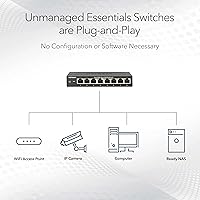
Not suitable for:

The NETGEAR GS348 48-Port Gigabit Unmanaged Switch is the wrong tool if your network demands any form of traffic control, visibility, or segmentation. There are no VLANs, no QoS settings, no port mirroring, and no management interface of any kind — if those features are on your requirements list, you need a managed switch and no amount of workarounds will change that. Buyers planning to power IP cameras, VoIP phones, wireless access points, or any other PoE-dependent devices will be disappointed, as this switch delivers no Power over Ethernet on any port. Organizations running larger infrastructure that requires link aggregation, SNMP monitoring, or spanning tree configuration should also look elsewhere. The chassis runs warm under sustained load, which is a normal trade-off for passive cooling, but anyone deploying it in a poorly ventilated enclosure or a hot server room should factor that in carefully. Finally, international buyers should note it is designed specifically for US and Canadian power standards.
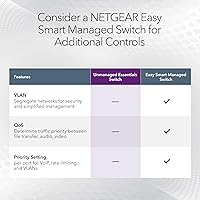
Specifications

  • Port Count: The switch provides 48 x RJ45 Gigabit Ethernet ports, each capable of 1000 Mbps full-duplex throughput.
  • Data Transfer Rate: Every port operates at 1000 Mbps (1 Gbps), ensuring consistent gigabit-speed connections across all connected devices simultaneously.
  • Cooling System: The unit uses fully passive, fanless cooling with no moving parts, relying on the metal chassis for heat dissipation.
  • Form Factor: Designed for 1U rackmount or flat desktop placement, with all necessary mounting hardware included in the box.
  • Dimensions: The chassis measures 17.32″ long x 10.24″ wide x 1.73″ tall, fitting standard 19-inch server rack enclosures.
  • Weight: The unit weighs 6.93 lbs (3.15 kg), making it manageable for single-person rack installation.
  • Case Material: The outer housing is constructed from metal, providing structural rigidity and passive thermal dissipation under continuous load.
  • Power Supply: An internal power supply unit is built into the chassis, eliminating the need for an external power brick.
  • Voltage: The switch operates at 48V DC and is compatible with US and Canadian electrical standards only.
  • Energy Efficiency: The unit is IEEE 802.3az Energy Efficient Ethernet compliant, automatically reducing power draw on ports with low or no traffic.
  • Management Type: This is a fully unmanaged switch with no software, web interface, or CLI — it requires zero configuration to operate.
  • PoE Support: The switch provides no Power over Ethernet capability on any of its 48 ports.
  • Interface Type: All 48 ports use the RJ45 connector standard, compatible with standard Cat5e, Cat6, and Cat6a Ethernet cables.
  • Warranty: NETGEAR covers the GS348 with a 3-year limited hardware warranty for buyers in supported regions.
  • In-Box Contents: The package includes the GS348 switch, a regional power cord, a 1U rack mounting kit, rubber footpads for tabletop use, and a quick installation guide.
  • Model Number: The official model number is GS348-100NAS, which is the US and Canada retail variant of this switch.
  • Availability: The product was first made available in May 2017 and has not been discontinued by the manufacturer as of the latest data.
  • Region: The GS348-100NAS is manufactured and warranted for use in the United States and Canada only.

Related Reviews
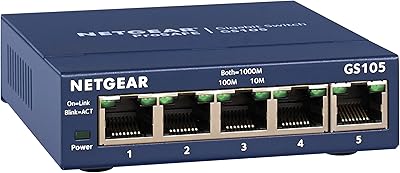
NETGEAR GS105NA 5-Port Gigabit Unmanaged Switch
85%
97%
Ease of Setup
93%
Network Performance
88%
Build Quality
96%
Noise Level
91%
Value for Money
More
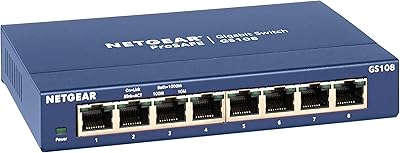
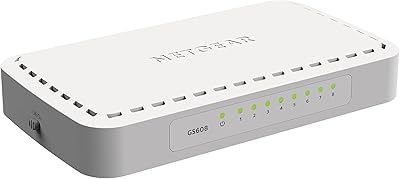
NETGEAR GS108 8-Port Gigabit Ethernet Switch
82%
97%
Ease of Setup
93%
Reliability & Longevity
88%
Build Quality
91%
Value for Money
89%
Port Performance
More
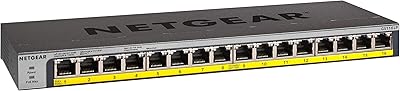
NETGEAR GS116LP 16-Port Unmanaged PoE+ Switch
86%
97%
Ease of Setup
93%
PoE Port Coverage
62%
PoE Power Budget
96%
Silent Operation
88%
Build Quality
More
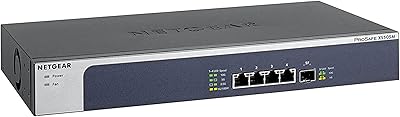
NETGEAR XS505M 5-Port 10G Multi-Gigabit Ethernet Unmanaged Switch
87%
91%
Performance
94%
Setup and Installation
88%
Build Quality
85%
Energy Efficiency
93%
Fanless Operation (Noise Level)
More
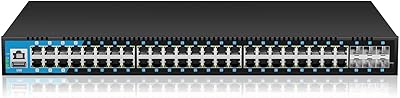
YuanLey YS4802GS-P8 48-Port Gigabit PoE Switch
79%
91%
Value for Money
93%
Ease of Installation
84%
PoE Performance
86%
Build Quality
52%
Fan Noise
More
keepLiNK 48-Port Gigabit PoE Switch
86%
89%
Performance
85%
Ease of Setup
91%
Build Quality
88%
Power Delivery (PoE+)
84%
Security Features
More
NETGEAR GS324 24-Port Gigabit Ethernet Switch
84%
97%
Ease of Setup
94%
Silent Operation
89%
Build Quality
92%
Port Performance & Stability
67%
Thermal Management
More
NETGEAR GS608 8-Port Gigabit Ethernet Switch
83%
97%
Ease of Setup
91%
Network Performance
94%
Silent Operation
67%
Build Quality
83%
Value for Money
More
NETGEAR GS316 16-Port Gigabit Network Switch
85%
97%
Ease of Setup
96%
Noise Level
78%
Build Quality
91%
Port Performance
88%
Reliability & Longevity
More
NICGIGA GS4802P 48-Port Gigabit PoE+ Switch
85%
89%
Value for Money
85%
Performance
92%
Setup & Installation
90%
Power Delivery for PoE Devices
87%
Build Quality & Durability
More

FAQ

Not at all. This is a true plug-and-play device — you power it on, connect your cables, and it works immediately. There is no setup wizard, no management interface, and no drivers to install on any connected computer.

It is genuinely silent. The switch has no fan whatsoever, so under any load level you will hear nothing from the unit itself. This makes it a popular choice for home offices, open workspaces, and recording environments where even a low hum would be distracting.

No, and this is an important point to check before buying. The switch does not support Power over Ethernet on any port. If your cameras, VoIP phones, or access points require PoE, you will need separate inline injectors or a dedicated PoE switch for those devices.

The metal body does run noticeably warm under sustained load, which is expected for a fanless design relying on passive heat dissipation. In a well-ventilated rack or on a desk with reasonable airflow, this is not a problem. Deploying it in a sealed, unventilated enclosure in a warm room is not recommended, however.

No. Because it is unmanaged, it has no traffic segmentation capabilities at all — no VLANs, no QoS, no port isolation, and no management features of any kind. If your setup requires any of those, you will need to step up to a managed switch.

Link aggregation is not supported. This is an unmanaged switch, so there are no configurable features of that kind. All 48 ports function independently at 1 Gbps each.

Yes on both counts. The switch occupies a single 1U slot in any standard 19-inch rack, and the rack mounting ears are included in the box. You also get rubber footpads if you prefer to set it flat on a desk or shelf.

Many buyers report using the same unit for five or more years without issues. The fanless design removes one of the most common hardware failure points in networking gear, and the all-metal construction adds to long-term durability. The three-year warranty gives you a meaningful safety net from the start.

Yes, fully. The RJ45 ports work with Cat5e, Cat6, and Cat6a cables, and will auto-negotiate the connection speed with whatever device is on the other end. You do not need to upgrade your existing cabling to use it at gigabit speeds.

The GS348-100NAS is specifically designed and warranted for use in the United States and Canada only, which relates to its power supply and regional certification. Using it outside those regions is not recommended and may void the warranty.

Where to Buy