Overview

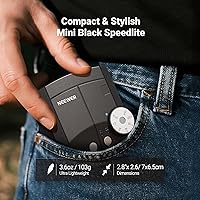
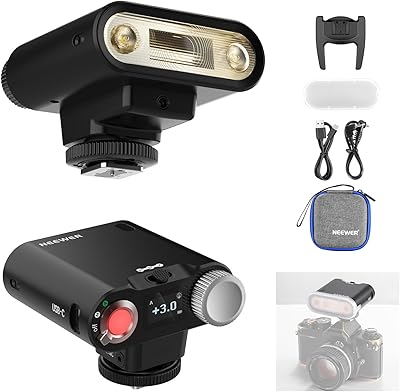
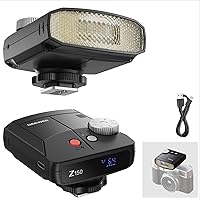
The NEEWER Z150 Mini Hot Shoe Flash is a compact, retro-styled speedlite built for photographers who want reliable fill light without hauling extra gear. At just 3.6 ounces, it slips into a jacket pocket — something no AA-battery flash can claim. The built-in rechargeable battery alone sets it apart from most units in this price range. Compatibility is broad: Canon, Nikon, Sony MI shoe, Fujifilm, Panasonic, and more. But this is a manual and optical slave flash only — there is no TTL auto exposure here. If you need the camera to do the thinking, look elsewhere. If you want affordable, portable light you control yourself, keep reading.
Features & Benefits

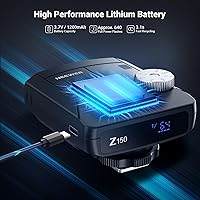
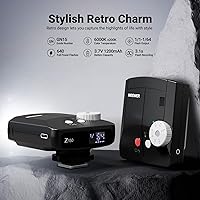
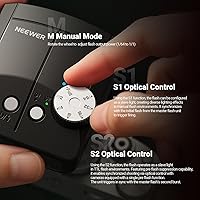
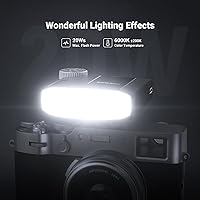
The Z150 flash runs on a 1200mAh lithium cell that delivers up to 640 full-power flashes per charge — enough to cover a full portrait session without reaching for a cable. Recycle time sits at 3.1 seconds at maximum power, acceptable for posed work but potentially slow during fast-paced event shooting. Output is rated at 20Ws (GN15), plenty for indoor fill and close-range portraits, though do not expect to overpower bright sunlight outdoors. Color temperature holds at 6000K (±200K), keeping skin tones consistent across a shoot. Three modes cover the basics: Manual from 1/64 to 1/1, plus S1 and S2 optical slave — S2 being especially useful when pairing with a TTL main flash that fires a pre-flash. Charging is USB-C.

Best For

This compact hot shoe flash is a natural fit for content creators and vloggers who want a portable fill light for indoor shoots, small events, or social content without investing in larger gear. It also works well as a first flash for beginners getting comfortable with manual exposure — the simple controls strip away TTL menu confusion entirely. Travel photographers will appreciate the USB-C charging and sub-4-ounce weight. Studio hobbyists can deploy it as a secondary optical slave triggered by a main strobe. Sony mirrorless users on the A7 series or ZV-E10, and Fujifilm shooters on compatible bodies, will find it one of the more affordable hot shoe options available for their systems.

User Feedback

With over 13,000 ratings and a 4.5-star average, the Z150 flash clearly resonates with buyers — though it pays to understand why. Most praise centers on portability and value, with users noting how easy setup is and how reliably S2 mode triggers alongside other flashes. USB-C charging gets mentioned often as a small but meaningful convenience. On the other side, buyers who expected strong outdoor fill were let down — GN15 simply does not cut through bright ambient light. A few note the plastic construction feels light in hand, which some read as cheap. The most avoidable frustration: shoppers who skipped the exclusion list and found their Canon Rebel, Sony A9III, or Fujifilm X100 body was not supported.

Pros

  • Built-in rechargeable battery eliminates AA batteries entirely — one USB-C cable handles everything.
  • Up to 640 full-power flashes per charge is enough to cover a full portrait session without touching a cable.
  • At 3.6 ounces, this mini speedlite genuinely fits in a jacket pocket — few hot shoe flashes can claim that.
  • S2 optical slave mode triggers reliably alongside TTL main flashes by ignoring the pre-flash burst.
  • Six thousand Kelvin color temperature stays consistent shot to shot, keeping skin tones predictable indoors.
  • Seven stops of manual power control from 1/64 to 1/1 gives beginners plenty of range to learn exposure.
  • Compatible with a wide range of Canon, Nikon, Sony MI shoe, Fujifilm, Panasonic, Olympus, and Pentax bodies.
  • Retro styling looks intentional rather than cheap — a minor point, but buyers notice and appreciate it.
  • USB-C charging means no proprietary cable to lose; it shares a charger with most modern phones and cameras.

Cons

  • No TTL support means every power adjustment is manual — a real workflow slowdown when conditions change quickly.
  • The 3.1-second recycle at full power is slow enough to cost you shots during any fast-paced shooting situation.
  • GN15 output cannot compete with bright ambient daylight, making outdoor fill flash largely impractical.
  • No battery level display beyond a basic LED — you may run out of charge mid-session with no warning.
  • The flash head is fixed with no tilt or swivel, ruling out bounce flash off ceilings or walls.
  • Long compatibility exclusion list catches buyers off guard — several popular entry-level Canon and Sony bodies are unsupported.
  • No high-speed sync support limits you to shutter speeds at or below 1/250s, a constraint outdoors.
  • Plastic construction raises durability questions for buyers who handle gear roughly or shoot in unpredictable conditions.
  • No included warming gel or diffuser, so the cooler 6000K output requires extra accessories for warmer portrait work.

Ratings

The NEEWER Z150 Mini Hot Shoe Flash has been analyzed using AI-driven review intelligence that processed thousands of verified global buyer experiences, actively filtering out incentivized, bot-generated, and duplicate feedback. What follows reflects the honest consensus — strengths that genuinely impressed real photographers and pain points that caused real frustration. Both sides are represented without softening.
Portability & Form Factor
94%
At 3.6 ounces, this mini speedlite is genuinely pocketable — buyers consistently mention tossing it into a camera bag side pocket or even a jacket pocket without thinking twice. For travel photographers and content creators shooting on the move, that kind of portability is hard to overstate.
The compact size does mean the flash head is fixed with no tilt or swivel, which limits creative bounce lighting options. A few buyers noted that the small footprint also makes the control buttons feel slightly cramped during quick adjustments in the field.
Battery Life & Charging
91%
The built-in 1200mAh lithium cell delivering up to 640 full-power flashes is a genuine differentiator — buyers covering portrait sessions or small events report finishing the day without needing to recharge. USB-C charging is repeatedly called out as a quality-of-life win in a product category still dominated by AA-battery units.
There is no battery indicator beyond a basic LED status light, which leaves some users guessing how much charge remains mid-session. A small number of buyers also reported that charge capacity appeared to drop noticeably after several months of regular use.
Light Output & Power
71%
29%
For indoor portraits, close-range product shots, and fill light against a window, the 20Ws output and GN15 rating are more than adequate. Buyers using the Z150 flash as a secondary fill alongside a key light consistently report clean, well-exposed results without harsh shadows.
Outdoors in daylight, the power ceiling is a hard wall — multiple buyers trying to use it as a fill flash against bright sunlight were disappointed. This is not a criticism of a defective unit; it is simply the physics of a compact flash at this output level, but buyers who did not research this upfront felt misled.
Ease of Use
89%
The stripped-back control layout — a mode button and a power dial — means beginners can be up and shooting in under two minutes. Buyers new to manual flash specifically praise how straightforward the learning curve is compared to navigating multi-menu TTL speedlites.
The simplicity is a double-edged situation: experienced photographers wanting fine-grained control or custom functions will hit the ceiling quickly. There is also no LCD display, so reading current power settings requires knowing the indicator light patterns rather than a clear numerical readout.
S2 Optical Slave Performance
86%
The S2 mode — designed to ignore a TTL pre-flash and fire only on the main burst — works reliably in practice. Buyers pairing the Z150 flash with a dedicated TTL speedlite or studio strobe as the main light report consistent triggering without misfires across multiple sessions.
Optical slave triggering is inherently line-of-sight dependent, and a handful of buyers noted occasional missed triggers when the sensor was partially blocked or in very bright ambient conditions. S1 mode, which fires on any flash, is more trigger-happy but less reliable in TTL-heavy setups.
Recycle Time
67%
33%
At lower power settings — say 1/8 or 1/16 — the recycle time drops well under a second, making it perfectly usable for casual burst shooting or continuous content creation at moderate output levels. Many buyers using it for indoor portraits at mid-power report no noticeable wait.
At full 1/1 power, the 3.1-second recycle is genuinely slow for any fast-paced work — wedding candids, street photography, or run-and-gun event coverage. More than a few buyers describe missing shots while waiting for the ready signal, which is a real operational frustration.
Color Temperature Consistency
83%
The 6000K output with a tight ±200K variance means skin tones stay predictable from shot to shot across a session. Buyers doing portrait work who mix this compact hot shoe flash with natural window light generally find the cooler daylight-balanced output blends without major color cast issues.
At 6000K, the light sits on the cooler side of neutral, which some buyers find slightly clinical for warm, flattering portrait work under tungsten ambient. A warming gel would fix this, but none is included, and that is an extra accessory cost some buyers did not anticipate.
Build Quality & Durability
63%
37%
For the price tier, the construction is functional — the hot shoe foot feels solid enough for regular mounting and dismounting, and the unit has held up for many buyers through months of regular use without reported failures. The retro aesthetic also earns genuine compliments.
The all-plastic body reads as lightweight in a way that triggers durability concerns for some buyers on first handling. A few long-term owners mention the power adjustment dial developing a slightly loose feel over time, and there is no weather sealing of any kind for outdoor conditions.
Camera Compatibility
72%
28%
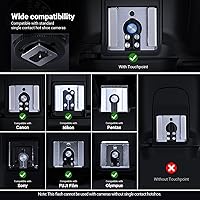
Across the supported systems — Canon DSLRs (outside the excluded Rebel/entry models), Nikon bodies, Sony MI shoe cameras, Fujifilm (select models), Panasonic, Olympus, and Pentax — buyers report reliable hot shoe connectivity and stable mounting with no wobble.
The exclusion list is long and specific: Canon EOS Rebel SL3, T7, T100, R50; Sony A9III, A99, A77, A350, ZV-1F; and Fujifilm X-A3, X100F, X100T are all unsupported. Buyers who purchased without checking this list make up a noticeable portion of the negative reviews, which is a real pre-purchase risk.
Manual Power Range
81%
19%
Seven stops of manual control from 1/64 to 1/1 gives a solid working range for dialing in exposure across varied shooting scenarios. Buyers learning flash photography specifically appreciate being able to work at very low power settings for subtle fill without blowing out close subjects.
Without TTL, every power change is a manual calculation and test shot. Buyers accustomed to auto-exposure flash describe this as a workflow slowdown, particularly when subjects or lighting conditions are changing quickly during a shoot.
Value for Money
88%
The combination of USB-C charging, built-in battery, and optical slave capability at this price point is genuinely strong for what the market typically offers. Buyers who understood the use case before purchasing — indoor fill, travel, beginner manual practice — overwhelmingly feel they got more than their money's worth.
Buyers who purchased expecting TTL functionality, strong outdoor power, or build quality comparable to mid-range branded speedlites feel the value equation breaks down. Managing expectations before purchase is the real issue, not the price-to-feature ratio itself.
Hot Shoe Fit & Mounting Stability
79%
21%
The standard single-contact hot shoe slides on and locks securely on the supported camera bodies buyers tested. There is a locking ring on the foot that keeps the unit from rotating or shifting during handheld shooting, which buyers appreciate during one-handed operation.
Because this is a single-contact shoe with no electronic communication pins beyond the center sync contact, there is zero data exchange with the camera — no power display in the viewfinder, no iTTL or E-TTL, and no high-speed sync. Advanced users will feel this limitation constantly.
Setup & Out-of-Box Experience
87%
The unit ships charged enough for basic testing, and the included USB-A to USB-C cable means buyers can top it off with whatever charger they already own. Most buyers describe going from unboxing to first test shot in under five minutes without needing to consult a manual.
The included documentation is minimal — more of a quick-reference card than a proper guide. Buyers wanting to understand the finer points of S1 versus S2 mode behavior in different TTL setups had to turn to YouTube or online forums rather than any included printed resource.

Suitable for:

The NEEWER Z150 Mini Hot Shoe Flash is a smart pick for content creators, vloggers, and social photographers who shoot primarily indoors and need a lightweight fill light they can grab and go without managing AA batteries or carrying a charger brick. Beginners getting their first taste of manual flash will find the stripped-back controls less intimidating than a full TTL speedlite, and the low entry cost means mistakes in learning are not expensive ones. Travel photographers who want a capable flash that weighs practically nothing and recharges via the same USB-C cable as their phone will feel right at home with this unit. It also earns its place as a secondary optical slave light in a hobbyist home studio setup — triggering reliably in S2 mode alongside a main strobe without adding bulk or cable clutter. Sony mirrorless shooters on compatible bodies like the A7 series or ZV-E10, and Fujifilm users on supported models, will find it one of the more practical and affordable hot shoe options in this price tier.
Not suitable for:

The NEEWER Z150 Mini Hot Shoe Flash is the wrong tool for photographers who rely on TTL auto-exposure flash — there is no electronic communication beyond the center sync contact, meaning your camera cannot control or read power levels automatically. If you shoot fast-paced work like wedding receptions, sports sidelines, or documentary events where missing a shot while waiting on a 3.1-second recycle is genuinely costly, this mini speedlite will frustrate you. Outdoor photographers hoping to balance flash against bright daylight will hit a hard power ceiling; GN15 at ISO 100 simply does not have the muscle to compete with sunlight at any meaningful distance. Buyers with specific excluded camera bodies — including the Canon EOS Rebel SL3, T7, and R50; Sony A9III, A99, and ZV-1F; or Fujifilm X100F, X100T, and X-A3 — need to stop here and verify compatibility before purchasing, as these bodies are explicitly unsupported and a common source of returns. Anyone expecting the build solidity of a mid-range branded speedlite will also find the lightweight plastic construction a letdown in hand.
Specifications

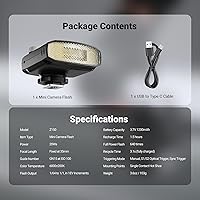
  • Brand & Model: Manufactured by NEEWER under the model designation Z150.
  • Output Power: Delivers 20 watt-seconds (Ws) of flash output with a Guide Number of 15 at ISO 100 in meters.
  • Color Temperature: Produces a daylight-balanced 6000K output with a variance of ±200K for consistent results across a shoot.
  • Flash Modes: Offers three operating modes: Manual power control, S1 optical slave, and S2 optical slave with pre-flash suppression.
  • Manual Range: Manual mode adjusts flash output across seven stops, from 1/64 (minimum) to 1/1 (full power).
  • Sync Speed: Maximum sync speed is 1/250s; high-speed sync is not supported on any compatible body.
  • Battery: Equipped with a built-in, non-removable 1200mAh lithium-ion rechargeable battery.
  • Battery Capacity: Rated for up to 640 full-power flashes on a single full charge under standard conditions.
  • Recycle Time: Recycles in approximately 3.1 seconds at full 1/1 power; significantly faster at reduced power settings.
  • Charging: Charges via USB-C; a USB-A to USB-C cable is included in the box.
  • Mount Type: Uses a standard single-contact hot shoe foot with a locking ring for secure mounting on compatible cameras.
  • Weight: Weighs 3.6oz (approximately 103g), making it one of the lighter hot shoe flash units in its category.
  • Dimensions: Measures 3.7 x 3.54 x 2.05 inches (approximately 94 x 90 x 52mm) in overall form factor.
  • Compatible Systems: Works with Canon (select models), Nikon, Sony MI shoe cameras, Fujifilm (select models), Panasonic, Olympus, and Pentax bodies.
  • Excluded Bodies: Not compatible with Canon EOS Rebel SL3, T7, T100, R50; Sony A9III, A99, A77, A350, ZV-1F; or Fujifilm X-A3, X100F, X100T.
  • TTL Support: Does not support TTL (Through-The-Lens) automatic flash metering on any compatible camera system.
  • Flash Head: Fixed flash head with no tilt or swivel capability; bounce lighting is not possible without a separate accessory.
  • Box Contents: Package includes one Z150 mini flash unit and one USB-A to USB-C charging cable; no diffuser or gel is included.

Related Reviews

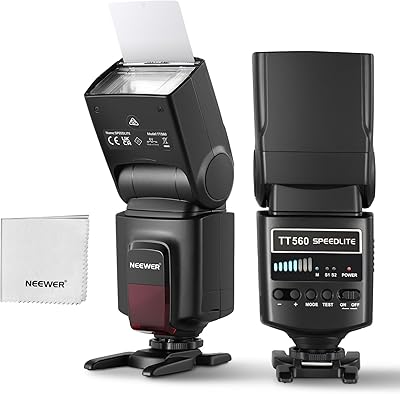
NEEWER TT560 Speedlite Flash
75%
91%
Value for Money
74%
Ease of Use
83%
Build Quality
78%
Compatibility
77%
Light Output & Power Range
More
NEEWER NW620 Speedlite Flash
75%
88%
Value for Money
84%
Flash Output & Power
79%
Build Quality
91%
LCD Display & Controls
62%
Recycling Time
More
NEEWER Z160 Camera Flash
81%
94%
Portability & Form Factor
83%
Build Quality
61%
Flash Output Power
88%
Battery Life & Charging
86%
Recycle Time
More
NEEWER HS60B Mini Video Light
81%
93%
Brightness Output
91%
Color Accuracy
94%
Portability & Form Factor
71%
App & Wireless Control
78%
Build Quality
More
Godox iA32 Mini Camera Flash
85%
88%
Ease of Use
92%
Portability
85%
Flash Power Control
91%
Recycling Time
80%
Build Quality
More
NEEWER S101-400W Strobe Flash Light
85%
91%
Lighting Power & Performance
86%
Ease of Use
80%
Recycle Time
88%
Build Quality
85%
Cooling Efficiency
More
NEEWER 750II TTL Camera Flash Speedlite
84%
88%
Flash Power & Performance
85%
Ease of Use
72%
Build Quality
90%
TTL Functionality
80%
Portability & Weight
More
Fujifilm EF-60 Shoe Mount Flash
88%
89%
Wireless Functionality
92%
Ease of Use
88%
Light Output Consistency
87%
Build Quality
95%
Compatibility with Fujifilm Cameras
More
Godox iT30 Pro S Mini Flash
81%
88%
TTL Accuracy
94%
Portability & Size
71%
Build Quality
83%
High-Speed Sync Performance
86%
Touchscreen Usability
More
Zeniko ZF04 Mini Hot Shoe Flash
80%
96%
Portability & Size
91%
Ease of Use
51%
Power Control & Flexibility
83%
Recycle Time
87%
Battery Life
More

FAQ

No — the NEEWER Z150 Mini Hot Shoe Flash uses a single-center-contact hot shoe with no electronic communication pins, so TTL auto-exposure is not possible on any supported camera. You set power manually, which is straightforward once you get the hang of it, but if TTL is a hard requirement for your workflow, this is not the right flash.
At full 1/1 power you get up to 640 flashes, which is more than enough for a standard portrait session of 200 to 300 shots with room to spare. Drop to 1/4 or lower and you will rarely think about battery life at all. The main caveat is that there is no battery percentage display, so if you are heading into a long event it is worth topping off via USB-C before you leave.

S1 fires the flash the moment it detects any other flash burst — useful when you are the only flash in the room. S2 is smarter: it ignores the pre-flash that TTL systems fire before the main burst, and only triggers on the main exposure flash. If you are pairing this unit with a TTL speedlite or a camera with built-in flash in TTL mode, S2 is the one to use, or you will get misaligned exposures.

Yes, the Sony A7 IV and A7C both use a Sony MI (Multi-Interface) hot shoe, and the Z150 flash is compatible with those bodies in manual and optical slave modes. Just keep in mind there is no Sony wireless radio control or advanced metering — you are working fully manually.

Unfortunately no. The Canon EOS Rebel T7 (also sold as the 1500D or 2000D) is on the explicit incompatibility list. The same goes for the Rebel SL3, T100, R50, and a few other entry-level Canon bodies. It is worth double-checking your exact model number against the exclusion list before purchasing.

At 1/1 full power, 3.1 seconds between flashes is noticeable if you are shooting quickly. For posed portraits where you control the pace, it is rarely an issue. The problem comes with candid or event shooting where you cannot wait — drop the power to 1/4 or lower and recycle time shortens dramatically, so dialing in the right power setting for your distance matters more than it might with a more powerful flash.

Yes, that is exactly what S1 and S2 modes are designed for. Place the flash off-camera within line of sight of your main flash or the camera's built-in pop-up flash, set the Z150 to S1 or S2, and it will fire wirelessly without any radio trigger or cable. It works reliably indoors; in bright outdoor conditions the optical sensor can occasionally miss a trigger, but for indoor setups it is a practical no-cost wireless solution.

Six thousand Kelvin is on the cooler side of neutral daylight — you will not get the warm, golden look of a 5500K flash, but it blends cleanly with natural window light and overcast outdoor light. For most portrait and content creation work it is fine. If you want warmer results, a cheap CTO warming gel cut to size and taped over the flash head will shift the output noticeably.

The all-plastic body is lightweight, which some buyers immediately associate with fragility — though most report no failures after months of regular use. The hot shoe foot feels solid and the locking ring holds firmly on camera. It is not a professional workhorse built for daily abuse over years, but for the use case it is designed for — casual, portable shooting — it holds up fine with reasonable care.

Technically yes, but with realistic expectations. GN15 at ISO 100 gives you a working distance of roughly 1 to 2 meters for a properly exposed fill in shade or soft outdoor light. Against direct midday sunlight, the output is simply not powerful enough to make a visible difference at any useful shooting distance. If outdoor fill in bright conditions is a primary use case, you would need a significantly more powerful unit.

Where to Buy