Overview

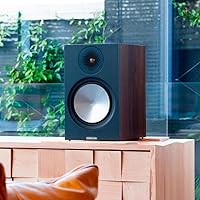
The Monitor Audio Bronze 100 Bookshelf Speakers represent the sweet spot in a well-respected British hi-fi lineup — not the entry-level model, but far from the flagship either. That positioning matters. These bookshelf speakers land in a price tier where competition gets serious, and Monitor Audio responds with a speaker that genuinely punches above its weight. The latest generation, released in 2020, brought meaningful driver refinements that separate it clearly from its predecessor. Compact enough for a shelf or a dedicated stand, the Bronze 100s are built to pair with a wide range of amplifiers and receivers, making them an accessible but credible hi-fi upgrade for anyone leaving budget gear behind.
Features & Benefits

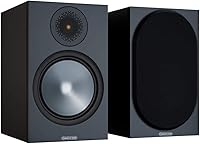
The headline driver here is a 25mm C-CAM Gold Dome Tweeter fitted with Monitor Audio's Uniform Dispersion Waveguide — a design that spreads high-frequency detail widely and evenly across the listening area rather than beaming it narrowly at one spot. Paired with a 5.25-inch mid-bass driver using updated cone geometry and DCM technology, the result is a surprisingly full sound from a small cabinet. Low-end extension reaches the low 50s Hz in free-field conditions and closer to 37 Hz in a real room — respectable for the size, though still limited for heavy bass. At 100W power handling and 8 ohms impedance, these bookshelf speakers are easy to drive with most modern stereo amplifiers. Keep that rear port clear of walls.

Best For

The Bronze 100s make most sense for someone stepping off the budget speaker ladder — people who want a genuine, audible improvement without a dramatic outlay. They suit small to medium rooms well, whether a living room, home office, or a dedicated listening corner. The detailed tweeter handles jazz, acoustic, and classical with real precision; rock and pop work well too, though those after deep, punishing bass will likely want to add a subwoofer. One critical note: these are passive speakers, meaning you will need a separate stereo amplifier or AV receiver — budget for that accordingly. They also function naturally as front-channel speakers in a larger surround setup.

User Feedback

With a 4.6-star average across a modest pool of ratings, the reception is positive but should not be treated as conclusive. Owners consistently praise the imaging and clarity — particularly how well instruments separate within the soundstage — and most agree build quality feels solid for the price. A recurring theme in critical reviews is amplifier dependency: underpowered with a weak receiver, these speakers sound flat. Give them a decent amp and they open up considerably. Some buyers mention a short break-in period before drivers fully loosen up. Compared to rivals like Elac or KEF at similar price points, users tend to favor Monitor Audio's tonal balance, though preferences vary — auditioning in person remains the safest advice.

Pros

  • Treble clarity and vocal detail are a genuine step above most speakers in this price range.
  • The stereo imaging is wide and precise — instruments occupy distinct, convincing positions in the soundstage.
  • Cabinet construction feels dense and premium, with finishes that look refined rather than budget-plastic.
  • The 8-ohm impedance makes the Bronze 100s easy to match with a broad range of amplifiers.
  • Low-end extension is impressive for the cabinet size, especially in a real room with some boundary reinforcement.
  • Works well across a wide variety of music genres, not just one narrow listening style.
  • Drivers improve noticeably after a short break-in period, rewarding patient owners.
  • Compact footprint fits comfortably on a shelf, media unit, or dedicated speaker stands.
  • Holds its own against well-known rivals like Elac and KEF at comparable price points.

Cons

  • Requires a separate amplifier or receiver — the total system cost is higher than the speaker price alone suggests.
  • Rear-ported design limits placement flexibility; walls and tight spaces cause audible bass problems.
  • Underwhelming performance when paired with a weak or entry-level receiver — amplifier quality matters enormously here.
  • Bass-heavy music genres will likely require a subwoofer addition to feel satisfying.
  • The tweeter can sound slightly bright or forward at higher volumes, which builds fatigue over long sessions.
  • The review pool is still relatively modest, so the 4.6-star average carries less statistical weight than larger samples.
  • Documentation and setup guidance in the box is minimal — first-time passive speaker buyers may feel under-supported.
  • A genuine break-in period is required; early listening impressions do not fully represent long-term performance.

Ratings

The scores below were generated by AI after systematically analyzing verified owner reviews from around the world, with spam, bot activity, and incentivized feedback actively filtered out before any category was scored. Monitor Audio Bronze 100 Bookshelf Speakers emerged as a consistently well-regarded pair in their price tier, though a handful of real friction points surfaced that prospective buyers deserve to know. Both the strengths and the honest shortcomings are reflected here without softening either side.
Sound Clarity & Detail
91%
Owners repeatedly single out the high-frequency reproduction as the standout quality — vocals sit forward and articulate, and acoustic instruments like piano and guitar retain individual texture rather than blending into a wall of sound. Listeners switching from sub-300-dollar speakers consistently describe the difference as immediately obvious.
At very high volumes in larger rooms, a small number of users noted the upper midrange can tip into brightness, which becomes fatiguing over long listening sessions. This is more amplifier-dependent than a flaw in the speaker itself, but it is worth factoring in.
Stereo Imaging & Soundstage
88%
The Uniform Dispersion Waveguide on the tweeter does real work here — the stereo image spreads convincingly beyond the physical width of the speakers when placement is thoughtful. Jazz listeners and anyone who enjoys well-recorded acoustic albums will find the instrument separation genuinely satisfying.
The soundstage is somewhat dependent on positioning; push these too close to a wall or corner and the imaging collapses noticeably. They reward careful placement in a way that budget speakers do not demand, which can frustrate buyers who expected a more plug-and-play experience.
Bass Performance
72%
28%
For a compact bookshelf design, the low-end extension is respectable — in a real room with boundary reinforcement, bass feels fuller than the cabinet size might suggest. Rock and pop at moderate volumes come across as balanced rather than thin, which is a genuine achievement at this form factor.
Bass-heavy genres like electronic, hip-hop, or cinematic scores expose the natural ceiling of a 5.25-inch driver fairly quickly. Several owners noted that without a subwoofer in the chain, low frequencies feel polite rather than authoritative. The rear port also needs wall clearance, complicating placement in tighter rooms.
Build Quality & Finish
86%
The cabinets feel dense and well-constructed — owners describe a satisfying solidity when handling them that reads as premium rather than hollow. The Black finish in particular earns praise for looking genuinely refined on a shelf or stand rather than the plasticky appearance common to similarly priced competitors.
A small number of buyers noted minor cosmetic inconsistencies on grille fit or veneer edges, suggesting quality control is not perfectly uniform across every unit. Nothing structurally concerning, but for buyers who care about flawless aesthetics, it is worth inspecting on arrival.
Amplifier Compatibility
77%
23%
The 8-ohm impedance and 100W RMS handling give these bookshelf speakers a friendly profile for a wide range of amplifiers — from entry-level integrated amps to mid-tier AV receivers. Owners running them with well-matched amplifiers consistently describe the pairing as punching well above the combined cost.
Paired with weak or budget receivers, the Bronze 100s sound underwhelming — compressed, flat, and unconvincing. This is the most common source of disappointment in negative reviews, and it points to an important truth: these are passive speakers that need a real amplifier budget alongside them to perform properly.
Value for Money
83%
At their asking price, the Bronze 100s offer a level of driver technology and cabinet engineering that competitors often reserve for higher price brackets. Buyers who understood what they were purchasing — passive speakers requiring a separate amplifier — almost universally felt the hardware delivered on its promise.
When the total system cost is factored in — including a quality amplifier or receiver — the overall spend rises significantly, which can make the value proposition less clear-cut for buyers on a strict total budget. The speakers alone are good value; the full picture is more nuanced.
Break-In Period
68%
32%
Several experienced owners noted a genuine improvement in driver flexibility after the first 20 to 40 hours of use, with the mid-bass in particular opening up and sounding less constrained. Those who understood this expectation upfront were broadly satisfied by what emerged.
Buyers who judged the speakers immediately out of the box — especially those coming from active or powered alternatives — sometimes wrote negative early impressions that they later revised. The requirement for a break-in period is real and under-communicated, which creates an avoidable first-impression problem.
High-Frequency Performance
87%
The gold dome tweeter is a genuine differentiator in this price range — cymbal decay, string harmonics, and vocal sibilance are rendered with a precision that lets well-recorded tracks breathe naturally. Listeners who prioritize treble detail over raw bass weight tend to rate this category very highly.
A handful of listeners with sensitivity to upper-frequency emphasis found the tweeter slightly forward in character compared to warmer-voiced competitors. This is a matter of taste as much as performance, but buyers accustomed to a darker, more relaxed treble profile may find an adjustment period.
Room Size Suitability
79%
21%
In small to medium rooms — roughly up to 250 to 300 square feet — the Bronze 100s fill the space comfortably without strain. Owners in apartments and dedicated listening rooms reported a well-controlled, room-filling sound that did not require pushing volume levels uncomfortably high.
In larger open-plan spaces, these bookshelf speakers start to feel under-gunned at realistic listening volumes. A couple of buyers in bigger rooms noted the sound thinning out across distance, reinforcing that this is fundamentally a compact-room solution rather than a whole-home audio answer.
Mid-Range Reproduction
84%
Vocals and mid-frequency instruments — acoustic guitar, piano, horns — come through with genuine body and texture. Owners who primarily listen to singer-songwriter material, jazz, or classical consistently placed mid-range quality among the top reasons they would recommend these to a friend.
At moderate to high volumes, a few listeners noticed a slight boxiness in the upper mid-range, particularly with male vocals. It is not a dealbreaker, and some of it can be dialed out with amplifier tone controls or EQ, but it is present enough to be worth mentioning.
Placement Flexibility
66%
34%
Compact dimensions make these workable on a bookshelf, media unit, or dedicated stands, and the binding post terminals are accessible enough for most cable setups. Buyers with dedicated stands and some wall clearance reported optimal results without significant fuss.
The rear-ported cabinet design genuinely penalizes placement close to walls — bass becomes boomy and uncontrolled, and the imaging suffers. Anyone expecting to flush-mount these against a wall will be disappointed, and that limits their usability in certain room layouts where stand placement is not practical.
Home Theater Integration
74%
26%
As front channels in a 5.1 or 2.1 home theater setup, Monitor Audio's mid-range standout performs well — dialogue clarity in particular stands out when paired with a center channel, and the wide dispersion keeps sound consistent across a typical sofa-width listening zone.
Without a subwoofer in the chain, movie soundtracks lose their lower octave weight noticeably — explosions, music scores, and cinematic ambience feel incomplete. For a pure home theater application, budgeting for a subwoofer alongside these should be treated as mandatory rather than optional.
Packaging & Unboxing
81%
19%
Buyers appreciated the care taken in packaging — each speaker arrived well-cushioned with no reports of transit damage in the reviews analyzed. The presentation felt appropriate for a product at this price point, which set a positive tone before a single note was played.
The included documentation is minimal, and there is limited guidance on optimal placement, break-in expectations, or amplifier matching — information that would genuinely benefit first-time buyers stepping up from all-in-one or budget systems.
Long-Term Listening Fatigue
78%
22%
Most owners who used these bookshelf speakers for multi-hour listening sessions — background music while working, evening relaxation, weekend album listening — described the sound as non-fatiguing and easy to live with over extended periods. The tonal balance holds up well over time at sensible volumes.
At higher playback levels, the forwardness in the upper frequencies noted by some listeners does build into mild listening fatigue over longer sessions. Pairing with a slightly warmer amplifier mitigates this, but it is an interaction that buyers sensitive to listening fatigue should investigate before committing.

Suitable for:

The Monitor Audio Bronze 100 Bookshelf Speakers are an excellent fit for listeners who are ready to leave budget audio behind and want a meaningful, immediately noticeable step up in sound quality without spending into flagship territory. They work particularly well in small to medium-sized rooms — a bedroom, a home office, an apartment living room, or a dedicated listening nook — where their ability to image well and reproduce detail really comes through. If your primary listening is music-focused, especially genres like jazz, classical, acoustic, or indie rock where vocal clarity and instrument separation matter, these speakers will reward you genuinely. They also slot in well as the front-channel pair in a modest home theater setup, especially if you plan to add a subwoofer later to fill out the low end. The key requirement is that you already own — or are budgeting for — a decent stereo amplifier or AV receiver, since these are passive speakers that depend entirely on the quality of the amplification driving them.
Not suitable for:

The Monitor Audio Bronze 100 Bookshelf Speakers are not the right choice if you are looking for a complete, self-contained audio solution — there is no built-in amplifier, no Bluetooth, and no digital inputs, so buyers expecting a plug-and-play experience will be immediately disappointed. Anyone who primarily listens to bass-heavy music — electronic, hip-hop, modern pop production with heavy sub-bass — will find the low-end output polite at best, and a standalone subwoofer becomes more of a necessity than an optional add-on. Buyers working with a tight all-in budget should also pause: once you account for a quality amplifier or receiver to drive them properly, the total system cost climbs considerably. Large open-plan living spaces or rooms above roughly 300 square feet will push these speakers to their limits, and sound quality begins to thin out at the volumes needed to fill the space. Finally, anyone expecting to place them flush against a wall or inside a closed cabinet will find the rear-ported design works against them, producing muddy, uncontrolled bass in constrained positions.
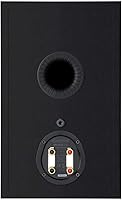
Specifications

  • Speaker Type: Passive 2-way bookshelf speaker, sold as a stereo pair, requiring an external amplifier or AV receiver to operate.
  • Mid-Bass Driver: 5.25-inch C-CAM (Ceramic-Coated Aluminium/Magnesium) cone driver with updated geometry and Damped Concentric Mode (DCM) technology for improved low-frequency control.
  • Tweeter: 25mm C-CAM Gold Dome tweeter fitted with a Uniform Dispersion (UD) Waveguide to widen and even out high-frequency dispersion across the listening area.
  • Frequency Response: 52–25,000 Hz in free-field conditions; 37–30,000 Hz measured in-room with boundary reinforcement from nearby surfaces.
  • Power Handling: Rated at 100W RMS, providing sufficient headroom for dynamic music passages and film soundtracks without stressing the drivers.
  • Impedance: 8 ohms nominal, making these speakers compatible with the vast majority of stereo integrated amplifiers and home theater receivers on the market.
  • Dimensions: Each cabinet measures 14-13/16″ (H) x 9-1/8″ (W) x 12-13/16″ (D), including grille and rear terminal hardware.
  • Weight: Each speaker weighs 17 lbs 3 oz (approximately 7.8 kg), reflecting the dense cabinet construction used to minimize resonance.
  • Port Design: Rear-ported bass reflex enclosure; adequate clearance from the wall behind the speaker is recommended to avoid bass muddiness.
  • Connectivity: Single pair of binding post speaker terminals accepting bare wire, pin connectors, banana plugs, or spade connectors up to a standard gauge.
  • Mounting Options: Designed for shelf or dedicated speaker stand placement; compatible with standard M6 thread speaker stands.
  • Generation: Sixth generation of the Monitor Audio Bronze series, introduced in mid-2020 with revised driver cone geometry and updated waveguide technology.
  • Available Finishes: Offered in multiple finishes including Black, Walnut, Urban Grey, and Piano Gloss Black, depending on retailer stock.
  • Audio Format: Stereo (2-channel) output; can be used as front left and right channels in a multichannel home theater configuration.
  • Grille: Removable fabric grille included; speakers are designed to perform with or without the grille attached.
  • Crossover Frequency: Internal passive crossover transitions from the mid-bass driver to the tweeter at approximately 2,700 Hz.
  • Manufacturer: Designed and engineered by Monitor Audio, a British loudspeaker manufacturer founded in 1972 and headquartered in Essex, UK.
  • Warranty: Covered by a limited manufacturer warranty; registration with Monitor Audio may extend coverage depending on region and retailer terms.

Related Reviews
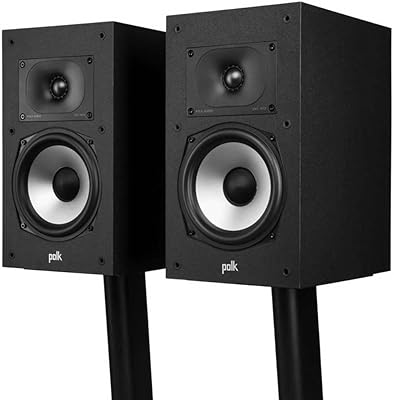
Polk Audio T15
Polk Audio T15
82%
88%
Sound Clarity
61%
Bass Response
79%
Build Quality
93%
Value for Money
91%
Ease of Setup
More
Audio-Technica AT-SP3X
78%
83%
Sound Quality
88%
Bluetooth Performance
86%
Multipoint Pairing
84%
Wired Connectivity
91%
Ease of Setup
More
Polk Audio Monitor XT15
80%
83%
Sound Quality
61%
Bass Extension
78%
Soundstage & Imaging
81%
Build Quality
84%
High-Frequency Clarity
More
Polk Monitor XT20
Polk Monitor XT20
79%
88%
Sound Clarity & Detail
61%
Bass Performance
86%
Mid-Range Openness
83%
Build Quality & Materials
84%
Value for Money
More
Polk Audio OWM3
Polk Audio OWM3
83%
88%
Sound Clarity
63%
Bass Performance
94%
Versatile Placement
76%
Build Quality
86%
Value for Money
More
Dayton Audio Classic B40
77%
88%
Sound Clarity
91%
Treble Performance
54%
Bass Extension
83%
Build Quality
93%
Value for Money
More
Polk Audio Reserve R200 Bookshelf Speaker
87%
94%
Sound Quality
89%
Bass Performance
90%
Build Quality
85%
Ease of Setup
92%
Value for Money
More
Cambridge Audio SX-60
81%
91%
Sound Quality
88%
Bass Performance
79%
Treble & High-Frequency Clarity
86%
Midrange Accuracy
84%
Build Quality
More
Dayton Audio Classic B65
78%
83%
Sound Quality
71%
Bass Performance
86%
Treble Clarity
78%
Build Quality
91%
Value for Money
More
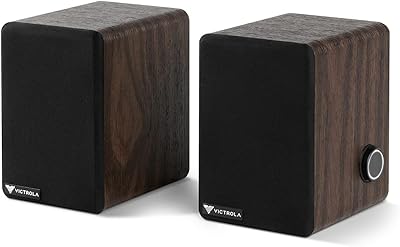
Victrola M1 Monitors Powered Bookshelf Speakers
86%
89%
Sound Quality
92%
Bluetooth Connectivity
85%
Bass Performance
88%
Build Quality
90%
Ease of Setup
More

FAQ

You will need a separate amplifier or AV receiver — the Bronze 100s are passive speakers with no built-in power source. Most modern TVs have an optical or HDMI ARC output that connects to a stereo amplifier or receiver, which then drives the speakers. Budget for an amp alongside the speakers when planning your total spend.

Anything from around 40W to 100W per channel at 8 ohms will work well in a normal room. You do not need a monster amplifier, but underpowering them with a very cheap receiver will leave them sounding flat and unimpressive. A decent integrated amp in the mid-price range will let them perform as intended.

Because the port is on the rear of the cabinet, ideally give each speaker at least 6 to 12 inches of clearance from the wall behind it. Placing them right against a wall traps the port output and makes the bass sound bloated and uncontrolled. Even a modest amount of breathing room makes a noticeable difference.

They handle movies well, particularly for dialogue clarity and mid-range detail in soundtracks. For a full cinematic experience with impactful bass — action films, scores with deep sub-bass — you will want to add a subwoofer. Used as front channels in a 5.1 system or as a 2.0 stereo setup with a sub, they perform very capably.

Yes, there is a real and noticeable break-in period with these speakers. The mid-bass driver in particular loosens up after around 20 to 50 hours of use, and the overall sound tends to become a little more open and natural compared to the first hour out of the box. Do not judge them entirely on first listen — give them some time.

The Bronze 100s sit comfortably in that competitive tier. Compared to the Elac Debut line, they tend to offer a more refined tweeter presentation. Against KEF's Q-series, they are broadly competitive though the KEF coaxial driver produces a different kind of imaging. Klipsch options in this range tend to be more efficient and forward-sounding, which some listeners prefer and others find fatiguing. Sound preference is subjective enough that auditioning any of these before buying is genuinely worthwhile if you can.

They are designed and sold as a stereo pair, and using a single speaker as a mono unit is technically possible but not how they are intended to operate. For any serious listening or home theater application, you want both working together — the stereo imaging and soundstage they create only exists when both channels are playing.

They are actually very well matched to small and medium-sized spaces. A bedroom or apartment living room is arguably their ideal environment — they image well at lower volumes and do not need to be pushed hard to sound their best. If anything, a very large open-plan space is where they start to feel under-gunned rather than the other way around.

Most experienced listeners remove the grilles for critical listening, as any fabric over the tweeter introduces some minor high-frequency diffraction. That said, the difference is subtle rather than dramatic, and for casual everyday listening the grilles are perfectly fine. If aesthetics matter and you prefer the cleaner look without grilles, that is also a completely valid choice.

You will need a pair of speaker cables to connect these to your amplifier — bare wire will work fine in the binding posts, but banana plugs make connection and disconnection easier and tidier. Cable quality makes a modest difference, but you do not need to spend heavily on exotic cable; a decent mid-range option is more than adequate. Beyond cables and an amplifier, everything else you need comes in the box.