Overview

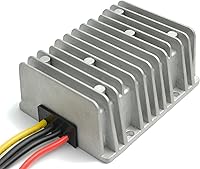
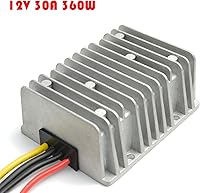
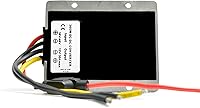
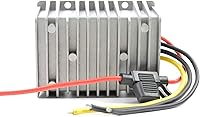
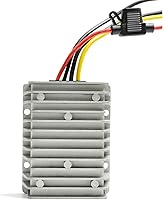
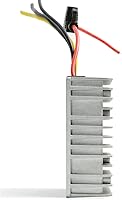
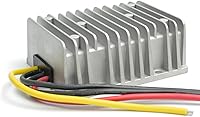
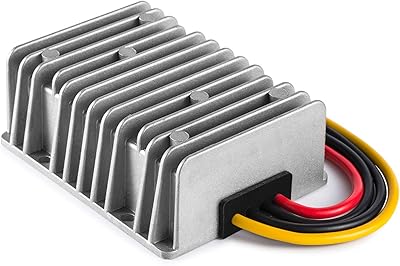
The MGGi 36-48V to 12V 30A Buck Converter is a compact DC-to-DC step-down module built for anyone who needs to tap a stable 12V supply from a 36V or 48V battery system. Golf cart owners, forklift operators, and DIY vehicle builders are its natural audience. What sets this buck converter apart from the cheaper end of the market is its die-cast aluminum shell filled with epoxy potting — a combination that suggests the manufacturer took thermal and moisture protection seriously. That said, be clear on what this is: a power infrastructure component that requires proper wiring knowledge. It is not plug-and-play.

Features & Benefits

Pull 30 amps continuously at 12V — that is 360 watts — and this step-down module barely flinches. The IP68 waterproof rating means you can mount it in a wheel well, under a golf cart seat, or inside a solar enclosure without worrying about rain or spray. Running at up to 96% efficiency, it wastes very little energy as heat, which matters when you are drawing from a battery bank you need to last all day. The fanless design eliminates noise and mechanical wear. Five built-in protections cover the scenarios that kill cheaper units: short circuits, runaway current, voltage spikes, overheating, and overloading — all handled passively.

Best For

The voltage reducer earns its place in a handful of specific scenarios. If you own a 48V golf cart and want to run a Bluetooth radio, a GPS unit, and a USB hub simultaneously, this is the kind of hardware that handles that load without needing a secondary battery. It works equally well for forklift technicians wiring up LED worklights or data terminals, and for off-grid solar builders who need a clean 12V rail from a 48V battery bank. The compact footprint — just over four inches long — makes it practical even in tight mounting spaces. Anyone who wants fire-and-forget reliability with built-in fault protection will find it a strong fit.

User Feedback

Buyers who have installed this buck converter in golf carts and solar rigs tend to praise the solid build quality and stable output voltage under normal loads. Several experienced installers recommend using 10-gauge wire or heavier for runs near the 30A ceiling — a practical detail the documentation does not spell out clearly. A recurring complaint from less experienced buyers is the lack of included connectors, which adds a small but real extra step. Heat performance under sustained near-maximum loads gets mixed marks; most users report no issues at moderate draw, but a handful note warmth at extended full load. Long-term reliability looks promising given the unit has been on the market since 2019, though most reviewer timelines stay under two years.

Pros

  • Handles up to 360W continuously, enough to run multiple 12V accessories simultaneously without thermal shutdown.
  • IP68 waterproof rating allows mounting in exposed locations, including undercarriage and outdoor enclosures.
  • Wide 30–60V input range covers both 36V and 48V battery systems, including packs that sag under heavy load.
  • Five passive protection circuits guard against the failure modes that destroy cheaper converters over time.
  • No cooling fan means completely silent operation and one fewer component that can wear out or clog.
  • Die-cast aluminum body with epoxy potting feels noticeably more robust than plastic-cased budget alternatives.
  • Compact size fits in tight spaces inside golf carts, solar cabinets, and industrial vehicle compartments.
  • High conversion efficiency means minimal wasted energy drawn from your battery bank during extended operation.
  • Has been commercially available since early 2019, giving it a meaningful track record compared to newer, untested units.
  • Stable output voltage under moderate loads makes it reliable for accessories like GPS units and audio systems.

Cons

  • No wiring connectors or terminals are included, requiring buyers to source appropriate hardware separately before installation.
  • Thin or absent documentation makes proper wire gauge selection guesswork for less experienced installers.
  • Voltage output can droop measurably when operating near the full 30A ceiling, which may affect sensitive electronics.
  • Heat buildup under sustained near-maximum loads has drawn mixed feedback from buyers running heavy continuous draws.
  • The unit has no adjustable output voltage, so it cannot be repurposed for anything other than a fixed 12V application.
  • Long-term reliability data past two years is sparse, making it hard to assess multi-year durability with confidence.
  • Mounting holes and plate-mount design require pre-planning and drilling; it cannot simply be set on a surface and secured.
  • No LED status indicator or diagnostic output makes it harder to confirm the unit is operating correctly after installation.

Ratings

Our AI rating engine analyzed verified global buyer reviews for the MGGi 36-48V to 12V 30A Buck Converter, actively filtering out incentivized, bot-generated, and duplicate submissions to surface only authentic purchase experiences. The scores below reflect both the genuine strengths that make this step-down module a standout in its niche and the real friction points buyers have encountered during installation and extended use. Nothing has been softened — where recurring complaints emerged across independent reviewers, the numbers reflect that honestly.

Build Quality
88%
The die-cast aluminum shell combined with epoxy-potted internals gives this unit a noticeably solid feel compared to the plastic-cased budget alternatives that dominate this price range. Golf cart and solar installers consistently report the housing shows no warping or corrosion after months of use in humid, dusty environments.
A handful of buyers note the mounting tabs feel slightly thin relative to the overall housing quality, raising minor concerns about vibration stress in high-shock vehicle applications. There is no secondary quality certification visible beyond the IP68 marking, which some industrial buyers would prefer to see.
Waterproofing
91%
IP68 certification proves its worth here — buyers who have mounted this voltage reducer beneath golf cart seats, inside forklift panels, and in outdoor solar enclosures report zero moisture-related failures even after prolonged exposure to rain and road spray. That level of confidence at this price point is genuinely uncommon in this product category.
While IP68 covers submersion under standard lab conditions, a small number of buyers in pressurized-wash or continuously submerged environments have questioned whether seal integrity holds indefinitely. The epoxy potting cannot be inspected or resealed, so any breach effectively means replacing the entire unit.
Output Stability
78%
22%
Under moderate loads — running a radio, GPS unit, and a couple of USB charging ports simultaneously — the 12V output stays consistent and well within tolerance for standard accessories. Most buyers in typical golf cart and solar panel applications report no noticeable flickering or unexpected device restarts.
When current draw pushes toward the 30A ceiling, some buyers report measurable voltage droop that can affect more sensitive electronics. This behavior is not unusual for converters in this class, but it is worth factoring in if precision instruments or devices with tight input voltage tolerances are part of the installation.
Installation Ease
51%
49%
Experienced DC electricians and vehicle technicians generally describe the physical setup as straightforward — terminals are clearly labeled and the mounting tab positions are practical. For buyers who already know how to size wire and install inline fusing, the actual connection work is relatively quick.
No wiring connectors, terminals, or meaningful installation guide are included, which creates genuine difficulty for less experienced buyers. Multiple reviews flag wire gauge selection as confusing, and several buyers report triggering protection circuits due to incorrect wiring — a frustrating and potentially costly first experience that better documentation would prevent.
Value for Money
83%
Relative to what you receive — IP68 sealing, five passive protection circuits, a die-cast housing, and 360W of continuous capacity — the mid-range price is genuinely competitive. Buyers who have priced equivalent-spec units from industrial suppliers frequently note this buck converter delivers comparable performance at a fraction of the cost.
The absence of included wiring accessories means the true out-of-pocket cost runs slightly higher than the listed price implies. Buyers who need to purchase appropriate gauge wire, ring terminals, and inline fusing hardware will add a modest but real overhead to the total installation budget.
Protection Features
86%
Five passive protections — covering short circuits, overcurrent, overvoltage, overtemperature, and overload — give this converter a genuine safety net that cheaper single-protection units simply cannot match. Multiple buyers have specifically noted that the short-circuit protection triggered and recovered cleanly during accidental wiring errors without damaging the unit or connected accessories.
There is no visual indicator — no LED status light, no audible alert — to signal when a protection circuit has activated, making fault diagnosis harder than it needs to be. Buyers unfamiliar with DC troubleshooting may not immediately distinguish between a tripped protection state and an outright unit failure.
Thermal Performance
71%
29%
At load levels up to around 15–20A, the aluminum housing manages heat effectively through passive convection, staying warm but never uncomfortably hot during typical golf cart or solar accessory use. The fanless design means thermal performance is genuinely silent and requires no maintenance over the unit's operating life.
Extended operation near the 30A maximum produces noticeably more warmth, and a handful of buyers in enclosed mounting spots with restricted airflow have reported automatic thermal shutdowns. The passive cooling approach is a strength in most scenarios, but it demands thoughtful placement when continuous high-current draw is part of the application.
Efficiency
82%
18%
Running at up to 96% conversion efficiency means very little of your battery capacity is wasted as heat during operation, which genuinely matters in golf cart and off-grid solar setups where runtime is a daily priority. Buyers in low-draw standby configurations also report that the converter does not create a meaningful parasitic drain on the source battery.
Peak efficiency figures represent ideal operating conditions, and real-world efficiency drops somewhat at very low loads or when pushing close to the maximum output rating. For buyers running highly variable load profiles, the practical average efficiency will land modestly below the headline specification.
Compatibility Range
87%
The 30–60V input window covers virtually every common 36V and 48V battery system on the market, including lithium packs with elevated resting voltages and flooded lead-acid packs that sag meaningfully under load. This flexibility makes the voltage reducer genuinely useful across golf carts, solar installations, and light industrial vehicles without any modification.
Buyers with 24V or 72V systems are entirely out of scope, and the fixed 12V output offers no adjustment for applications requiring a different target voltage. Anyone needing variable or non-standard output will need to look at a different product class.
Documentation
42%
58%
Basic polarity labeling on the terminals is legible and accurate, giving experienced installers enough to orient themselves without any paperwork. The straightforward two-terminal input and output layout does lower the barrier somewhat for anyone who has wired a DC converter before.
The included documentation is genuinely sparse — no wiring diagram, no wire gauge guidance, no fusing recommendations, and no troubleshooting section. This is the most frequently cited complaint across buyer reviews and represents a meaningful gap for the hobbyist and first-time installer audience this product clearly attracts.
Physical Footprint
81%
19%
At just over four inches long and weighing barely more than a pound, this step-down module fits comfortably in spaces where bulkier industrial converters simply would not. Golf cart owners regularly report tucking it under a seat or behind a panel without any visible modification to the vehicle.
The plate-mount design requires pre-drilled or pre-fabricated mounting points, adding a step for buyers who expected a more flexible mounting solution. In very compact enclosures, the wired terminal connections extend the effective installed footprint by a few inches beyond the unit dimensions alone.
Long-term Reliability
67%
33%
Having been on the market since early 2019, the unit has accumulated a meaningful track record, and buyers reporting one to two years of continuous use in golf cart and solar applications generally describe stable, uninterrupted performance. The sealed epoxy construction offers reasonable protection against the moisture and vibration that typically degrade open-frame converters over time.
Verified reliability data beyond 24 months of use is genuinely scarce, making it difficult to assess how the unit holds up over a five-year installation horizon. The manufacturer lifetime rating of 100,000+ hours is stated without independent validation, and should be treated as aspirational rather than a confirmed performance guarantee.
Noise Level
94%
The completely fanless design means this converter contributes zero audible noise to any installation, which is a practical advantage in golf cart audio builds or quiet off-grid setups where fan hum would be intrusive. Buyers installing high-quality audio systems specifically cite the silent operation as a deciding factor over fan-cooled alternatives at similar price points.
The fanless approach is inherently silent, but that same characteristic requires adequate airflow around the unit to manage heat under load. In practice, placement decisions needed to maintain safe operating temperatures can limit where the converter can be discreetly concealed within a tight build.

Suitable for:

The MGGi 36-48V to 12V 30A Buck Converter is purpose-built for anyone running a 36V or 48V DC system who needs a dependable 12V supply for accessories — and that covers a surprisingly wide range of buyers. Golf cart and club car owners who want to add a radio, GPS, backup camera, or USB charging ports without a separate battery will find this step-down module handles that kind of multi-device load with headroom to spare. Forklift technicians and industrial vehicle operators benefit equally, since a stable 12V rail for data terminals, LED work lights, or communication equipment is often a practical necessity. It also fits neatly into off-grid solar setups where a 36V or 48V battery bank is already in place and a clean 12V feed is needed for lighting, inverters, or small appliances. The IP68 waterproof housing makes it a realistic choice for outdoor or undercarriage mounting where moisture exposure is unavoidable. Buyers who value passive safety features and want hardware that protects itself — and their vehicle — without manual intervention will appreciate the built-in protection stack.

Not suitable for:

The MGGi 36-48V to 12V 30A Buck Converter is not a good match for buyers expecting a simple out-of-the-box installation experience. There are no included wiring connectors, terminals, or a wiring diagram thorough enough for beginners, which means anyone unfamiliar with DC electrical work will likely struggle or wire it incorrectly — a real safety concern at 30 amps. It is also the wrong choice if your source voltage falls outside the 30–60V DC input range; a 24V or 72V system would need a different converter entirely. Buyers looking for a regulated output that stays perfectly locked at 12V under every load condition may encounter slight voltage droop near maximum current draw, which could matter for sensitive electronics. If your application requires only a few amps — powering a single small device, for instance — this is more hardware than necessary, and a smaller, cheaper unit would do the job without the added bulk. Long-term reliability data beyond two years is still limited, so buyers with mission-critical uptime requirements in commercial applications may want to factor that uncertainty into their decision.

Specifications

  • Input Voltage: Accepts a DC input range of 30–60V, covering both 36V and 48V battery systems, including packs that sag under load.
  • Output Voltage: Delivers a fixed DC output of 12V, suitable for powering standard automotive and industrial 12V accessories.
  • Output Current: Rated for a continuous output current of 30A, with no listed peak surge rating beyond the continuous specification.
  • Output Power: Maximum continuous power output is 360W, sufficient to run demanding loads such as LED arrays, audio systems, or small air-conditioning units.
  • Efficiency: Conversion efficiency reaches up to 96% at optimal load, minimizing heat generation and reducing unnecessary drain on the source battery.
  • Waterproof Rating: Carries an IP68 waterproof certification, meaning it is fully sealed against dust ingress and can withstand continuous water immersion under defined conditions.
  • Housing Material: The outer shell is die-cast aluminum, providing structural rigidity and passive heat dissipation without relying on active cooling components.
  • Encapsulation: Internal electronics are sealed with epoxy potting compound, protecting circuitry from moisture, vibration, and contamination.
  • Cooling Method: Relies entirely on free air convection for thermal management, with no internal fan or heat sink fins requiring maintenance.
  • Protections: Five built-in passive protections guard against overcurrent, overvoltage, overtemperature, overload, and short-circuit conditions without requiring external modules.
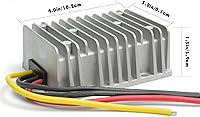
  • Dimensions: The unit measures 4 x 3.2 x 1.5 inches, making it compact enough to mount in tight spaces inside vehicle compartments or enclosures.
  • Weight: Weighs 1.1 pounds, light enough for panel or undercarriage mounting without adding meaningful structural load.
  • Mounting Type: Designed for panel mount or plate mount installation using the integrated mounting tabs on the housing.
  • Rated Lifetime: The manufacturer rates operational lifetime at over 100,000 hours under normal operating conditions, though independent long-term verification data is limited.
  • Manufacturer: Produced by XingHua and sold under the MGGi brand, a supplier specializing in DC power conversion modules for vehicle and industrial applications.

Related Reviews
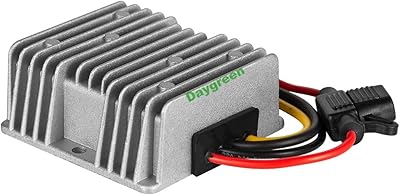
Daygreen A7D1220 20A DC-DC Buck Converter
77%
91%
Output Voltage Stability
84%
Build Quality & Durability
63%
Thermal Management
89%
Waterproofing & Environmental Protection
78%
Ease of Installation
More
Valefod 48V/12V 60A Buck Converter
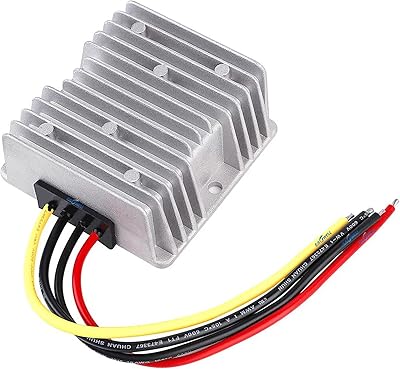
72%
77%
Build Quality
54%
Thermal Management
79%
Output Voltage Stability
86%
Ease of Installation
58%
Sustained Current Delivery
More
Eagwell 12V to 48V 288W Boost Converter
78%
88%
Output Voltage Stability
91%
Conversion Efficiency
84%
Build Quality
61%
Sustained Load Performance
82%
Value for Money
More
MGGi DC Converter 8V-40V to 12V 6A 72W
86%
88%
Performance
94%
Ease of Installation
91%
Durability
85%
Reliability in Various Environments
90%
Safety Features
More
MGGi 12V to 24V 480W Boost Converter
79%
88%
Output Voltage Stability
91%
Waterproofing & Weather Resistance
61%
Thermal Management
89%
Ease of Installation
84%
Build Quality
More
Valefod 48V to 24V 60A 1440W DC to DC Buck Converter
84%
92%
Power Output Performance
89%
Efficiency of Power Conversion
85%
Build Quality and Durability
80%
Ease of Installation
90%
Weather Resistance (IP67)
More
DROK 48V 480W Adjustable DC Power Supply
81%
86%
Voltage Accuracy
91%
Ease of Use
78%
Build Quality
83%
Thermal Management
67%
Fan Noise Level
More
Victron Energy Orion-Tr 12V to 12V DC to DC Converter 9A
85%
89%
Value for Money
91%
Ease of Installation
85%
Build Quality & Durability
90%
Power Conversion Efficiency
88%
Compact Size
More
SDRGEEK 1000W 12V AC to DC Converter
76%
74%
Output Stability
81%
Build Quality
78%
Cooling Performance
83%
Ease of Connection
77%
Value for Money
More
BOSYTRO 12V 600W AC to DC Converter
86%
88%
Performance Under Load
91%
Cooling System Efficiency
85%
Ease of Setup
90%
Build Quality & Durability
70%
Noise Level
More

FAQ

The MGGi 36-48V to 12V 30A Buck Converter is designed specifically for 36V and 48V systems, so a standard 48V golf cart battery pack is well within its operating range. The 30–60V input window also means it stays functional even when your battery voltage dips under load, which is a real-world condition most golf carts experience.

For runs where you are drawing anywhere near the full 30A, you should use at least 10 AWG wire, and many experienced installers recommend going to 8 AWG for longer cable runs to limit voltage drop. The unit does not come with wiring or terminals, so you will need to source those separately before you start.

Yes, comfortably. A typical marine radio draws around 5–7A, a GPS unit draws under 1A, and a dual USB charger pulls maybe 2A — you are well under 30A combined. The voltage reducer has plenty of headroom for that kind of multi-device setup.

IP68 is the highest standard consumer and light industrial waterproofing rating, covering full submersion, so rain, road spray, and occasional puddle splashing are not a concern. That said, submerging it in standing water for extended periods goes beyond typical use and is not recommended.

Yes, and this is important. The unit has internal protections, but they are designed to protect the converter itself, not your vehicle wiring. Always install an appropriately rated fuse or circuit breaker on the input wire close to the battery — this is standard practice for any DC power installation at these current levels.

Yes, that is exactly why the input range extends down to 30V. Voltage sag to 44V is well within operating parameters, so you should not see any dropout or instability in the 12V output under those conditions.

It works well for this application. As long as your battery bank voltage stays within the 30–60V window — which a properly managed 48V lithium or lead-acid bank will — the step-down module will deliver stable 12V power for lights, inverters, or charge controllers.

The built-in short-circuit protection should cut output immediately to prevent damage to the unit and to any connected devices. Once the fault is cleared, the converter typically recovers on its own without needing a manual reset, though you should verify correct output voltage before reconnecting your accessories.

Under moderate loads — say, 10 to 15A — the aluminum housing gets warm but not hot to the touch. Most buyers report no issues at those draw levels. Where heat becomes more noticeable is during extended operation close to the full 30A rating, so if your application runs near that ceiling continuously, make sure the unit has adequate airflow around it.

If you are comfortable reading a basic wiring diagram, identifying positive and negative terminals, and working with DC circuits, it is manageable. The challenge is that the documentation is minimal and no connectors are included, so you need to come prepared with the right terminals, wire, and fusing hardware. If you have never worked with high-current DC wiring before, having a knowledgeable friend or a local auto electrician check your work before powering it up is genuinely worth the time.