Overview

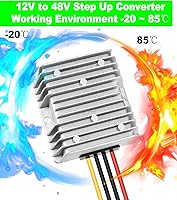
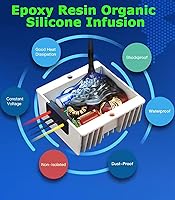
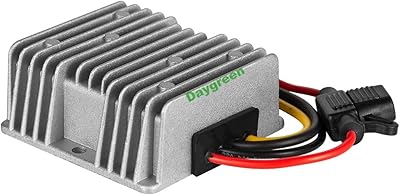
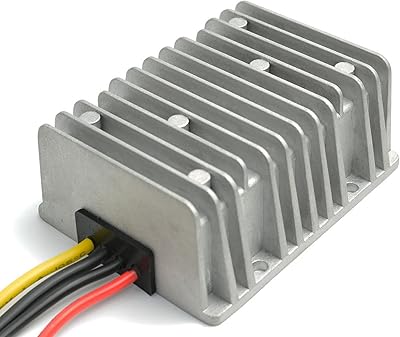
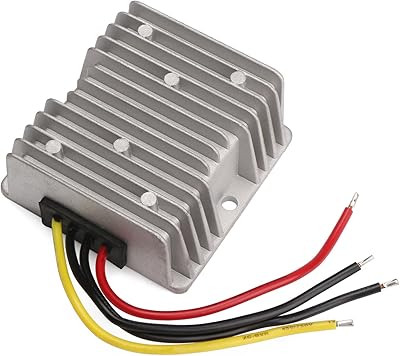
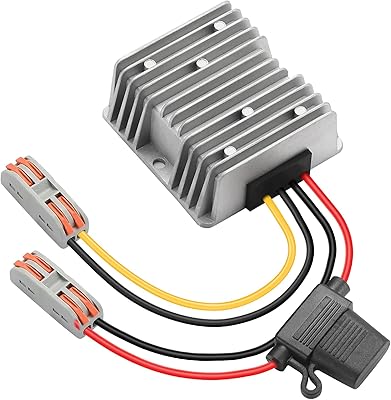
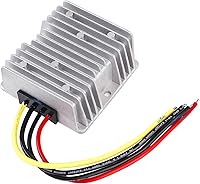
The Eagwell 12V to 48V 288W Boost Converter is a compact DC-DC step-up unit built for off-grid setups, vehicles, and anywhere you need to push a 12V source up to a stable 48V output. Eagwell has carved out a quiet niche in the DC power conversion space, and this module reflects that focus. The aluminum shell and silicone-sealed casing give it a durability edge over the cheaper plastic-bodied alternatives you’ll find at similar price points. It’s not a flagship industrial unit, but it hits a practical middle ground — solid construction, credible specs, and a form factor small enough to tuck into a golf cart panel or RV cabinet without drama.
Features & Benefits

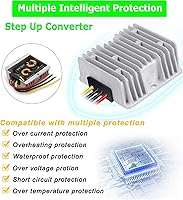
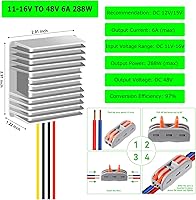
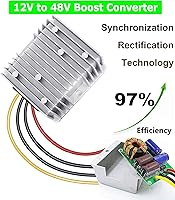
What stands out technically about this step-up converter is the use of synchronous rectification, a method that recycles switching energy rather than burning it off as heat, which is how Eagwell claims up to 97% conversion efficiency. In practical terms, that means less thermal stress on surrounding components during long runs. The FR-4 multilayer PCB uses fully surface-mounted components, improving reliability compared to through-hole designs. There’s also a comprehensive protection circuit covering over-voltage, under-voltage, overload, overheating, and short-circuit conditions — a genuine safety net for permanent installs. Input tolerance runs from 11V to 16V, which handles real-world battery sag without tripping the unit. At roughly 4 x 3.2 x 1.3 inches and 10.6 ounces, it mounts easily, and the screw-terminal connections keep wiring secure.

Best For

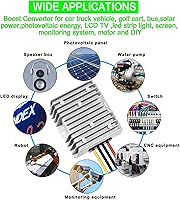
This 12V-to-48V boost module makes the most sense for people with a specific voltage gap to bridge. Golf cart owners often need to run 48V accessories — lighting controllers, monitors, or USB hubs — from a 12V auxiliary battery, and this fits that role cleanly. RV and solar users who’ve built a 12V battery bank but need a 48V output rail for certain loads will find it equally useful. It’s also become a go-to for Starlink Mini installs in vehicles or remote cabins, where a stable 48V DC feed is required without access to shore power. DIY builders powering 48V motors or LED drivers will appreciate that no custom PCB work is needed — just wire in, verify polarity, and go.

User Feedback

With over 240 ratings and a strong average score, buyer sentiment around the Eagwell boost converter skews clearly positive. The most consistent theme is stable voltage output — multiple users tested it under load and reported clean 48V readings with minimal fluctuation. Heat management also draws frequent praise; even after sustained use, the aluminum housing stays noticeably cooler than buyers expected based on past experiences with cheaper converters. Installation feedback is largely favorable, with the screw terminals described as solidly built and easy to work with. That said, a handful of reviewers question whether the unit can truly sustain peak rated wattage over extended periods without throttling. Long-term durability under continuous maximum load remains the most cited uncertainty — something worth factoring in for mission-critical applications.

Pros

  • Up to 97% conversion efficiency means very little energy is wasted as heat during normal operation.
  • The aluminum alloy shell and silicone sealing offer meaningful durability in dusty, damp, or vibration-prone environments.
  • Built-in protection against over-voltage, under-voltage, overload, overheating, and short-circuits adds a real safety layer.
  • Input tolerance of 11V to 16V handles the voltage sag common in real 12V battery systems without nuisance shutdowns.
  • Screw-terminal connections make for a clean, permanent install that won’t loosen from vibration over time.
  • At roughly 4 x 3.2 x 1.3 inches and under 11 ounces, it fits in tight enclosures where larger converters simply won’t.
  • Buyers consistently report stable 48V output under moderate real-world loads with minimal voltage fluctuation.
  • The FR-4 multilayer PCB with SMD components is a more reliable construction choice than basic single-layer boards at this price.
  • Straightforward wiring and no configuration requirements mean most users are up and running in under 30 minutes.
  • Broad use-case compatibility — golf carts, RVs, solar rigs, Starlink Mini, LED arrays — makes it a versatile stock item for tinkerers.

Cons

  • The 288W figure appears to reflect peak rather than sustained capacity; plan your load conservatively.
  • No included documentation or wiring diagram means first-time DC converter users may have to rely on third-party guides.
  • Long-term reliability under continuous heavy loads is not well-established; the product has only been on the market since mid-2022.
  • Output is fixed at 48V with no adjustment, so it cannot double as a variable-voltage bench supply.
  • There is no visible LED indicator or status feedback, making it harder to diagnose issues during troubleshooting.
  • The brand has limited independent third-party testing or certifications publicly available, which may concern commercial installers.
  • At 6A maximum output current, it won’t suit loads requiring more than 288W even intermittently.
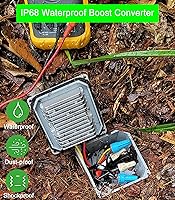
  • Silicone sealing helps but the unit is not rated for full immersion or prolonged direct water exposure.
  • A small number of buyers have reported units failing earlier than expected, suggesting some variability in production quality control.

Ratings

The scores below were produced by our AI system after analyzing verified buyer reviews worldwide for the Eagwell 12V to 48V 288W Boost Converter, with spam, incentivized feedback, and bot activity actively filtered out before scoring. Each category reflects what real users experienced across diverse setups — from golf cart builds to Starlink-in-a-van installs — not what the manufacturer claims. Both the genuine strengths and the recurring frustrations are represented transparently in every number.

Output Voltage Stability
88%
Buyers running this step-up converter for Starlink Mini, golf cart accessories, and RV LED systems consistently report a rock-solid 48V output under real-world loads. Measured readings stay close to the rated output even as input battery voltage fluctuates, which is exactly what sensitive downstream electronics require.
A small portion of buyers noted minor voltage sag when loads approached the upper power limit, which is not unusual for converters in this class. For highly sensitive equipment like precision monitoring instruments, independent output filtering may still be worth adding as a precaution.
Conversion Efficiency
91%
The synchronous rectification design genuinely delivers on its efficiency claims, with the aluminum housing staying noticeably cooler than competing units buyers had previously used at comparable load levels. Less wasted energy translates to longer battery run times in solar and RV setups where every watt-hour matters.
Efficiency figures are self-reported by the manufacturer with no independent third-party test data publicly available to confirm the 97% claim across the full load range. At very light loads, boost converters typically see reduced efficiency, and this unit is unlikely to be an exception to that general principle.
Build Quality
84%
The aluminum alloy shell and silicone-sealed enclosure give this 12V-to-48V boost module a noticeably more substantial feel than the bare-PCB or plastic-cased alternatives found at lower price points. Buyers installing it in golf cart compartments and vehicle enclosures frequently comment on how well it holds up to vibration and minor impacts.
While the external housing is solid, there is no IP rating or official ingress protection certification, leaving buyers to judge moisture resistance by feel rather than published spec. A handful of reviewers noted that the silicone sealing appeared inconsistently applied on some units, raising minor quality-control questions.
Sustained Load Performance
61%
39%
For the majority of real-world use cases — Starlink Mini in a vehicle, LED lighting strips, monitoring systems, and low-power motors — actual draw rarely approaches the rated ceiling, meaning most buyers in typical scenarios never run into performance limitations during normal daily use.
The 288W rating appears to represent a peak rather than a reliable continuous figure, and buyers who have tested sustained loads near that level report increased heat buildup and, in some cases, early failure. Anyone planning to run loads consistently above roughly 200W should either derate expectations or consider a higher-rated unit.
Value for Money
82%
18%
Relative to its price tier, this step-up converter offers a specification package — aluminum housing, synchronous rectification, multilayer PCB, full protection suite — that would cost considerably more from established industrial converter brands. For hobbyists, van-lifers, and solar DIYers who do not need certified industrial gear, the value proposition is genuinely strong.
The value calculus shifts if the unit fails prematurely under sustained heavy loads, as replacement costs and reinstallation labor make a second purchase feel expensive in hindsight. The absence of any stated warranty terms also makes it harder to factor long-term cost of ownership into the buying decision with real confidence.
Thermal Management
86%
Heat management is one of the most frequently praised aspects in buyer reviews, with users reporting that the housing stays comfortably warm rather than hot even after sustained operation at moderate loads. The passive aluminum cooling approach works reliably in typical environments like RV cabinets and under-seat golf cart compartments.
There is no active cooling, so installations inside fully sealed enclosures with zero airflow will perform worse thermally than open-mount setups. A few buyers pushing loads near the rated ceiling reported more significant heat buildup, suggesting that ventilation becomes a genuine concern at higher sustained wattages.
Protection Features
83%
The five-layer protection suite covering over-voltage, under-voltage, overload, overheating, and short-circuit provides meaningful peace of mind for permanent installs in vehicles and off-grid systems where ongoing human monitoring is not practical. Buyers have noted the unit recovers cleanly after a short-circuit event rather than requiring a hardware reset.
Protection thresholds are not user-configurable, so buyers with specific voltage trip-point requirements have no way to adjust them. There is also no visible status indicator or alarm output to signal when a protection mode has been triggered, which makes remote troubleshooting considerably harder.
Ease of Installation
87%
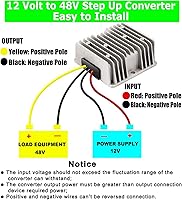
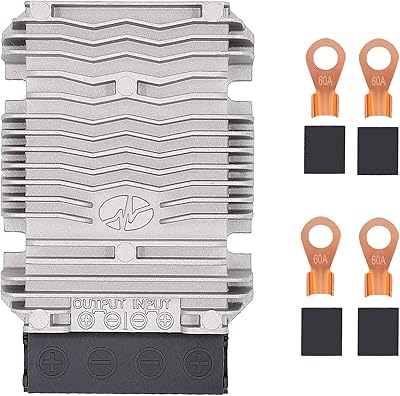
Screw terminals accept standard wire gauges cleanly, and the polarity labels printed on the board are clear enough that most buyers complete the install without needing additional resources. For common use cases like adding a 48V rail to a golf cart or wiring a Starlink Mini in a van, the process is genuinely straightforward.
The product ships with minimal documentation — no wiring diagram, no recommended fuse sizing, and no guidance on maximum wire run lengths at rated current. Buyers without prior DC converter experience will need to seek third-party installation guides, which adds friction to what should otherwise be a simple wire-and-go setup.
Input Voltage Tolerance
85%
The 11V to 16V input window is genuinely practical for real battery systems, where voltage moves constantly between resting, charging, and loaded states. Buyers in solar and RV setups specifically appreciate that the converter does not shut off during low-battery sag conditions that would trip narrower-tolerance units.
The input window does not extend below 11V, so deeply discharged batteries or systems with significant voltage drop across long or undersized cable runs may cause the unit to cut out before the battery is actually depleted. Buyers with marginal wiring setups should carefully account for cable voltage drop in their installation planning.
Long-Term Reliability
63%
37%
The majority of buyers who use this 12V-to-48V boost module for intermittent or moderate loads — the application it is genuinely designed for — report trouble-free operation over many months without any sign of degradation. Units installed in golf carts and RVs for seasonal use have accumulated largely positive long-term track records.
A recurring thread in negative reviews involves units failing after extended periods of continuous operation near peak load, pointing to a potential gap between rated specs and actual long-term thermal endurance. With the product on the market only since mid-2022, multi-year reliability data across diverse conditions is still limited.
Size & Mounting
89%
At just over four inches long and barely an inch and a quarter thick, this step-up converter fits in spaces where larger industrial modules simply will not go. Buyers mounting it behind dashboard panels, inside battery boxes, or under golf cart seats consistently highlight how little room it actually requires.
The unit ships without any mounting hardware — no screws, brackets, or adhesive feet — so buyers need to source their own fastening solution, which is a minor but avoidable friction point. The smooth aluminum base also makes adhesive mounting less secure without surface preparation or a bracket.
Wiring & Connections
81%
19%
Screw terminals are robustly built and hold wire ends securely without the loosening-over-time issues that crimp or push-in connectors often develop in high-vibration vehicle environments. Several buyers specifically called out the terminal quality as a standout detail relative to cheaper converters they had previously tried.
The terminal block does not accommodate ferrule-tipped wires easily without slight modification, which is a minor inconvenience for buyers who prefer that wiring style for cleaner installs. There is also no strain relief built into the housing, leaving wire exits entirely dependent on external cable management choices.
Documentation & Support
47%
53%
The board markings for input and output polarity are legible and accurate, which is the most critical piece of information needed to wire the unit correctly. For experienced DC power builders, those four labeled terminals are genuinely all the documentation they need to complete a clean install.
Beyond the terminal labels, documentation is essentially nonexistent — no fuse sizing guidance, no derating table, no warranty terms, and no technical support contact. Buyers who encounter a problem have no official channel to turn to, leaving online forums as the primary troubleshooting resource by default.
EMI & Output Noise
72%
28%
Most buyers using the Eagwell boost converter alongside audio equipment, monitoring systems, and communication gear report no noticeable interference issues at typical load levels, suggesting the PCB design incorporates at least basic EMI suppression. For standard vehicle accessory and LED driver applications, noise is simply not a reported concern.
There are no published EMI compliance certifications or conducted emissions test results for this unit, so buyers integrating it near sensitive RF equipment — such as amateur radio gear or precision sensors — are operating without meaningful assurance. A small number of buyers noted faint audio interference in their systems at higher load levels.
Brand Credibility
68%
32%
Eagwell has built a focused product catalog in the DC power conversion niche, and the physical quality of this step-up converter is consistent with a brand that understands the application rather than simply relabeling generic modules. The product has accumulated a meaningful verified review base since its 2022 launch, which supports a baseline level of credibility.
Eagwell lacks the brand recognition, published certifications, or verifiable customer support infrastructure of established converter manufacturers, which matters for buyers in commercial or safety-sensitive deployments. The absence of any stated warranty policy is a notable gap that undermines buyer confidence when evaluating the long-term investment.

Suitable for:

The Eagwell 12V to 48V 288W Boost Converter is a strong fit for anyone who needs to bridge a specific voltage gap in a vehicle, off-grid system, or DIY power setup without overcomplicating the installation. Golf cart owners who want to run 48V accessories from a 12V auxiliary battery will find this step-up converter slots in cleanly with minimal wiring effort. It also works well in RV and solar builds where a 12V battery bank needs to feed a 48V bus for LED systems, monitoring equipment, or motor controllers. The growing Starlink Mini user base in particular has found this 12V-to-48V boost module useful for powering the dish in vehicles and remote off-grid cabins where only a 12V source is available. If you understand basic DC wiring, can verify polarity before powering up, and have a realistic load that stays within the unit’s comfortable operating range, this is a practical and well-built solution at its price point.
Not suitable for:

The Eagwell 12V to 48V 288W Boost Converter is not the right choice for applications that demand continuous operation right at or near the 288W ceiling for extended periods, as real-world sustained performance may fall short of that peak rating. Industrial or mission-critical deployments — such as powering medical equipment, telecom infrastructure, or any load where an unexpected dropout causes serious harm — should look at purpose-built, certified industrial converters with verified continuous duty ratings. This step-up converter also won’t suit buyers whose source voltage falls consistently outside the 11V–16V input window, such as systems running on 24V or 36V battery banks. Those completely new to DC power electronics who aren’t comfortable confirming polarity, load calculations, and fuse protection before wiring should either consult someone experienced or choose a kit with more hand-holding documentation. Long-term reliability under punishing, round-the-clock maximum loads remains an open question based on the available user data.
Specifications

  • Input Voltage: Accepts a DC input range of 11V to 16V, covering standard 12V lead-acid and lithium battery systems including real-world sag conditions.
  • Output Voltage: Delivers a fixed 48V DC output with no onboard adjustment; the output is regulated and not variable.
  • Output Current: Maximum continuous output current is rated at 6A at 48V DC under optimal conditions.
  • Rated Power: Peak power rating is 288W, reflecting the product of maximum output voltage and current; real-world sustained capacity may be lower depending on input voltage and thermal conditions.
  • Efficiency: Conversion efficiency is rated at up to 97%, achieved through synchronous rectification topology that recycles switching energy rather than dissipating it as heat.
  • Converter Type: This is a DC-DC boost (step-up) converter, designed exclusively to raise a lower DC input voltage to a higher DC output voltage.
  • PCB Construction: Uses an FR-4 multilayer printed circuit board with fully surface-mount (SMD) components, offering higher integration density and improved thermal and vibration resilience versus through-hole designs.
  • Shell Material: The outer housing is machined aluminum alloy, which passively dissipates heat while providing structural protection against impact and crushing.
  • Sealing: Silicone sealant is applied around the housing perimeter to resist moisture ingress and dust in harsh or outdoor-adjacent environments.
  • Dimensions: Physical footprint measures 4.02 x 3.19 x 1.26 inches (approximately 102 x 81 x 32 mm), suited for installation in tight enclosures or behind panels.
  • Weight: Unit weighs 10.6 oz (approximately 300 g), making it light enough for vehicle-mounted applications where mass is a consideration.
  • Wiring Interface: Input and output connections are made via screw terminals, which accept bare wire ends and support secure, permanent installations without soldering.
  • Protection Suite: Built-in smart circuitry provides over-voltage input protection, under-voltage input cutoff, overload protection, overtemperature shutdown, and short-circuit protection on the output.
  • Brand: Manufactured by Eagwell, a brand specializing in DC power conversion components for automotive, solar, and off-grid applications.
  • Market Availability: First listed on Amazon in July 2022; the product carries an Amazon ASIN of B0B7WZGCM3.

Related Reviews

Daygreen A7D1220 20A DC-DC Buck Converter
77%
91%
Output Voltage Stability
84%
Build Quality & Durability
63%
Thermal Management
89%
Waterproofing & Environmental Protection
78%
Ease of Installation
More
MGGi 36-48V to 12V 30A Buck Converter
77%
88%
Build Quality
91%
Waterproofing
78%
Output Stability
51%
Installation Ease
83%
Value for Money
More
Valefod 48V/12V 60A Buck Converter
72%
77%
Build Quality
54%
Thermal Management
79%
Output Voltage Stability
86%
Ease of Installation
58%
Sustained Current Delivery
More
Victron Energy Orion-Tr 12V to 12V DC to DC Converter 9A
85%
89%
Value for Money
91%
Ease of Installation
85%
Build Quality & Durability
90%
Power Conversion Efficiency
88%
Compact Size
More
SDRGEEK 12V 600W AC to DC Converter
85%
88%
Power Performance
91%
Cooling Efficiency
75%
Ease of Installation
86%
Build Quality
94%
Safety Features
More
YBBOTT DC 12V 10A Step Down Converter
86%
86%
Performance
92%
Build Quality & Durability
89%
Ease of Installation
72%
Thermals/Heat Management
91%
Protection Features
More
SDRGEEK 1000W 12V AC to DC Converter
76%
74%
Output Stability
81%
Build Quality
78%
Cooling Performance
83%
Ease of Connection
77%
Value for Money
More
BOSYTRO 12V 600W AC to DC Converter
86%
88%
Performance Under Load
91%
Cooling System Efficiency
85%
Ease of Setup
90%
Build Quality & Durability
70%
Noise Level
More
DROK 36V 48V to 12V Voltage Reducer
87%
89%
Performance & Power Output
91%
Ease of Installation
92%
Build Quality & Durability
88%
Versatility for Various Applications
90%
Weather Resistance
More
Anbull 600W 12V DC Power Supply Converter
81%
83%
Output Stability
78%
Build Quality
71%
Cooling & Fan Noise
91%
Ease of Setup
93%
Power Switch Convenience
More

FAQ

Yes, this is actually one of the most common real-world uses for this step-up converter. The Starlink Mini requires a stable 48V DC input, and this module converts your vehicle’s 12V system up to exactly that. Just make sure your battery can supply enough current on the input side, and add an inline fuse on the positive input wire as a precaution.

Treat 288W as the rated peak rather than a guaranteed continuous figure. In practice, sustained loads in the 150W–200W range are where this 12V-to-48V boost module tends to operate most comfortably and coolest. If you push it close to 288W for extended periods, monitor the housing temperature and make sure airflow around the unit is reasonable.

For the input side carrying higher current at 12V, a minimum of 10 AWG wire is advisable for loads above 150W, and you should always install an inline fuse or circuit breaker on the positive input wire close to the battery. For the 48V output side, 14 AWG is typically sufficient for the lower current. The unit has built-in short-circuit protection, but an external fuse is still good practice.

It works fine with both. The input voltage window of 11V to 16V comfortably covers the discharge and charge range of 12V LiFePO4 batteries (typically 10V–14.6V) as well as AGM and flooded lead-acid types. Just verify your battery’s actual voltage range stays within that window.

Unfortunately, the included documentation is minimal at best. Most buyers rely on the screw terminal labels (which are printed on the board) and general DC wiring knowledge. If you’re new to this type of install, look up a basic boost converter wiring diagram online before you start — the connections themselves are straightforward once you know input positive, input negative, output positive, and output negative.

The silicone sealing helps resist splashes and condensation, but this unit is not rated for direct water exposure or submersion. An engine bay location is possible if the unit is sheltered from direct spray and isn’t near excessive heat sources. For exposed outdoor mounts, a small weatherproof enclosure is a smarter choice than relying on the factory sealing alone.

The output is fixed at 48V — there is no potentiometer or software setting to change it. If you need a variable output or a different target voltage, this is not the right device for that application.

Under moderate loads, the aluminum housing stays surprisingly cool, which aligns with what most buyers report. The high efficiency rating means less energy is converted to waste heat compared to older converter designs. For installations near the top of the power range or in enclosed spaces with poor airflow, adding a small 12V fan nearby is a low-cost insurance measure.

Technically you could chain a 24V-to-12V step-down converter into this unit’s input, but that introduces two stages of conversion loss and is generally inefficient and over-complicated. A better approach for a 24V source would be to source a dedicated 24V-to-48V boost converter instead.

The Eagwell 12V to 48V 288W Boost Converter has accumulated a broadly positive track record for intermittent and moderate-load use cases, with the majority of buyers reporting stable performance. The area where long-term confidence is less established is continuous operation at or near maximum rated wattage — a small but notable portion of reviews mention failures under those conditions. For typical use cases like Starlink, golf cart accessories, or RV LED systems, the load rarely hits that ceiling, so reliability concerns are less of a practical issue.