Overview

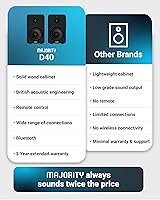
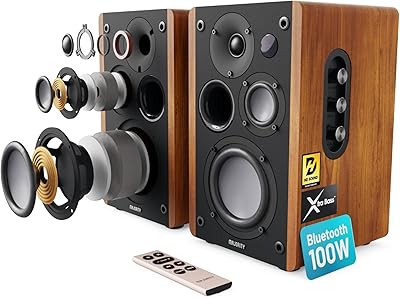
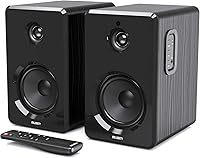
The Majority D40 Powered Bookshelf Speakers are a surprisingly complete package for anyone ready to leave behind tinny TV audio or underwhelming desktop sound. Built by UK-based Majority — a Cambridge-developed brand with genuine audio credentials — the D40 pair arrives as a ready-to-use stereo setup with cables, a remote, and no separate amplifier needed. The solid wood cabinet gives them a noticeably more substantial feel than most rivals at this price tier, and the clean modern look means they sit comfortably on a desk or shelf without looking out of place. A 3-year full warranty adds a layer of reassurance that is genuinely appreciated at this level.
Features & Benefits

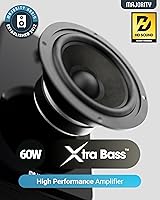
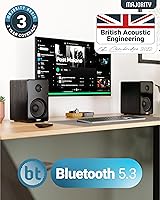
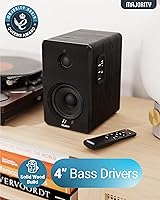
What stands out about the D40 pair is not any single spec — it is the combination. You get 60W of amplified output through a 4-inch bass driver and 1-inch tweeter per speaker, which is respectable in a cabinet this size. The input list is unusually broad: Bluetooth 5, optical, RCA, USB, SD card, and 3.5mm aux are all covered, making it easy to connect a TV, turntable, and laptop without constantly swapping cables. Hi-res audio support and digital signal processing help keep the sound clean across sources. The side-panel controls and included remote make day-to-day use genuinely convenient without any fuss.

Best For

These bookshelf speakers suit people who need one pair to handle multiple sources — vinyl listeners connecting via RCA, laptop users on Bluetooth, and TV owners running optical all benefit equally from the flexible input setup. They work particularly well in small to medium rooms where 60W provides comfortable headroom without strain. Students, apartment dwellers, and anyone building a compact home office will find them easy to live with. That said, if your listening leans heavily toward bass-driven genres, pairing these powered monitors with a small subwoofer later on is worth keeping in mind — the 4-inch drivers have natural limits.

User Feedback

Across several hundred verified reviews, the D40 pair holds a strong 4.3-out-of-5 rating, with the most consistent praise focused on midrange clarity — vocals, acoustic guitar, and spoken-word content all come through with real presence. TV users specifically highlight the optical input as a low-effort, noticeable upgrade from built-in television sound. The criticisms worth knowing: some buyers find the bass thin at lower volumes, which is an honest expectation from a compact driver without a subwoofer. The plastic remote feels budget relative to the speakers themselves, and a small number of users have flagged occasional Bluetooth dropout, though most report reliable wireless pairing.

Pros

  • Unusually wide input selection — optical, RCA, Bluetooth, USB, SD, and aux — covers almost every source in one box.
  • Solid wood cabinet construction reduces unwanted resonance and looks noticeably more premium than plastic-bodied alternatives.
  • At 60W, the D40 pair delivers comfortable volume headroom for small and medium rooms without distortion.
  • Midrange clarity draws consistent praise from buyers, particularly for vocals, podcasts, and acoustic music.
  • Ships as a complete ready-to-use kit with cables, remote, and manual — no extra purchases needed on day one.
  • Optical input is a reliable, low-fuss connection for TV users wanting a quick audio upgrade.
  • Hi-res audio support and digital signal processing help maintain clean playback across different input sources.
  • A 3-year full warranty is a meaningful commitment that stands out at this price point.
  • Compact footprint fits comfortably on a desk, shelf, or TV stand without dominating the space.
  • Bluetooth pairing works reliably for the majority of users within a practical 10-meter range.

Cons

  • Bass response feels noticeably thin at lower volumes, making a separate subwoofer necessary for bass-heavy listening.
  • The included remote is plastic and feels cheap relative to the overall build quality of the speakers.
  • A small but consistent number of users report intermittent Bluetooth dropout, which can interrupt wireless listening.
  • No built-in phono preamp means turntable users with a standard moving-magnet cartridge will need a separate preamp stage.
  • At 3.8 kg total, the pair is not portable — these are strictly fixed-position, mains-powered speakers.
  • Side-panel controls, while functional, can be awkward to reach depending on placement height and shelf depth.
  • No tone controls or EQ adjustment means you cannot compensate for room acoustics or personal sound preferences.
  • Single-unit active design means if the amplifier section fails, both speakers are effectively out of service.

Ratings

The scores below for the Majority D40 Powered Bookshelf Speakers were generated by our AI engine after analyzing verified buyer reviews from global markets, with spam, bot-submitted, and incentivized feedback actively filtered out before any scoring took place. Each category reflects the genuine consensus of real owners — strengths are credited where they are earned, and recurring frustrations are not glossed over. The result is an honest, balanced picture of what it is actually like to live with these powered monitors day to day.
Sound Quality
78%
22%
Midrange performance consistently draws praise from buyers who use these speakers for vocals, podcasts, and acoustic music — there is a clarity and presence to the upper-mid range that outperforms what you would expect at this price. Digital signal processing keeps the sound clean across different input sources, which listeners switching between Bluetooth and optical particularly appreciate.
Bass reproduction is the most commonly cited limitation: at lower volumes the low end thins out noticeably, and even at higher levels the 4-inch drivers simply cannot deliver the physical impact that bass-heavy genres demand. Buyers who expected full-range sound without a subwoofer frequently leave disappointed in this specific area.
Value for Money
86%
The combination of solid wood cabinets, built-in amplification, hi-res audio support, and a six-input connectivity list at this price tier is genuinely difficult to match. Most owners feel they received substantially more hardware than the price suggested, and the 3-year warranty adds long-term value that rivals at the same price point rarely offer.
While the overall package is strong, a few buyers feel the remote and internal cabling quality lag behind the speaker cabinets themselves, slightly undercutting the value narrative. Those who later needed to add a subwoofer for satisfying bass found the total system cost crept higher than the initial outlay implied.
Build Quality
74%
26%
The solid wood enclosures are a genuine differentiator — they feel substantial and look more premium on a desk or shelf than the plastic-bodied competitors they sit alongside. The cabinet finish is consistently praised as clean and professional, holding up well after months of regular use.
The included remote is the weak link: buyers describe it as light, plasticky, and prone to feeling unresponsive over time, which jars against the otherwise solid cabinet build. A small number of owners have also noted that the connection cable between the active and passive speaker feels thinner than the enclosures deserve.
Connectivity
91%
Six distinct input options — Bluetooth 5, optical, RCA, USB, SD card, and 3.5mm aux — is an unusually generous selection for this market segment, and real-world owners genuinely use the breadth daily. TV users love the optical input, turntable owners rely on RCA, and casual listeners default to Bluetooth, all without needing any additional hardware.
There is no built-in phono preamp, which catches some turntable buyers off guard when they connect a standard moving-magnet cartridge and get an unacceptably quiet or distorted signal. The lack of a dedicated subwoofer output also limits easy system expansion for buyers who later want to add low-end support.
Bluetooth Performance
71%
29%
The majority of owners report stable, responsive Bluetooth pairing with phones and laptops within a typical room, and the 10-meter range covers most living rooms and bedrooms without dropout under normal conditions. Codec support handles everyday streaming from Spotify and YouTube without audible compression artifacts at moderate volumes.
A recurring thread in user feedback involves intermittent dropout when multiple wireless devices compete in the same space, and a handful of owners report that re-pairing is occasionally required after the speakers lose connection unexpectedly. This is not a universal experience, but it surfaces often enough to be a genuine consideration for buyers who plan heavy wireless use.
Setup & Ease of Use
88%
The out-of-box experience is notably frictionless — all necessary cables are included, the active and passive speakers connect via a single cable, and input switching via the remote or side-panel buttons takes seconds. Most buyers report being up and running with their primary source within ten minutes of opening the box.
First-time active speaker buyers occasionally get confused by the single-power-point design, unsure why only one speaker has volume controls, and the manual could do more to explain the active-passive relationship clearly. Optical setup occasionally requires toggling the TV audio output settings, which catches less tech-confident users off guard.
Volume & Power
77%
23%
In small to medium rooms, 60W of amplified output provides comfortable headroom — buyers use these at well under half volume in typical listening sessions, leaving plenty of range before any clipping or strain becomes audible. Desktop users in particular find the power level well-matched to close listening distances.
In larger open rooms or for buyers who prefer high-volume listening, the 60W 2.0 configuration can start to feel underpowered, and the sound at the upper end of the volume range loses some of the composure it has at moderate levels. Those expecting to fill a medium living room at party volumes will find the system falling short.
Design & Aesthetics
83%
The rectangular wood-finish cabinets have a clean, modern look that sits comfortably in home office, bedroom, and living room settings without looking like utilitarian studio gear. Buyers frequently mention that the speakers look more expensive than they are, which matters when they are sitting in a visible space every day.
The color and finish options are limited to a single black variant, which suits most setups but leaves buyers who want a lighter or wood-grain aesthetic with no alternative. The overall form is functional rather than distinctive — it reads as competent rather than characterful.
Remote Control
52%
48%
The remote covers the core functions — volume, input selection, and power — which is all most buyers need for comfortable daily use from across a room. Having any remote at all at this price point is genuinely appreciated by buyers who compared these against rivals that require manual button presses only.
The remote itself is widely described as the least satisfying component in the box: the plastic is lightweight, button travel feels imprecise, and responsiveness degrades for some users within months of regular use. A meaningful number of reviewers specifically called it out as something they would happily replace if a better alternative were available.
Bass Response
58%
42%
Within the realistic limits of a 4-inch driver, the D40 pair manages reasonably controlled and defined bass for jazz, folk, classical, and spoken word content, where low-end extension matters less than midrange accuracy. The wooden enclosure does help with tightness and reduces the muddiness that comparably sized plastic-bodied speakers often exhibit.
Sub-bass simply does not exist at this driver size without a dedicated subwoofer, and buyers who listen to electronic music, hip-hop, or film soundtracks will find the low end unconvincing. The gap between expectation and reality is the single most common source of negative feedback across the entire review pool for these speakers.
Input Switching
82%
18%
Switching between sources is quick and intuitive using either the remote or the side buttons, with a satisfying and consistent response whether you are jumping from Bluetooth to optical or from RCA to aux. Buyers who regularly rotate between a TV, turntable, and laptop find this workflow genuinely frictionless in daily use.
There is no automatic input detection, so the speakers will not switch to an active source on their own — you always need to manually select the input, which minor though it sounds can become a small daily friction point for multi-source households. Input labeling on the unit itself is minimal, creating a brief learning curve for new users.
Midrange Clarity
87%
This is arguably the strongest single aspect of the listening experience: vocals are rendered with real presence and definition, and instruments like acoustic guitar, piano, and brass come through with convincing texture at normal listening distances. Buyers who primarily stream podcasts, audiobooks, or vocal-forward music are consistently among the most satisfied owners.
At higher volumes the midrange can harden slightly, losing some of the smoothness present at moderate levels, which affects sustained listening sessions. Buyers used to more expensive studio monitors will notice a compression in the upper-midrange detail that is simply a constraint of the driver and amplifier components at this price tier.
Warranty & Support
84%
A 3-year full warranty is a meaningful commitment that few competitors at this price level match, and buyers who have gone through the returns or replacement process generally describe Majority's customer support as responsive and practical rather than obstructive. The Cambridge-based brand origin gives the warranty more credibility than a faceless overseas seller might.
As with most consumer electronics warranties, the fine print matters — some buyers have found that certain fault types sit in a grey area regarding what is covered, and international buyers outside the UK occasionally report that warranty logistics are slower and less streamlined. The support experience is broadly positive but not uniformly excellent.

Suitable for:

The Majority D40 Powered Bookshelf Speakers are an excellent match for anyone who wants a single, compact stereo setup that handles multiple sources without the complexity of a separate amplifier or receiver. If you have a turntable, a laptop, and a smart TV all competing for one pair of speakers, the broad input selection — RCA, optical, Bluetooth, USB, and aux — makes switching between them genuinely practical. Desktop listeners working in smaller rooms will appreciate how 60W fills a bedroom or home office without needing more speaker than the space demands. Students and apartment dwellers benefit most here: the compact footprint, solid wood build, and all-in-one nature mean you get real stereo sound without assembling a multi-component system. Casual gamers and TV upgraders looking to move on from built-in display audio will also find the optical input a particularly straightforward improvement.
Not suitable for:

Buyers who prioritize deep, physical bass response should think carefully before committing, because the Majority D40 Powered Bookshelf Speakers rely on 4-inch drivers with no dedicated subwoofer, and low-end performance at lower volumes is genuinely limited by physics rather than any design flaw. If your listening habits lean heavily toward electronic music, hip-hop, or cinematic soundtracks where sub-bass matters, you will likely feel the gap unless you budget for an additional subwoofer from the start. Audiophiles or serious home theater enthusiasts who expect precise imaging, wide soundstaging, or the kind of output that fills a large living room should look further up the price ladder. The remote, while convenient, feels plasticky and does not inspire confidence for long-term daily use, which may frustrate buyers who expect build quality to match across every component in the box. Anyone already owning a quality amplifier and passive speakers will find no advantage here, since the built-in amplification is the core proposition rather than a bonus.
Specifications

  • Total Power: The system delivers 60W of total amplified output across a 2.0 stereo channel configuration.
  • Driver Config: Each speaker houses a 4-inch woofer and a 1-inch tweeter for a two-way driver arrangement.
  • Cabinet Material: Both enclosures are constructed from solid wood, which reduces resonance compared to plastic-bodied alternatives.
  • Dimensions: Each speaker unit measures 5.3″ deep by 8.7″ wide by 7.04″ tall.
  • Total Weight: The complete pair weighs 3.8 kg (8.38 lbs) combined, making them suitable for shelf or desktop placement.
  • Inputs: Available connections include Bluetooth 5, optical (Toslink), RCA stereo, USB Type-A, SD card slot, and 3.5mm aux.
  • Bluetooth Range: Wireless Bluetooth connectivity operates reliably up to a 10-meter range under typical indoor conditions.
  • Audio Format: The speakers support hi-resolution audio playback with onboard digital signal processing for cleaner output across sources.
  • Power Source: Both units are powered via AC mains supply; no battery operation is available.
  • Remote Control: A plastic infrared remote control is included in the box and requires two AAA batteries, which are also included.
  • Surround Config: The system operates as a 2.0 stereo pair with no built-in subwoofer channel.
  • Compatible Devices: Confirmed compatible sources include smart TVs, desktop and laptop computers, gaming consoles, projectors, and turntables with a preamp.
  • Warranty: Majority provides a 3-year full warranty along with a hassle-free returns policy for this product.
  • Brand Origin: The D40 was developed by Majority, a consumer audio brand based in Cambridge, UK.
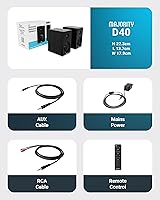
  • Box Contents: The package includes both speaker units, a power cable, RCA and aux cables, the remote, and a printed user manual.
  • Control Method: Volume and input selection can be adjusted using either the side-panel buttons on the active speaker or the included remote.
  • Water Resistance: These speakers carry no water resistance rating and are strictly intended for indoor use only.
  • Tweeter Size: Each speaker unit includes a 1-inch tweeter driver dedicated to high-frequency reproduction.

Related Reviews

Majority D100 Bookshelf Speakers
74%
76%
Sound Quality
71%
Bass Performance
83%
Build Quality
89%
Connectivity Range
68%
Phono Stage
More
Majority D40X Powered Bookshelf Speakers
78%
83%
Sound Quality
74%
Bass Performance
86%
Build Quality
91%
Connectivity & Inputs
67%
Bluetooth Performance
More
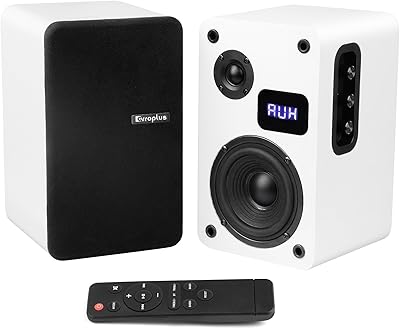
Orroplus OR-02 Powered Bookshelf Speakers
77%
83%
Sound Clarity & Midrange
61%
Bass Performance
91%
Connectivity & Input Range
78%
Bluetooth Performance
72%
Setup & Ease of Use
More
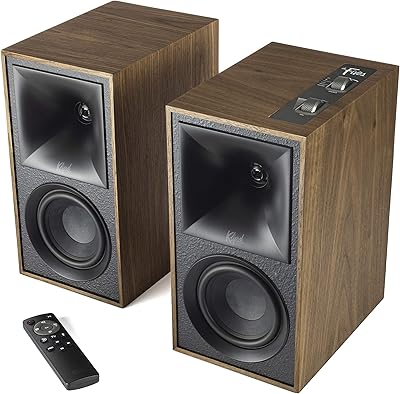
Klipsch The Fives Powered Bookshelf Speakers
86%
92%
Sound Quality
89%
Connectivity Options
85%
Setup & Installation
88%
Build Quality
91%
Bass Performance
More
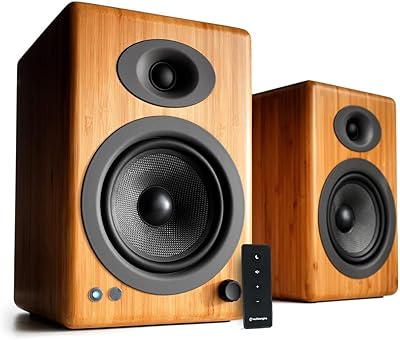
Audioengine A5+ Powered Bookshelf Speakers
80%
91%
Sound Quality
93%
Build Quality
88%
Amplifier Performance
67%
Connectivity & Inputs
78%
Value for Money
More
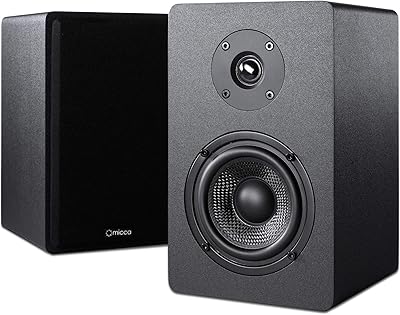
Micca PB42X Powered Bookshelf Speakers
83%
87%
Sound Quality
91%
Value for Money
76%
Bass Performance
89%
Ease of Setup
85%
Build Quality
More
Fluance Ai41 Powered Bookshelf Speakers
82%
88%
Sound Quality
73%
Bass Performance
84%
Treble Clarity
91%
Build Quality
87%
Connectivity & Inputs
More
Kanto TUK Powered Bookshelf Speakers
88%
88%
Sound Quality
72%
Bass Response
93%
Setup & Installation
90%
Connectivity Options
85%
Build Quality
More
Klipsch R-41PM Powered Bookshelf Speakers
80%
88%
Sound Clarity & Detail
67%
Bass Performance
84%
Soundstage & Imaging
91%
Built-in Phono Preamp
86%
Connectivity & Input Range
More
Electrohome Huntley EB10 Powered Bookshelf Speakers
76%
74%
Sound Quality
61%
Bass Response
83%
Build Quality
82%
Value for Money
88%
Design & Aesthetics
More

FAQ

No, the Majority D40 Powered Bookshelf Speakers have a built-in amplifier in the active (left) speaker unit, so you plug them directly into a power outlet and connect your source. There is nothing extra to buy to get them working out of the box.
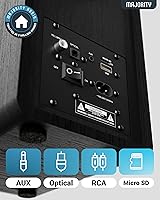
It depends on your turntable. If your record player has a built-in phono preamp — most modern budget decks do — you can connect it via the RCA input without any issue. If your turntable outputs a raw phono signal, you will need an external phono preamp between the turntable and the speakers, as these powered monitors do not have one built in.

The easiest way is via the optical (Toslink) input, which most modern smart TVs support. Just run an optical cable from your TV's audio output to the corresponding port on the active speaker, select the optical input using the remote or side-panel button, and you are set.

For most users, pairing is straightforward and the connection holds well within a typical room. A small number of buyers have reported occasional dropout, which tends to happen when there are several competing wireless devices nearby or when the source is near the edge of the 10-meter range. Keeping your phone or laptop within a few meters generally prevents any issues.

Honestly, they handle it adequately but not impressively. The 4-inch drivers produce a reasonably tight low end, but they do not move enough air to reproduce deep sub-bass. If that genre is your primary listening, the D40 pair works better as part of a 2.1 setup with a small subwoofer added later.

Yes, both USB and SD card playback are supported for MP3 files, which is a genuinely useful feature for setups where you want music without keeping a phone or computer nearby. Just make sure your files are in a compatible format before assuming everything will play back correctly.

In a small to medium bedroom or home office they get comfortably loud — loud enough that you will rarely push them to their limits. In a larger open-plan living room, 60W across a 2.0 setup will fill the space but may feel slightly underpowered at higher listening levels.

It works fine for basic volume and input switching, but it is clearly built to a budget — the plastic feels light and some buyers have found it less responsive over time. It is the one component in the box that does not quite match the quality of the speaker cabinets themselves.

No, this is a traditional active-passive stereo pair where the active speaker powers both units via an internal cable connection. The two speakers are designed to work together as a stereo system and cannot be separated for independent mono use.

The box includes both speakers, a power cable, an RCA stereo cable, a 3.5mm aux cable, the remote with two AAA batteries, and a user manual. For optical connection to a TV you would need to purchase a separate Toslink optical cable, as one is not included in the standard package.