Overview

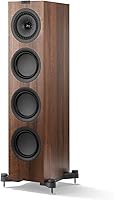
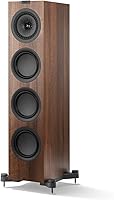
The KEF Q550 Floorstanding Speaker is the latest version of KEF's long-running Q Series, arriving with more than a cosmetic refresh. The redesigned cabinet and premium Walnut finish give it a presence that feels intentional — not like a budget box dressed up. Positioned in the mid-to-upper tier of the floorstanding market, this KEF tower is aimed at serious listeners who want real performance without stepping into bespoke audiophile territory. One thing worth flagging upfront: this floorstanding speaker is sold individually, not as a pair. If you need two, budget for two.

Features & Benefits

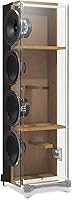
At the heart of this floorstanding speaker is KEF's Uni-Q driver design, which positions the tweeter directly at the center of the midrange cone. In practice, sound radiates from a single point rather than two separate locations, giving vocals and instruments a more cohesive, focused quality. The redesigned crossovers and updated woofer surrounds keep the bass tighter and better controlled than you might expect at this size. Two auxiliary bass radiators supplement the low end without a traditional port, which helps this KEF tower sound fuller in smaller rooms. With a sensitivity of 86dB and nominal 8-ohm impedance, it pairs well with most mid-powered amplifiers.

Best For

The Q550 is genuinely well-suited to a few specific listener profiles. If you've been running bookshelf speakers and want more weight and presence in the room without committing to a full audiophile stack, this KEF tower makes a compelling case. Home theater builders will find it works well as a front-channel speaker in a 5.1 setup, bringing real authority to movie dialogue and effects. The Walnut finish also makes it living room-friendly in a way that flat-black towers often aren't. Buyers who prioritize imaging and soundstage over sheer bass output will get the most from it — particularly when paired with a clean amplifier in the 50 to 100-watt range.

User Feedback

Owner reviews paint a fairly consistent picture. The midrange and vocal clarity get singled out repeatedly — listeners describe voices and acoustic instruments as natural and well-placed in the stereo field. Build quality draws praise too, with several buyers noting it feels and looks more expensive than alternatives at a similar price point. The criticisms are worth knowing: in larger rooms the bass can feel lean, and some owners recommend adding a subwoofer to fill things out properly. A few buyers were caught off guard by the sold-as-single format — easy to miss, but important. Multiple reviewers also note a noticeable break-in period, so give it some hours before drawing conclusions.

Pros

  • Uni-Q driver design produces a remarkably cohesive soundstage with precise imaging that cheaper towers rarely match.
  • Vocal clarity and midrange transparency are consistently praised by owners across music genres.
  • Cabinet build quality feels and looks more premium than most competitors at a similar price point.
  • The Walnut finish integrates naturally into living rooms without the industrial look of typical black-box speakers.
  • Compatible with a wide range of amplifiers, making it practical for listeners upgrading an existing system.
  • Auxiliary bass radiators extend the low-end without a port, reducing cabinet noise and improving bass control.
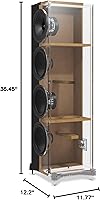
  • At roughly 36.45 inches tall, the Q550 delivers full-range sound in most rooms without requiring a subwoofer.
  • Crossover design is noticeably improved over earlier Q Series iterations, resulting in cleaner transitions between drivers.
  • Works well as both a dedicated stereo pair and as front channels in a home theater system.

Cons

  • Sold as a single unit — buying a stereo pair means doubling the cost, which surprises many first-time buyers.
  • Bass performance can feel lean in large or acoustically untreated rooms without a subwoofer to supplement.
  • Requires a meaningful break-in period before the drivers settle; early listening sessions may underrepresent its true sound.
  • At 32 pounds per speaker, placement and repositioning takes more effort than lighter bookshelf alternatives.
  • Magnetic grilles are sold separately, which feels like an oversight at this price level.
  • The analytical sound character can be unforgiving with low-quality recordings or lossy streaming sources.
  • Sensitivity of 86dB means it needs a competent amplifier to really open up — budget receivers may fall short.
  • Limited finish options may not suit every interior, especially modern minimalist or all-white room aesthetics.

Ratings

The KEF Q550 Floorstanding Speaker has been scored by our AI system after parsing verified owner reviews from global markets, with spam, bot-generated feedback, and incentivized posts actively filtered out before analysis. The ratings below reflect where real buyers consistently agree — and where genuine frustrations surface — covering everything from sonic performance to the practicalities of living with these towers day to day. Both strengths and pain points are represented transparently, so you can make a genuinely informed decision.

Sound Clarity
91%
Owners repeatedly single out midrange transparency and vocal reproduction as standout qualities — voices and acoustic instruments sit in the mix with a naturalness that is hard to find at this price tier. Listeners moving up from entry-level towers report the improvement in clarity is immediately obvious.
The analytical character of the Q550 means poorly recorded tracks or heavily compressed streaming audio can sound unforgiving. A small number of reviewers found the top end slightly forward on certain amplifier pairings, which added fatigue during long listening sessions.
Soundstage & Imaging
89%
The coaxial driver arrangement — with the tweeter nested at the center of the midrange cone — produces a genuinely cohesive stereo image that outperforms most similarly priced competing towers. Buyers regularly note that instruments feel precisely placed and the listening sweet spot is wider than expected.
Some users found imaging performance highly sensitive to speaker placement and toe-in angle, requiring experimentation to get right. In non-symmetrical rooms or awkward layouts, achieving the full benefit of the Q550s imaging capabilities can take real effort.
Bass Performance
67%
33%
In small to medium rooms, the dual auxiliary bass radiators do a solid job of extending the low end without the port noise you sometimes get from similarly sized vented cabinets. Bass is generally described as tight and controlled rather than overblown, which suits jazz, acoustic, and vocal-focused music well.
In larger rooms or open-plan spaces, multiple owners report the bass feeling thin and underwhelming without a dedicated subwoofer. This is the most common complaint in the review pool — buyers expecting room-filling low-end from a tower this size can be disappointed.
Build Quality
88%
The cabinet feels dense and well-damped, with minimal resonance when you knock on the panels — a quality check many audiophile buyers actually perform. The Walnut veneer finish is consistently described as looking far more premium than alternatives at a similar price point.
A few reviewers noted minor inconsistencies in the veneer finish near the base or binding post area, suggesting quality control is not perfectly uniform across all units. The grilles being sold separately also draws criticism, as it makes the out-of-box presentation feel slightly incomplete.
Value for Money
74%
26%
When purchased during promotional periods, the Q550 is widely regarded as offering strong performance-per-dollar for serious listeners stepping up from bookshelves. The build and sonic performance genuinely punch above the price in a direct head-to-head with similarly priced competition.
Because the product is sold as a single speaker, the real cost for a stereo pair is double the listed price — something many buyers only realize after purchasing one unit. At full price for a pair, some reviewers feel the value proposition weakens compared to competing full-range towers.
Amplifier Compatibility
82%
18%
The 8-ohm nominal impedance and 10–100W power range means the Q550 works well with a wide variety of amplifiers, from modestly powered integrated amps to beefier separates. Most buyers found it easy to pair with existing equipment without any impedance mismatch concerns.
The 86dB sensitivity rating is on the lower end of efficient, meaning underpowered budget receivers can struggle to drive the speakers to satisfying volumes. A handful of buyers running older or entry-level receivers reported the sound feeling dynamically compressed at moderate listening levels.
Home Theater Performance
78%
22%
As front left and right channels in a 5.1 or 5.0 home theater setup, the Q550 handles dialogue intelligibility and dynamic movie passages with genuine authority. The wide dispersion from the coaxial driver makes it forgiving for off-axis seating positions, which is a real advantage in family setups.
The lean bass performance in larger rooms means movie-watching without a subwoofer can feel like something is missing during action-heavy scenes. Buyers who expected the towers alone to deliver cinematic impact in large living rooms were among the more disappointed voices in the review pool.
Setup & Placement
71%
29%
The included floor spikes and rubber feet give buyers options for both hard floors and carpeted rooms, and most owners report a straightforward initial setup process. The tower format means no stands are required, which simplifies the overall room arrangement.
At 32 pounds per speaker, repositioning during the placement experimentation phase is physically demanding. Several reviewers noted that the Q550 is quite sensitive to toe-in and distance from the rear wall, requiring multiple adjustment sessions before the sound locked in optimally.
Break-In Experience
61%
39%
Buyers who stuck with the Q550 through the break-in phase — generally described as 50 to 100 hours of use — consistently report a meaningful improvement in driver openness and bass control. Patience during this period was rewarded in the majority of long-term owner accounts.
The break-in requirement is a genuine friction point, with several buyers forming negative first impressions that influenced their early reviews. For buyers who audition briefly before deciding, the Q550 risks being underestimated before the drivers have had adequate run-in time.
Aesthetic Design
86%
The Walnut finish integrates into living spaces with a level of elegance rarely seen at this tier — multiple owners specifically mention that partners or family members approved of how the speakers looked in the room, which is not a trivial consideration for a large floor-standing product.
Color options are limited, and buyers with modern minimalist or all-white interiors may find the warm wood finish difficult to integrate. The absence of included grilles also means the raw drivers are visible out of the box, which some buyers find aesthetically unfinished.
Packaging & Unboxing
77%
23%
The Q550 arrives well-protected with foam inserts and secure internal packaging that prevents transit damage in the vast majority of cases. Most buyers report the unboxing experience feeling appropriate for a premium speaker purchase.
A small number of reviews document minor cosmetic damage on arrival, suggesting the packaging — while generally adequate — may not fully protect the veneer finish in rougher shipping conditions. The lack of included accessories beyond spikes and feet leaves the unboxing feeling somewhat sparse.
Vocal & Midrange Accuracy
93%
This is arguably the Q550s defining strength — the coaxial driver arrangement produces a midrange that sounds open and uncolored in a way that genuinely distinguishes it from similarly priced conventional tower designs. Reviewers who listen to a lot of acoustic music, jazz, and vocals consistently rate this aspect the highest.
The exceptionally transparent midrange can expose weaknesses elsewhere in the signal chain, meaning low-quality sources or DACs become more noticeable. A small number of listeners found the midrange to have a slightly cool character that made pop and electronic music feel less energetic than they preferred.
Long-Term Satisfaction
81%
19%
The majority of long-term owners — those who reviewed after six months or more — express high satisfaction, particularly after the break-in phase and once amplifier pairing is optimized. The Q550 tends to reward buyers who invest time in setup rather than those looking for immediate plug-and-play gratification.
A subset of buyers who purchased primarily for bass-heavy music genres reported declining satisfaction over time as the limitations in large-room low-end performance became more apparent. Managing expectations around the sold-individually format also left some buyers with lingering frustration that affected their overall satisfaction scores.

Suitable for:

The KEF Q550 Floorstanding Speaker is a strong fit for music lovers who have outgrown bookshelf speakers and want a genuine step up in room presence and sonic depth without venturing into esoteric audiophile territory. If you already own a solid integrated amplifier in the 50 to 100-watt range, this KEF tower will reward that investment — it is revealing enough to show what a good source and amp can do, but forgiving enough not to punish modest setups. Home theater builders looking for authoritative front speakers in a 5.1 configuration will find the Q550 handles dialogue, dynamics, and cinematic effects with real composure. The Walnut finish also makes this floorstanding speaker a natural fit for living rooms and listening spaces where aesthetics matter as much as acoustics. Listeners who prioritize a precise, well-defined soundstage and natural vocal reproduction over thunderous low-end will feel right at home here.

Not suitable for:

The KEF Q550 Floorstanding Speaker is not the right call for buyers who want chest-thumping bass without a subwoofer, particularly in larger open-plan rooms where the Q550's low-end reach can start to feel thin. If your budget only stretches to a single unit and you assumed the listing price covered a stereo pair, stop — this KEF tower is sold individually, and that catches a lot of buyers off guard. Listeners who prefer a warm, forgiving sound signature may find this floorstanding speaker a touch analytical, especially on poorly recorded material. It also requires some break-in time before it settles into its best performance, so impatient buyers looking for instant gratification might misjudge it early. Finally, anyone working with a low-powered vintage receiver or a budget class-D amp under 30 watts may not drive the Q550 to its full potential.

Specifications

  • Speaker Type: Floorstanding tower speaker designed for use as a primary stereo or front home theater channel.
  • Driver Config: Each cabinet houses a 5.25″ Uni-Q Driver Array, one 5.25″ dedicated bass driver, and two 5.25″ auxiliary bass radiators.
  • Tweeter: A 1″ tweeter is mounted at the acoustic center of the midrange cone as part of the Uni-Q Array.
  • Frequency Response: Rated frequency response is 51Hz to 28kHz at ±3dB, with a free-field extension down to 47Hz at -6dB.
  • Sensitivity: Sensitivity is rated at 86dB measured at 2.83V at 1 meter, which is adequate for most mid-powered amplifiers.
  • Impedance: Nominal impedance is 8Ω with a minimum of 3.7Ω, keeping it compatible with a broad range of amplifier designs.
  • Amplifier Load: Recommended amplifier power is between 10 and 100 watts per channel for safe and optimal operation.
  • Max Output: Maximum output level is rated at 108dB, sufficient for loud listening levels in typical domestic rooms.
  • Crossover: The internal crossover operates at 2.5kHz, dividing duties between the Uni-Q Array and the low-frequency drivers.
  • Dimensions: Each speaker measures 36.45″H x 11.77″W x 12.2″D, making it a full-size floor-standing cabinet.
  • Weight: Each unit weighs 32 pounds, so moving or repositioning the speakers requires some care.
  • Finish: Available in Walnut veneer, which gives the cabinet a warm, furniture-grade appearance.
  • Connectivity: Connection is via wired binding posts only — there is no wireless or Bluetooth capability on this passive speaker.
  • Grille: Magnetic cloth grilles are compatible but sold separately and are not included in the standard package.
  • Unit Count: This product is sold as a single speaker; purchasing a stereo pair requires ordering two units individually.
  • Warranty: Covered by KEF's limited manufacturer warranty; buyers should verify current terms directly with KEF or their retailer.
  • Brand: Manufactured by KEF, a British speaker company with a long-standing reputation in both consumer and professional audio.
  • Model Number: The official model designation for this variant is SP3960WA, with the product identifier Q550WA.

Related Reviews
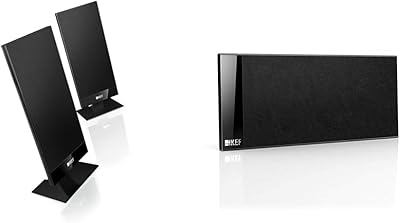
KEF T101 Satellite and Center Channel Speakers
80%
88%
Sound Clarity
91%
Build Quality
94%
Design & Aesthetics
89%
Dialogue Intelligibility
62%
Value for Money
More
KEF Q350 Bookshelf Speakers
86%
93%
Sound Quality
80%
Bass Performance
88%
Build Quality
91%
Design and Aesthetics
85%
Ease of Setup
More
KEF Q150 Bookshelf Speakers
77%
93%
Sound Staging
91%
Vocal & Midrange Clarity
62%
Bass Performance
67%
Amplifier Compatibility
84%
Treble Smoothness
More
DALI Oberon 7 Floorstanding Speaker
79%
91%
Sound Quality
79%
Bass Performance
86%
Treble Clarity
88%
Soundstage & Imaging
93%
Build Quality
More
KEF Q250c Center Channel Speaker
80%
93%
Dialogue Clarity
88%
Build Quality
91%
Off-Axis Performance
79%
Value for Money
67%
Bass Performance
More
KEF LS50 Meta
KEF LS50 Meta
78%
96%
Sound Staging & Imaging
93%
Treble Clarity & Detail
91%
Midrange Performance
78%
Bass Response
62%
Amplifier Pairing Sensitivity
More
Yamaha NS-F210BL Floorstanding Speaker
78%
83%
Sound Quality
67%
Bass Performance
81%
Value for Money
78%
Build Quality
86%
Dialogue Clarity
More
KEF T301C Center Channel Speaker
80%
93%
Dialogue Clarity
96%
Design & Aesthetics
88%
Build Quality
67%
Value for Money
48%
Bass Performance
More
Focal Chora 826 Floorstanding Loudspeaker
79%
93%
Sound Quality
91%
Soundstage & Imaging
74%
Bass Performance
88%
Build Quality
67%
Amplifier Sensitivity
More
SVS Prime Pinnacle Floorstanding Speakers
81%
93%
Bass Performance
89%
Midrange Clarity
86%
High-Frequency Detail
91%
Soundstage & Imaging
88%
Dynamic Range
More

FAQ

Just one. The KEF Q550 Floorstanding Speaker is sold as a single unit, which catches a lot of buyers off guard. If you need a stereo pair, you will need to add two to your cart. It is worth double-checking your order before checkout.

Anything in the 50 to 100-watt per channel range from a reputable brand will work well. The Q550 is not particularly difficult to drive — its 8-ohm nominal impedance is friendly to most receivers and integrated amplifiers — but it does benefit from a clean, stable power source. Avoid pairing it with a very low-powered budget receiver if you want it to open up fully.

In a small to medium-sized room, probably not for everyday listening. The tower handles low frequencies reasonably well on its own. That said, in larger rooms or for home theater use where you want real impact, adding a subwoofer will round out the sound considerably.

Several owners report that the Q550 sounds noticeably better after 40 to 100 hours of use. In the first few days the drivers can sound a bit stiff or closed-in. Give them time before deciding what you think — it is worth the patience.

It means the tweeter sits right in the center of the midrange cone rather than being mounted separately. The result is that high and mid frequencies come from essentially the same point in space, which makes the stereo image feel more precise and the sound more cohesive across a wider listening area.

No, the magnetic cloth grilles are sold separately. The speaker ships without them. Whether you need grilles is a personal preference, but it is an extra cost to factor in if you want that cleaner, covered look.

Technically yes, but given their size and price they are best used as front left and right channels. For surrounds, most people use smaller bookshelf speakers from the same Q Series family, like the Q150, to keep the tonal character consistent throughout the system.

The Q750 uses a larger 6.5″ Uni-Q driver and has a slightly wider frequency range, which gives it more authority in bigger rooms. If your room is on the larger side or you listen at higher volumes regularly, the Q750 is worth the extra spend. For small to medium rooms, the Q550 holds its own comfortably.

KEF uses a real wood veneer on the Walnut finish, which gives it a noticeably more premium look and feel compared to the vinyl wraps common on speakers at lower price points. It is one of the details owners tend to comment on positively.

No stands needed — these are floor-standing towers designed to sit directly on the floor. KEF includes floor spikes and rubber feet for placement on hard floors or carpet respectively, which helps with stability and can slightly affect bass coupling depending on your flooring.

Where to Buy