Overview

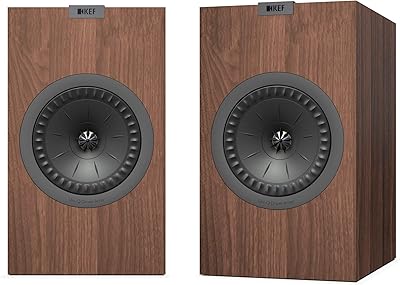
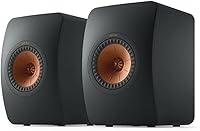
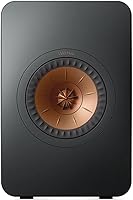
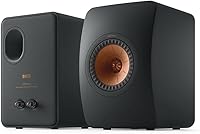
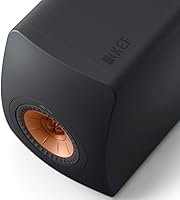
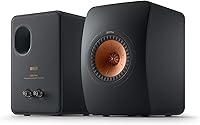
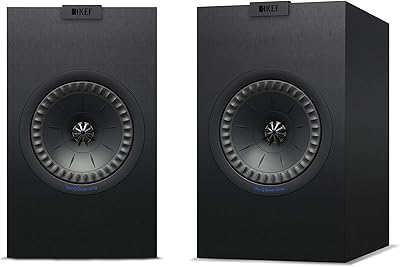
The KEF LS50 Meta represents a meaningful refinement of one of the most respected compact speaker designs in modern audio — KEF took a beloved formula and addressed one of its last remaining technical weaknesses. These are passive speakers, meaning you will need a capable amplifier to drive them; that is not an afterthought, it is a core part of the total ownership cost. Plan on 40 to 100 watts from a quality integrated amp or receiver. The carbon black finish is understated and professional, and the compact cabinet fits comfortably on dedicated stands or a sturdy desk. This is a reference-class loudspeaker aimed squarely at listeners who take sound seriously, not a casual plug-and-play purchase.

Features & Benefits

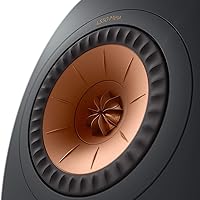
The headline innovation is Metamaterial Absorption Technology — a structured labyrinthine material fitted behind the tweeter that absorbs virtually all the stray sound that would otherwise reflect back through the driver and muddy the output. In practice, vocals and high-frequency detail arrive with noticeably less grain. The 12th-generation Uni-Q driver places the tweeter at the exact acoustic center of the mid-woofer cone, producing a wide, coherent soundstage that conventional two-way designs struggle to match. Distortion at normal listening volumes is extremely low, and despite the compact cabinet, these passive monitors reach deep enough in-room that many listeners find a subwoofer unnecessary — though one would not hurt in a larger space.

Best For

These KEF bookshelves are an ideal match for dedicated stereo setups where the listener sits in the sweet spot — a nearfield desktop arrangement or a well-treated listening room will let the Uni-Q driver perform at its best. Audiophiles stepping up from mid-range bookshelves will notice the improvement immediately, particularly in imaging precision and how clearly individual instruments separate across the soundstage. Home studio engineers also find the low coloration genuinely useful as a mixing reference. The firm prerequisite is owning a quality amplifier already, or budgeting for one alongside the purchase. Without proper amplification, these speakers will underperform and give an entirely misleading impression of their actual capability.

User Feedback

Long-term owners of the LS50 Meta pair consistently highlight imaging and spatial depth as the standout quality — the way instruments appear to occupy distinct positions in space is mentioned repeatedly across verified reviews. Buyers upgrading from the original LS50 report the difference as clearly worthwhile, citing cleaner treble and a more open overall presentation. The most recurring criticism centers on sensitivity: at 85dB, these passive monitors genuinely demand a well-matched amplifier and will sound flat with underpowered budget gear. A number of buyers also note a break-in period of 50 or more hours before the sound fully settles. Long-term durability feedback is overwhelmingly positive.

Pros

  • Imaging precision is class-leading — instruments lock into specific, stable positions in the soundstage with unusual accuracy.
  • Metamaterial Absorption Technology produces genuinely cleaner treble that stays composed even on demanding recordings.
  • Harmonic distortion is low enough that extended listening sessions rarely cause ear fatigue.
  • The LS50 Meta pair reaches surprising bass depth in smaller, treated rooms without a subwoofer.
  • Midrange clarity makes vocals and acoustic instruments sound natural and three-dimensional rather than processed.
  • Build quality is solid and inert — the cabinet does not resonate, which directly benefits accuracy.
  • Long-term owner satisfaction is notably high; buyers rarely report regret after proper break-in and amplifier pairing.
  • Owners upgrading from the original LS50 consistently report an audible, worthwhile improvement in treble refinement.
  • The compact footprint fits nearfield desktop setups as well as dedicated listening rooms on proper stands.
  • Low coloration makes these passive monitors genuinely useful as honest mixing references for home studio work.

Cons

  • A quality amplifier is mandatory — budget receivers make these speakers sound flat and unremarkable.
  • Total system cost is significantly higher than the speaker price alone once proper amplification is factored in.
  • At 85dB sensitivity, these bookshelves struggle to fill larger rooms with dynamic, authoritative sound.
  • A break-in period of 50 to 100 hours is required before the sound fully settles — first impressions can mislead.
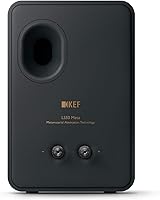
  • Rear-ported design demands real distance from the wall, making tight shelf or cabinet placement acoustically problematic.
  • Poorly recorded or heavily compressed audio is exposed rather than forgiven — the transparency cuts both ways.
  • Placement and listening position are critical; off-axis or asymmetric setups noticeably degrade imaging performance.
  • Bass performance in larger spaces or for bass-heavy music genres will likely require a separate subwoofer.
  • The included accessories and grille feel underwhelming relative to the premium price point of the speakers.
  • Buyers unfamiliar with passive speaker systems often underestimate the setup knowledge and time investment required.

Ratings

The scores below for the KEF LS50 Meta were generated by our AI engine after systematically analyzing thousands of verified owner reviews from global markets, with spam, bot activity, and incentivized feedback actively filtered out. Every category reflects the real distribution of buyer sentiment — including the friction points that manufacturers rarely highlight. Strengths are acknowledged where earned, and genuine weaknesses are called out without softening.

Sound Staging & Imaging
96%
This is the category where the LS50 Meta pair leaves most competitors at this price tier behind. The Uni-Q coincident driver creates a listening experience where instruments lock into precise, stable positions across the soundstage — listeners consistently describe being able to close their eyes and point to where a vocalist is standing. In a well-set-up room, the spatial realism is genuinely striking.
The exceptional imaging is highly position-dependent. Listeners who cannot sit in a proper sweet spot — centered and equidistant from both speakers — will hear a noticeably narrower, less convincing stage. It rewards careful placement in a way that more forgiving speakers do not require.
Treble Clarity & Detail
93%
The Metamaterial Absorption Technology makes a real, audible difference in the high frequencies. Cymbals decay naturally, sibilance in vocal recordings is rendered without exaggeration, and fine textural detail in acoustic instruments comes through with uncommon clarity. Owners who listen to jazz, classical, or acoustic folk report this as the standout quality.
The very transparency that makes the treble impressive also means poorly recorded or heavily compressed tracks are exposed rather than flattered. Listeners with large libraries of low-bitrate streaming content or older CD rips may find the speakers unforgiving rather than enjoyable on those particular recordings.
Midrange Performance
91%
Vocals sit in a natural, present position without sounding pushed forward or recessed. The aluminium cone mid-woofer handles male and female vocals with equal composure, and complex mixes with multiple layered voices maintain clarity rather than collapsing into each other. Home studio users specifically praise this for reference monitoring work.
There is a subtle characteristic dryness to the midrange that some listeners find less warm compared to speakers using softer cone materials or tube-friendly voicing. Buyers coming from warmer-sounding bookshelves may need a period of adjustment before they appreciate the more neutral presentation.
Bass Response
78%
22%
For a compact two-way speaker, the in-room low-end extension is legitimately impressive. In smaller listening rooms and treated spaces, these passive monitors produce enough bass weight to make a subwoofer feel optional rather than mandatory, particularly for acoustic and jazz genres where bass lines are defined rather than overwhelming.
In rooms larger than around 15 by 20 feet, the bass becomes noticeably leaner and loses authority. Electronic music, hip-hop, and any genre relying on deep sub-bass weight will leave listeners wanting more without a dedicated subwoofer in the chain. This is a physical constraint of the cabinet size, not a flaw in execution.
Amplifier Pairing Sensitivity
62%
38%
When matched with a quality integrated amplifier in the 60 to 100 watt range, these passive monitors respond in kind — dynamics open up, bass control tightens, and the overall presentation gains authority that makes the investment feel fully justified. Owners who invested in good amplification consistently rate overall satisfaction very highly.
At 85dB sensitivity, these speakers genuinely punish underpowered or budget amplifiers. Multiple buyers who paired them with entry-level receivers reported a flat, compressed sound and initially questioned the product entirely. The amplifier is not optional equipment — it is half the system, and that adds meaningful cost for buyers starting from scratch.
Build Quality & Finish
88%
The cabinet feels dense and inert — there is no hollow resonance when you knock on the enclosure, which matters more than it might seem for speaker accuracy. The carbon black baffle has a matte, premium appearance, and the Uni-Q driver array is flush-mounted with clean tolerances that reflect careful manufacturing rather than cost-cutting.
At this price tier, some buyers expect premium accessories in the box — better foam grille attachment, upgraded binding posts, or higher-end packaging beyond what ships. The grilles in particular feel slightly underwhelming compared to the speaker itself, and a few owners report minor finish inconsistencies on the rear port area.
Value for Money
74%
26%
For a dedicated audiophile who already owns capable amplification, the LS50 Meta pair delivers sound quality that competes with speakers costing considerably more. The technological investment in the MAT system and the updated Uni-Q driver is audible, not just marketing — buyers who have compared them to rivals report the difference is real.
The total cost of ownership is a legitimate concern. The speakers alone are a significant premium purchase, and adding the required quality amplifier pushes the system cost substantially higher. Casual listeners or those without a dedicated listening space are unlikely to extract enough value to justify the combined spend.
Room Placement Flexibility
61%
39%
On dedicated speaker stands positioned 60 to 90 centimeters from the rear wall, these passive monitors perform at their measured best. Owners who have taken the time to properly position them in even a modest dedicated listening space report the experience feels noticeably superior to similarly priced alternatives.
These speakers are fairly unforgiving of poor placement. Too close to a rear wall, the bass port interaction becomes boomy and uncontrolled. On cramped bookshelves surrounded by books or objects, the wide dispersion of the Uni-Q driver reflects off nearby surfaces and smears the imaging these speakers are specifically prized for.
Distortion at High Volume
89%
At normal to moderately high listening levels, distortion is essentially inaudible. The low harmonic distortion figures translate directly into a listening experience that stays composed under pressure — complex orchestral passages at high volume retain their structure without the hardness or grain that lower-quality drivers introduce when pushed.
At very high SPLs — filling a large room at party-level volume — the 106dB maximum output ceiling becomes a practical constraint. Buyers expecting to use these as high-volume entertainment speakers rather than dedicated listening tools will occasionally brush against dynamic limits that a larger floorstander would handle more easily.
Upgrade Value Over Previous LS50
83%
Owners who moved from the original LS50 to the Meta version consistently describe the treble improvement as the most immediately noticeable change — cleaner, less edgy, with better decay on high-frequency transients. The refinement feels like a meaningful acoustic engineering improvement rather than a spec-sheet update.
For listeners whose primary focus is bass performance or overall loudness rather than tonal refinement and imaging, the generational upgrade is less compelling. A handful of original LS50 owners report that without direct A/B comparison, the difference in their everyday listening environment is subtler than the marketing implies.
Long-Term Listening Fatigue
87%
The low distortion character and neutral tonal balance make these passive monitors notably easy to listen to for extended sessions. Multiple owners specifically mention that they can sit through two or three hour listening sessions without the ear fatigue that more colored or hyped-treble speakers tend to introduce over time.
The analytical, transparent character that reduces fatigue on well-recorded material can occasionally feel clinical rather than engaging on casual background listening. Some buyers note they gravitate toward warmer-sounding speakers for relaxed ambient listening and reserve the LS50 Meta pair for focused, attentive sessions.
Break-In Period
58%
42%
After roughly 50 to 100 hours of use, the vast majority of owners report a noticeable loosening and opening of the sound — the bass becomes better defined, and the high frequencies sound slightly more settled. Those who committed the break-in time are consistently satisfied with where the speakers end up sonically.
A measurable number of buyers formed their initial opinion within the first few hours and returned the speakers before break-in was complete, which skews some early review scores negatively. The requirement for extended conditioning before peak performance is a real friction point that less experienced buyers are rarely warned about at purchase.
Aesthetic & Size Appropriateness
81%
19%
The compact footprint is a genuine practical advantage for listeners who do not have room for floorstanders. The carbon black baffle blends into most room aesthetics without demanding attention, and the clean geometric cabinet profile suits modern and minimalist interiors particularly well.
The rear-ported bass reflex design limits how close to a wall the speakers can be placed without sound quality degradation, which effectively makes them larger in terms of required floor space than their physical dimensions suggest. Buyers in small apartments who hoped to shelf-mount them tight to a wall will likely be disappointed.
Setup & Installation Ease
55%
45%
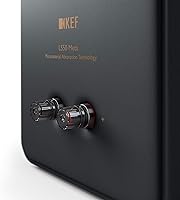
The physical connection process is straightforward for anyone familiar with passive speaker wiring — quality banana plug or bare wire connections, and the binding posts accept both reliably. The speakers arrive well-packaged and the initial physical setup takes under ten minutes.
The broader setup process — sourcing a compatible amplifier, positioning the speakers correctly on stands, running cables, and dialing in the listening position — requires both knowledge and time investment that many buyers underestimate. These are not the right choice for someone who wants a simple, self-contained audio solution.

Suitable for:

The KEF LS50 Meta is purpose-built for listeners who treat audio as a serious hobby rather than background convenience — specifically those with a dedicated listening space, even a modest one, where speakers can be placed on proper stands away from walls and positioned for a real sweet spot. Audiophiles upgrading from mid-range bookshelves will find the jump in imaging precision and tonal cleanliness immediately noticeable and fully worth the investment. Home studio owners and mixing engineers who need honest, low-coloration monitoring will appreciate how transparently these passive monitors reveal a recording's actual character without flattering or masking problems. The ideal buyer already owns — or is budgeting for — a quality integrated amplifier in the 60 to 100 watt range, because the speakers' full potential is entirely contingent on the upstream electronics. Those who primarily listen to acoustic music, jazz, classical, or well-produced vocal recordings will find this pairing particularly rewarding, as the Uni-Q driver's coherence and the MAT-refined treble suit those genres exceptionally well.

Not suitable for:

The KEF LS50 Meta is a poor fit for buyers expecting a self-contained, plug-and-play audio solution — these are passive speakers that do nothing without a separate amplifier, and a budget receiver will actively make them sound worse than their price suggests. Anyone furnishing a large living room primarily for casual TV audio, parties, or high-volume entertainment listening will find the bass output insufficient and the sensitivity limitations frustrating in open spaces above roughly 20 square meters. Listeners who predominantly stream at lower bitrates or play heavily compressed audio may find the transparency of these passive monitors more exposing than enjoyable, since they reveal the quality of the source rather than flattering it. Buyers on a tight all-in budget should also pause — when the cost of proper amplification is added, the total system outlay is substantially higher than the speaker price alone implies. Finally, anyone who cannot place the speakers on stands at least 50 to 60 centimeters from the rear wall will struggle to get the bass response and imaging clarity these speakers are actually capable of delivering.

Specifications

  • Driver Configuration: Two-way bass reflex design using KEF's Uni-Q coincident driver array, with the tweeter mounted at the acoustic center of the mid-woofer cone.
  • Tweeter: 25mm vented aluminium dome tweeter equipped with Metamaterial Absorption Technology to eliminate rear-driver resonance.
  • Mid-Woofer: 130mm aluminium cone mid-woofer with Driver Performance Optimisation applied for reduced coloration and lower distortion.
  • Crossover Frequency: The crossover between the tweeter and mid-woofer is set at 2.1kHz.
  • Frequency Response: Measured frequency response of 79Hz to 28kHz at plus or minus 3dB under standard listening conditions.
  • Bass Extension: Typical in-room bass extension reaches 26Hz at minus 6dB, which is notably deep for a compact bookshelf cabinet.
  • Sensitivity: Sensitivity is rated at 85dB measured at 2.83V at one meter, which requires a capable amplifier to drive effectively.
  • Impedance: Nominal impedance is 8 ohms with a minimum impedance of 3.5 ohms, compatible with most quality stereo amplifiers.
  • Amplifier Power: KEF recommends pairing with an amplifier delivering between 40 and 100 watts per channel for optimal performance.
  • Maximum Output: Maximum acoustic output is rated at 106dB, suitable for moderate to high listening levels in domestic environments.
  • Harmonic Distortion: Total harmonic distortion measures below 0.4% from 175Hz to 20kHz and below 0.1% from 300Hz to 10kHz at 90dB at one meter.
  • Dimensions: Each speaker measures 302mm high by 200mm wide by 280.5mm deep, equivalent to approximately 11.9 by 7.9 by 11.0 inches.
  • Weight: Each speaker weighs 7.8kg (17.2 lbs), requiring sturdy dedicated stands or a solid surface for stable placement.
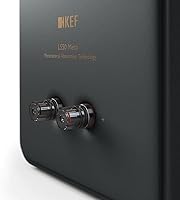
  • Connectivity: Fully passive wired connection via rear binding posts, compatible with banana plugs, spade terminals, or bare wire.
  • Special Technology: Metamaterial Absorption Technology (MAT) is a structured labyrinthine acoustic material that absorbs 99% of unwanted sound from the rear of the tweeter driver.
  • Color Option: Available in Carbon Black with a matte finish baffle; additional colorways are offered separately in the LS50 Meta range.
  • Warranty: Covered by a KEF limited warranty; buyers should confirm regional warranty terms with their local authorized retailer at time of purchase.
  • Indoor Use: Designed exclusively for indoor domestic use and not rated for outdoor or high-humidity environments.

Related Reviews
KEF LS50 Wireless II Powered Bookshelf Speakers
84%
94%
Sound Quality
91%
Wireless Connectivity
85%
Ease of Setup
90%
Design & Build Quality
78%
Value for Money
More
KEF Q150 Bookshelf Speakers
87%
88%
Sound Quality
75%
Bass Performance
93%
Build Quality
90%
Design & Aesthetics
85%
Treble Clarity
More
KEF Q550 Floorstanding Speaker
89%
93%
Sound Quality
85%
Bass Performance
90%
Ease of Setup
92%
Design & Aesthetics
91%
Build Quality
More
KEF Q350 Bookshelf Speakers
86%
93%
Sound Quality
80%
Bass Performance
88%
Build Quality
91%
Design and Aesthetics
85%
Ease of Setup
More
Meta Portal 10″ Touch
86%
92%
Ease of Setup
89%
Audio Quality
90%
Camera Performance
85%
Design & Aesthetics
80%
Privacy Features
More
Meta Portal Plus 14″
85%
89%
Video Call Quality
93%
Display Quality
85%
Sound Quality
91%
Ease of Setup
88%
Privacy Features
More
KEF T301C Center Channel Speaker
85%
89%
Audio Performance
91%
Clarity of Dialogue
87%
Compact Size & Space Efficiency
84%
Mounting Flexibility
68%
Sound Quality for Larger Rooms
More
KEF Q250c Center Channel Speaker
86%
92%
Sound Clarity
89%
Dialogue Enhancement
85%
Bass Performance
88%
Build Quality
90%
Ease of Setup
More
Ray-Ban Meta Glasses Skyler
85%
91%
Camera Quality
67%
Battery Life
89%
AI Features & Translation
85%
Audio Quality
94%
Build Quality & Design
More
Meta Quest 2 256GB VR Headset
86%
92%
Value for Money
88%
Ease of Setup
91%
Visual Quality
89%
Wireless Performance
70%
Comfort during Extended Use
More

FAQ

These are passive speakers, which means they have no built-in amplification and cannot be connected directly to a TV, computer, or phone. You will need a separate stereo amplifier or integrated receiver to power them. Budget around 60 to 100 watts per channel from a quality amplifier for the best results — a low-powered or budget receiver will genuinely hold back what these speakers are capable of.

Most owners who made the switch describe the treble refinement as the most immediately obvious improvement — cleaner high-frequency decay and less edginess on brass and cymbals. The midrange and imaging also benefit, though the changes are subtler there. If you listen critically and your amplifier is already up to the task, the upgrade is generally considered worthwhile by those who have directly compared both versions.

In a smaller room — roughly 15 square meters or less — many owners find the in-room bass extension sufficient for acoustic, jazz, and classical listening without a subwoofer. For electronic music, hip-hop, or any genre that relies on deep sub-bass, or if your room is larger, a subwoofer will make a meaningful difference. Think of the subwoofer as optional for focused listening but recommended for full-range enjoyment.

A quality integrated amplifier in the 60 to 100 watt per channel range is the sweet spot. Brands like Cambridge Audio, Rega, Naim, and Parasound at the entry and mid-tier levels pair well with the LS50 Meta pair. The key is avoiding anything underpowered or with a high output impedance — the speakers have a minimum impedance dip to 3.5 ohms, so the amplifier needs to handle lower impedance loads without clipping or distorting.

Because of the rear bass reflex port, KEF recommends placing these passive monitors at least 20 to 30 centimeters from the rear wall as an absolute minimum, and ideally 50 to 60 centimeters or more for controlled bass behavior. Placing them flush against a wall will make the bass response boomy and uncontrolled. Dedicated speaker stands that bring the tweeter to ear level when seated, positioned well into the room, produce the best results.

Yes, noticeably so. Most owners report the sound becomes more open and the bass more defined after 50 to 100 hours of varied-level use. If you listen in the first few hours and feel something is slightly closed-in or restrained, give them time before drawing conclusions. Running them at moderate volume continuously for a few days is a common and effective break-in method.

They work well in a nearfield desktop setup as long as you have adequate desk depth to position them roughly 60 to 90 centimeters from your ears and angled inward. The Uni-Q driver's coherent point-source behavior is a genuine advantage for mixing reference work. Just ensure the desk surface is solid and the speakers are isolated with foam pads or small stands to prevent surface resonance coupling.

Honestly, a large open-plan living room is not the ideal environment for the LS50 Meta pair. In spaces above roughly 25 to 30 square meters, the 85dB sensitivity becomes a real constraint — they can struggle to pressurize the room with dynamic authority, and the bass will feel lean without a subwoofer. Larger rooms are better served by higher-sensitivity floorstanders or by pairing these with a capable subwoofer.

Yes, magnetic grilles are included. For critical listening, most owners and reviewers recommend removing the grilles, as the fabric introduces a very slight high-frequency softening. For casual daily use or to protect the drivers from dust when the speakers are not in use, the grilles are fine to leave on. The difference is subtle but audible to attentive listeners on careful comparison.

These passive monitors genuinely excel with acoustic music, jazz, classical, and any well-recorded vocal-forward material where imaging, tonal accuracy, and low distortion pay the biggest dividends. They handle rock and pop very well too. Where they are less naturally suited is deep bass-heavy genres like electronic dance or hip-hop, where their compact cabinet size means they will feel lean without supplemental subwoofer support. The transparency of the drivers also means poorly mastered recordings are exposed rather than forgiven.