Overview

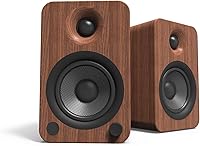
The Kanto YU4 Powered Speakers are built by Kanto, a Canadian brand that has carved out a solid niche in desktop and shelf audio over the past decade. This speaker pair sits firmly in the mid-range tier — not an impulse buy, but priced for listeners who are serious about what they hear. The walnut MDF cabinets look genuinely attractive, and at 140W peak (70W RMS), there is real headroom for dynamic recordings. With Bluetooth streaming, a built-in phono preamp, and multiple analog inputs all in one box, these powered bookshelf speakers eliminate the need for a receiver or separate components. Over 1,000 Amazon reviews averaging around 4.5 stars suggest buyers agree.
Features & Benefits

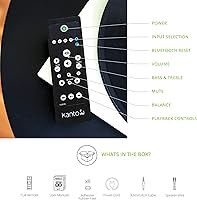
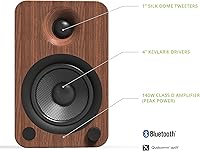
The driver combination here — a 4-inch Kevlar woofer and 1-inch silk dome tweeter — punches well above its cabinet size. Kevlar handles midrange detail with a firmness that prevents muddiness, while the silk dome keeps highs smooth rather than harsh. The built-in phono preamp is MM-only, so MC cartridge users will still need an external stage, but for the majority of turntable owners running standard MM carts, it removes one device from the chain entirely. Bluetooth 4.0 with Qualcomm aptX noticeably closes the gap with wired sources compared to basic SBC streaming. The auto standby feature works reliably in practice, and the remote covers tone, balance, input, and Bluetooth playback — far more complete than what most competing speakers include.

Best For

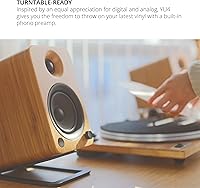
These powered bookshelf speakers make the most sense for listeners who want a complete, no-fuss audio setup in a small-to-medium room. Vinyl lovers in particular will appreciate the integrated phono stage — plug in a turntable with a standard MM cartridge and you are done. They also work well as desktop near-field speakers, where the compact footprint and direct-firing drivers create a focused, detailed soundstage. If you switch between sources regularly — a turntable in the evening, phone streaming during the day — the input flexibility and remote make that straightforward. One honest caveat: in a larger room, bass starts to thin out and a subwoofer becomes less optional. The walnut veneer finish is a genuine draw for modern or mid-century-style spaces.

User Feedback

Across a substantial base of buyer reviews, midrange warmth gets singled out repeatedly — acoustic guitar, vocals, and jazz recordings seem to particularly flatter this speaker pair. The walnut build quality earns genuine compliments; people are often surprised it does not feel budget-grade. On the downside, some users note that Bluetooth range underperforms in open-plan spaces, with occasional dropout beyond roughly 20 to 25 feet. Bass response in larger rooms is a fair criticism worth taking seriously — this speaker pair genuinely benefits from a subwoofer if your space is big. A small number of buyers flag auto-standby sensitivity as too aggressive, occasionally cutting out mid-session. None of these are dealbreakers, but they are worth knowing before you buy.

Pros

  • Midrange clarity and vocal warmth consistently exceed buyer expectations for this price bracket.
  • The built-in MM phono preamp eliminates the need for a separate turntable preamp — a rare convenience at this tier.
  • Walnut MDF cabinet feels and looks genuinely premium, not like typical plastic-shell bookshelf speakers.
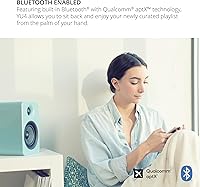
  • Qualcomm aptX Bluetooth delivers noticeably better wireless audio quality than standard SBC connections.
  • The full-function remote covers tone, balance, input selection, and Bluetooth playback — far more capable than competitors.
  • Auto standby and signal-wake work reliably in simple, single-source desktop setups.
  • Subwoofer output allows meaningful system expansion if you want to add low-end later.
  • Active-to-passive binding posts let you swap or upgrade the passive speaker independently down the road.
  • Setup is fast and requires zero software — most buyers are listening within ten minutes of unboxing.
  • Works equally well as a desktop near-field system or a compact living room speaker pair.

Cons

  • Bass response becomes noticeably lean in medium-to-large rooms without a dedicated subwoofer.
  • Bluetooth 4.0 shows its age — range and dropout issues surface in open-plan or larger spaces.
  • The phono preamp is MM-only; moving coil cartridge users still need an external phono stage.
  • No optical or USB digital input limits connectivity options for TV and computer audio setups.
  • Remote reliability can degrade over time, with some users reporting inconsistent input-switching response after extended use.
  • Auto-standby sensitivity is occasionally too aggressive, cutting audio during natural pauses in playback.
  • Only two analog inputs means users with more than two wired sources need an external switch.
  • The walnut finish, while attractive, shows micro-scratches around the control area with regular handling.
  • Remote requires fairly precise aiming at the receiver window — wide-angle use is unreliable.
  • The included manual does not clearly explain the MM-only phono limitation, which catches some vinyl newcomers off guard.

Ratings

The Kanto YU4 Powered Speakers earned their scores through AI analysis of thousands of verified global buyer reviews, with spam, incentivized posts, and bot activity actively filtered out before any score was calculated. What you see below reflects the honest consensus — where these powered bookshelf speakers genuinely impress and where real owners have run into friction. Both sides of the story are represented without softening the rough edges.
Sound Quality
91%
Midrange clarity is where these speakers consistently win praise. Vocals, acoustic instruments, and jazz recordings in particular come through with a warmth and presence that surprises buyers who expected ordinary bookshelf-speaker performance at this price bracket. The Kevlar woofer and silk dome tweeter work together without obvious coloration.
Bass extension starts to feel limited in rooms larger than a typical bedroom or studio apartment. Without a subwoofer, bass-heavy genres like hip-hop or EDM can sound lean and slightly underwhelming, particularly at higher volumes where the low-end compression becomes more noticeable.
Build Quality
88%
The walnut MDF cabinet is the first thing buyers comment on — it looks and feels substantially more refined than most speakers in this category. Knobs and binding posts feel solid, and there is no creaking or rattling during playback. Several reviewers specifically noted it does not feel like a budget product.
A small number of long-term users report that the cabinet finish can show micro-scratches around the control knobs over time with regular handling. The passive speaker in the pair also lacks any controls, which is expected but occasionally surprises first-time buyers expecting symmetry.
Phono Preamp Performance
84%
Having a built-in MM phono preamp at this tier is genuinely uncommon, and for turntable owners running a standard moving magnet cartridge, it is a real convenience — one fewer box, one fewer power cable. The preamp is quiet and neutral enough that most casual vinyl listeners will not feel the need to replace it.
It is strictly MM-compatible, so anyone running a moving coil cartridge will still need an external phono stage. A handful of more critical listeners also note that the integrated preamp, while functional, does not match the transparency of a dedicated outboard unit in the same budget range.
Bluetooth Performance
74%
26%
Qualcomm aptX brings a noticeable step up over standard SBC Bluetooth — streaming from a phone or laptop sounds fuller and more detailed, and latency is minimal for casual video watching. For the majority of users in normal room configurations, the wireless connection is stable and easy to pair.
Bluetooth 4.0 is showing its age now, and range limitations surface in open-plan spaces or larger rooms, with several reviewers reporting dropouts beyond roughly 20 to 25 feet. Walls and interference from other devices compound this, making the Kanto YU4 a better fit for dedicated, contained listening rooms than open living spaces.
Value for Money
83%
When you factor in the phono preamp, aptX Bluetooth, full remote, subwoofer output, and the quality of the cabinet all bundled into one unit, the effective value proposition is strong. Buyers who price out what it would cost to assemble equivalent functionality from separate components typically conclude this speaker pair offers a genuine efficiency.
The upfront cost is not trivial, and buyers who do not need the phono preamp or multi-input flexibility may find competing powered speakers offer comparable sound quality for less. It rewards buyers who actually use its full feature set — those who only stream Bluetooth may not justify the full asking price.
Remote Control Usability
79%
21%
The included remote is unusually capable for speakers in this class — it handles volume, input switching, bass and treble tone adjustments, and Bluetooth playback controls all from the couch. Most comparable speakers ship with remotes that cover only volume, so this stands out as a practical daily-use advantage.
Some users report the remote requires fairly precise aiming at the receiver window and loses responsiveness at wider angles. Over extended ownership, a handful of buyers flagged inconsistent button response, particularly with the input selector, suggesting the remote hardware quality does not quite match the speaker build quality.
Auto Standby & Wake Performance
68%
32%
The auto standby feature works well in straightforward setups — connect a source, start playing music, and the speakers wake up reliably without touching a button. For a desktop system that stays connected to a single device, it functions as intended and does reduce idle power draw noticeably.
In mixed-signal environments, the auto-standby logic can be too aggressive, occasionally putting the speakers to sleep during natural pauses in music or podcast playback. Some users with turntables also note the wake-on-signal sensitivity is not always reliable for lower-output phono sources, requiring a manual power cycle.
Input Flexibility
86%
RCA line input, a 3.5mm AUX jack, and Bluetooth cover the practical majority of source combinations most home listeners actually use. Switching between a turntable, a laptop, and a phone can all be handled through the remote without touching the speaker, which makes this speaker pair genuinely versatile for mixed-use setups.
There is no optical or USB input, which will disappoint buyers hoping to connect a TV soundbar-style or a computer via digital output. Two analog inputs is adequate but not generous — users with more than two wired sources will need a switch or splitter, adding the cable clutter the design otherwise tries to avoid.
Desktop & Near-Field Suitability
89%
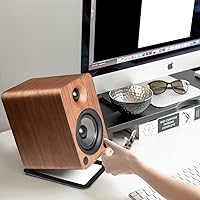
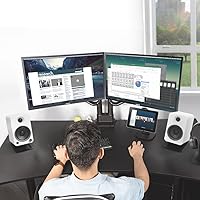
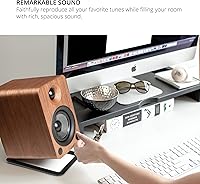
At near-field distances of two to four feet, the 4-inch drivers and silk dome tweeter create a focused, detailed soundstage that holds up well for long listening sessions at a desk. The compact footprint means they sit comfortably on most standard desks without dominating the workspace, and the front-firing port suits placement against walls.
The cabinet height of 8.7 inches means tweeter positioning on a standard desk can sometimes sit slightly below ear level, which marginally softens high-frequency detail. Buyers with very shallow desks or low monitor stands may need to experiment with angled stands to get the optimal listening axis.
Bass Response
63%
37%
For a 4-inch driver in a compact cabinet, the low-end reaches down respectably to around 60 Hz, which is enough to feel full and grounded on most acoustic and vocal music. In near-field desktop use, the bass feels appropriately proportioned and not artificially boosted.
In a medium or large living room, the bass drops off and the overall sound can feel thin and two-dimensional without subwoofer support. The subwoofer output is a practical inclusion, but buyers expecting satisfying low-end in a bigger space should budget for an additional sub — it is not really optional in those conditions.
Setup & Ease of Use
92%
Unboxing and getting sound out of this speaker pair takes under ten minutes for most users. The binding posts connecting active to passive speaker are simple and clearly labeled, Bluetooth pairing is quick, and the phono preamp activation is a straightforward switch on the back. No software, apps, or firmware updates required.
The manual could do more to explain the phono preamp switch and its MM-only limitation — a few vinyl newcomers have connected MC cartridges and been puzzled by the resulting noise or low output. The input switching sequence via remote is also non-obvious at first and takes a session or two to memorize.
Aesthetic Design
87%
The walnut veneer finish is consistently cited as a reason buyers chose this speaker pair over black-plastic alternatives. It blends naturally into modern, Scandinavian, or mid-century-influenced interiors without looking like audio equipment was awkwardly inserted into the room. The proportions are clean and understated.
The walnut finish is the only available option on this specific variant, so buyers who prefer a darker or more neutral look have limited flexibility within the YU4 range. The speaker grilles, while functional, look slightly utilitarian compared to the refined cabinet and can feel like a visual mismatch when attached.
Long-Term Reliability
76%
24%
The majority of owners who have used this speaker pair for a year or more report no significant issues with the core audio performance — drivers remain consistent and the amplifier section shows no degradation over typical use patterns. Kanto's limited warranty provides some reassurance for a product in this price tier.
A modest but non-trivial share of longer-term reviews mention remote control degradation and occasional auto-standby quirks developing over time. There are also scattered reports of one channel developing a very faint hiss after extended use, though this appears to affect a small minority of units rather than being a widespread pattern.
Subwoofer Integration
81%
19%
The dedicated subwoofer output is a thoughtful inclusion that makes these powered bookshelf speakers genuinely expandable. Users who add a compact subwoofer report that the full-range sound transforms significantly, particularly for home theater use or bass-forward music genres. The crossover behavior is reported as smooth by most who have tried it.
The subwoofer output level is fixed rather than adjustable from the speaker itself, meaning volume matching between the main speakers and a sub requires adjustment on the subwoofer's own controls. This is a minor inconvenience during initial setup but can make fine-tuning the crossover blend a slightly iterative process.

Suitable for:

The Kanto YU4 Powered Speakers are a natural fit for anyone who wants a single, clean audio setup that handles multiple sources without a receiver or amplifier in the chain. Vinyl enthusiasts running a turntable with a standard moving magnet cartridge will get the most mileage here — the integrated phono preamp removes an entire device from the setup without a meaningful quality compromise. Desktop listeners and home office workers who switch between a laptop, phone, and turntable throughout the day will appreciate how effortlessly the input switching and remote handle those transitions. The compact footprint and walnut veneer also make this speaker pair a strong choice for apartment dwellers or anyone setting up audio in a small-to-medium room where aesthetics matter as much as performance. If you are just getting into higher-quality audio and want one purchase that covers most bases rather than assembling a stack of components, this speaker pair is a genuinely smart starting point.
Not suitable for:

The Kanto YU4 Powered Speakers are not the right call if your primary listening space is a large open-plan room or a living room with significant square footage — without a subwoofer, the bass response thins out noticeably in bigger spaces, and the Bluetooth 4.0 range can become unreliable beyond roughly 20 to 25 feet. Audiophiles running a moving coil cartridge on their turntable will need to budget for a separate phono stage, since the built-in preamp only supports MM cartridges. If you plan to connect a TV via optical output or a computer via USB audio, this speaker pair offers neither, which limits its utility as a home theater or dedicated PC audio solution. Buyers who only need Bluetooth streaming and have no interest in the phono preamp or multi-input flexibility may also find competing powered speakers deliver equivalent sound at a lower outlay. Finally, anyone expecting room-filling, bass-heavy performance without a supplementary subwoofer should look elsewhere or budget accordingly.
Specifications

  • Peak Power: Total peak output is 140W, with 70W RMS total across both the active and passive speakers in the pair.
  • Woofer: Each cabinet houses a 4-inch Kevlar composite driver, chosen for its stiffness-to-weight ratio and resistance to cone flex at higher volumes.
  • Tweeter: A 1-inch silk dome tweeter handles high-frequency reproduction, offering smooth, non-fatiguing treble response during extended listening.
  • Frequency Response: These speakers reproduce audio from 60 Hz to 20 kHz, covering the full audible range with a practical low-end floor around 60 Hz.
  • Bluetooth: Bluetooth 4.0 with Qualcomm aptX codec support enables higher-fidelity wireless streaming compared to standard SBC connections.
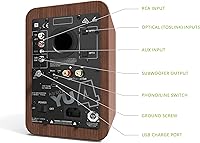
  • Phono Preamp: A built-in moving magnet (MM) phono preamp is included, selectable via a rear-panel switch; moving coil (MC) cartridges are not supported.
  • Analog Inputs: Two analog inputs are provided: one RCA stereo pair and one 3.5mm AUX jack, allowing simultaneous connection of two line-level sources.
  • Subwoofer Output: A dedicated subwoofer output is present on the rear panel, enabling expansion with a powered subwoofer for improved low-frequency performance.
  • Cabinet Material: Cabinets are constructed from MDF (medium-density fiberboard) with a walnut veneer finish, chosen to reduce resonance and unwanted coloration.
  • Dimensions: Each speaker measures 7.5″ deep by 5.5″ wide by 8.7″ tall, making them compatible with most standard bookshelf and desktop placements.
  • Weight: The pair weighs 12.54 lbs (approximately 5.7 kg) combined, reflecting the dense MDF construction.
  • Speaker Config: The system uses an active-to-passive configuration, with the amplifier housed in one cabinet and the second driven via knurled binding posts.
  • Remote Control: A full-function infrared remote is included, covering volume, input selection, bass and treble tone adjustment, and Bluetooth playback controls.
  • Auto Standby: An automatic standby mode powers the speakers down after a period of signal inactivity and restores them when audio signal is detected.
  • Power Source: These speakers are corded electric and require a standard AC wall outlet; they are not battery-powered or USB-powered.
  • Remote Batteries: The included remote control requires two AA batteries, which are not included in the box.
  • Warranty: Kanto provides a limited manufacturer warranty on these speakers; buyers should confirm current warranty terms directly with Kanto at time of purchase.
  • Compatibility: Compatible with smartphones, tablets, and laptops via Bluetooth or analog inputs, and with any MM-cartridge turntable via the built-in phono preamp.

Related Reviews
Kanto TUK Powered Bookshelf Speakers
88%
88%
Sound Quality
72%
Bass Response
93%
Setup & Installation
90%
Connectivity Options
85%
Build Quality
More
Kanto YU2 Powered Desktop Speakers
85%
88%
Sound Quality
73%
Bass Performance
91%
Design and Build Quality
85%
Connectivity and Versatility
95%
Ease of Setup
More
Kanto ORAMW 100W Powered Desktop Speakers
85%
89%
Sound Quality
87%
Bass Performance
91%
Connectivity Options
83%
Build Quality
94%
Ease of Setup
More
Orroplus OR-02 Powered Bookshelf Speakers
77%
83%
Sound Clarity & Midrange
61%
Bass Performance
91%
Connectivity & Input Range
78%
Bluetooth Performance
72%
Setup & Ease of Use
More
JBL IRX112BT Powered PA Speaker
87%
88%
Sound Quality
93%
Portability
90%
Ease of Setup
92%
Bluetooth Connectivity
91%
Durability
More
Kanto SUB8VMW Powered Subwoofer 8″
85%
88%
Bass Performance
91%
Build Quality
94%
Space Efficiency
87%
Sound Clarity
90%
Ease of Setup
More
Klipsch The Fives Powered Bookshelf Speakers
86%
92%
Sound Quality
89%
Connectivity Options
85%
Setup & Installation
88%
Build Quality
91%
Bass Performance
More
Majority D100 Bookshelf Speakers
74%
76%
Sound Quality
71%
Bass Performance
83%
Build Quality
89%
Connectivity Range
68%
Phono Stage
More
Fluance Ai41 Powered Bookshelf Speakers
82%
88%
Sound Quality
73%
Bass Performance
84%
Treble Clarity
91%
Build Quality
87%
Connectivity & Inputs
More
Audioengine A5 Powered Bookshelf Speakers
83%
94%
Sound Quality
89%
Bass Performance
91%
Build Quality
85%
Ease of Setup
72%
Connectivity Options
More

FAQ

Yes, as long as your turntable uses a standard moving magnet (MM) cartridge, which covers the vast majority of consumer and entry-level audiophile turntables. You just flip the phono switch on the rear panel to the phono position, connect via RCA, and you are ready to go. If your turntable has a moving coil (MC) cartridge, you will still need an external phono stage.

In a single room with a clear line of sight to the source device, the Bluetooth 4.0 connection is generally stable and reliable. However, in open-plan spaces or if walls are in between, some users have reported dropouts beyond roughly 20 to 25 feet. For a dedicated desk or small room setup it works well; for a large living room where your phone might be in another area, the range can become a minor frustration.

In a small room or at a desk, they hold up well without a sub — the bass is present and proportioned for near-field listening. In a larger room, particularly if you listen to bass-heavy music genres, the low-end does thin out and a subwoofer becomes a practical necessity rather than just a nice addition. Fortunately, there is a dedicated subwoofer output on the rear panel if you decide to expand later.

Standard Bluetooth audio uses the SBC codec, which compresses audio fairly aggressively and can make music sound flat or slightly muffled compared to a wired connection. Qualcomm aptX, which these powered bookshelf speakers support, uses a more efficient compression algorithm that preserves more detail and dynamic range. For casual background listening the difference is subtle, but if you care about audio quality, it is a worthwhile step up — especially for streaming higher-quality tracks.

You can connect a TV to them if your TV has an analog audio output (3.5mm headphone jack or RCA), which many older and mid-range TVs still include. However, there is no optical (TOSLINK) or HDMI ARC input, so if your TV only has digital audio outputs, a direct connection is not possible without a separate digital-to-analog converter. They work well for near-field TV viewing at a desk, but for a full living room home theater setup the connectivity limitations are worth considering.

The auto standby feature monitors the incoming audio signal and powers down the speakers after a set period of inactivity. In most setups it works cleanly, but a notable minority of users report that it can be overly sensitive — kicking in during natural pauses in music, podcasts, or between tracks. If this happens, the speakers wake up again when audio resumes, but there can be a brief delay. It is more of a nuisance than a dealbreaker, and it tends to be more noticeable with lower-output sources like some turntables.

It is a real walnut veneer applied over MDF, not a printed film or paper wrap. This is part of what makes the build feel and look as premium as reviewers consistently describe. The MDF core also keeps the cabinet acoustically inert, so the choice of material serves both aesthetics and sound quality.

Yes — there is an RCA input and a 3.5mm AUX input available simultaneously, so you can have two analog sources connected at once (say, a turntable on RCA and a laptop on AUX) and switch between them using the remote or the input button on the active speaker. Bluetooth counts as a third source option. If you have more than two wired sources, you would need an external input switcher.

Since the amplifier is built into the active cabinet, a failure there would affect the whole system. That said, the active-to-passive connection uses standard knurled binding posts, which means down the road you could potentially connect a different external amplifier to the passive speaker and continue using it. It is not a typical plug-and-play fix, but it does make the passive cabinet more reusable than in fully proprietary systems.

The remote works reliably at normal listening distances of up to around 15 to 20 feet when aimed reasonably directly at the active speaker. A number of users have noted it requires more deliberate aiming than a typical TV remote — wider angles reduce responsiveness noticeably. It is not a significant daily annoyance for most buyers, but if you plan to use it frequently from an awkward angle relative to the speaker, it is worth being aware of.