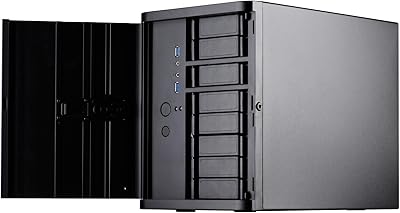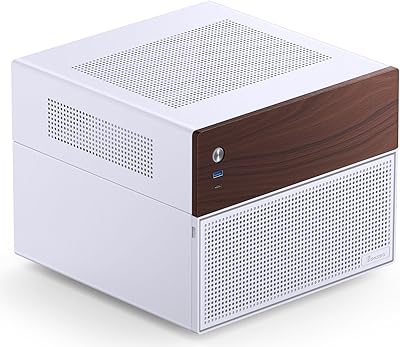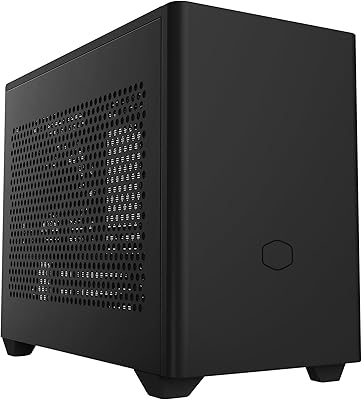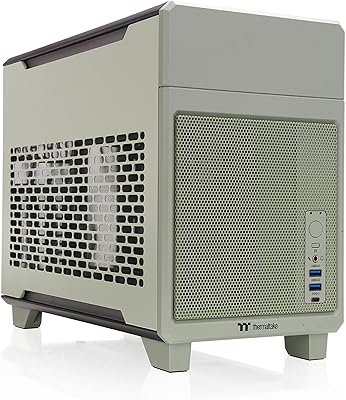
Overview

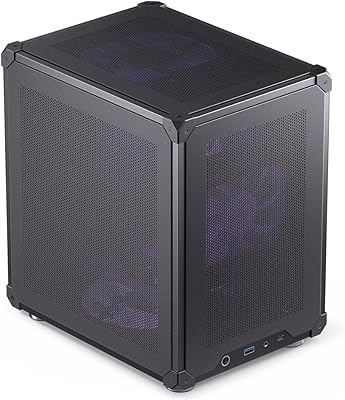
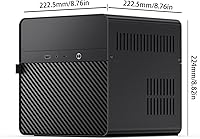
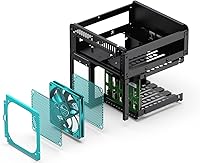
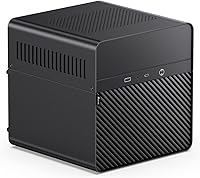
The Jonsbo N2 Mini-ITX NAS Case is a compact aluminum chassis aimed squarely at home lab builders who want real storage capacity without dedicating a rack to it. At roughly 222 x 222 x 224mm, it barely takes up more desk space than a thick hardcover book. This compact home server case sits in a practical middle ground between cheap plastic enclosures and expensive purpose-built NAS appliances — and it ships with a 120mm rear fan included, so you are not immediately sourcing extra hardware after unboxing. The all-aluminum body gives it a noticeably solid, rigid feel that distinguishes it from similarly priced plastic rivals at first touch.

Features & Benefits

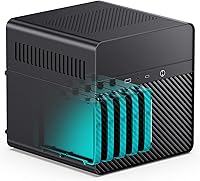
Pack five 3.5-inch drives and one 2.5-inch SSD into this mini-ITX NAS chassis and you have a genuinely useful local storage pool — enough for a Plex library, offsite backups, and a dedicated boot drive without compromise. The SFX PSU slot accepts units up to 150mm, which covers most compact power supplies on the market. Cable management is tight inside, but the removable upper cover genuinely helps during the build — pull it off, lay everything out, and route cables before locking the lid down. The front panel includes USB 3.2 Gen 2 Type-C alongside a USB 3.0 port and combo audio jack. The 65mm CPU cooler height limit is a real constraint worth planning around before you buy.

Best For

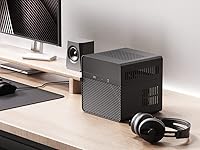
This compact home server case makes the most sense for technically confident builders who want to run TrueNAS, Unraid, or a Proxmox home lab without owning a full tower or rack unit. If you are migrating away from a locked-down NAS appliance and want freedom to swap hardware, install a low-profile GPU for light transcoding, or run a full desktop OS alongside your storage, the N2 enclosure fits that brief well. The near-cube footprint means it can live on a shelf or beside a monitor without dominating the workspace. Just go in knowing that low-profile coolers and SFX-only power supplies are non-negotiable hardware choices for this build path.

User Feedback

Buyers consistently single out the build quality as a genuine strength — the aluminum construction feels noticeably more substantial than competing plastic cases, and most report that panels align cleanly out of the box. Recurring complaints tend to cluster around two areas: the 65mm CPU cooler ceiling catches builders off guard if they did not plan their parts list carefully, and cable routing inside the cramped interior takes real patience. A number of users note the included fan is serviceable but audible under load, prompting swaps to quieter aftermarket options. Reports of drive vibration or resonance with multiple spinning hard drives installed are worth monitoring if you plan on running a full five-bay array continuously.

Pros

  • Aluminum construction feels noticeably more solid and premium than plastic cases at a comparable price point.
  • Five 3.5-inch bays plus one 2.5-inch slot offer real storage density without requiring a full tower footprint.
  • Near-cube dimensions make it one of the more desk- and shelf-friendly multi-bay ITX cases available.
  • A 120mm fan is included out of the box, which cuts down on the parts list for a basic build.
  • The removable upper cover makes drive installation and initial cable routing far less frustrating than sealed designs.
  • Front USB 3.2 Gen 2 Type-C adds modern connectivity that many competing cases at this tier skip.
  • Full aluminum body contributes to passive heat dissipation alongside the active rear fan cooling.
  • The N2 enclosure supports a low-profile GPU up to 197mm, giving Plex builders a viable transcoding option.
  • SFX PSU compatibility keeps the internal layout organized and leaves more room for drive cabling.
  • Build quality consistency is well-regarded across user reports, with panels aligning cleanly on most units.

Cons

  • The 65mm CPU cooler height limit is a hard constraint that requires careful parts selection before purchasing a cooler.
  • Cable management inside the chassis is genuinely cramped with five drives and their power leads installed simultaneously.
  • The included fan is adequate at idle but audible enough under load that many builders replace it with a quieter alternative.
  • Multiple spinning hard drives can introduce noticeable vibration and low-frequency resonance that the aluminum body transmits fairly efficiently.
  • Only SFX power supplies are supported, which can add cost if you do not already own one.
  • Occasional reports of standoff alignment issues suggest tolerances are not perfectly consistent across every unit produced.
  • No integrated drive vibration dampening means noise management depends entirely on the drives and mounting hardware you choose.
  • The low-profile GPU restriction eliminates most mid- and high-performance graphics cards, limiting compute-heavy workloads significantly.

Ratings

The Jonsbo N2 Mini-ITX NAS Case earns a nuanced scorecard based on AI analysis of verified buyer reviews collected globally, with spam, bot-generated, and incentivized submissions actively filtered out before scoring. This compact home server case attracts a technically literate audience, which means the feedback is unusually detailed and candid — both the genuine strengths and the recurring frustrations are reflected accurately in the scores below.

Build Quality
91%
The all-aluminum construction earns consistent praise from builders who have handled budget plastic cases before — the body feels solid, panels align without flex, and the overall fit and finish is noticeably above what the price tier typically delivers. Users frequently describe it as feeling closer to a boutique SFF case than a mass-market product.
A minority of buyers report minor standoff alignment inconsistencies that require patience during motherboard installation. While not a widespread manufacturing defect, it suggests quality control tolerances are not perfectly uniform across every unit produced.
Storage Density
93%
Fitting five 3.5-inch drives plus a dedicated 2.5-inch SSD into a chassis roughly the size of a cube is the core reason most buyers choose this enclosure. Home Plex servers, Unraid arrays, and TrueNAS pools all benefit from this bay count without requiring a tower footprint.
With all five bays occupied by large-capacity spinning drives, power cable routing becomes noticeably congested. The density that makes this case appealing is the same reason the internal volume feels cramped once everything is installed.
Cable Management
54%
46%
The removable upper cover genuinely helps during the initial build, giving builders clearer access to route cables before closing everything up. Builders who plan their cable runs carefully and use right-angle SATA connectors report a manageable, if tight, final result.
This is the most consistently cited frustration across user feedback. Five drives, their SATA data cables, five power connectors, the motherboard harness, and a GPU all compete for limited space. Builders describe it as one of the most cable-dense ITX builds they have attempted, and the results are rarely tidy.
Cooling Performance
68%
32%
The included 120mm rear fan handles basic workloads adequately, and the aluminum shell contributes passive dissipation that plastic cases simply cannot match. For low-TDP processors running idle NAS workloads, thermal performance is generally reported as satisfactory.
Under sustained load — simultaneous drive access, transcoding, or prolonged CPU activity — the single included fan shows its limits. Many users replace it within the first few weeks of operation, citing audible noise at higher RPMs rather than thermal failure as the primary motivation.
CPU Cooler Compatibility
57%
43%
The 65mm height ceiling is workable for builders who plan around it from the start, and a solid selection of low-profile coolers from established brands fits comfortably. For low-TDP chips common in home server builds, thermal headroom within this constraint is generally adequate.
This limitation catches a meaningful number of buyers off guard, particularly those accustomed to standard tower cooler builds. It is a hard ceiling with no workaround, and it functionally rules out any processor that runs hot under load unless paired with a very efficient low-profile solution.
Noise Level
63%
37%
At idle with a light drive load, the N2 enclosure operates at an unobtrusive background level that most users find acceptable in a home office or living space. The aluminum body does not amplify fan noise the way thin plastic panels can.
Running multiple spinning hard drives simultaneously introduces a low-frequency hum that the rigid aluminum shell transmits more efficiently than dampened plastic alternatives. The stock fan also becomes audible under load, and combined drive spin-up noise during boot is noticeable in quiet environments.
Value for Money
82%
18%
Relative to purpose-built NAS appliances with locked-down hardware, this compact home server case offers substantially more flexibility per dollar. Builders who factor in the included fan and the premium aluminum construction generally consider the price justified against plastic-bodied competitors in the same range.
If your parts list requires an SFX PSU purchase specifically because of this case, the effective cost of entry rises. Buyers already owning an ATX power supply will need to budget for an SFX unit, which adds to the total build cost in a way that is easy to overlook initially.
Assembly Experience
61%
39%
The removable upper cover is a genuine quality-of-life feature that experienced builders appreciate. Drive installation is straightforward in isolation, and the layout is logical enough that anyone comfortable with ITX builds will recognize the workflow quickly.
The combination of tight internal volume, screw-mount drives, and dense cabling makes this one of the more demanding ITX builds in its category. First-time SFF builders will likely find the process frustrating, and even experienced hands report that full population of all five bays takes considerably more time than a typical case.
Front I/O
84%
The inclusion of a USB 3.2 Gen 2 Type-C port on the front panel is a meaningful differentiator at this price point and size class. Paired with a USB 3.0 Type-A port and a combo audio jack, the front panel covers practical daily use without requiring a hub for most setups.
There is no SD card reader, and the single USB 3.0 Type-A port can feel limiting if you regularly connect multiple peripherals directly to the case. Buyers using this as a dual-purpose desktop and server occasionally wish for an additional USB-A port.
Form Factor & Footprint
94%
The near-cube geometry at roughly 222mm on each side is one of the most space-efficient multi-bay ITX enclosures available. It fits naturally on a desk corner, inside a media cabinet, or on a shelf without requiring significant clearance planning around it.
The cube shape, while compact in footprint, does mean the case is taller than some users expect when placed under a monitor. It is not a criticism of the design so much as a reminder that six drives and a full ITX system cannot fully disappear — there is an inherent minimum volume involved.
Drive Vibration Isolation
51%
49%
For users running SSDs exclusively in the 2.5-inch bay alongside a limited number of spinning drives, vibration is rarely reported as a significant concern. Light workloads with one or two HDDs tend not to generate noticeable resonance.
The screw-mount drive trays lack rubber grommets or vibration-dampening inserts by default, and the aluminum body conducts mechanical vibration efficiently. Running a full five-bay array of spinning drives at idle produces a persistent low hum that several users describe as intrusive enough to prompt aftermarket isolation solutions.
GPU Compatibility
66%
34%
The 197mm low-profile GPU clearance opens up a meaningful selection of cards suitable for hardware transcoding — a key use case for Plex builders who want Intel Arc or similar low-profile options installed alongside their storage array.
The low-profile restriction is an absolute ceiling that eliminates virtually every mid-range and high-end graphics card. Builders who need meaningful compute performance alongside storage density will find the GPU options in this form factor genuinely limited and potentially underpowered for demanding workloads.
PSU Compatibility
71%
29%
The SFX standard is well-supported by major PSU brands, and the 150mm length limit accommodates the majority of SFX units currently on the market. Bottom-mount positioning keeps the power supply out of the airflow path and lowers the chassis center of gravity slightly.
Buyers who do not already own an SFX unit face an additional purchase that ATX-based builds avoid. SFX power supplies carry a price premium over equivalent ATX models, and the selection of high-wattage SFX options remains narrower, which can complicate builds with higher power budgets.
Motherboard Fitment
77%
23%
The vast majority of mini-ITX boards install without issue, and the standard ITX mounting layout means most builders can proceed with confidence using any board from major manufacturers. The case does not impose unusual restrictions beyond the ITX form factor itself.
A subset of users reports minor standoff placement inconsistencies that require adjustment during installation. While not common, these fitment edge cases are persistent enough in community feedback to suggest that verifying standoff positions before mounting the board is a worthwhile precaution.

Suitable for:

The Jonsbo N2 Mini-ITX NAS Case is purpose-built for the kind of technically confident home lab builder who has outgrown a pre-built NAS appliance and wants full control over their hardware stack. If you are running Unraid, TrueNAS, or Proxmox on a mini-ITX board and need five 3.5-inch drive bays in a chassis that does not dominate a shelf or desk, this enclosure fits that requirement directly. It also works well for Plex server builders who want local storage density alongside a low-profile GPU for hardware transcoding, all within a footprint roughly the size of a cube. People with limited workspace who still want meaningful redundancy — think a home office corner, a living room media cabinet, or an apartment desk — will appreciate how little floor and shelf space this chassis actually consumes. Anyone comfortable speccing low-profile coolers and SFX power supplies as part of a deliberate build plan will find the constraints here manageable rather than frustrating.

Not suitable for:

The Jonsbo N2 Mini-ITX NAS Case is a poor match for builders who want to drop in a standard ATX tower cooler or a full-height GPU and call it done — the 65mm CPU height ceiling and low-profile-only GPU slot are persistent design boundaries, not edge cases. If you are planning to run a thermally demanding processor at full sustained load, the limited cooler clearance will force you into a narrow selection of low-profile options that may not satisfy your cooling headroom. Builders who prefer ATX or Micro-ATX motherboards are simply out of luck, as only mini-ITX boards fit. Anyone expecting a spacious interior for easy cable management will find the tight volume genuinely challenging, particularly with five drives and their associated power cables installed. If a quiet, vibration-free environment is critical — say, a bedroom or a recording space — running multiple spinning hard drives in this compact aluminum enclosure may introduce more noise and resonance than you are willing to tolerate.

Specifications

  • Dimensions: The chassis measures 222.5 x 222.5 x 224mm (W x D x H), forming a near-perfect cube that keeps its desk or shelf footprint minimal.
  • Material: The entire outer body is constructed from aluminum, which contributes to structural rigidity and passive thermal dissipation.
  • Drive Bays: The enclosure accommodates five 3.5″ hard drives and one dedicated 2.5″ SSD bay for a combined total of six storage devices.
  • Motherboard: Only Mini-ITX form factor motherboards are supported; Micro-ATX and larger boards will not fit the chassis.
  • CPU Cooler: Maximum CPU cooler height is strictly 65mm, requiring low-profile cooler selection during parts planning.
  • PSU Support: The power supply bay accepts SFX form factor units with a maximum length of 150mm, mounted at the bottom of the chassis.
  • GPU Clearance: A single low-profile expansion card up to 197mm in length is supported via the PCI slot.
  • Included Fan: A 120mm rear exhaust fan is included in the box and serves as the primary active cooling component.
  • Front I/O: The front panel provides one USB 3.2 Gen 2 Type-C port, one USB 3.0 Type-A port, and one combined headphone and microphone audio jack.
  • PCI Expansion: One low-profile PCI expansion slot is available, with a maximum card length of 197mm.
  • Cooling Method: Cooling is handled through active air circulation via the included rear fan, supplemented by the aluminum shell's passive heat transfer.
  • Case Weight: The assembled chassis weighs approximately 3.65kg without components installed, reflecting the all-aluminum construction.
  • Color: The N2 is available in black, with a uniform matte finish across the aluminum panels.
  • PSU Mount: The power supply is mounted at the bottom of the case, helping lower the center of gravity and keeping the internal layout organized.
  • Upper Cover: The integrated upper cover is fully removable, which simplifies drive installation and cable routing during the build process.

Related Reviews
Jonsbo N1 Mini-ITX NAS Case
75%
93%
Build Quality
88%
Hot-Swap Functionality
91%
Storage Capacity Design
54%
PSU Compatibility
58%
CPU Cooler Clearance
More
SilverStone DS380B Mini-ITX NAS Case
69%
93%
Drive Bay Capacity
88%
Hot-Swap Functionality
76%
Build Quality
41%
Cable Management
57%
Thermal Performance
More
JONSBO N3 Mini-ITX NAS PC Chassis
82%
88%
Build Quality
84%
Cooling Performance
90%
Ease of Assembly
87%
Space Efficiency
82%
Storage Flexibility
More
Jonsbo N4 NAS PC Case
73%
83%
Build Quality
91%
Aesthetic Design
88%
Storage Flexibility
84%
Hot-Swap Functionality
47%
CPU Cooler Clearance
More
Cooler Master NR200 Mini-ITX Case
85%
91%
Build Quality
88%
Cooling Performance
94%
GPU Compatibility
84%
Ease of Assembly
86%
Airflow Efficiency
More
SilverStone Technology SG13P Mini-ITX Case
85%
89%
Build Quality
87%
Cooling Performance
91%
Storage Flexibility
95%
Size & Portability
65%
Cable Management
More
Thermaltake TR100 Mini-ITX SFF Case
77%
91%
Component Compatibility
78%
Build Quality
86%
Value for Money
67%
Thermal Performance
72%
Cable Management
More
AUDHEID K3 4-Bay Mini-ITX NAS Case
70%
83%
Build Quality
78%
Value for Money
81%
Drive Compatibility
67%
Thermal Performance
54%
Cable Management
More
Cooler Master NR200P V3 Mini-ITX Case
79%
88%
Build Quality
93%
GPU Compatibility
79%
Cooling Performance
74%
Ease of Building
82%
PCIe 5.0 Riser Cable
More
Jonsbo C6 Mini MATX Mesh PC Case
84%
91%
Airflow Performance
95%
Ease of Assembly
87%
Build Quality
88%
Cooling System Customization
65%
Cable Management
More

FAQ

No. The maximum CPU cooler height is 65mm, so standard tower coolers are out. You will need a low-profile cooler specifically designed for compact builds — options from Noctua, Thermalright, and ID-Cooling all have models that fit within this limit. It is worth sorting your cooler compatibility before finalizing any other parts.

Only Mini-ITX boards fit. The internal tray is sized specifically for the ITX standard, so anything larger simply will not mount correctly. If your preferred board is Micro-ATX, this chassis is not the right fit.

No, the case does not include a PSU. You will need to source a separate SFX unit with a maximum length of 150mm. Most mainstream SFX power supplies from Corsair, SeaSonic, and Silverstone fall within this limit, but always verify the exact length of any unit you are considering before purchasing.

At idle with light loads it is relatively quiet, but under sustained load — say, running a full Plex transcode while spinning up all five drives — a fair number of users find it audible enough to warrant a swap. Replacing it with a quality 120mm fan from Noctua or Be Quiet tends to bring noise levels down noticeably without sacrificing airflow.

Yes, fully. The case itself is OS-agnostic — it is just a chassis. As long as your mini-ITX motherboard is supported by TrueNAS, Unraid, or whichever platform you choose, this enclosure works fine. Many builders run exactly these systems in it.

It is a real consideration. Aluminum is a decent conductor of vibration, and running five spinning 3.5″ drives can introduce a low hum or resonance, particularly at startup when drives spin up together. Some builders add foam or rubber grommets under the drive trays to dampen this. If you are placing this case in a quiet room, it is worth budgeting for basic vibration isolation materials.

Yes, but only a low-profile card up to 197mm in length. That rules out most mid-range and high-end GPUs, but low-profile options from the Intel Arc A310 or older Nvidia GT 1030 range work and are commonly used for this exact purpose in compact home server builds.

It takes patience. The internal volume is tight by design, and with five drives plus their power cables, a GPU, and the motherboard all competing for space, routing cables neatly requires planning. Removing the upper cover before you start and using right-angle SATA connectors helps significantly. It is not a beginner-friendly build experience.

That depends entirely on the drives you choose. With five 3.5″ bays and current consumer hard drive capacities reaching 20TB or more per disk, the theoretical maximum with today's hardware is around 100TB raw across the HDD bays, plus whatever 2.5″ SSD you install. Usable capacity will depend on your RAID or storage pool configuration.

The drives are secured with screws rather than tool-free clips. It is a minor inconvenience during initial setup, but it results in a more secure and vibration-resistant mount compared to plastic tool-free systems — which matters more in a multi-drive NAS context than in a typical gaming build.

Where to Buy