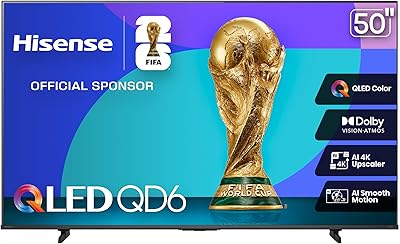

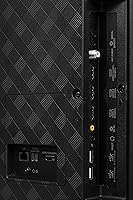
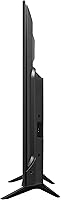
Overview

The Hisense 50U6G1 50-inch 4K QLED Smart TV is one of those sets that quietly challenges the assumption that you need to spend significantly more to get genuinely impressive picture quality. Hisense has spent years building credibility in a space dominated by Samsung and LG, and the U6G1 reflects that steady progress. Launched in 2022, it still holds its ground against newer budget competition. Google TV as the smart platform is a real advantage, bringing a polished, app-rich experience to everyday use. Just be clear going in: this is a strong mid-range performer, not an OLED rival.

Features & Benefits

Quantum Dot technology here means colors look noticeably richer and more saturated than what you get from a standard LCD panel — in practice, things like vivid sports jerseys or sunset landscapes genuinely pop on screen. Hisense's proprietary ULED processing works behind the scenes to sharpen contrast and smooth out motion, which matters most during fast action sequences. The 600-nit peak brightness across 32 full-array local dimming zones is strong for this tier, though sustained brightness under typical viewing conditions sits lower. Dolby Vision handles HDR grading beautifully, and FilmMaker Mode strips away unnecessary post-processing so films look exactly as directors intended. The built-in Atmos audio adds spatial depth, though it cannot replace a proper soundbar.

Best For

This 50-inch smart TV hits a sweet spot for buyers who want QLED-level color performance without stepping into premium pricing territory. It works well as a primary living room screen or a bedroom set where the 50-inch size fills the space comfortably without overwhelming it. Cord-cutters will appreciate the depth of the Google TV app library and Chromecast built-in for effortless casting. If your home already runs on Google Assistant or Amazon Alexa, voice control integration feels natural rather than tacked on. Those who mix streaming, sports, and casual gaming across a single display will find the 50U6G1 handles the variety well, with the caveat that the native 60Hz refresh rate is a real limitation for serious console gamers.

User Feedback

Across owner reviews, color vibrancy and brightness consistently earn the most praise — many buyers coming from older or cheaper sets are genuinely surprised by how vivid the picture looks out of the box. The Google TV interface also gets high marks for being intuitive and quick to navigate. On the downside, some users flag blooming around bright objects in dark scenes, which is a known limitation of LCD local dimming at this price point and worth knowing before you buy. The remote feels plasticky compared to competitors. Built-in sound draws mixed feedback — fine for daytime TV, but thin for movies. A handful of long-term owners mention no significant reliability issues, which is reassuring.

Pros

  • Quantum Dot color technology produces noticeably richer, more saturated images than standard LCD TVs at this price.
  • 600-nit peak brightness makes HDR content look genuinely impactful, especially in moderately lit rooms.
  • Full-array local dimming across 32 zones delivers meaningful contrast improvements over edge-lit alternatives.
  • Dolby Vision support ensures HDR content is tone-mapped accurately across a wide range of streaming sources.
  • Google TV is one of the more polished smart TV platforms available, with fast navigation and a deep app library.
  • Chromecast built-in makes casting from phones, tablets, and laptops effortless without additional hardware.
  • FilmMaker Mode is a genuine differentiator, preserving the director's intended look without artificial processing.
  • Compatible with both Google Assistant and Amazon Alexa, giving voice control flexibility regardless of your smart home setup.
  • Owners consistently report solid reliability with no major hardware issues surfacing in long-term feedback.
  • For the feature set on offer, the price-to-performance ratio is hard to beat in the 50-inch QLED category.

Cons

  • Local dimming blooming is noticeable around bright objects on dark backgrounds, a recurring complaint from owners.
  • The native 60Hz refresh rate is a real limitation for next-gen console gamers expecting smooth 120fps gameplay.
  • Sustained brightness under prolonged HDR scenes drops below the advertised 600-nit peak figure.
  • The included remote feels cheap and plasticky relative to what competitors offer at a similar price point.
  • Built-in speakers lack bass and dynamic range, making a separate soundbar nearly essential for movie watching.
  • No HDMI 2.1 port means advanced gaming features like Variable Refresh Rate at 4K resolution are not supported.
  • As a 2022 model, long-term software support and future OS updates are not guaranteed.
  • Dark scene performance, while improved by local dimming, still trails what premium mini-LED or OLED TVs can achieve.
  • The stand design requires a relatively wide surface, which can be awkward on smaller TV consoles or furniture.
  • Some users report that the Google TV interface occasionally feels sluggish when switching between demanding apps.

Ratings

The scores below for the Hisense 50U6G1 50-inch 4K QLED Smart TV were generated by our AI system after analyzing thousands of verified global buyer reviews, with spam, bot-submitted, and incentivized feedback actively filtered out. Each category reflects the honest consensus of real owners — strengths are credited where earned, and recurring pain points are not glossed over. The result is a transparent, balanced picture of exactly what this 50-inch smart TV delivers in everyday use.

Picture Quality
83%
Owners consistently praise the richness and vibrancy of colors, especially when streaming HDR content from Netflix or Disney+. The Quantum Dot panel makes nature documentaries and animated films look genuinely striking, and Dolby Vision grading is handled accurately across brightness levels.
Dark scene performance is a recurring concern — blooming around subtitles or bright UI elements on a black background is visible in a dimmed room. Sustained brightness during long HDR sequences also drops noticeably below the peak 600-nit marketing figure.
Local Dimming
67%
33%
Having 32 full-array dimming zones is a real advantage over edge-lit TVs in this price range, giving the 50U6G1 noticeably better contrast in mixed-lighting scenes like sunsets or candlelit interiors. Most casual viewers find the overall contrast improvement meaningful during everyday watching.
The zone count is still limited enough that halo blooming appears around isolated bright objects — most noticeably during credits sequences or dark action scenes. Enthusiasts who scrutinize display performance will find this a persistent frustration, even with dimming set to its most aggressive setting.
Color Accuracy
81%
19%
Out-of-the-box color calibration is better than many competing sets at this tier, and FilmMaker Mode in particular gives film purists a reliable starting point without hours of manual adjustment. Quantum Dot coverage means DCI-P3 gamut reproduction is genuinely broad for the price.
The default Cinema and Standard picture modes tend to oversaturate greens and reds slightly, which can make skin tones look unnatural on some content. Users who do not explore the picture settings may never find the modes that show the panel at its best.
Smart TV Platform
88%
Google TV earns consistent praise for its clean content discovery interface, which intelligently surfaces recommendations from across streaming services in a single feed. Voice search through the remote works reliably, and the app library covers every major streaming platform without exception.
A small but consistent group of users reports occasional interface lag when switching between demanding apps or loading the home screen after the TV has been idle. The pre-installed app suggestions on the home screen can feel pushy until they are manually reorganized.
Gaming Performance
54%
46%
The 50U6G1 handles 4K 60fps gaming from a PS5 or Xbox Series X without issue, and input lag in Game Mode is low enough that casual and mid-level gamers will not notice meaningful delays during play. For non-competitive gaming, it covers the basics adequately.
The 60Hz native panel and absence of HDMI 2.1 are hard limitations for anyone who bought a next-gen console specifically for 120fps performance. Variable Refresh Rate support is also absent, which means screen tearing can appear during fast-paced titles that push frame rates inconsistently.
Built-in Audio
58%
42%
For background TV watching, news, and talk shows, the built-in speakers are perfectly serviceable and get loud enough for a mid-sized room. Dialogue clarity is decent at moderate volumes, and most users find it acceptable as a starting point before upgrading.
Bass response is thin and the stereo separation is narrow, which makes action movies and music-heavy content feel flat. Despite Dolby Atmos decoding support, the built-in drivers simply cannot create any sense of spatial audio, and most serious viewers will want a soundbar within the first month.
Brightness & HDR Impact
76%
24%
At 600 nits peak, this 50-inch smart TV delivers HDR highlights that genuinely stand out in a normally lit living room — explosions, sun glare, and bright skies have real pop that budget 300-nit TVs cannot match. Dolby Vision content in particular benefits from the headroom.
The gap between peak and sustained brightness is noticeable during long viewing sessions, where the panel throttles down to protect itself. In very bright rooms with direct sunlight, the screen can still look washed out, and it does not reach the sustained brightness levels of top-tier mini-LED competitors.
Motion Handling
72%
28%
ULED motion processing keeps sports and fast-action content reasonably smooth, and most casual sports viewers find the default motion settings satisfying without needing to dig into the menu. FilmMaker Mode also gives film watchers an easy way to eliminate the soap-opera effect entirely.
At the stronger motion enhancement settings, some artificial judder and edge artifacts appear around fast-moving objects. Turning motion smoothing off entirely can make live sports look choppier than some viewers expect from a 2022 model at this price point.
Build & Design
74%
26%
The slim profile and matte black bezel look clean and modern on a TV stand or wall-mounted above a fireplace. At 35 pounds, it is manageable to handle during installation, and the overall fit and finish looks more premium than the price tag might suggest.
The stand design requires a fairly wide surface and does not offer height adjustment or swivel, which limits placement flexibility. Some owners note that the rear panel feels slightly flimsy compared to comparable TVs from Samsung and Sony at the same screen size.
Remote Control
61%
39%
The voice remote makes initial Google TV setup noticeably easier, and the dedicated streaming app buttons save time for users who rely on a handful of services daily. The layout is logical enough for new users to get comfortable quickly.
The physical quality of the remote is a frequent complaint — it feels lightweight and plasticky in hand compared to remotes bundled with Roku or higher-end Samsung sets. Button feedback is soft and some users find it difficult to distinguish keys by touch alone in a dark room.
Setup & Ease of Use
87%
Google TV guides first-time users through Wi-Fi connection, Google account sign-in, and app installation with a genuinely smooth onboarding process. The majority of owners report being fully set up and watching content within 20 to 30 minutes of unboxing.
Users who do not have a Google account may find the setup flow pushes them toward creating one more aggressively than they would like. A small number of owners also reported issues syncing Alexa during initial setup, requiring a manual workaround through the Alexa app.
Connectivity
82%
18%
The port selection covers most real-world needs: multiple HDMI inputs for consoles and streaming sticks, USB for media drives, and both wired Ethernet and dual-band Wi-Fi for flexible network options. Bluetooth adds wireless headphone or speaker pairing without any extra adapters.
The absence of HDMI 2.1 is the single most consequential connectivity gap for buyers planning to future-proof their setup. Those with older AV receivers may also find that ARC implementation on the HDMI port occasionally requires manual audio format adjustments to work reliably.
Value for Money
86%
When measured against what the 50U6G1 actually delivers — Quantum Dot color, Dolby Vision, full-array local dimming, and Google TV — the overall feature density is hard to match at this price tier. Most owners feel they got meaningfully more TV than they expected for their budget.
The value proposition weakens slightly if you factor in the near-mandatory soundbar purchase that most users end up making. Competing sets from TCL's 6-Series occasionally match or beat it on key specs at similar prices, so the 50U6G1 is not without credible alternatives.
Long-term Reliability
79%
21%
Owner feedback spanning one to two years of use is largely positive, with few reports of panel degradation, backlight failure, or significant software instability over time. Google TV also receives periodic updates that keep the smart platform feeling reasonably current.
As a 2022 model, long-term software support from Hisense is not guaranteed beyond a fixed window, and some owners express concern about how many more major OS updates the platform will receive. A handful of isolated reports mention Wi-Fi connectivity dropping after extended use, requiring router resets.

Suitable for:

The Hisense 50U6G1 50-inch 4K QLED Smart TV is a strong fit for buyers who want genuinely good picture quality without paying flagship prices. Streaming-heavy households will feel right at home with Google TV, which offers a well-organized app library, built-in Chromecast, and responsive voice control through both Google Assistant and Alexa. The 50-inch screen size is versatile enough to serve as a primary living room display in mid-sized spaces or as a premium bedroom TV without feeling oversized. Families who watch a mix of HDR movies, sports, and casual gaming across a single display will find the 50U6G1 covers those bases competently. Anyone already embedded in the Google or Amazon ecosystem will find the smart platform integration feels natural rather than forced.

Not suitable for:

Buyers expecting the deep blacks and infinite contrast of an OLED panel will find the Hisense 50U6G1 50-inch 4K QLED Smart TV falls short of that standard, as LCD-based local dimming simply cannot replicate the pixel-level precision OLED offers. Serious console gamers, particularly those with a PlayStation 5 or Xbox Series X, should think carefully before committing: the native 60Hz refresh rate and lack of HDMI 2.1 mean next-gen performance features like 4K at 120fps are off the table. Dedicated home theater enthusiasts who prioritize audio will almost certainly need to budget for a soundbar, as the built-in speakers lack the depth and clarity that immersive movie watching demands. Those planning to use this TV in a very bright, sun-drenched room should also note that while peak brightness is respectable, sustained brightness under prolonged HDR content may not fully combat strong ambient light. Finally, buyers who want cutting-edge smart TV software should be aware this is a 2022 model, and while Google TV remains capable, it will not receive updates indefinitely.

Specifications

  • Screen Size: The panel measures 49.5 inches diagonally, commonly marketed as a 50-inch class display.
  • Display Tech: Uses QLED technology with Quantum Dot enhancement for wider color gamut coverage compared to standard LCD panels.
  • Resolution: Native 4K Ultra HD resolution (3840 x 2160 pixels) for sharp, detailed images across all content types.
  • Refresh Rate: Native 60Hz panel refresh rate, which is standard for this price tier but a limitation for high-frame-rate gaming.
  • Peak Brightness: Rated at 600 nits peak brightness, which is meaningfully higher than most budget TVs that typically land between 200 and 400 nits.
  • Local Dimming: Full-array local dimming with 32 zones allows independent brightness control across the panel for improved contrast.
  • HDR Support: Supports Dolby Vision, HDR10, and HLG formats, covering the vast majority of HDR content available on streaming platforms.
  • Audio Format: Dolby Atmos decoding is supported, though full spatial audio effect depends on the connected speakers or soundbar rather than the built-in drivers.
  • Output Wattage: Built-in speaker system outputs 160W total, though real-world loudness and clarity are modest relative to that figure.
  • Smart Platform: Runs Google TV, which provides a curated content interface, Google Assistant voice search, and access to thousands of streaming apps.
  • Voice Control: Compatible with both Google Assistant (built-in via voice remote) and Amazon Alexa when connected to an Alexa-enabled device.
  • Casting: Chromecast is built in, allowing direct casting from Android and iOS devices, laptops, and Chrome browsers without additional hardware.
  • Connectivity: Includes HDMI, USB, Bluetooth, dual-band Wi-Fi, and Ethernet ports for flexible wired and wireless device connections.
  • Picture Modes: Includes FilmMaker Mode, which disables motion smoothing and post-processing to preserve the director's intended visual presentation.
  • Dimensions: Set measures 43.9″ wide, 25.4″ deep (with stand), and 3″ in depth, making it a relatively slim profile for wall-mount installations.
  • Weight: The TV weighs approximately 35 pounds, which is manageable for a two-person wall-mounting installation.
  • Color Finish: Available in a matte black finish that minimizes reflections from overhead or side lighting in typical living spaces.
  • Release Year: Originally launched in March 2022, making it a second-generation ULED model that benefited from Hisense's prior U6 series learnings.

Related Reviews
Hisense 43″ E6 QLED 4K Smart TV
76%
88%
Picture Quality
54%
Motion Handling
83%
HDR Performance
67%
Smart TV Interface
58%
Audio Performance
More
Samsung 50-Inch QLED 4K Q80C Series Smart TV
84%
94%
Picture Quality
88%
Sound Quality
91%
Gaming Performance
89%
Value for Money
85%
Smart Features
More
Samsung The Frame LS03F 50-inch QLED TV
77%
91%
Art Mode & Display Illusion
78%
Picture Quality
94%
Design & Aesthetics
58%
Art Store Value
88%
Installation & Setup
More
Hisense 50R7E 50-Inch 4K Roku Smart LED TV
84%
87%
Picture Quality
92%
Roku Streaming Performance
90%
Value for Money
65%
Sound Quality
70%
Brightness in Well-lit Rooms
More
Samsung 50-inch Q7F QLED 4K Smart TV
75%
86%
Picture Quality
78%
HDR Performance
83%
Color Accuracy
61%
Motion Handling
54%
Gaming Performance
More
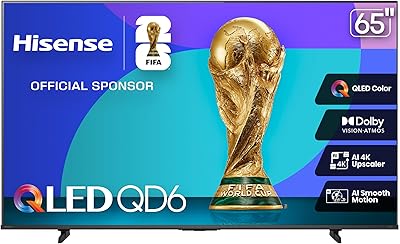
Hisense 50-inch QD6 QLED 4K Smart TV
76%
83%
Picture Quality
78%
Color Accuracy
71%
Motion Handling
76%
Gaming Performance
81%
Smart Platform
More
Hisense 50-inch R6 4K Smart Roku TV
72%
78%
Picture Quality
74%
HDR Performance
51%
Refresh Rate & Motion Handling
91%
Smart Platform (Roku TV)
57%
Audio Performance
More
Samsung 50-inch Q60A QLED TV
75%
88%
Color Accuracy
57%
Contrast & Black Levels
79%
Brightness
71%
4K Upscaling
58%
Motion Handling
More
Hisense 65-inch QD6 QLED 4K Smart TV
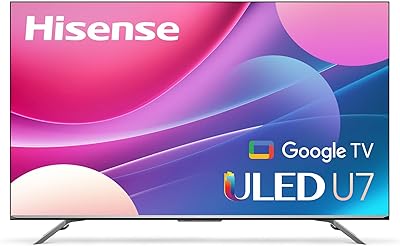
76%
81%
Picture Quality
78%
Brightness & HDR Performance
72%
Motion Handling
76%
Gaming Performance
69%
Smart TV & Interface
More
Westinghouse 50-inch Xumo 4K Smart TV
69%
74%
Picture Quality
61%
Smart Platform (Xumo TV)
83%
Value for Money
52%
Audio Quality
88%
Setup & Ease of Use
More

FAQ

It handles dark-room viewing reasonably well for its price tier, but it is not without limitations. The 32-zone full-array local dimming does a decent job of deepening blacks, though some blooming is visible around bright objects set against dark backgrounds. If you watch a lot of nighttime cinema content, you will notice it more than someone who mainly watches in a bright living room. An OLED would handle dark scenes better, but at a much higher cost.

You can connect either console and they will work fine, but the 50U6G1 has a native 60Hz panel and lacks HDMI 2.1, so you will not be able to run games at 4K and 120fps simultaneously. Most PS5 and Xbox Series X titles can still run at 4K 60fps or 1080p 120fps, which the TV does support. If high-frame-rate gaming is a priority for you, it is worth considering a TV with HDMI 2.1 support instead.

Google TV is generally well-regarded for its content discovery, pulling recommendations from multiple streaming services into a single unified feed. It is arguably more polished than Fire TV and on par with Roku in terms of app availability. If you already use Google services like YouTube or Google Photos, the integration feels natural. One minor note: some users find the interface slightly busier than Roku's cleaner layout, but it is easy to get used to.

For casual daytime TV watching, news, or sitcoms, the built-in speakers are perfectly adequate. But if you plan to watch movies or shows with a lot of dynamic audio — action sequences, music, quiet dialogue followed by loud effects — a soundbar makes a noticeable difference. The built-in drivers lack the bass response and stereo separation to do Dolby Atmos content real justice, even though the TV decodes the format.

FilmMaker Mode turns off motion smoothing, sharpening filters, and other post-processing effects that TVs apply by default. The result is that movies look the way the director and cinematographer intended — with natural motion rather than the artificial soap-opera effect you sometimes get from motion enhancement settings. If you watch a lot of films and find other picture modes look a bit too processed or hyper-real, FilmMaker Mode is worth enabling.

Setup is straightforward. The stand attaches with a few screws, and Google TV walks you through Wi-Fi connection and account sign-in with clear on-screen prompts. Most owners report being up and running within 20 to 30 minutes. The voice remote simplifies the initial setup process further, since you can search for apps or adjust settings without typing manually.

Yes, particularly when it comes to color. Quantum Dot technology allows the panel to reproduce a much wider range of colors than a standard LCD, which is most obvious in vibrant, saturated content like nature documentaries, animated films, and sports. The difference in everyday content like news or sitcoms is subtler, but on HDR-graded streaming content the improvement is clearly visible.

Yes, the 50U6G1 is wall-mountable and uses a standard VESA 200x200mm mounting pattern, which is compatible with a wide range of third-party brackets. At around 35 pounds, a standard fixed or tilting wall mount handles it without issue. Just make sure to check the bracket weight rating before purchasing.

The 50U6G1 supports Chromecast built-in natively, but AirPlay 2 support is not confirmed for this model. Apple device users can still cast content through the YouTube app or use an Apple TV connected via HDMI as an external streaming device, but native AirPlay mirroring from an iPhone or Mac is not a reliable feature on this TV.

At a similar price point, the main competitors are TCL's 5-Series and 6-Series and Samsung's entry-level QLED lineup. The TCL 6-Series often trades blows with this Hisense QLED on local dimming performance and tends to have strong gaming specs. Samsung's entry QLED sets usually cost a little more for the same screen size but offer a more premium remote and the Tizen smart platform. Hisense tends to offer the most features per dollar, though Samsung and TCL have a slight edge in brand-level after-sales support in many markets.