Overview

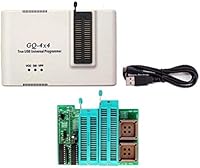
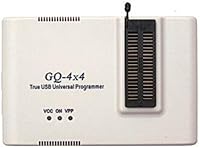
The GQ Electronics GQ-4X4 Universal EPROM Programmer is a serious piece of kit developed by MCUmall Electronics in Canada — a company with genuine credibility in the chip programming space. EPROMs are erasable programmable read-only memory chips, and a dedicated programmer is what lets you read, write, or back up their contents reliably. This USB EPROM programmer is built around a 40-pin ZIF socket, which handles a broad range of chip packages, and it ships with a 16-bit EPROM adapter already included — not sold separately. At its price point, this is clearly a tool aimed at people who need it to actually work, not casual experimenters dipping a toe in.
Features & Benefits

One of the strongest arguments for this chip programmer is connectivity: pure USB, no parallel port adapter required, which matters on any modern workstation. Beyond that, what stands out is the breadth of supported chip families — covering common 27C series chips through to more specialized variants found in legacy hardware. The bundled 16-bit adapter extends that coverage without hunting down accessories separately. Software updates are free for life, the interface supports 14 languages, and the manufacturer runs an active technical forum where you can get real answers before or after purchase. That last point is genuinely unusual in this niche and worth weighing seriously when choosing between competing programmers.

Best For

The GQ-4X4 fits neatly into a few specific hands. Retro gaming and arcade collectors use it to back up or replace ROM chips in vintage machines, including slot machine boards — the manufacturer lists this explicitly, and it is a legitimate, practical use case. Embedded systems engineers will appreciate not juggling multiple programmers for different chip packages. Small repair shops handling vintage hardware will find the broad adapter compatibility keeps the tool relevant across many jobs. It also suits lab or classroom settings where older chip architectures are still studied. That said, this is less ideal for absolute beginners — EPROM programming carries a real learning curve and the tool does not hide that fact.

User Feedback

With a 4.4-star average across 134 ratings — solid for a niche technical tool — buyers are largely satisfied with this USB EPROM programmer. Experienced users consistently highlight reliable chip reads across different families and appreciate software updates that keep pace with real-world needs. The manufacturer forum earns specific praise: people get actual responses, which matters considerably when you are stuck mid-project. On the critical side, newcomers flag the software interface as dated and initial setup as less intuitive than expected. A handful of users also note that real-world chip support can occasionally diverge from the listed compatibility, so verifying your specific chip model before purchasing is a sensible precaution.

Pros

  • True USB connectivity means no parallel port adapter is needed, so it works cleanly with any modern laptop or desktop.
  • The bundled 16-bit EPROM adapter adds meaningful chip coverage right out of the box, with no extra purchase required.
  • Lifetime free software upgrades protect your investment and keep the tool relevant as chip support evolves.
  • A 4.4-star average across 134 ratings is a strong endorsement in a niche where expert buyers leave detailed, demanding feedback.
  • The manufacturer runs an active technical support forum — real answers from real engineers, not just a FAQ page.
  • Broad adapter compatibility across TSOP, SOIC, PLCC, and other package types makes this chip programmer genuinely versatile for shop or lab use.
  • Software supports 14 languages, making it accessible for international users and multi-region lab environments.
  • Experienced users consistently report reliable reads and writes across a wide range of supported chip families.
  • Hardware and software are both developed in-house by MCUmall Electronics, which means tighter integration and more coherent support than third-party bundles.

Cons

  • The software interface looks dated by modern standards and takes real time to learn before you feel comfortable using it confidently.
  • First-time EPROM users should expect a meaningful learning curve — this tool assumes baseline technical knowledge.
  • Real-world chip compatibility occasionally diverges from the official supported chip list, so verifying your specific chip before buying is strongly advisable.
  • At 14.4 ounces with an unusually elongated form factor, the physical design is awkward to store or transport conveniently.
  • Forum-based support, while active, is slower than live chat or phone support — not ideal when you are stuck on a time-sensitive job.
  • No official quick-start guide aimed at beginners is included, which means new users rely heavily on community resources to get started.
  • The tool is categorized under USB Cables on Amazon, which signals poor discoverability and occasionally leads to mismatched buyer expectations.
  • Users working exclusively with modern flash or EEPROM chips may find many supported chip families irrelevant to their actual workflow.

Ratings

The scores below reflect an AI-driven analysis of verified global user reviews for the GQ Electronics GQ-4X4 Universal EPROM Programmer, with spam, bot-generated, and incentivized feedback actively filtered out before scoring. Each category was weighted against real-world usage patterns reported by engineers, retro hardware collectors, and repair technicians who rely on this chip programmer in professional and hobbyist settings alike. Both the genuine strengths and the recurring frustrations are reflected here without softening either side.

Chip Compatibility
88%
Users working with a broad range of legacy EPROM families consistently report that the GQ-4X4 handles chip recognition and programming reliably across a wide spectrum of supported types. For repair technicians dealing with varied vintage hardware, this breadth reduces the need to source multiple programmers for a single job.
A recurring frustration is that the published compatibility list does not perfectly match real-world performance for every chip variant. A handful of users found that certain chips required firmware updates or simply did not behave as expected, making pre-purchase verification on the manufacturer forum a necessary step rather than an optional one.
Software Quality
74%
26%
The programming software is functional, regularly updated, and supports 14 languages — a genuine advantage for international lab environments and users who do not work primarily in English. Long-term users appreciate that lifetime free updates have meaningfully expanded chip support over the years without any additional cost.
The interface design is visibly dated and takes real effort to navigate for anyone unfamiliar with legacy engineering software conventions. New users frequently report a frustrating onboarding experience, and the lack of a guided setup flow means first sessions often require heavy reliance on community resources to get anything working correctly.
Build & Hardware Quality
82%
18%
The physical construction of this USB EPROM programmer is solid and purpose-built — the 40-pin ZIF socket operates smoothly and holds chips securely without the wobble common in cheaper programmers. Users who have owned the unit for several years generally report no mechanical degradation in the socket or connectors.
The elongated form factor is awkward to store in a compact workspace, and the all-white plastic finish shows wear and discoloration over time in shop environments. It does not feel premium for its price tier, even if the core hardware performs reliably.
Ease of Setup
58%
42%
For users with prior experience in chip programming or embedded systems work, the initial setup is manageable and the USB connectivity eliminates the parallel port headache that plagued older programmers in this category. Experienced hobbyists tend to reach a comfortable workflow within a few sessions.
Absolute beginners consistently describe the setup process as significantly harder than expected, with software configuration, driver installation, and chip parameter selection all presenting friction points. The absence of a clear quick-start guide means that first-timers spend considerable time on the manufacturer forum before successfully programming their first chip.
Adapter Coverage
84%
The bundled 16-bit EPROM adapter adds real value out of the box, and the broader ecosystem of compatible adapters — covering TSOP, SOIC, PLCC, PSOP, and FWH packages — means the tool stays relevant across a wide variety of chip form factors encountered in repair and retro hardware work.
Sourcing specific adapters beyond what is bundled requires navigating the MCUmall store or third-party options, which can be slow and occasionally confusing given the volume of available accessories. Users who need an uncommon package type may face delays waiting for the right adapter to arrive.
Manufacturer Support
91%
The MCUmall technical forum stands out as one of the strongest support ecosystems in this niche — users report receiving substantive, technically accurate responses rather than generic boilerplate replies. For a specialized tool where documentation can be sparse, having direct access to knowledgeable support before and after purchase is a meaningful differentiator.
Forum-based support inherently lacks the immediacy of live chat or phone assistance, and response times vary depending on query volume. If you hit a blocking issue mid-project on a deadline, waiting for a forum reply can be genuinely inconvenient.
Value for Money
77%
23%
Factoring in the bundled 16-bit adapter, lifetime software updates, and broad chip family coverage, the long-term cost of ownership compares favorably to assembling equivalent capability from multiple cheaper programmers. Repair shops and serious hobbyists tend to regard it as a sound investment over a multi-year horizon.
The upfront cost is a real barrier for casual users or those who only need to program one or two chip types occasionally. At this price point, buyers expecting a polished, consumer-grade experience will likely feel they overpaid given the dated software interface and lack of beginner-friendly onboarding.
USB Connectivity
93%
True USB operation on a modern PC with no parallel port dependency is a straightforward but important advantage that users coming from older Willem-style programmers specifically call out as a relief. It works without exotic driver configurations on current Windows versions for the majority of buyers.
A small number of users have reported driver recognition issues on certain system configurations, requiring manual driver installation steps that are not clearly documented in the included materials. These cases appear to be the exception rather than the rule, but they do occur.
Long-term Reliability
86%
Users who have owned this chip programmer for multiple years consistently describe it as a dependable workhorse that holds up well under regular bench use. The combination of durable socket hardware and ongoing software updates means the tool does not become obsolete or fragile within a typical product lifespan.
There is limited user data on very high-cycle-count socket wear, which is a relevant concern for repair shops that insert and remove chips dozens of times per week. A few long-term users noted that the ZIF socket eventually loosens with heavy use, though this appears to be a long-term rather than early-stage issue.
ROM Backup Use Case
89%
For collectors backing up ROM chips from arcade boards, vintage gaming machines, or slot machine hardware, this programmer handles the task with a level of chip family coverage that few competitors at this tier can match. The manufacturer explicitly supports this use case, which translates into better chip list coverage and forum knowledge for these specific applications.
Users focused exclusively on ROM backup for a single chip type may find the broader feature set unnecessary for their needs, making the price feel less justified. Occasional compatibility gaps with specific ROM variants from certain machine manufacturers have also been flagged in community discussions.
Software Update Cadence
79%
21%
The lifetime free update model is genuinely appreciated by long-term owners, and the update history demonstrates that MCUmall actively adds chip support and addresses reported bugs over time rather than abandoning the software after the initial release period.
The pace of updates is slow relative to user requests, and new chip support can take several months to appear after users first report needing it. For anyone working with a recently identified chip variant, the wait can be frustrating when the forum response is essentially confirmation that the update is in the queue.
Portability
61%
39%
At 14.4 ounces, the unit itself is not heavy, and USB power delivery means there is no external power brick to carry — a practical advantage for technicians who occasionally move between workbenches or locations.
The unusual elongated dimensions make this chip programmer awkward to pack into a standard tool bag or carry case, and it does not sit particularly stable on its own without a flat clear surface. It is realistically a fixed bench tool rather than something you will comfortably bring to a client site.
Documentation Quality
52%
48%
The MCUmall forum effectively compensates for thin official documentation by providing a searchable repository of real user questions and answers accumulated over years of community use. For motivated users, the information needed to solve most problems is available somewhere in that archive.
The included documentation is sparse and does not come close to covering the practical questions new users encounter during setup and first use. The gap between what the manual explains and what a first-timer actually needs to know is wide enough that several buyers have described the official materials as nearly unhelpful on their own.

Suitable for:

The GQ Electronics GQ-4X4 Universal EPROM Programmer is built for people who already know what an EPROM is and have a specific job to get done. Retro gaming collectors and arcade enthusiasts will find it particularly well-suited for backing up or replacing ROM chips in vintage machines, including slot machine boards — a use case the manufacturer explicitly supports. Embedded systems engineers who regularly work with legacy chip architectures will appreciate having one tool that covers a wide range of chip families and package types without requiring a separate programmer for each. Small electronics repair shops dealing with vintage hardware on a routine basis will get strong long-term value from the lifetime software upgrades and broad adapter compatibility. Researchers and educators working with older memory architectures in lab environments will also benefit from the multi-language software support and the active manufacturer forum, which provides real technical help rather than generic documentation.
Not suitable for:

The GQ Electronics GQ-4X4 Universal EPROM Programmer is not the right choice for someone who is new to chip programming and expecting a plug-and-play experience. EPROM programming involves understanding chip datasheets, voltage requirements, and software configuration — none of which the tool simplifies dramatically for first-timers. If you only need to program modern microcontrollers or flash-based chips commonly used in current embedded projects, this programmer is likely overkill and poorly matched to your actual needs. The software interface, while functional and regularly updated, reflects the utilitarian design typical of specialized engineering tools rather than consumer-friendly applications, which can frustrate users accustomed to polished modern UIs. Anyone looking for a low-cost way to experiment casually with memory chips should consider a simpler, cheaper entry-level programmer before committing to a tool at this tier.
Specifications

  • Connector: The programmer connects to a host computer via USB, requiring no legacy parallel port or additional interface adapter.
  • Pin Socket: A 40-pin ZIF (zero insertion force) socket is built into the unit, allowing chip insertion and removal without pin damage.
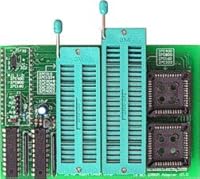
  • Bundled Adapter: A 16-bit EPROM adapter is included in the package, extending support to wider data-bus chip families without an additional purchase.
  • Supported Chips: Compatible chip families include the 27C400, 27C800, 27C160, 27C322, 27C1024, 27C2048, 27C4096, 27C4002, M27C322, and 28F102 series.
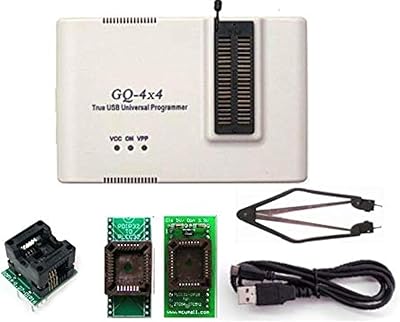
  • Package Types: Supported IC package formats include PSOP44, PSOP56, TSOP48, TSOP40, TSOP32, SOIC, PLCC84, PLCC44, PLCC32, and FWH via compatible adapters.
  • Software Updates: The companion programming software from MCUmall receives free lifetime upgrades, covering new chip support and bug fixes at no ongoing cost.
  • Language Support: The software interface supports 14 languages, making the tool accessible to users in a wide range of international markets.
  • Dimensions: The unit measures 1.97 x 6.69 x 88.19 inches, resulting in an unusually elongated form factor relative to its width.
  • Weight: The programmer weighs 14.4 ounces, making it a lightweight bench tool despite its extended length.
  • Model Number: The official model designation is PRG-112, as assigned by the manufacturer GQ Electronics LLC.
  • Manufacturer: Designed and developed by MCUmall Electronics Inc., a Canadian company operating under the GQ Electronics LLC brand name.
  • Color: The unit is finished in white.
  • Availability: The product was first made available for purchase in July 2015 and has not been discontinued by the manufacturer.
  • User Rating: The programmer holds a 4.4-out-of-5-star average rating based on 134 customer reviews on Amazon.
  • Forum Support: MCUmall operates an active technical support forum providing pre-sales and post-sales assistance directly from the manufacturer.

Related Reviews
GQ GQ-4X4 Universal Device Programmer
79%
91%
Programming Accuracy
88%
Chip Compatibility
86%
Build Quality
57%
Software Usability
73%
Value for Money
More
Rubis Tweezer Crab Universal
87%
94%
Precision and Effectiveness
89%
Ergonomic Design
91%
Durability and Sharpness
85%
Comfort for Extended Use
88%
Value for Money
More
Chord Electronics Mojo 2
81%
96%
Sound Quality
88%
Portability & Form Factor
94%
IEM Compatibility
83%
Build Quality
91%
Input Versatility
More
Universal Remote MX-990
84%
88%
Value for Money
85%
Ease of Setup
90%
Display Quality
92%
Device Compatibility
80%
Build Quality
More
Pebblebee Card Universal (2024)
82%
91%
Cross-Platform Compatibility
83%
Battery Life
93%
Form Factor & Portability
74%
Charging & Power Management
77%
Tracking Accuracy
More
SofaBaton U2 Universal Remote Control
78%
71%
Ease of Setup
74%
App Experience
88%
Macro Functionality
91%
Backlit Buttons
83%
Device Compatibility
More
SofaBaton X1S Universal Remote Control
77%
61%
Ease of Setup
88%
Activity Programming
83%
Hub Signal Reliability
74%
Device Compatibility
81%
Build Quality
More
Energizer Recharge Universal Charger
86%
88%
Charging Speed
93%
Battery Compatibility
91%
Ease of Use
86%
Build Quality
92%
Value for Money
More
iFixit Essential Electronics Toolkit
84%
93%
Bit Quality
71%
Bit Variety
74%
Driver Ergonomics
91%
Case & Organization
78%
Opening Tools
More
Walfront EZP2019 USB EEPROM Flash Programmer
71%
83%
Read & Write Speed
74%
Chip Compatibility
86%
Automatic Chip Detection
81%
Offline Copy Function
51%
Software Quality
More

FAQ

It connects entirely over USB, so any modern Windows PC will work fine. There is no parallel port requirement, which is one of the more practical advantages over older Willem-style programmers that needed legacy hardware to function.

Yes, this is one of its most common real-world uses. The GQ Electronics GQ-4X4 Universal EPROM Programmer explicitly supports ROM backup for classic gaming and arcade hardware, including slot machine boards. Just make sure your specific chip model appears on the supported chip list before buying, since real-world compatibility occasionally differs slightly from the published list.

The package ships with the programmer unit itself and a 16-bit EPROM adapter, which meaningfully extends the range of chips you can work with right away. Depending on the chip packages you work with most, you may eventually want additional adapters, but the included adapter covers a solid range of common use cases.

It is steeper than most people expect. EPROM programming requires understanding chip datasheets, correct voltage settings, and proper software configuration — none of which the tool automates for you. If you are brand new to this, budget time to read through the MCUmall forum and documentation before your first session. Experienced electronics hobbyists will get up to speed faster.

MCUmall runs a dedicated technical forum where you can post questions and get responses from people who actually know the hardware. Multiple buyers have specifically called this out as a genuine differentiator — it is not just a generic FAQ page. Response times can vary, but the depth of support available there is notably better than what you get from most niche electronics vendors.

Software updates are free for the lifetime of the product, which is a meaningful commitment for a tool in this category. As new chip variants get added to the supported list or bugs get addressed, you download the update at no cost through the MCUmall website.

It supports both, provided you use the correct adapter. The compatible adapter list covers a range of surface-mount packages including TSOP, SOIC, PSOP, PLCC, and FWH footprints. The base unit handles the 40-pin through-hole ZIF socket natively.

For repair shops dealing with vintage hardware and legacy EPROM chips on a routine basis, this programmer holds up well. The broad chip family support and adapter compatibility mean fewer tool changes mid-job, and the lifetime software updates keep it relevant over time. The main friction point is the learning curve at the start, but once you are comfortable with the software, the workflow becomes straightforward.

The listed dimensions do look odd at first glance, but the unit is compact in practice — it sits flat on a bench without taking up much footprint. The elongated measurement appears to reflect the ZIF socket arm when fully accounted for. It is not a large or bulky device by bench tool standards.

It is worth verifying your specific chip before purchasing. Several users have noted that a small number of chips listed as supported did not behave as expected in practice, or required firmware updates to work correctly. Posting your chip model on the MCUmall forum before buying is a good way to confirm compatibility with someone who has firsthand experience.

Where to Buy